



Indexed universal life (IUL) insurance is sold as a way to get stock market growth with no downside and tax-free income later. The reason so many people search for why IUL is a bad investment is that the product rarely performs the way the pitch implies. Growth is capped, dividends are left out, the cost of insurance inside the policy rises every year, and surrender charges lock you in for a decade or more.
Quick answer: For most people, IUL is a poor substitute for investing because fees and insurance charges eat into returns, upside is capped, and the illustrations used to sell it have historically been more optimistic than results. It isn’t a scam, and it can fit a narrow set of buyers who need permanent coverage and have already maxed out tax-advantaged accounts. If you own one, get an in-force illustration before deciding anything.
Is IUL a Good Investment?
For most buyers, no. An IUL is a permanent life insurance policy first and a savings vehicle second, and the insurance costs and fees come out before any index credit is added. Independent analysts generally expect long-run IUL cash value returns to land well below the stock market’s, and the products are complex enough that buyers often don’t see the gap until years later.
The sales pitch vs. what the policy does
The pitch usually has three parts: your cash value grows with the S&P 500, you can never lose money because of a 0% floor, and you can take tax-free income in retirement through policy loans. Each statement is technically true and practically incomplete.
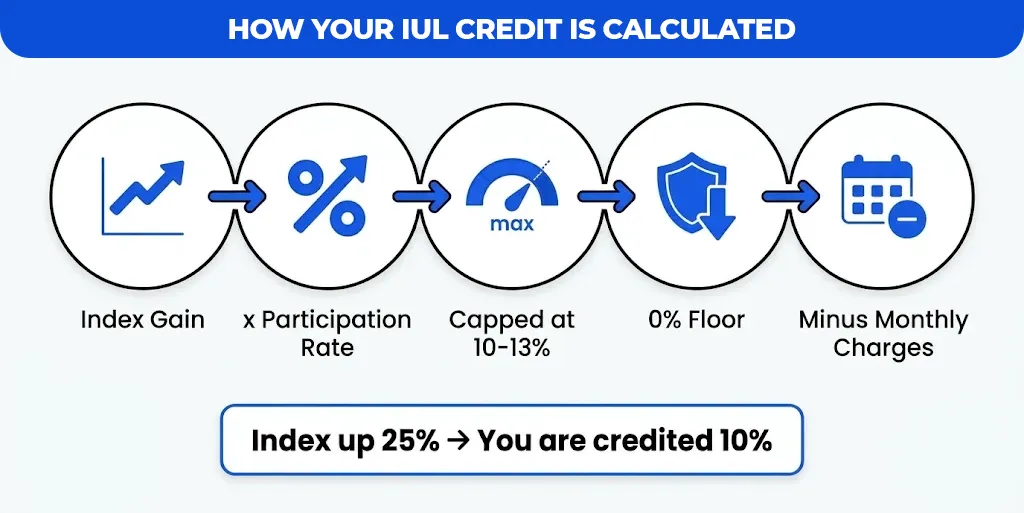
• “Grows with the S&P 500” means your credit is based on the index’s price change, up to a cap, after a participation rate, and without dividends. In a year the market returns 20%, a policy with a 10% cap credits 10%.
• “Never lose money” means the index credit can’t be negative. Your cash value can still fall, because the cost of insurance and policy fees are deducted every month regardless of the index.
• “Tax-free income” means policy loans aren’t taxed while the policy stays in force. If the policy lapses with loans outstanding, the gain becomes taxable in one year.
Ramsey Solutions, which has written at length against IUL, calls the product “a rip-off packaged with a slick sales pitch” and “a terrible way to invest.” That’s an opinion, and insurers and agents dispute it, but the mechanics behind the criticism aren’t in dispute.
What are the dangers of IUL?
The risks that matter most for buyers:
• Underperformance: Caps, participation rates, excluded dividends, and fees combine to leave returns far below a plain index fund over long periods.
• Rising internal costs: The charge for the death benefit increases with age, so a policy funded at the minimum can run short of cash value in later years.
• Lapse and tax bills: A policy that runs out of cash value with outstanding loans can lapse, and the IRS treats the gain as income.
• Lock-in: Surrender charges typically run 10 to 15 years, so leaving early means losing a large share of what you paid.
• Changing terms: Insurers can lower caps and participation rates after you buy, down to the contract’s guaranteed minimums, which can be very low.
When IUL can make sense
Fairness requires saying who it can fit. IUL can be reasonable for someone who needs permanent life insurance for a lifelong dependent or an estate plan, has already maxed out a 401(k), IRA, and HSA, can fund the policy well above the minimum for many years, and understands the moving parts. That describes a small group. For everyone else, the case for buying term coverage and investing separately is strong. Our guide to term vs. permanent life insurance covers the basics of that decision.
How Indexed Universal Life Really Works
An IUL is universal life insurance whose cash value earns interest based on the movement of a stock index, subject to limits the insurer sets. Each month, the insurer deducts the cost of insurance and fees from your cash value; each year, it credits interest based on the index, the cap, the participation rate, and the floor. The gap between what the index did and what you were credited is where the product’s economics live.
The moving parts
• Index: Usually the S&P 500 price index, measured from one policy anniversary to the next. Price index means dividends aren’t included.
• Cap: The maximum credit in a year. Hans Goldstein, who tracks IUL contracts, reports that caps on S&P 500 one-year accounts are often 10% to 13% as of October 2026. If the index rises 25%, you get the cap.
• Participation rate: The share of the index gain you receive. At 80%, a 10% index gain credits 8%.
• Spread: A percentage subtracted from the index gain before crediting, used on some accounts instead of or alongside a cap.
• Floor: The minimum credit, usually 0%. A down year credits zero, not a loss.
• Guaranteed minimums: The insurer can change the cap and participation rate each year, but not below the contract’s guaranteed minimums. Goldstein’s review of 33 IULs found only 8 publish a guaranteed minimum cap, ranging from 0.25% to 4%, with a median of 2%.
Cost of insurance drag
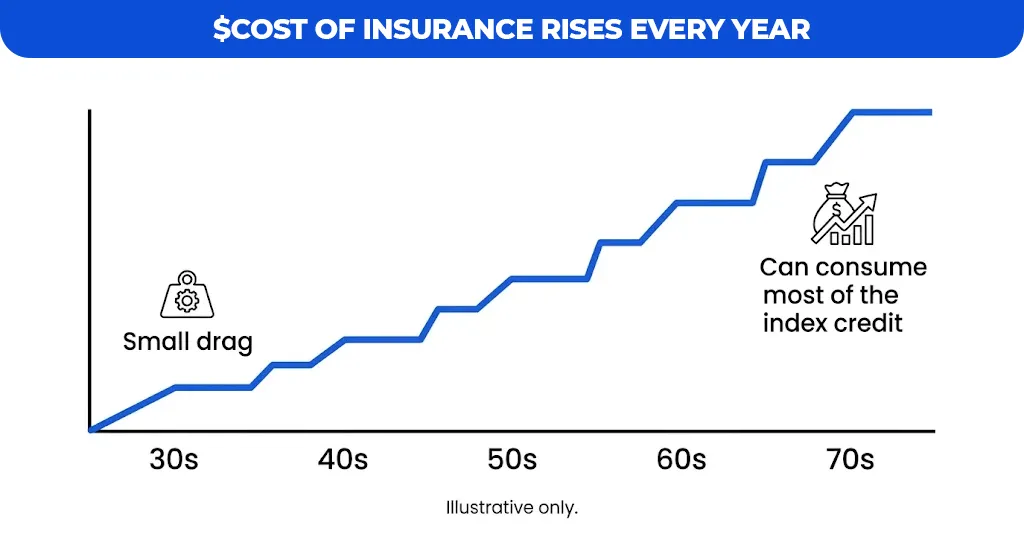
Every month, the policy deducts the cost of insurance (COI) for the death benefit, plus administrative fees and, in early years, premium loads. COI is based on your age and the amount at risk, so it rises every year you own the policy. In your 30s it may be small relative to premiums. In your 60s and 70s, it can consume most of the index credit in an average year and all of it in a flat one. Policies funded at the minimum premium, which is how many are sold, are the ones most exposed.
The 0% floor isn’t a 0% return
The floor applies to the index credit only. In a year the index falls, you’re credited 0%, and then the monthly charges still come out. A policy with 1.5% to 3% in annual charges loses that much in a flat or down year. White Coat Investor, a physician-run finance site, estimates long-run IUL cash value returns in roughly the 2% to 5% range after costs, similar to whole life, and notes the market’s long-run return of about 10% includes roughly 2 percentage points of dividends that IULs don’t credit.
A hypothetical comparison
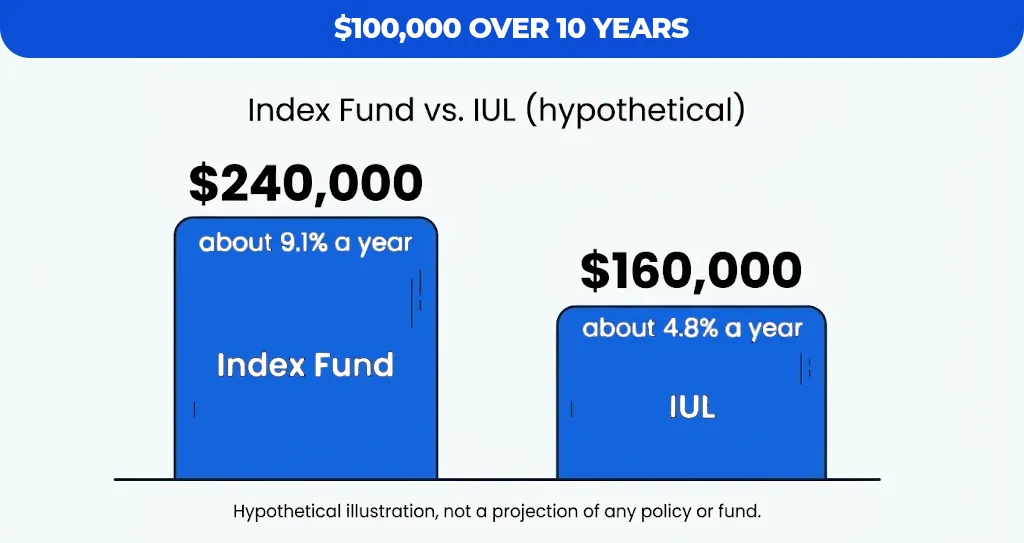
The numbers below are illustrative, not a prediction. They assume the same ten years of market returns for a plain S&P 500 index fund and for an IUL account with a 10% cap, 100% participation, a 0% floor, dividends of about 2% excluded, and 1.5% a year in total policy charges.
Year returns (index fund, total): 12%, -18%, 26%, 3%, 21%, -5%, 15%, 8%, 28%, 10%
Index fund: $100,000 grows to about $240,000 (about 9.1% a year)
IUL account: $100,000 grows to about $160,000 (about 4.8% a year)
In the two down years, the fund fell and the IUL credited 0%.
In the four years above the cap, the fund kept the gain and the IUL stopped at 10%.
Every year, the IUL paid 1.5% in charges; the fund’s expense ratio is a few hundredths of a percent.
The IUL did avoid the two losses. It also gave up far more in the up years than it saved in the down years, which is the pattern critics point to.
| Dimension | Retail IUL policy | Direct S&P 500 index fund | Edge |
| Upside | Capped, often 10% to 13% a year; insurer can lower it | Uncapped | Index fund |
| Dividends | Excluded | Included, about 2% a year | Index fund |
| Downside | 0% floor on credits; charges still deducted | Full market losses | IUL, in down years |
| Annual costs | Cost of insurance, admin fees, loads; rise with age | Typically under 0.1% | Index fund |
| Liquidity | Surrender charges for 10 to 15 years; loans available | Sell any day | Index fund |
| Taxes | Loans tax-free while in force; gain taxable if the policy lapses | Capital gains taxed; tax-advantaged in a Roth or 401(k) | Depends on account type |
| Death benefit | Yes | No | IUL |
| Transparency | Complex; terms can change | Simple | Index fund |
10 Reasons Why IUL Is a Bad Investment
The “10 reasons why IUL is a bad investment” lists that circulate on Reddit and personal finance sites vary in detail, but they converge on the same structural points. Here is the critics’ case, with the mechanism behind each reason and what the evidence supports. Where a point is contested or depends on the policy, that’s noted.
1. Caps can be cut after you buy
The cap you’re shown at sale isn’t guaranteed. Insurers reset caps and participation rates each year based on their hedging costs and interest rates, and the only protection is the contract’s guaranteed minimum, which Goldstein’s survey found is published for just 8 of 33 products and runs from 0.25% to 4%. A policy illustrated at a 10% cap could legally be credited far less in later years.
2. Dividends are left out
IUL credits track the S&P 500 price index, not total return. Dividends have contributed roughly 2 percentage points a year to the index’s return in recent decades, according to White Coat Investor’s analysis, and historically more. Over 30 years, missing 2% a year is the difference between a large nest egg and one roughly 40% smaller.
3. The cost of insurance rises every year
The death benefit inside the policy is priced like annual renewable term: cheap when you’re young, expensive when you’re old. Charges that were a small drag at 35 can exceed the index credit at 70. Policies funded near the minimum premium are most at risk of running out of cash value late in life, exactly when replacing coverage is hardest.
4. Front-loaded commissions and long surrender charges
Agents are typically paid a large first-year commission based on the target premium, which is one reason early-year cash values are so low relative to premiums paid. Surrender charges, which recover those costs if you leave, commonly run 10 to 15 years. Someone who cancels in year five often gets back far less than they paid in.
5. Illustrations have run ahead of results
IUL illustrations project cash value using an assumed credited rate. Regulators have tightened the rules three times: Actuarial Guideline 49 in 2015 capped illustrated rates, AG 49-A in 2020 limited how multipliers and bonuses could be illustrated, and further revisions in 2023 and 2026 restricted how new volatility-controlled indices and short-history indices can be shown. Each round followed complaints that illustrated rates of 6% to 7% weren’t matching what policies delivered. Independent estimates of realized long-run returns cluster in the 2% to 5% range.
6. Lapse risk and tax bills
If cash value runs out, the policy lapses. If you’ve taken loans, the IRS treats gain above your premiums as taxable income in the lapse year, even though you received the money years earlier. Policies that are overfunded too quickly can also become modified endowment contracts under Internal Revenue Code section 7702A, which fails the 7-pay test and makes distributions taxable and potentially subject to penalties. An IUL designed as an income vehicle has to be funded and managed carefully for decades to avoid both outcomes.
7. Weak results for children
IUL for kids is marketed as locking in insurability and building tax-free wealth. The insurance a child needs is minimal, so most of the premium goes to building cash value through a product with the same caps and charges described above. A 529 plan grows tax-free for education with low costs, a custodial Roth IRA grows tax-free for life once the child has earned income, and a UTMA account is flexible and cheap. The child section below compares them.
8. Participation rates and spreads add a second haircut
Beyond the cap, many accounts apply a participation rate below 100% or a spread that’s subtracted from the gain. Goldstein’s survey found guaranteed minimum participation rates as low as 5% on some products. Illustrations usually show the current, more generous rates.
9. State protections help, but don’t change the math
Searches for “why IUL is a bad investment in California” reflect the state’s reputation for consumer rules. California does require a free-look period of at least 30 days for life policies sold to buyers 60 and older, with a bold notice on the policy cover, and it adopts the national illustration standards. Those rules give buyers a window to reconsider and somewhat more honest projections. They don’t change the caps, charges, or dividend exclusion.
10. Better tax-advantaged tools already exist
The tax benefits IUL advertises are available more cheaply elsewhere. A Roth IRA and Roth 401(k) grow and pay out tax-free with low-cost index funds. An HSA is triple tax-advantaged. A 529 is tax-free for education. For most households, filling those accounts first, and buying term insurance for the death benefit, costs less and returns more than an IUL.
| Reason | How value is lost | Impact on the policyholder | Alternative |
| Caps cut after sale | Credited rate falls toward low guaranteed minimums | Returns below the illustration | Index fund with no cap |
| Dividends excluded | Roughly 2% a year of market return never credited | About 40% less wealth over 30 years | Total-return index fund |
| Rising cost of insurance | Charges grow with age and consume credits | Cash value can shrink late in life | Term insurance priced separately |
| Commissions and surrender charges | Low early cash value; 10 to 15 year lock-in | Large loss if you leave early | Liquid accounts |
| Optimistic illustrations | Projections above realized returns | Underfunded policies | Plan on conservative assumptions |
| Lapse and MEC rules | Taxable gain on lapse; 7-pay test violations | Unexpected tax bill | Roth accounts |
| Weak for children | Insurance costs on a child who needs little coverage | Slower growth than education or custodial accounts | 529, custodial Roth IRA, UTMA |
| Participation and spreads | Second reduction after the cap | Credits below index gain even in capped years | Direct indexing |
| State rules | Protections help at purchase, not over 30 years | Window to cancel; same economics | Free-look period to reconsider |
| Better alternatives exist | Same tax benefits at lower cost | Lower lifetime wealth | 401(k), Roth IRA, HSA, term plus investing |
Note: Critics and defenders argue about magnitudes, not mechanics. Insurers point out that IUL offers a death benefit, downside protection, and tax-deferred growth that an index fund doesn’t. The question for a buyer is whether those features are worth what they cost compared with buying them separately.
Rich People, Dave Ramsey, and IUL for Kids
Three questions come up in almost every IUL discussion: whether wealthy families use it, what Dave Ramsey thinks, and whether it’s a smart gift for a child. The short answers are: the wealthy use a different product, Ramsey is firmly against it, and children usually do better in education or custodial accounts.
Do rich people use IUL?
Wealthy families do use life insurance for tax planning, but usually not retail IUL. The product most associated with the ultra-wealthy is private placement life insurance (PPLI), a customized policy that wraps private equity, hedge funds, and other investments inside a life insurance contract. A February 2024 Senate Finance Committee investigation described PPLI as a tax shelter holding at least $40 billion for “only a few thousand individuals,” and found it accounts for about 0.003% of individual life insurance policies in force. PPLI isn’t available to middle-class buyers; the Senate release calls it an “ultra-niche financial product.”
So the sales line that “this is how the rich build wealth” conflates two things. The rich use bespoke policies with institutional investments and minimal insurance costs, often inside estate plans with large exemptions. A retail IUL with a 10% cap and standard charges isn’t that product. High earners who do buy IUL generally already have maxed-out retirement accounts and a need for permanent coverage; that’s the narrow case where it fits.
What does Dave Ramsey say about an IUL?
Ramsey Solutions is blunt. Its IUL guide, updated in June 2026, calls the product “a rip-off packaged with a slick sales pitch” and “a terrible way to invest.” The criticisms it lists are the ones above: fees including sales commissions, rider fees, administrative expenses, and premium charges that can shrink cash value even in a 0% year; growth that’s always limited by a cap the insurer can lower; and complexity that requires constant monitoring. Its advice is to “buy term life insurance for income replacement, and invest in growth stock mutual funds for long-term wealth.”
Ramsey’s position is a philosophy as much as an analysis, and IUL advocates have published point-by-point rebuttals. The mechanics he criticizes, though, are accurately described, and his bottom line matches what independent analysts conclude for most households.
Is IUL a good investment for kids?
Usually not. A child needs very little life insurance, so a child IUL is mostly a savings vehicle built inside a product with caps, fees, and a long surrender period. The main argument for it, guaranteed future insurability, can be met more cheaply with a small whole life policy or a child rider on a parent’s policy. For growing money, three accounts usually do better:
• 529 plan: Tax-free growth and withdrawals for qualified education expenses, with low-cost index fund options in most state plans. Non-education withdrawals of earnings are taxed and penalized.
• Custodial Roth IRA: Tax-free growth for life, but the child must have earned income to contribute, so it works once they have a job, even a summer one.
• UTMA or UGMA custodial account: Flexible, low-cost, and taxable, with the money becoming the child’s at the age of majority.
| Vehicle | Growth | Tax treatment | Costs | Best for |
| 529 plan | Market-based, uncapped, with index fund options | Tax-free for education; penalties on non-qualified earnings | Low, varies by state plan | College or K-12 tuition savings |
| Custodial Roth IRA | Market-based, uncapped | Tax-free growth and qualified withdrawals | Low | A child or teen with earned income |
| UTMA or UGMA account | Market-based, uncapped | Taxable; some income taxed at the child’s rate | Low | Flexible gifts with no use restriction |
| Child IUL | Capped index credits minus insurance and policy charges | Tax-deferred; loans tax-free while in force | High relative to cash value; surrender charges | Families specifically wanting permanent coverage on a child |
| Child whole life or rider | Guaranteed, slow cash value growth | Tax-deferred | Moderate | Locking in insurability cheaply |
Note: Our guides to the IUL account and max-funded IUL explain how these policies are structured when they are set up well. The criticisms here apply most strongly to minimally funded policies sold as investments.
How to Audit an Existing IUL and Weigh Alternatives
If you already own an IUL, don’t cancel it on the strength of an article. Surrender charges and tax consequences can make a bad policy worse to leave than to keep. Get the facts first, then choose among keeping, restructuring, exchanging, or surrendering.
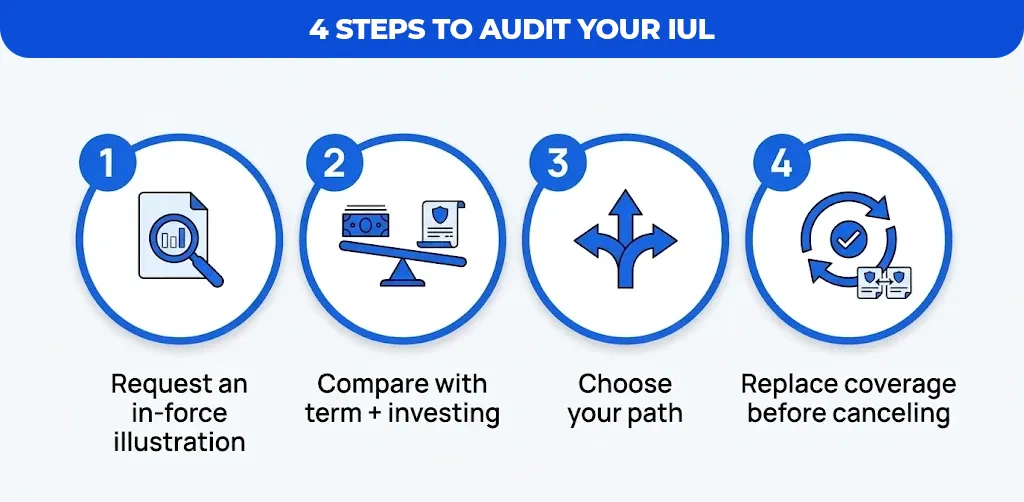
Step 1: Request an in-force illustration
Call your insurer and ask for an in-force illustration at the current cap and participation rate, and a second one at the guaranteed minimums. This shows how your policy is actually performing, when it would lapse under each scenario, and what premium would keep it in force to age 100. Also ask for the surrender charge schedule and your cost basis.
Step 2: Compare against term plus investing
Take the premium you pay now. Price a term policy for the death benefit you need, using our term life insurance quotes page as a starting point, and assume the difference is invested in a low-cost index fund at a conservative return. Compare that projection with the in-force illustration at the guaranteed minimums, not the current rates. Simple IUL calculators online can help, but the in-force illustration is the only number that reflects your actual contract.
Step 3: Choose a path
• Keep and fund it properly. If you’re past the surrender period and the policy is well funded, it may be worth keeping, especially if your health has changed and new coverage would be expensive.
• Reduce the death benefit. Lowering the face amount cuts the cost of insurance and can stabilize cash value. Ask about the minimum face amount that avoids making the policy a modified endowment contract.
• Stop paying and let it ride. Some policies can run on existing cash value for years. The in-force illustration shows how long.
• 1035 exchange. You can move cash value into another life policy or an annuity without triggering tax on the gain. This can make sense when the current policy is failing and a lower-cost permanent policy still fits your needs.
• Surrender. You receive the cash surrender value, and any gain above premiums paid is taxable. If the surrender value is below what you paid, there’s no tax, but there’s also no deduction for the loss.
Step 4: Replace coverage before you cancel
If you still need a death benefit, have the replacement term policy approved and in force before surrendering or exchanging anything. Assurance Gurus can help you audit your IUL policy against current term and permanent options.
Note: Anyone recommending you surrender one policy to buy another has a commission at stake. Ask for the comparison in writing, including surrender charges on the old policy and the new policy’s surrender schedule.
Conclusion
The reason IUL is a bad investment for most people isn’t fraud; it’s arithmetic. Caps and excluded dividends trim the upside, insurance charges rise every year, surrender charges lock in the early losses, and the illustrations used to sell the product have repeatedly needed regulatory correction. A 0% floor protects against market losses but not against the policy’s own costs. The product can fit a narrow group that needs permanent coverage and has exhausted better tax-advantaged accounts. For everyone else, term insurance for protection and low-cost index funds for growth do the same jobs more cheaply and more transparently.
| Your situation | What to consider |
| Being pitched an IUL as an investment | Ask for the guaranteed-minimum illustration and compare with term plus a Roth or 401(k) |
| Haven’t maxed out retirement accounts | Fill those first; IUL rarely beats them |
| Need permanent coverage and have maxed everything else | IUL or guaranteed universal life may fit; compare carefully |
| Already own an IUL | Get an in-force illustration before changing anything |
| Thinking about an IUL for a child | Compare with a 529, custodial Roth IRA, or UTMA first |
| Policy is underperforming and past surrender charges | Weigh reducing the face amount, a 1035 exchange, or surrender, with tax advice |
Review Your Options With Assurance Gurus
Whether you’re being pitched an IUL or already own one, a second opinion costs nothing. Audit your IUL policy at Assurance Gurus: share your in-force illustration or the proposal you’ve been shown, and a licensed agent can compare it with term, guaranteed universal life, and other permanent options from several carriers.
• Request a review or quote: Get a quote from Assurance Gurus
• Estimate your coverage need: Life insurance calculator
• Call: 888-363-1938