


Is accident insurance worth it? It depends on one practical question: could you pay the out-of-pocket costs of an injury without financial strain? Accident insurance pays cash directly to you after a covered accidental injury, and you can use the money for your deductible, coinsurance, or everyday bills. Premiums run from a few dollars to more than $50 a month, depending on how much coverage you choose.
The risk it addresses is real. The National Safety Council (NSC) estimates that 54.5 million people in the United States, about 1 in 5, sought medical attention for an injury in 2024. The financial exposure can be large too. For 2026, the federal limit on out-of-pocket costs for health plans regulated by the Affordable Care Act (ACA) is $10,600 for an individual and $21,200 for a family
| Quick Answer Accident insurance is worth it when an unexpected injury bill would strain your budget even after your health plan pays its share. It is supplemental coverage that pays you a capped cash benefit for a covered accidental injury. It does not replace health insurance, and it does not cover illness.It can be a good fit if you have a high deductible, children, or costs beyond medical bills, and it adds less if you can cover your out-of-pocket maximum from savings or already hold overlapping benefits. |
| Key Takeaways Accident insurance is supplemental. It pays cash benefits, up to a predetermined limit, for covered accidental injuries.Premiums range from a few dollars to more than $50 a month.Whether it is worth it depends on your deductible exposure, your non-medical costs after an injury, and the benefits you already have.Illness and preexisting conditions are excluded, and work-related injuries and certain risky activities often are too.Accident coverage can be held alongside an HSA-qualified high-deductible health plan, and the tax treatment of benefits depends on who paid the premiums. |
What Is Accident Insurance?
Accident insurance is a type of insurance that pays cash benefits, up to a predetermined limit, when the policyholder has an accidental injury that the plan covers. It is designed to supplement major medical health insurance. Related terms include accident supplement and accident protection insurance, the name UnitedHealthcare uses for its product.
Accident insurance is not health insurance, and it does not satisfy the ACA’s minimum essential coverage requirement. The National Association of Insurance Commissioners (NAIC), the organization of state insurance regulators, describes accident-only coverage as paying a lump sum or fixed dollar amount after an accident that requires hospitalization or treatment.
How Does Accident Insurance Work?
Accident insurance works alongside your health plan, not in place of it. The process generally follows these steps:
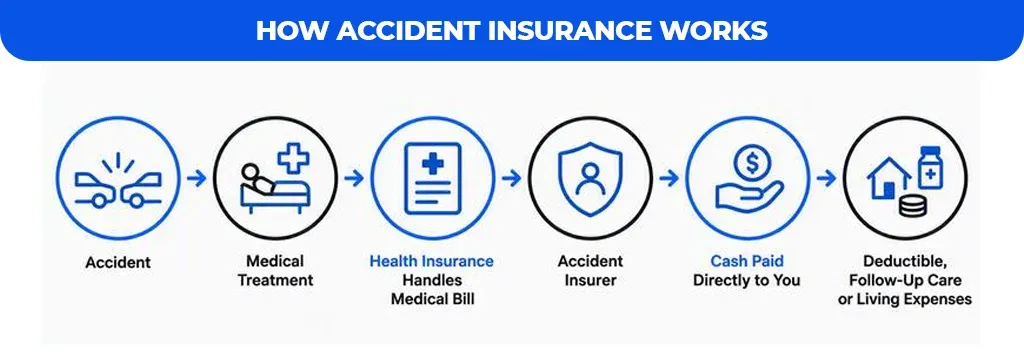
- You are injured in a covered accident and treated. Your health plan handles the bill under its own deductible, copays, and coinsurance.
- You submit proof of treatment to the accident insurer, which pays you directly rather than paying the provider.
- You decide how to use the money, whether for your deductible, follow-up care, or living expenses.
Payment structures differ. Some policies pay a lump sum regardless of your out-of-pocket costs, while others pay no more than the costs you actually incur, up to the policy limit. Some pay the full benefit up front, and others spread payments over time as follow-up treatment such as physical therapy is received. Because structures differ, confirm whether a quote pays a fixed schedule or reimburses actual costs before you compare prices.
What Does Accident Insurance Cover?
Coverage depends on the policy, but the range of covered injuries is wide. Policies can respond to anything from a sprained ankle or a cut that needs stitches to an injury that results in a coma or paralysis. It is common for policies to set separate, lower payout caps for specific treatments such as emergency room visits, urgent care visits, stitches, and surgery. Some policies add accidental death and dismemberment coverage or prescription discounts.
The cash can also offset costs that a medical bill does not include. A person recovering from an injury might miss work, travel to see specialists, or buy equipment to use at home. Workplace accidents fall under workers’ compensation insurance, while accidents outside work are the ones a voluntary accident plan addresses.
NSC’s home and community category covers preventable injuries that are not work-related and do not involve motor vehicles on streets and highways. In 2026, 45.8 million people in that category suffered nonfatal injuries that required medical consultation.
What Is Not Covered by Accident Insurance?
Exclusions vary by policy, so read the exclusion list before you enroll. Accident insurance will not pay when a claim results from an illness or a preexisting condition. Policies also often exclude injuries from natural disasters, certain risky activities, work-related circumstances, and self-inflicted injuries. Some exclude injuries sustained under the influence of drugs or alcohol or during a high-risk activity such as bungee jumping.
If anyone in your household plays organized sports or does recreational activities, check whether the policy covers those injuries, because coverage differs by plan.
One more limit matters. Your health plan’s out-of-pocket maximum caps your annual cost sharing, but an accident policy pays only up to its own benefit limits. A serious injury can therefore produce a bill larger than the benefit you collect.
How Much Does Accident Insurance Cost?
Monthly premiums range from a few dollars to more than $50, depending on the scope of coverage. More limited benefits generally carry lower premiums. At $50 a month, a policy costs $600 a year and $3,000 over five years. Some insurers base premiums on age and health.
Premium alone does not show value. Compare the annual premium with what the policy would pay for an injury you can realistically picture, such as an emergency room visit with imaging or a broken bone. If the schedule replaces only a small share of your likely out-of-pocket cost, you are paying mainly for peace of mind, which can be reasonable if you know that is what you are buying.
Is Accident Insurance Worth It?
Use this three-part test to check whether a policy fits your situation. It is an editorial framework, not an industry standard.
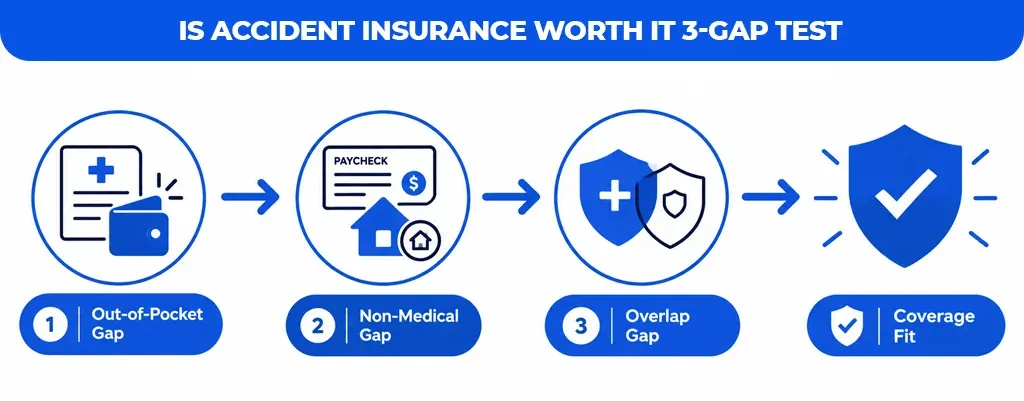
The out-of-pocket gap
Start with your health plan. Among covered workers with a general annual deductible, the average deductible for single coverage was $1,886 in 2026, and 34% of covered workers had a general annual deductible of $2,000 or more for single coverage. Beyond the deductible, the federal ceiling on annual cost sharing is $10,600 for an individual and $21,200 for a family in 2026. It rises to $12,000 and $24,000 in 2027.
Then compare those figures with your savings. In the Federal Reserve’s 2026 household survey, 63% of adults said they would cover a $400 emergency expense with cash or its equivalent, and 70% said they could pay at least $500 using only savings.
The non-medical gap
Injuries can cost money that a health plan does not address, including missed work, travel to specialists, and equipment for recovery at home. A policy that pays a fixed amount to you can be used for any of these costs, while a reimbursement policy pays no more than the costs you actually incur. Ask yourself whether you have paid leave or disability coverage that would replace income during recovery.
The overlap gap
Check what you already have. Employer-provided disability benefits, a hospital indemnity policy, an accidental death and dismemberment (AD&D) benefit, or a health plan with a low out-of-pocket maximum can reduce the need for another policy. Confirm that you are not paying twice for the same gap.
How to read your results
| Your answers | What it suggests |
| Gap 1 is a yes | A policy deserves serious consideration. First compare what any benefits you already have would pay for an injury, then compare benefit schedules and annual caps. |
| Gap 1 is a no, and Gap 2 is a yes | Check whether disability coverage or savings fits the income gap better. An accident cash benefit can help, but read the schedule first. |
| Gaps 1 and 2 are both a no | A policy is likely optional. The same money may be better placed in savings or a stronger health plan. |
Who Should Get Accident Insurance? (Do You Need Accident Insurance?)
Your situation matters more than any single rule. The table matches common situations with supporting data.
| Your situation | Why it may matter | Supporting data |
| You have a high-deductible health plan | More of an injury bill falls on you before the plan pays. | An HSA-qualified high-deductible plan must carry a deductible of at least $1,700 for self-only or $3,400 for family coverage in 2026. |
| You have children or teenagers | Injury-related emergency department visits are common among children and teenagers. | In 2020, there were nearly 3 million emergency department visits for nonfatal injuries among children ages 1 to 14. Falls lead for younger children, and being struck by an object or person leads for adolescents, who had 1.9 million visits in 2023. |
| You are self-employed or have limited paid leave | A cash benefit can cover costs beyond the medical bill, such as missed work. | Cash benefits can offset missed work, travel, and home equipment costs. |
Accident Insurance vs. Health Insurance and Other Supplemental Plans
Health insurance vs. accident insurance
| Feature | Health insurance (major medical) | Accident insurance |
| Purpose | Helps pay for covered medical care, including illness and injury | Pays cash benefits for covered accidental injuries, up to a predetermined limit |
| Who receives payment | Most plans pay medical providers | You, directly |
| Covers illness | Yes | No |
| Counts as minimum essential coverage | ACA-compliant major medical does | No |
| Limit on your annual costs | Out-of-pocket maximum of no more than $10,600 individual or $21,200 family in 2026 | Benefit limits apply, but the policy does not cap your bills |
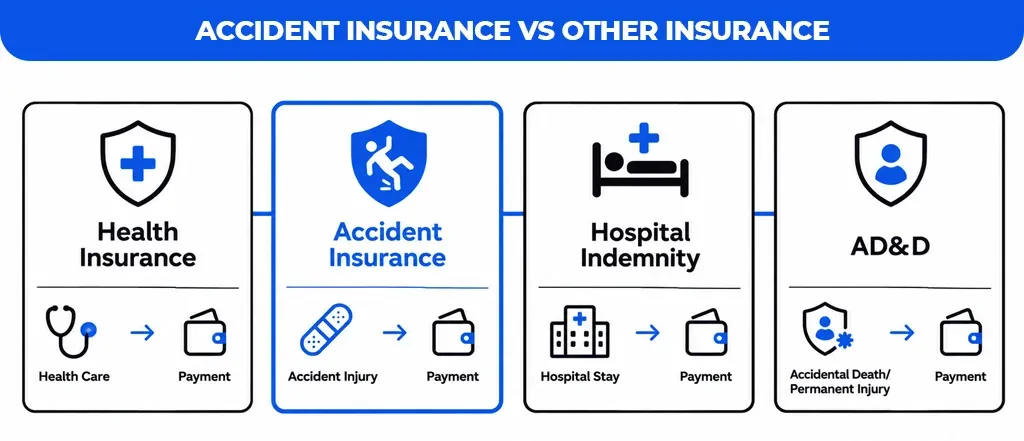
How accident insurance compares with other supplemental policies
| Policy | What triggers payment | How it pays |
| Accident insurance | A covered accidental injury | Cash to you, per the policy schedule or up to actual costs |
| Hospital indemnity (fixed indemnity) | A hospital admission or other listed service | A fixed amount, such as $200 on admission or $100 per day in the hospital |
| Critical illness (specified disease) | A diagnosis of a condition named in the policy | Added protection on top of existing medical coverage |
| Accidental death and dismemberment (AD&D) | Accidental death or a covered permanent injury | A lump sum to you or your beneficiaries |
Is hospital insurance or indemnity insurance worth it?
Hospital indemnity insurance, sometimes sold as hospital insurance, pays fixed amounts regardless of the total charges. Anthem describes it as paying cash when you are admitted for an injury or illness. Indemnity plans are not major medical coverage, and holders without other minimum essential coverage can owe a penalty in states that impose one. Run the three-gap test before buying one as an add-on.
Accident Insurance vs. Accidental Death Insurance (AD&D)
Accident insurance and accidental death and dismemberment (AD&D) insurance sound alike but pay for different events. AD&D pays a lump sum to you or your beneficiaries after an accident that causes death or a permanent injury the policy names, such as loss of a limb, vision, hearing, or speech, or paralysis. Accident insurance can pay for an injury that heals completely, such as an emergency room visit for a broken arm, while AD&D would not.
AD&D also differs from life insurance, which generally pays a death benefit regardless of how you die, subject to insurer restrictions. NSC ranks preventable injuries third among causes of death in the United States, behind heart disease and cancer. AD&D therefore responds to a narrower set of deaths than life insurance does.
How to Compare Accident Insurance Policies
Once the three-gap test points toward buying, use this checklist to compare quotes:
- Payment structure: fixed schedule or reimbursement of actual costs.
- Benefit schedule: amounts for an emergency room visit, imaging, fractures, and follow-up care.
- Caps: per-event and annual limits, which decide how much you can collect in a year.
- Exclusions: sports, recreational activities, and intoxication clauses.
- Fine print: waiting periods, preexisting condition limits, and state availability.
- Tax and portability: whether premiums are pre-tax and whether coverage continues if you change jobs.
- Insurer strength: the insurer’s AM Best financial strength rating and its complaint record through your state department of insurance or the NAIC consumer insurance search.
Conclusion
Deciding whether accident insurance is worth it comes down to assessing your unique financial vulnerability. If an unexpected emergency room bill or fracture would trigger a financial crisis, this supplemental coverage delivers essential peace of mind by putting guaranteed cash directly in your hands. However, if your savings comfortably handle your health plan’s out-of-pocket maximum, investing those dollars elsewhere is a smarter financial move.
Whether you are navigating a high-deductible health plan, managing a busy family with active children, or simply looking to eliminate financial blind spots, having the right supplemental coverage makes all the difference. Take a proactive step toward total financial peace of mind by visiting Assurance Gurus today. Compare top-rated accident insurance quotes, explore expert comparison tools, and find a customized policy that protects both your health and your hard-earned savings.