



| Quick Answer Yes, people with diabetes can get life insurance. Insurers no longer treat a diabetes diagnosis as an automatic decline. Underwriters evaluate your A1C control, diabetes type, treatment method, and complication history to place you in a rate class. Well-managed Type 2 diabetics with an A1C under 7% often qualify for Standard or Standard Plus rates, while Type 1 diabetics and applicants with complications typically receive a table-rated, simplified issue, or guaranteed issue policy instead. |
Key Takeaways
- Diabetes alone does not disqualify you from life insurance for diabetics. Underwriters focus on how well the condition is managed, not just the diagnosis on your chart.
- A1C is the single most important lab value underwriters review. The American Diabetes Association’s general glycemic target for most non-pregnant adults is below 7%, with individualized targets that can run higher or lower depending on age and health history.
- Type 2 diabetes accounts for the large majority of diagnosed diabetes cases in the U.S. and generally underwrites more favorably than Type 1 diabetes, which insurers treat as a longer-duration, insulin-dependent condition.
- If you don’t qualify for fully underwritten term or whole life coverage, simplified issue and guaranteed issue policies remain available, usually with lower face amounts and a higher cost per dollar of coverage.
- Applicants who miss Standard criteria are typically table-rated rather than declined. Each table level adds a defined percentage on top of the standard premium.
Diabetes affects a substantial share of the U.S. population. According to the CDC’s National Diabetes Statistics Report, an estimated 40.1 million people in the United States, or about 12% of the population, have diabetes, and 29.1 million of them have been diagnosed. The remainder have diabetes that has not yet been identified. That scale is exactly why insurers have built detailed, diabetes-specific underwriting guidelines instead of relying on a blanket decline.
Can Diabetics Get Life Insurance?
Yes. Having Type 1 or Type 2 diabetes does not automatically disqualify you from traditional life insurance. Modern underwriting looks past the diagnosis itself and evaluates how proactively you manage the condition day to day.
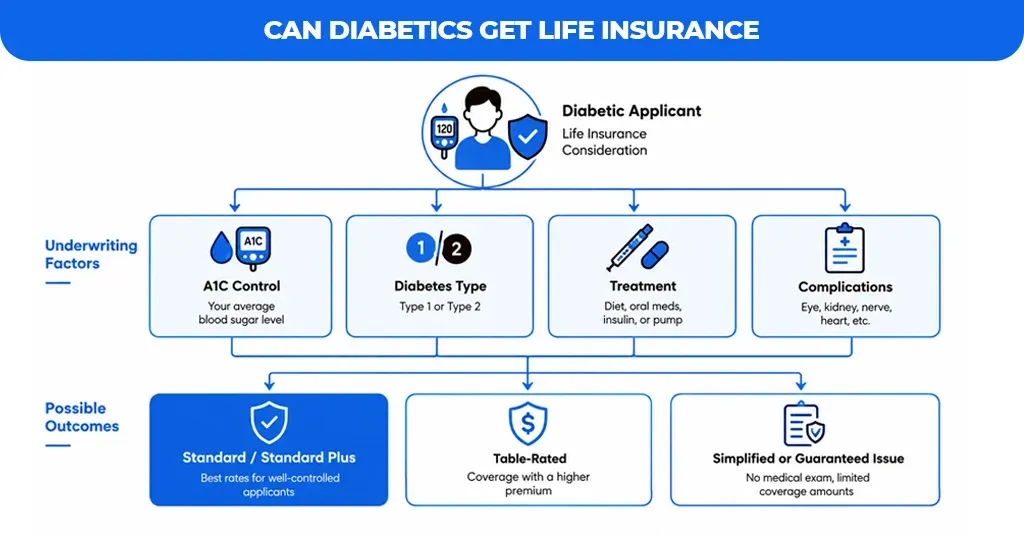
Underwriters typically review four categories of information when they assess a diabetic applicant:
- A1C levels. Your three-month average blood sugar reading is the primary metric insurers use to judge control. The American Diabetes Association’s Standards of Care set a general target of below 7% for most non-pregnant adults, noting that the appropriate goal should be individualized based on age, disease duration, and other health conditions.
- Age of onset and diabetes type. A diagnosis later in adulthood, and Type 2 status specifically, tends to underwrite more favorably than early-onset Type 1 diabetes, largely because of the shorter typical disease duration and lower reliance on insulin in the early years.
- Treatment method and compliance. Diet-and-exercise control, oral medication, insulin injections, and insulin pump use are each viewed differently by underwriters, with diet-and-lifestyle management generally receiving the most favorable treatment and insulin dependence drawing closer scrutiny.
Applicants with an A1C between roughly 6.0% and 7.0%, no insulin use, and no complications frequently qualify for Standard pricing under widely used industry underwriting guidelines, and some carriers extend Standard Plus rates to Type 2 applicants with an A1C below 6.5% and a clean complication history.
How Underwriting and Rate Classes Work
Insurers sort every applicant into a rate class based on overall mortality risk, then price the premium according to that class. Diabetics are rarely placed in the very best classes, but most land in Standard or a table-rated class rather than being declined.
A typical rate-class hierarchy, from best to most rated, looks like this:
- Preferred Best / Preferred reserved for applicants in excellent health; essentially unavailable to diabetics.
- Standard Plus: possible for well-controlled Type 2 diabetics at select carriers with a low A1C and no complications.
- Standard is the realistic target for most diabetics with an A1C under roughly 7.0% and no complications.
- Table-rated classes are assigned when an applicant does not meet Standard criteria; coverage is still issued, but at a higher premium.
Table Ratings Explained
A table rating is not a decline. It’s a surcharge system: each table level adds a defined percentage on top of the standard premium for the same coverage amount. Carriers label these tiers with either numbers (1–16) or letters (A–P), and the two systems are typically equivalent to one another. According to industry underwriting references, a common structure adds roughly 25 percentage points per level, as shown below.
| Table Rating | Increase Over Standard Premium |
| 1 / A | 125% |
| 2 / B | 150% |
| 3 / C | 175% |
| 4 / D | 200% |
| 5 / E | 225% |
| 6 / F | 250% |
| 7 / G | 275% |
| 8 / H | 300% |
Type 1 vs. Type 2 Diabetes: How Underwriting Differs
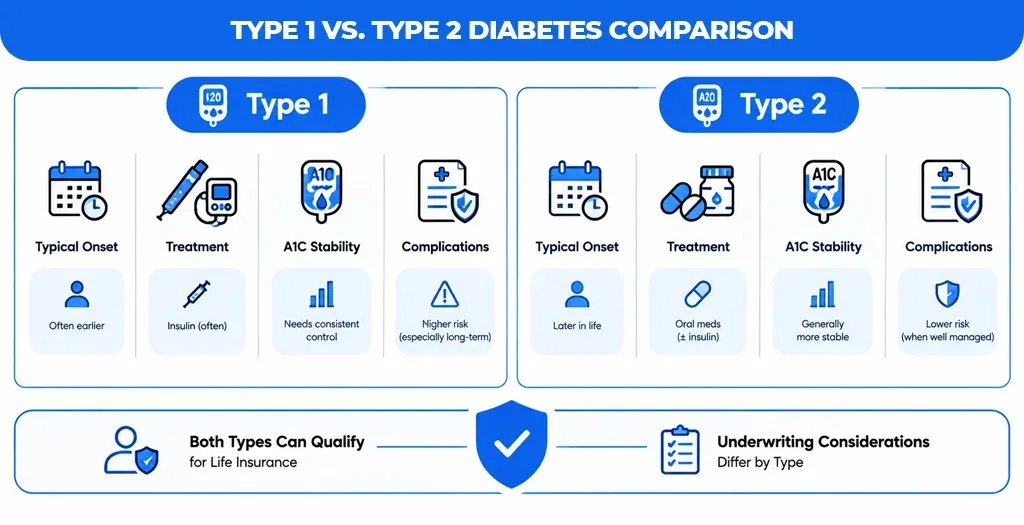
Type 2 diabetes generally underwrites more favorably than Type 1 because of its typically later onset and greater reliance on lifestyle and oral medication in the early stages. Type 1 diabetics can still qualify for competitive coverage, particularly with a long, stable history and modern monitoring technology.
Type 1 Diabetes
Type 1 diabetes is underwritten more conservatively at most carriers because of its autoimmune origin, earlier typical age of onset, longer expected disease duration, and constant insulin dependence. That said, insurers increasingly reward demonstrated stability: a long history of well-managed Type 1 diabetes without complications, consistent A1C readings, and no recent hospitalizations for severe hypoglycemia can meaningfully improve the offer. The growing use of continuous glucose monitors, insulin pumps, and automated insulin delivery systems gives underwriters more objective data to evaluate control, which can work in a well-managed applicant’s favor.
Type 2 Diabetes
Type 2 diabetes accounts for the large majority of diagnosed diabetes cases in the United States, and it is the form underwriters encounter most often, so most carriers have well-calibrated guidelines for it. Type 2 is also associated with a later average age of onset and a stronger link to lifestyle management, both of which insurers view as favorable. A well-controlled Type 2 applicant with an A1C under roughly 7.5%, no insulin use, and no neuropathy, retinopathy, or kidney involvement can typically qualify for Standard rates at most major carriers, with some reaching Standard Plus when the A1C is under 7.0%.
Life Insurance Policy Options for People with Diabetes
Diabetics have access to the same core policy types as any other applicant: term, whole life, simplified issue, and guaranteed issue, but which one fits best depends on your A1C control, complication history, and how much underwriting scrutiny you’re willing to go through.
| Policy Type | Medical Exam | Underwriting Depth | Typical Face Amount | Best For |
| Term Life | Usually required (some simplified programs skip it) | Full health questionnaire, labs, records review | Higher amounts, often $100,000+ | Budget-conscious coverage for a mortgage, income replacement, or child-rearing years |
| Whole / Permanent Life | Usually required | Full underwriting | Varies; often available from $25,000 up | Lifelong protection, cash value accumulation, and estate or final-expense planning |
| Simplified Issue | None | Health questionnaire only, no exam | Lower than fully underwritten policies, commonly up to the tens of thousands | Diabetics with elevated A1C or complications who still want meaningful coverage without a paramedical exam |
| Guaranteed Issue | None | No health questions at all | Capped, commonly in the $5,000–$25,000 range depending on carrier | Applicants who have been declined elsewhere or have poorly controlled diabetes with complications |
Guaranteed issue and simplified issue policies typically come with a graded death benefit in the first two to three years, meaning beneficiaries may receive a return of premiums plus interest rather than the full face amount if the insured dies of natural causes early in the contract. That trade-off is the price of skipping medical underwriting entirely.
What Drives Your Premium as a Diabetic Applicant
Your premium is set by the table or rate class you land in, which is driven by your A1C, diabetes type, treatment method, complication history, and general health markers like blood pressure and cholesterol, not by diabetes alone. There is no single published “average rate” for diabetics because these variables combine differently for every applicant.
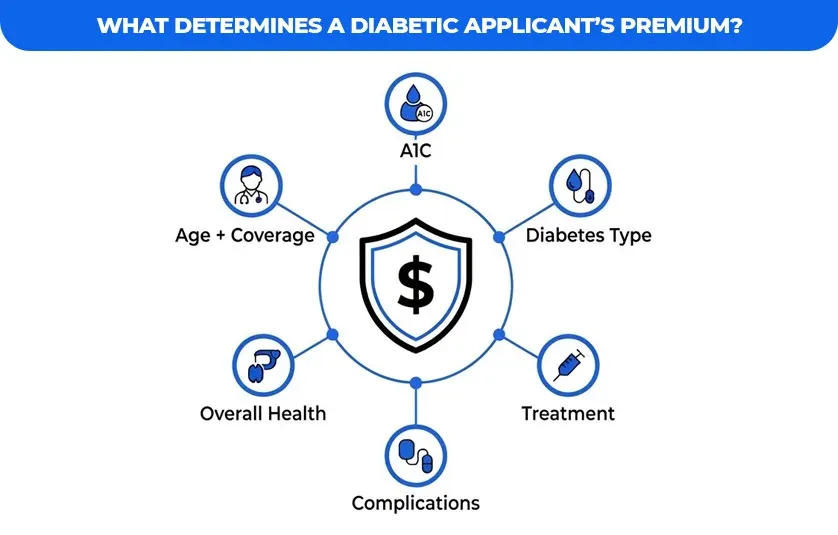
Factors that most directly move your rate class include:
- Control method. Diet-and-exercise-only management is viewed most favorably, oral medication is next, insulin injections raise scrutiny further, and insulin pump use draws additional underwriting attention, though modern pump and monitoring data can also demonstrate stability.
- A1C stability over time. Insurers generally want to see at least six to twelve months of consistent A1C readings rather than a single favorable test.
- Complications. A history of diabetic coma, severe insulin reactions, eye disease, kidney protein in urine, neuropathy, skin ulcerations, or amputation will move you to a higher table or, in severe cases, a decline for fully underwritten coverage.
- General health. Blood pressure, cholesterol, tobacco use, and body mass index compound with diabetes in the underwriter’s risk calculation, since these factors independently affect cardiovascular risk.
- Age, coverage amount, and term length. As with any applicant, a larger death benefit and a longer term period raise the premium independent of your health profile.
Because underwriting guidelines for diabetes vary meaningfully from one carrier to the next, the only reliable way to know your actual premium is to get quotes run against your specific labs and history rather than relying on a generic published rate.
Tips for Getting the Best Life Insurance Rate With Diabetes
Preparation before you apply, and choosing the right carrier, matter as much as your diagnosis itself. The steps below are the ones that most directly influence which rate class you land in.
- Stabilize your A1C first. Aim to bring your A1C into your target range and hold it there for three to six months before applying, since underwriters look for a consistent trend, not a single good test.
- Document your care. Keep a record of endocrinologist visits, lab results, and medication or device compliance. A clear paper trail signals active management to an underwriter.
- Address secondary risk factors. Blood pressure, cholesterol, and body weight compound with diabetes in the underwriter’s risk model, so improvements here can help your overall class even if your A1C stays the same.
- Work with an independent agent. Because table-rating guidelines for diabetes differ significantly by carrier, an independent broker who can shop your profile across multiple companies rather than a single captive insurer is more likely to find the most favorable underwriter for your specific numbers.
- Check the carrier’s financial strength and licensing. Before committing to a policy, review the insurer’s financial strength rating from an agency such as AM Best, and confirm the company is licensed in your state through your state insurance department or the NAIC’s consumer resources. This matters most with smaller, diabetes-friendly specialty carriers.
Conclusion
Securing life insurance for diabetics doesn’t have to feel like navigating a maze blindfolded. Armed with proactive A1C management, consistent medical documentation, and the right independent guidance, you can completely transform your underwriting outcome and lock in secure, affordable protection for the people who matter most. Remember, insurance carriers are no longer looking for perfection; they are looking for proven control, stability, and commitment to your long-term health.
Ready to find the right coverage? Let the specialists at Assurance Gurus help you compare personalized, no-obligation quotes from top-rated, diabetes-friendly insurance carriers. Take the first definitive step toward ultimate financial security right now by visiting Assurance Gurus to speak with an independent expert.