


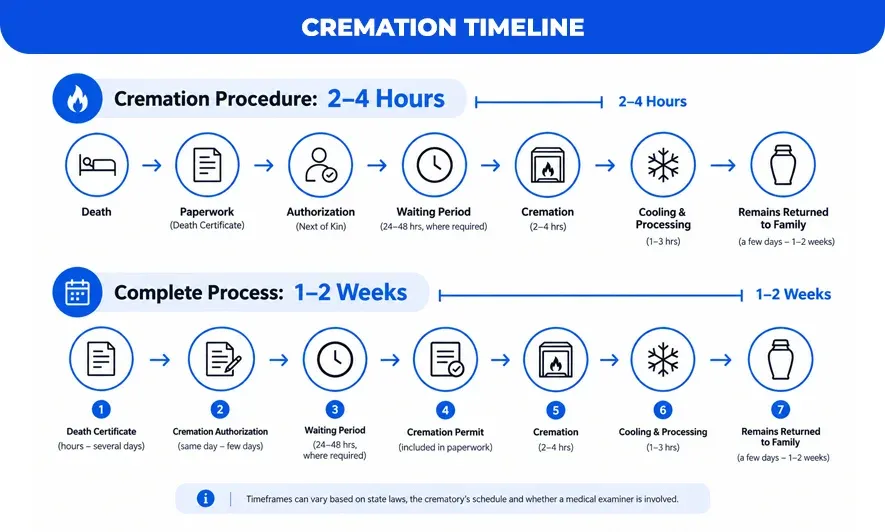
The cremation procedure itself takes 2 to 4 hours for an average adult, at chamber temperatures generally cited by crematory operators and industry sources as 1,400°F to 1,800°F. The complete process, however, from the time of death to the moment a family receives the cremated remains, typically takes longer, generally 1 to 2 weeks, depending on state law, paperwork processing, and the crematory’s schedule.
This distinction matters because the physical cremation procedure is only one part of a longer sequence. Before cremation can legally proceed, a death certificate must be issued, a cremation authorization form must be signed, and in many states a mandatory waiting period must pass. After the procedure, the remains are cooled, processed, and returned to the family, which adds additional days.
This article breaks down each stage of that timeline with verified, sourced data, explains what affects the total time, and answers the most common related questions.
| Quick Answer Cremating a body takes 2 to 4 hours for the physical procedure. The full process, including legally required paperwork, waiting periods, and returning the remains to the family, generally takes 1 to 2 weeks. |
Key Takeaways
- The cremation procedure itself takes 2–4 hours; it is not the part of the process that takes the longest.
- Most of the total timeline is paperwork and legal waiting periods, which are set by state law and vary by jurisdiction.
- A mandatory waiting period of 24 to 48 hours applies in many states before cremation can legally proceed (state law varies; some states have no mandatory waiting period).
- Average adult cremated remains weigh roughly 4 to 8 pounds, according to crematory operators and the Cremation Association of North America (CANA).
- The U.S. cremation rate was projected at 63.4% for 2025, according to the National Funeral Directors Association (NFDA).
How Long Does the Cremation Procedure Itself Take?
The cremation procedure generally takes 2 to 4 hours for an average adult body. During this time, the body is placed in a cremation chamber, known as a retort, which is heated to a temperature commonly cited by crematory operators as 1,400°F to 1,800°F (760°C to 982°C). At this temperature, intense heat, not open flame, breaks down soft tissue and organic matter, leaving bone fragments behind.
The Cremation Association of North America (CANA) describes cremation as a thermal process that reduces human remains to bone fragments, which are then processed and pulverized into particles that are usually no more than one-eighth of an inch in size (Source: CANA).
Why Cremation Time Varies by Body Size and Container
Body size and weight are a primary variable within the 2-to-4-hour window, since a larger body requires more time and sustained heat exposure to complete the process. The type of cremation container also plays a role: simpler containers such as unfinished wood or heavy-duty cardboard tend to combust faster than a denser hardwood casket, which can extend the time the chamber needs to complete the cycle.
Because these variables differ case by case, funeral homes and crematories are the most reliable source for an exact estimate in any individual situation.
Can Family Members Witness the Cremation?
Many crematories offer what is known as a witness cremation, in which immediate family members are present as the process begins, typically for personal, cultural, or religious reasons. This option does not change the length of the cremation procedure itself; families who wish to arrange it should confirm availability with the funeral director in advance, since not every facility offers this option or has the space to accommodate it.
What Is the Complete Cremation Timeline From Death to Receiving Ashes?
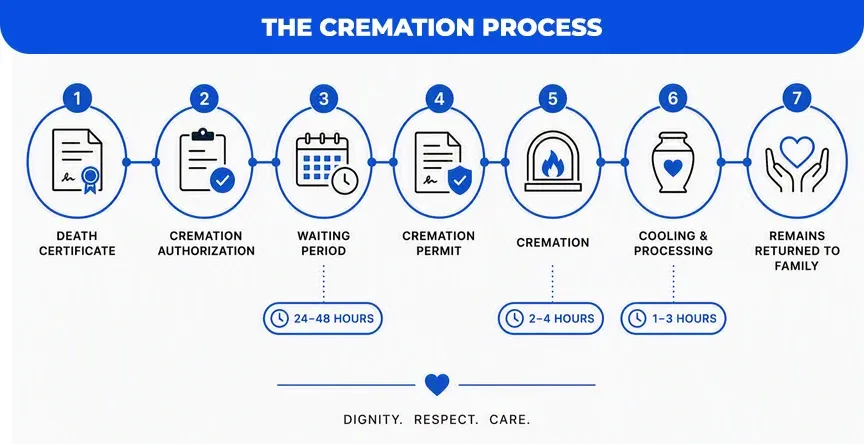
The complete cremation timeline includes several stages beyond the procedure itself. While exact timing depends on the state, the crematory, and whether a medical examiner is involved, the stages below reflect the sequence described by crematory operators and funeral industry sources.
| Stage | Typical Timeframe |
| Death certificate completed and filed | Hours to several days, depending on the case |
| Cremation authorization signed by next of kin | Same day to a few days |
| State-mandated waiting period (where applicable) | 24 to 48 hours, where required by state law |
| Cremation permit issued | Included within the paperwork window above |
| The cremation procedure itself | 2 to 4 hours |
| Cooling and processing of remains | Roughly 1 to 3 hours |
| Return of remains to the family | A few days to about 1 to 2 weeks total, from date of death |
Cases that do not require a medical examiner’s investigation or an autopsy tend to move through this sequence faster. Cases involving an unattended death, an accident, or another circumstance that requires investigation by a coroner or medical examiner can extend the total timeline well beyond two weeks, since cremation cannot proceed until the investigation and death certificate are complete.
What Legal Steps and Paperwork Are Required Before Cremation?
Cremation cannot proceed until specific legal documents are completed. These requirements are set at the state level, so exact rules differ by jurisdiction, but the following three documents are required in nearly every U.S. state.
- Death certificate completed and signed by a physician or medical examiner, certifying the cause of death.
- Cremation authorization form signed by the legal next of kin or a designated agent, giving formal permission for the cremation.
- Cremation permit issued by the local health department or county registrar, giving legal clearance to proceed.
Many states also require a mandatory waiting period between death and cremation. For example, Texas Health and Safety Code §716.004 prohibits cremation within 48 hours of the time of death listed on the death certificate, unless that requirement is waived in writing by a medical examiner, justice of the peace, or court order (Source: Texas Health and Safety Code §716.004). Other states, including Illinois and New York, require a minimum 24-hour waiting period. Waiting-period rules vary by state, and some states do not impose a mandatory waiting period at all, so it is worth confirming the specific requirement with the funeral home or crematory handling the arrangements.
During a mandatory waiting period, the deceased is typically kept under refrigeration at the funeral home or crematory rather than embalmed, since embalming is not a legal requirement for cremation. Embalming may still be requested by the family if a viewing or service is planned before the cremation takes place.
What Happens After the Cremation Procedure Ends?
Once the cremation procedure is complete, several additional steps take place before a family receives the remains.
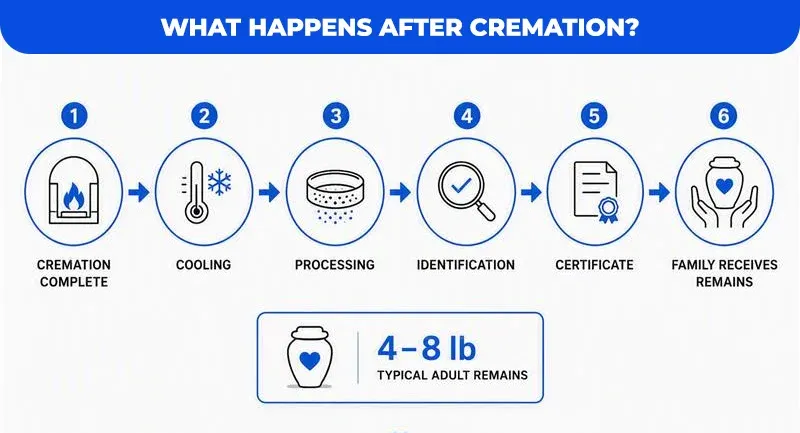
- Cooling: The bone fragments are cooled before they can be safely handled and processed.
- Processing: The cooled fragments are mechanically processed into the fine, granular substance commonly referred to as “ashes” or cremated remains, which CANA describes as particles typically no more than one-eighth of an inch (Source: CANA).
- Identification: a heat-resistant metal ID tag accompanies the body through the entire process and is placed with the cremated remains, which is a standard industry practice intended to confirm the identity of the remains returned to the family.
- Return to family: crematories typically provide a certificate of cremation along with the remains, either for pickup or through regulated shipping.
Average adult cremated remains weigh roughly 4 to 8 pounds, according to crematory operators and the Cremation Association of North America. The exact weight is driven primarily by bone density and skeletal structure rather than the person’s body weight in life, which is a useful detail to know when selecting an urn size.
What Factors Influence the Cremation Timeline?
Several variables affect where a specific case falls within the timeframes above. Legal requirements and administrative processing generally have the largest effect on the total timeline, while the cremation procedure itself varies less.
| Factor | Effect on Timeline |
| Body size and weight | Larger bodies generally require more time within the 2–4 hour cremation window. |
| State-mandated waiting period | Where required, adds 24–48 hours before cremation can legally proceed. |
| Medical examiner or autopsy involvement | Can extend the timeline by days or weeks, since cremation cannot proceed until the investigation is complete. |
| Crematory scheduling and case volume | Higher demand at a facility can create a queue before the procedure begins. |
| Cremation container material | Denser materials, such as hardwood, can take longer to break down than simple cardboard containers. |
| Speed of paperwork processing | Delays in issuing the death certificate or permit pause the process until resolved. |
Cremation Rates in the U.S. and Globally: Why the Process Looks Different by Region
Cremation demand affects scheduling and, in turn, timing. According to the National Funeral Directors Association’s 2026 Cremation & Burial Report, the U.S. cremation rate was projected to reach 63.4% in 2025, compared with a projected burial rate of 31.6% (Source: NFDA, 2026 Cremation & Burial Report). The same report projects the U.S. cremation rate will reach 82.1% by 2045, with the burial rate declining to 13.3%.
As cremation demand rises, more crematories are operating at or near capacity in some regions, which can extend scheduling wait times even when paperwork and legal steps move quickly.
Cremation rates are considerably higher in some other countries. In Japan, cremation accounted for 99.97% of deaths in 2023 and 99.98% in 2024, according to Japan Society of Environmental Crematory data compiled by the International Cremation Federation According to International Cremation Federation, cremation.org.uk. Japan’s cremation infrastructure, built around this near-universal demand, is generally cited as a factor in its efficient scheduling and processing capacity.
Related Cremation Terms and Options Worth Knowing
Families researching timelines often encounter related terms that affect both cost and scheduling. Direct cremation refers to cremation without a viewing, visitation, or funeral service beforehand, which is typically the fastest and lowest-cost option. Traditional or full-service cremation includes a viewing or funeral service prior to the procedure, which can add time to the overall schedule. Flame-based cremation is the standard method offered by U.S. crematories, while alkaline hydrolysis, sometimes marketed as water cremation, is a chemical alternative available in a growing number of states. After the process is complete, families typically choose between a cremation urn, a columbarium niche, or scattering the remains, none of which affect the cremation timeline itself but are worth planning for in advance.
Conclusion: Navigating the Cremation Timeline With Confidence
Understanding how long does it take to cremate a body helps families manage expectations during a challenging time. While the physical cremation procedure takes only a few hours, navigating legal paperwork, mandatory waiting periods, and administrative scheduling requires patience, ultimately bringing the total duration to one or two weeks.
Proactive planning and close communication with a licensed funeral director ensure a smooth, transparent journey from initial arrangements to the final return of your loved one’s remains. Reach out to a trusted professional today to secure a personalized estimate and honor your family’s specific needs with dignity and peace of mind.