

Cremation Process Explained

Cremation Process Explained: Step-by-Step Guide

Cremation is now the majority choice for U.S. families, with CANA reporting a national cremation rate of 61.8% in 2024, rising to 62.8% in 2026. Yet most people planning a cremation for the first time still have basic questions about what happens, how long it takes, and what a family is allowed to decide. This guide walks through the cremation process step by step, using information from CANA, the FTC, and state cremation statutes.

Quick Answer

Cremation is a regulated procedure that uses intense heat, generally between 1,400°F and 1,600°F, to reduce human remains to bone fragments inside a machine called a cremator. According to CANA, the cremation itself takes roughly 30 minutes to over two hours, depending on body size, and by law it typically cannot occur until at least 48 hours after death. The bone fragments are then cooled and mechanically processed into the fine, granular material commonly called cremated remains or ashes. The full process, from legal authorization to the return of remains, usually takes longer than the cremation itself because of paperwork, permits, and scheduling.

Key Takeaways

  • CANA reports a 61.8% U.S. cremation rate for 2026 and 62.8% for 2026, with growth projected to reach 69.1% by 2030.
  • The cremation chamber itself operates at 1,400°F to 1,600°F and runs for about 30 minutes to two hours, according to CANA.
  • State law generally prohibits cremating more than one person in the same chamber at the same time without written authorization from each family, as reflected in statutes such as California Health and Safety Code Section 7054.7.
  • The FTC Funeral Rule gives families the right to an itemized price list and lets them decline any cremation-related goods or services they do not want.
  • The average adult’s cremated remains weigh between four and six pounds, per CANA, and are pulverized to particles no larger than one-eighth of an inch.

What Is the Cremation Process?

According to CANA, cremation is the mechanical, thermal, or other dissolution process that reduces human remains to bone fragments, followed by processing and pulverization of those fragments into small, uniform pieces. This definition covers more than one technology. Flame-based cremation, which uses direct heat inside a cremator, remains the most widely available method through funeral homes and crematories. Alkaline hydrolysis, sometimes called water cremation, uses water, alkaline chemicals, heat, and pressure instead of flame, though CANA notes it is currently legal and available only in a limited number of states and provinces.

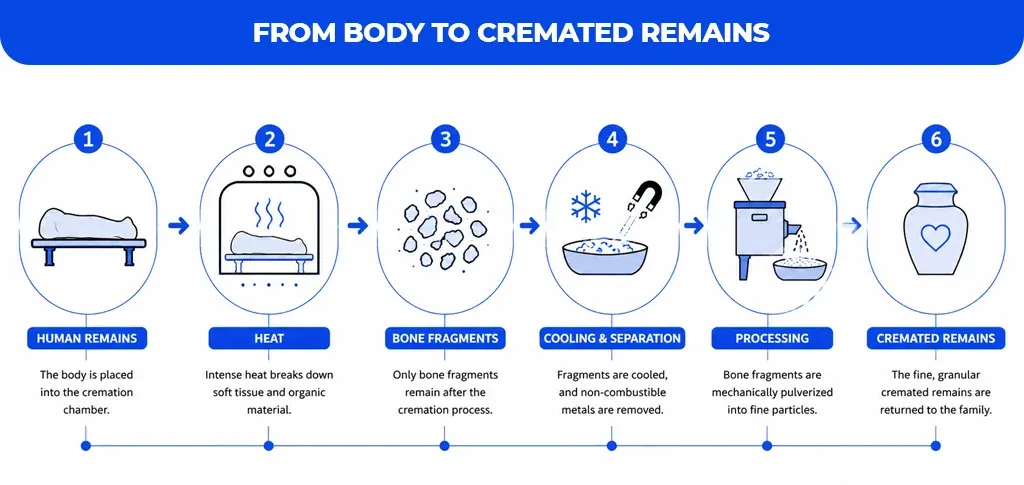
It helps to understand that cremation does not turn a body directly into ash. The heat consumes soft tissue and organic material, leaving bone fragments behind. Those fragments, not ash in the traditional sense, are what families ultimately receive after processing.

The Cremation Process, Step by Step

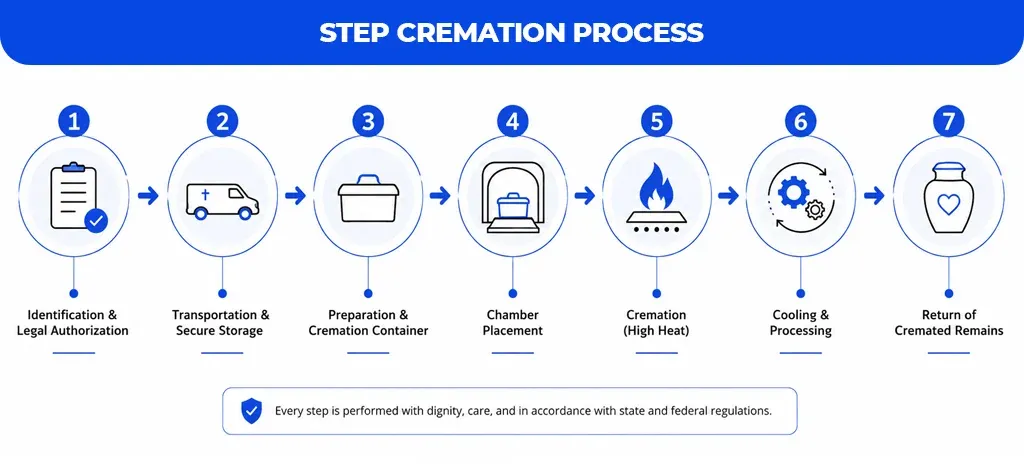
CANA outlines at least four core elements of cremation: transportation of the deceased, secure cold storage, the cremation itself, and the return of cremated remains to the authorized agent. In practice, that breaks down into the following steps.
Step Cremation Process

Identification and Legal Authorization

The crematory must receive a signed authorization from the legally recognized decision-maker, plus a burial-transit permit and any required state paperwork. Staff verify the deceased’s identity against this documentation and assign a cremation number or identification disc that stays with the remains throughout. Requirements and waiting periods vary by state, so a funeral director can explain the rules that apply locally.

Transportation and Secure Storage

The deceased is transported from the place of death to a funeral home or, less commonly, directly to the crematory, then held in secure, cold storage until cremation is scheduled. CANA notes that cremation typically occurs at least 48 hours after death, though exact timing depends on state law and family scheduling.

Preparation and the Cremation Container

Jewelry and other personal items are generally removed and returned to the family unless other arrangements are made. Certain medical devices, including pacemakers, may need to be removed for safety reasons. The deceased is then placed in a cremation container, which must be rigid, leak-resistant, and combustible, such as a cardboard container, rental casket, or fully combustible wooden casket. Metal caskets cannot be cremated.

Placement in the Cremation Chamber

Staff confirms identification once more before the container is moved to the cremator and placed inside the primary chamber, manually or with a mechanical loader. The identification disc goes into the chamber with the remains so it travels through the entire process with the deceased.

The Cremation

Once the chamber door closes, the cremation is monitored until complete. CANA explains the process works in two stages: primary combustion breaks down tissue, organs, body fat, and container materials in the main chamber, while resulting gases move to a secondary chamber for further combustion before venting through an exhaust stack. Chamber temperatures generally run between 1,400°F and 1,600°F, and the body, which CANA notes is 65% to 85% water by weight, is essentially converted from a solid to a gas.

Cooling and Processing the Remains

The bone fragments are swept or vacuumed from the chamber into a cooling tray. Non-combustible material, such as metal from surgical implants, dental work, or casket hardware, is separated out and typically recycled. The remaining fragments are then pulverized by a processor into a consistent, granular texture no larger than one-eighth of an inch, per CANA.

Return of the Cremated Remains

The processed remains are placed in a plastic liner inside a temporary container or the urn the family selected. Identification is verified a final time before the container is labeled and released to the authorized agent, closing a chain-of-custody record that runs from removal at the place of death through final return, since cremation is irreversible.
COST & EXPENSE PLANNING

Wondering how final expense policies can cover end-of-life costs like cremation or burial? Let independent experts at Assurance Gurus find a budget-friendly policy to protect your family from out-of-pocket expenses.

An Overview of the Cremation Process

StageWhat Happens
AuthorizationLegal paperwork, permits, and identification are completed and verified.
StorageThe deceased is held in secure, cold storage until scheduling is finalized.
ContainerThe deceased is placed in an approved, combustible cremation container.
CremationThe container enters the chamber and is exposed to 1,400°F–1,600°F heat for roughly 30 minutes to two hours.
CoolingBone fragments cool, and non-combustible material is separated.
ProcessingFragments are pulverized to particles no larger than one-eighth of an inch.
ReturnRemains are placed in an urn or temporary container and released to the family.

Types of Cremation

Types of Cremation

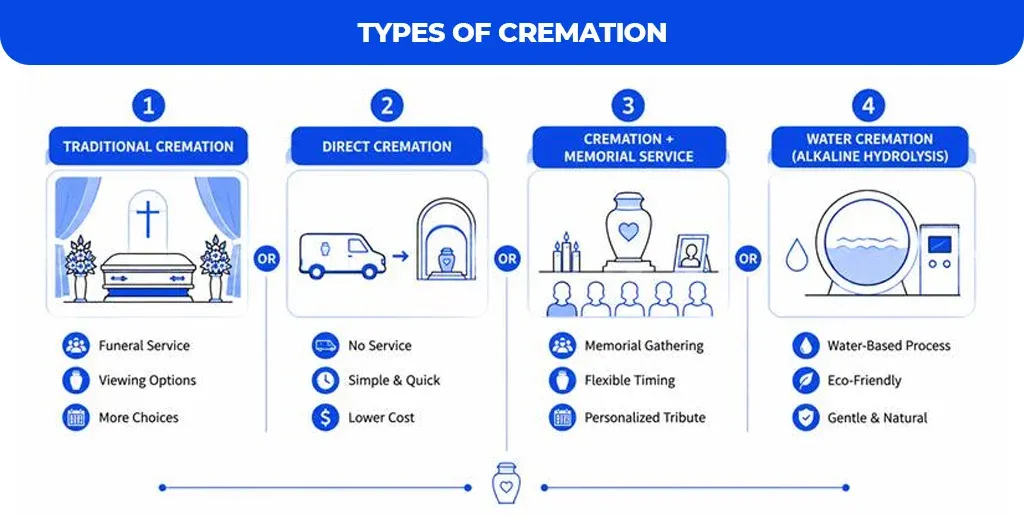
The word “cremation” can describe several different service arrangements as well as different underlying technologies.

Traditional Cremation

This option includes a funeral service, viewing, or visitation before the cremation takes place, allowing families a conventional memorial experience while still choosing cremation for final disposition.

Direct Cremation

Direct cremation happens without a formal viewing, visitation, or ceremony beforehand. It is generally the simplest and least expensive cremation option, since it removes embalming, casket, and facility costs from the price.

Cremation With a Memorial Service

Some families choose to hold a memorial gathering after the cremation instead of before it. This approach still allows for readings, photographs, music, or religious and cultural traditions, on a timeline that works for the family.

Water Cremation (Alkaline Hydrolysis)

Also called aquamation, this method uses water, an alkaline solution, heat, and pressure to accelerate the natural breakdown of remains instead of using flame. CANA confirms that flame-based cremation and alkaline hydrolysis are the only two legally recognized cremation processes in the U.S. and Canada, and availability depends on state or provincial law.

How Long Does the Cremation Process Take?

The cremation itself, meaning the time the body spends inside the chamber, generally takes 30 minutes to a little over two hours, depending on body size and the heat already stored in the chamber, according to CANA. The overall timeline from death to receiving the remains is almost always longer, since it depends on legal authorization, required waiting periods, transportation, crematory scheduling, and the time needed for cooling and processing. Families should ask their provider for a realistic estimate rather than assuming remains will be ready within a day or two.

What Happens to the Body During Cremation?

Inside the primary chamber, intense heat breaks down soft tissue, organs, and body fat, converting most of the body’s mass into gas that is vented through a secondary combustion stage. What remains afterward is bone fragments, sometimes with small pieces of metal from surgical implants, dental fillings, or jewelry that was not removed beforehand. CANA notes that this metal is separated before processing and is typically recycled rather than returned with the remains.
From Body to Cremated Remains

What Happens to Cremation Ashes After the Process?

Once a family receives cremated remains, they generally have several options for what to do next, subject to local and state regulations:

  • Keeping the remains in an urn at home.
  • Scattering them in a location where scattering is legally permitted.
  • Burying the cremated remains in a cemetery plot or family plot.
  • Placing the urn in a columbarium niche.
  • Dividing remains into keepsake urns or memorial jewelry for multiple family members.

Because scattering and burial rules vary by city, state, and property type, it is worth checking local regulations or asking the funeral provider before finalizing a plan.


Pros and Cons of the Cremation Process

ProsCons
Offers flexible memorial timing and optionsNot preferred under every religious or cultural tradition
Can be less expensive than a funeral with burial, per NFDA cost dataRules on scattering and burial of remains vary by location
Does not require purchasing or maintaining a burial plotAdditional services, urns, or ceremonies can add to the base cost
Gives families multiple options for memorializing remainsSome families prefer having a permanent gravesite to visit

Cremation vs. Burial: What’s the Difference?

FactorCremationBurial
Final remainsCremated remains (bone fragments)Body remains in a casket
Memorial optionsUrn, scattering, columbarium, jewelryCemetery plot or family gravesite
Land requirementOften minimal or noneTypically requires cemetery space
Median U.S. cost (NFDA, 2023 study)$6,280 for a funeral with cremation$8,300 for a funeral with viewing and burial
RegulationGoverned by state cremation statutesGoverned by state and cemetery regulations

How Much Does the Cremation Process Cost?

According to NFDA’s General Price List study, the national median cost of a funeral that includes cremation, an alternative container, and an urn was $6,280, compared with $8,300 for a funeral with viewing and burial. Direct cremation, which skips embalming, viewing, and a formal ceremony, is reported by multiple industry sources as substantially less expensive, since families are largely paying for transportation, basic services, and the cremation fee itself. Costs vary by region and provider, so the FTC Funeral Rule requires providers to give an itemized General Price List so families can compare options before committing.

Is Cremation Right for You or Your Family?

There is no universally correct answer, since the decision depends on personal and family circumstances. It may be worth considering cremation if your family values:

  • Flexibility in memorial timing and location
  • A wider range of options for final resting place
  • An alternative to purchasing and maintaining a burial plot
  • Potentially simpler logistics, especially for direct cremation

On the other hand, families with strong religious or cultural preferences for burial, or those who want a permanent gravesite to visit, may find traditional burial a better fit.

Understanding the Cremation Process

Cremation is a carefully regulated sequence of authorization, preparation, controlled combustion, cooling, and processing, not a single instantaneous event. Families have meaningful choices at nearly every stage, and costs and procedures vary by location and provider. Understanding each step and knowing your rights under the FTC Funeral Rule can make the process feel more manageable during an already difficult time.

Whether you are comparing cremation and burial, researching funeral expenses, or planning ahead financially for your family, Assurance Gurus can help you explore your options and make more informed decisions about funeral planning, insurance, and end-of-life costs.

EXPERT GUIDANCE

Ready to ensure your final arrangements or family protection are fully covered? Visit Assurance Gurus today to compare policy quotes and secure complete peace of mind.

Frequently Asked Questions About the Cremation Process

No, in a standard cremation without an autopsy or organ donation, internal organs are not surgically removed beforehand. Certain implanted medical devices, such as pacemakers, are typically removed for safety reasons, since some devices can react dangerously to the heat of the cremation chamber.

According to CANA, cremation typically takes between 30 minutes and a little over two hours inside the chamber, depending on the size of the body and the heat already retained in the equipment. This is separate from the overall timeline for authorization, scheduling, and returning the remains.

In many cases, yes. CANA notes that families may arrange to witness the cremation, and some crematories allow limited viewing of behind-the-scenes procedures. Availability depends on the specific provider and state regulations, so it is best to ask the crematory directly when making arrangements.

Only one body may be placed in a cremation chamber at a time in nearly all circumstances. Many state statutes, including California Health and Safety Code Section 7054.7 and Texas Health and Safety Code Section 716.153, prohibit simultaneous cremation of more than one person in the same chamber unless every family involved provides written authorization, which typically only happens in specific cases such as a parent and infant.

Direct cremation is cremation that takes place without a funeral, viewing, or visitation beforehand. It is generally the most affordable cremation option because it removes embalming, casket, and facility costs from the price.

Water cremation, also called alkaline hydrolysis, uses water, an alkaline solution, heat, and pressure to break down remains instead of flame. CANA confirms it is a legally recognized process, though availability is limited to certain states and provinces.