



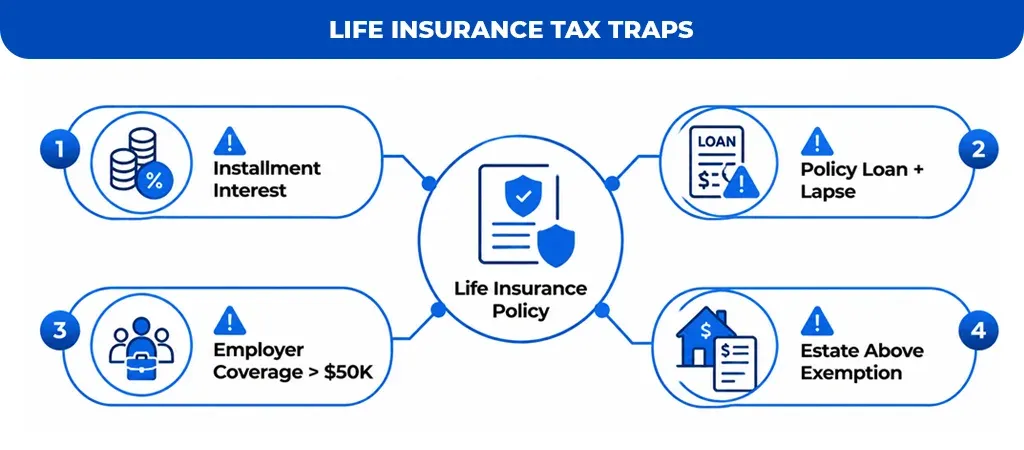
Life insurance death benefits are generally not subject to federal income tax when they are paid to a named beneficiary in a single lump sum. This protection comes from Internal Revenue Code (IRC) Section 101(a) and applies regardless of the size of the payout. “Generally tax-free,” however, is not the same as “always tax-free.” Certain circumstances can create a tax liability for a policyholder or beneficiary, including installment payouts, outstanding policy loans, employer-provided coverage above $50,000, and estates that exceed the federal exemption threshold.
This guide explains how life insurance is taxed across death benefits, cash value withdrawals, and policy loans; when the standard tax-free treatment does not apply; and how planning tools such as an Irrevocable Life Insurance Trust (ILIT) can help reduce a beneficiary’s tax exposure. It also covers whether life insurance premiums are tax-deductible and answers the most common questions beneficiaries ask about taxes on a payout.
Quick AnswerIn most cases, no. A life insurance death benefit paid as a lump sum to a named beneficiary is exempt from federal income tax under IRC Section 101(a). Exceptions apply to interest on installment payouts, lapsed policies with an outstanding loan balance, employer-paid group-term coverage above $50,000, and estates above the federal exemption. |
Key TakeawaysLump-sum death benefits paid to a named beneficiary are exempt from federal income tax under IRC Section 101(a), regardless of the payout amount.If a beneficiary chooses installment payments, the principal stays tax-free, but any interest earned on the unpaid balance is taxed as ordinary income.A policy loan is not taxable on its own, but a lapsed or surrendered policy with an outstanding loan balance can create a taxable event.Employer-paid group-term life insurance above $50,000 is reported as imputed income under IRC Section 79.For 2026, the federal estate tax exemption is $15 million per individual and $30 million per married couple with portability, per IRS Revenue Procedure 2025-32; amounts above the exemption are taxed at a top federal rate of 40%.Personal life insurance premiums are not tax-deductible for individuals; business-owned policies follow separate and more limited rules. |
Do You Pay Taxes on Life Insurance? The Core Tax Rules Explained
Whether a policyholder or beneficiary owes tax depends on how the money is paid out and who owns the policy. The two rules below cover most individual life insurance situations.
How IRC Section 101(a) Protects Beneficiaries from Income Tax
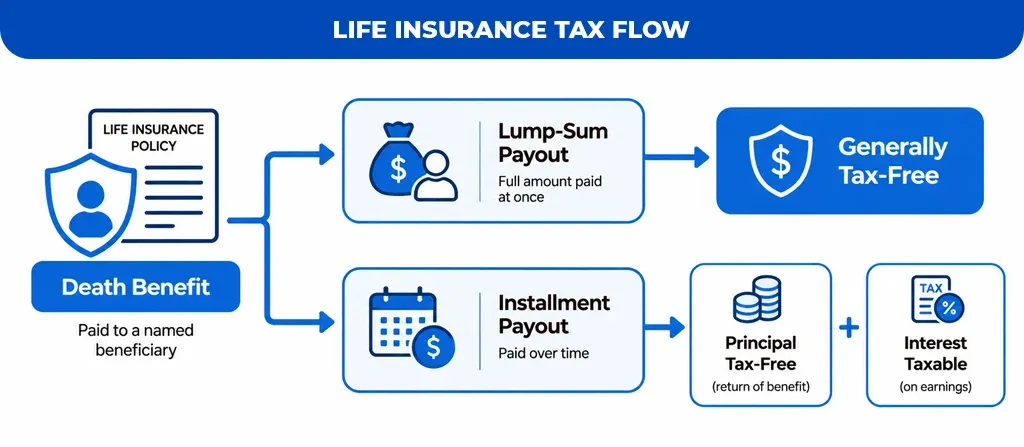
Under IRC Section 101(a), amounts received under a life insurance contract because of the death of the insured are generally excluded from the beneficiary’s gross income. This applies whether the policy is term life, whole life, universal life, or final expense insurance, and it applies to a $50,000 policy or a $2,000,000 policy in the same way. The exclusion covers the death benefit itself; it does not automatically cover interest that accrues on that benefit after death, which is addressed in the next section.
The Cost Basis Rule for Living Benefits and Cash Withdrawals
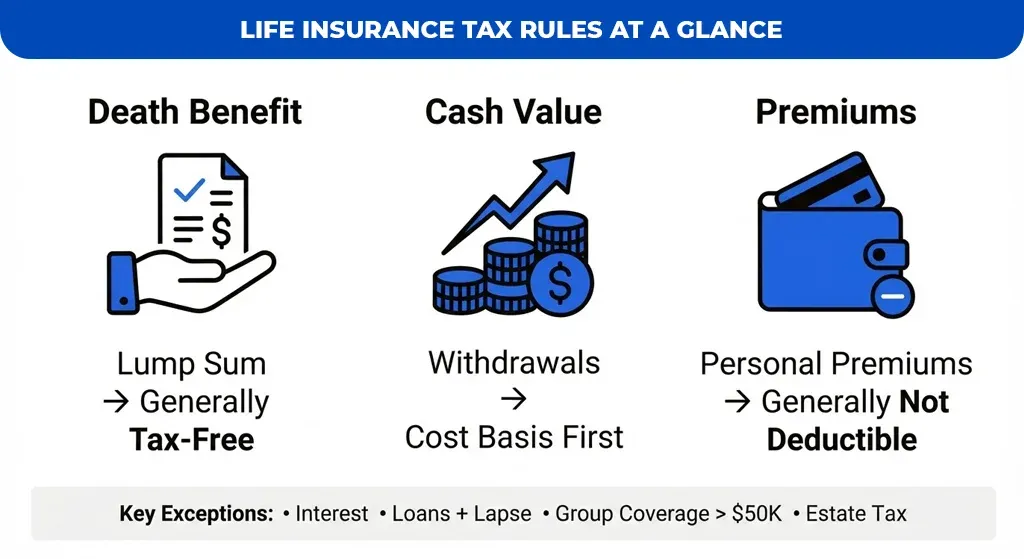
Permanent life insurance policies, such as whole life and universal life, build cash value over time. When a policyholder withdraws from that cash value while still living, the withdrawal is generally treated first as a tax-free return of the policy’s cost basis, the total premiums paid with after-tax dollars. Withdrawals that exceed the cost basis are taxable as ordinary income in the year they are received. Term life insurance and final expense insurance policies typically do not build cash value, so this rule applies primarily to permanent coverage.
How Is Life Insurance Taxed Across Different Payout Methods?
The tax treatment of a policy is not limited to a single lump-sum death benefit. How the insurer distributes the money, and how the policyholder uses the cash value while alive, both affect the outcome.
Lump-Sum vs. Installment Payouts and Interest Tax Liability
A beneficiary who takes the death benefit as a lump sum receives the full amount income-tax-free under IRC Section 101(a). A beneficiary who instead chooses an installment option, receiving the benefit over several years with interest, still receives the original principal tax-free, but the interest portion of each payment is taxable as ordinary income. This distinction matters for beneficiaries comparing a single check against a structured payout from the insurance company.
The Hidden Tax Risks of Permanent Policy Loans and Surrenders
Borrowing against the cash value of a permanent policy is not treated as taxable income at the time of the loan, because policy loans are not classified as income under current IRS rules. The risk appears if the policy lapses or is surrendered while a loan is outstanding: at that point, any loan amount that exceeds the policy’s cost basis is generally treated as taxable income. Because this can happen without the policyholder actively choosing to cash out, it is one of the more commonly misunderstood tax traps in permanent life insurance.
Dividends, Accumulation, and Tax Triggers
Dividends paid by a mutual life insurance company are typically treated by the IRS as a nontaxable return of premium, since they are considered a refund of amounts the policyholder already paid. If dividends are left with the insurer to accumulate interest rather than taken as cash, the interest that accrues on those dividends is taxable as ordinary income, even though the dividend itself is not.
When Is Life Insurance Taxable? Identifying Hidden Traps
Death benefits are protected from income tax in most situations, but three specific scenarios can remove or reduce that protection.
Employer-Paid Group-Term Coverage Above $50,000
Under IRC Section 79, the first $50,000 of employer-provided group-term life insurance is excluded from an employee’s taxable income. Coverage above $50,000 is different: the IRS requires the value of that excess coverage to be calculated using its Uniform Premium Table I and reported as “imputed income” on the employee’s Form W-2, even though the employee never receives that amount in cash. This applies to group-term coverage carried directly or indirectly by an employer; it does not apply to individually owned term or permanent policies.
Estate Tax Exposure and Federal Exemption Thresholds
If the insured person owned the policy at the time of death rather than a trust or another party, the full death benefit is included in their gross estate for federal estate tax purposes, even though it remains free of income tax to the beneficiary. For estates of individuals who die in 2026, the federal estate tax exemption is $15 million per person, or $30 million for a married couple using portability. Estates above the exemption are taxed at a top federal rate of 40%. This exemption is set under the One, Big, Beautiful Bill Act and is scheduled to be indexed for inflation starting in 2027.
The Transfer-for-Value Rule
If an existing life insurance policy is sold or otherwise transferred to another party in exchange for cash or other valuable consideration, the income-tax-free treatment of the death benefit can be partially lost under the transfer-for-value rule. In that situation, the new owner may owe income tax on the portion of the death benefit that exceeds what they paid for the policy plus any premiums they paid afterward. Certain transfers, such as those to the insured, a partner of the insured, or a corporation in which the insured is a shareholder or officer, are excluded from this rule.
How to Avoid Paying Unnecessary Taxes on Life Insurance
Several planning strategies can reduce or eliminate the tax exposure described above, particularly for larger estates and cash-value policies.
Leveraging an Irrevocable Life Insurance Trust (ILIT)
Transferring ownership of a policy to an ILIT removes the death benefit from the insured’s taxable estate, since the trust, not the individual, owns the policy. This strategy is used primarily by individuals whose total estate value is likely to approach or exceed the federal exemption. One important limitation applies: under IRC Section 2035, if the insured transfers an existing policy into the ILIT and dies within three years of the transfer, the death benefit can be pulled back into the taxable estate. Policies purchased directly by the ILIT are not subject to this lookback period.
Strategic Beneficiary Designations vs. Naming “Your Estate”
Naming specific individuals or a trust as beneficiary, rather than listing “my estate,” allows the death benefit to bypass probate court, keeps the proceeds further from creditor claims against the estate, and avoids folding the benefit into the estate’s asset total for administrative purposes. Beneficiary designations should be reviewed after major life events, such as marriage, divorce, or the birth of a child, since a designation form generally overrides instructions in a will.
Tracking Cash Value to Avoid MEC Triggers
A permanent policy can be reclassified by the IRS as a Modified Endowment Contract (MEC) if premiums are paid in at a rate that exceeds federal limits designed to keep life insurance from being used primarily as a short-term investment vehicle. Once a policy becomes a MEC, withdrawals and loans lose the favorable “first-in, first-out” cost-basis treatment described earlier and are instead taxed on a “last-in, first-out” basis, meaning gains are taxed first. Work with the insurance company or a licensed financial professional to monitor premium payments.
Is Life Insurance Tax Deductible?
Personal Policies vs. Business Deductions
For most individuals, life insurance premiums are not tax-deductible. The IRS treats personal life insurance, whether term, whole, universal, or final expense coverage, as a personal expense rather than a deductible medical or business cost, so premiums cannot be written off on a federal income tax return.
Key Man Insurance and Corporate Plan Exceptions
When a business owns a policy on an owner or executive to protect against the financial impact of that person’s death, commonly called Key Man or key person insurance, the premiums are generally not deductible if the business is a direct or indirect beneficiary of the policy. Certain employer-provided group-term plans and specific split-dollar arrangements have their own, more limited deductibility rules, and businesses considering these structures should confirm current treatment with a tax professional or CPA, since the rules depend on plan design and beneficiary status.
Pros and Cons of Life Insurance Tax Structures
The table below summarizes the tax advantages and disadvantages of the three structures covered in this guide.
| Feature / Strategy | Advantages | Disadvantages |
| Standard Death Benefit | Income-tax-free when paid as a lump sum to a named beneficiary (IRC Section 101(a)). | Included in the insured’s gross estate if they owned the policy, which can create estate tax exposure above the federal exemption. |
| Cash Value Growth | Grows on a tax-deferred basis; withdrawals up to cost basis are generally tax-free. | Withdrawals above cost basis are taxable, and a lapse or surrender with an outstanding loan can trigger an unexpected tax bill. |
| Irrevocable Life Insurance Trust (ILIT) | Can remove the death benefit from the insured’s taxable estate when structured correctly. | Requires formal legal setup, ongoing administration, and a three-year lookback period under IRC Section 2035. |
Conclusion: Secure Your Financial Legacy with Assurance Gurus
Standard life insurance death benefits bypass federal income tax in the large majority of cases, which is what makes life insurance a dependable foundation for financial planning. The exceptions are narrow but specific: installment interest, lapsed policies with outstanding loans, group-term coverage above $50,000, and estates above the federal exemption. Understanding where these exceptions apply and using tools like an ILIT or correct beneficiary designations where appropriate helps ensure the protection you are paying for reaches the people it is intended for.
Explore more guides, comparison tools, and personalized insurance strategies at Assurance Gurus to make sure your policy and your broader financial plan are working together.