



Quick Answer: A 40-year-old buying a $500,000, 20-year term life policy pays about $26 a month on average, based on Policygenius data reported by NerdWallet in 2026. Younger, healthy applicants often pay under $20 a month, while whole life, older ages, and more extensive coverage amounts push the monthly cost well into the hundreds of dollars.
Term life insurance for a healthy applicant in their 20s or 30s typically costs between $14 and $27 a month for $500,000 in coverage. Whole life insurance for the same age group runs from roughly $110 to $190 a month, because it lasts a lifetime and builds cash value. Your actual premium depends on your age, gender, health, smoking status, coverage amount, and the type of policy you choose.
Key Takeaways
- The commonly cited “average” of $26 a month applies to a specific profile: a 40-year-old, non-smoking applicant buying a $500,000, 20-year term policy.
- Term life insurance is consistently the cheapest way to buy a large death benefit; whole life and universal life cost several times more because they build cash value and never expire.
- Women generally pay less than men at every age because women have a longer average life expectancy: 81.4 years versus 76.5 years, according to the CDC’s most recent mortality data.
- Smokers can pay six to ten times more than non-smokers for the same coverage.
- Rates in this article are national averages for preferred or standard health applicants. Your own quote will vary by insurer, state, and underwriting class.
How Much Does Life Insurance Cost Per Month on Average?
The average cost of life insurance is about $26 a month, based on a 40-year-old buying a $500,000, 20-year term policy, according to Policygenius data cited by NerdWallet in 2026. This figure is the most widely used benchmark in the industry and matches figures published by Aflac. Costs move well outside this average once age, gender, health, and policy type change.
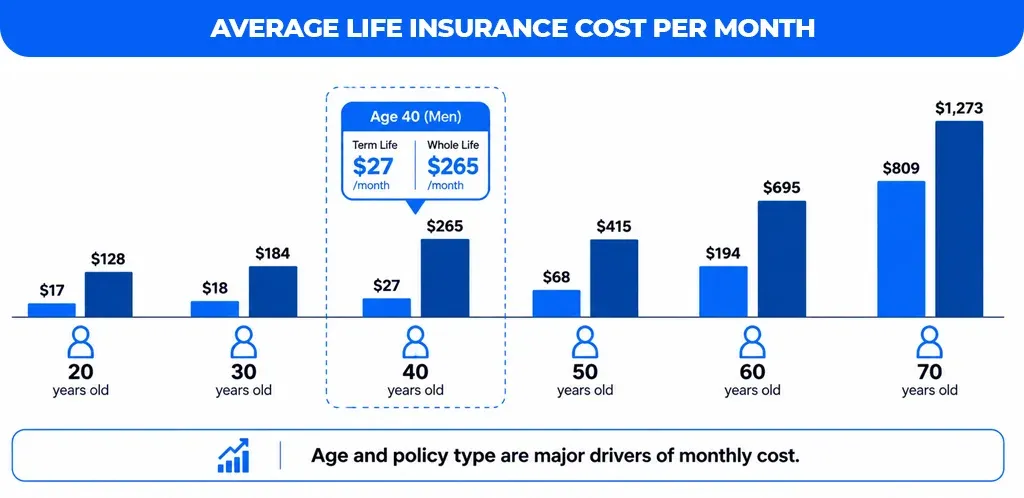
Different research firms quote different “average” numbers because they use different assumptions. Some analyses average rates across every age group and both sexes, which produces a wider range; for example, one 2026 industry rate report put average monthly costs between roughly $47 and $59 depending on gender when blending ages together (MoneyGeek, 2026). The $26-a-month figure is useful because it is tied to one specific, common buyer profile rather than a blended average, which makes it easier to compare against your own age and coverage needs.
Here is how average monthly term life premiums compare to whole life premiums at the same coverage amount, based on 2026 rate data for a $500,000 policy on a non-smoking applicant in good health:
| Age | Term Life Men | Term Life Women | Whole Life Men | Whole Life Women |
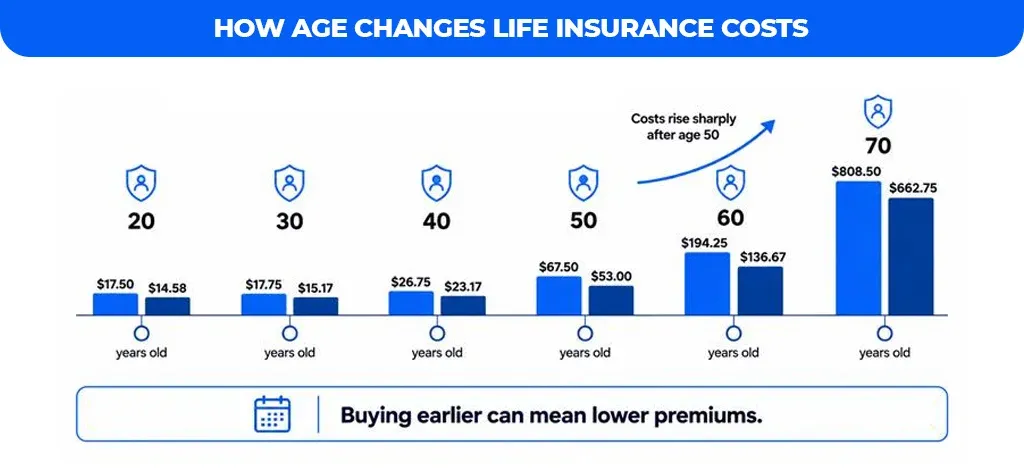
| 20 | $17.50 | $14.58 | $128.25 | $112.08 |
| 30 | $17.75 | $15.17 | $183.92 | $160.75 |
| 40 | $26.75 | $23.17 | $265.00 | $237.42 |
| 50 | $67.50 | $53.00 | $415.25 | $359.75 |
| 60 | $194.25 | $136.67 | $694.58 | $608.67 |
| 70 | $808.50 | $662.75 | $1,272.75 | $1,151.00 |
What Factors Determine How Much You Pay Per Month?
Life insurance premiums are priced primarily on mortality risk. Insurers weigh your age, gender, smoking status, health history, family medical history, occupation, and the coverage amount and policy type you choose. Age and health are the two factors with the biggest effect on your monthly premium.
Underwriters, the insurance company staff who evaluate your application and assign your rate, sort applicants into risk classes such as preferred plus, preferred, and standard, with preferred plus reserved for the healthiest applicants (NerdWallet, 2026). The main factors insurers assess include:
- Age. Premiums rise every year you wait, since your mortality risk increases and your remaining life expectancy shortens.
- Gender. Women typically pay less than men of the same age and health because of the CDC’s life expectancy data noted above.
- Smoking and tobacco use. Nicotine use is linked to higher rates of cancer and respiratory disease, and smokers can pay six to ten times more for the same policy.
- Health and medical exam results. Blood pressure, cholesterol, height and weight, and pre-existing conditions all factor into your risk class.
- Family medical history. A history of heart disease, cancer, or diabetes in your immediate family can raise your rate.
- Occupation and hobbies. High-risk jobs (such as commercial pilots or offshore workers) and hobbies like skydiving can increase premiums.
- Policy type. Term life is the least expensive; permanent policies such as whole life and universal life cost substantially more.
A few factors that insurers are not allowed to use, or generally do not use, when setting your premium include your race, ethnicity, sexual orientation, marital status, credit score, or the number of beneficiaries you name.
How Much Is Term Life Insurance Per Month?
Term life insurance is the cheapest form of coverage because it only pays a death benefit if you die within a fixed period, usually 10, 20, or 30 years, and it never builds cash value. A healthy 30-year-old can typically buy $500,000 in 20-year term coverage for around $15 to $18 a month.
Term life insurance is priced around the length of the term as well as your age. Longer terms lock in a rate for more years, which means a higher starting premium. Based on 2026 rate data for a healthy, non-smoking 40-year-old buying $500,000 in coverage:
| Term Length | Monthly Rate Men | Monthly Rate Women |
| 10 years | $16.75 | $14.58 |
| 20 years | $26.75 | $23.17 |
| 30 years | $47.83 | $37.58 |
Term length should generally match how long you have a financial obligation to protect, such as the years left on a mortgage or until your youngest child becomes financially independent.
How Much Is Whole Life and Universal Life Insurance Per Month?
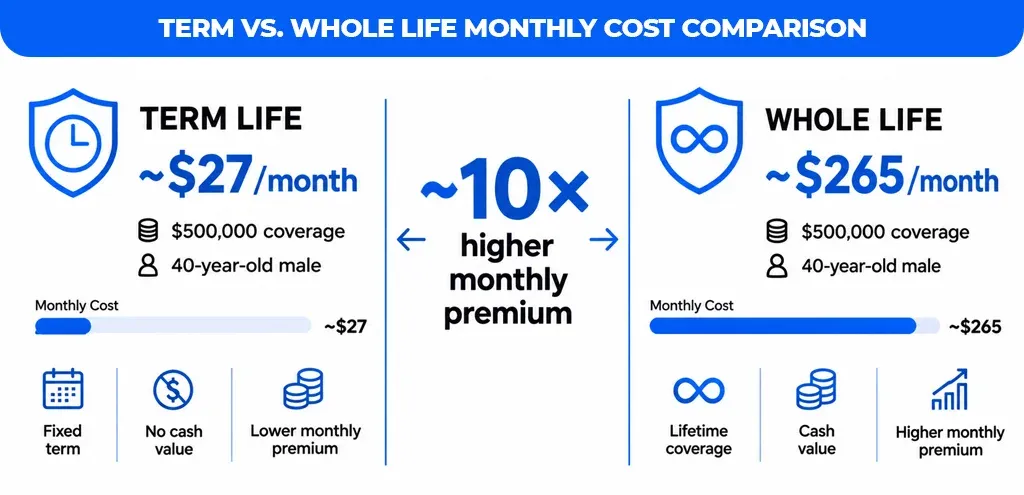
Whole life insurance costs several times more than term life for the same coverage amount because it lasts your entire life and builds tax-deferred cash value you can borrow against later. A healthy 40-year-old man pays around $265 a month for $500,000 in whole life coverage, compared with about $27 a month for an equivalent term policy.
Whole life and universal life insurance are both types of permanent life insurance, but they work differently:
- Whole life insurance has fixed premiums and a guaranteed cash value growth rate set by the insurer.
- Universal life insurance offers flexible premiums and a cash value component tied to interest rates or, in some variations, market index performance, which means the monthly cost can be adjusted within limits, but the death benefit is less guaranteed if underfunded.
Permanent policies cost more for several reasons: they never expire as long as premiums are paid, they accumulate cash value on a tax-deferred basis, policyholders can borrow against that cash value, and agents typically earn ongoing commissions on permanent policies rather than a front-loaded commission as with term.
Term vs. Whole Life Insurance: Side-by-Side Comparison
| Feature | Term Life Insurance | Whole Life Insurance |
| Monthly cost (40-year-old male, $500K) | ~$27/month | ~$265/month |
| Coverage length | Fixed term (10–30 years) | Lifetime, as long as premiums are paid |
| Cash value | None | Builds over time, tax-deferred |
| Premiums | Level for the term, then expire or renew at a much higher rate | Level for life |
| Best suited for | Income replacement, mortgage protection, temporary needs | Estate planning, lifelong dependents, cash value goals |
| Ability to borrow against policy | No | Yes, once cash value accumulates |
How Much Is a $1 Million or $100,000 Life Insurance Policy Per Month?
A $1 million, 20-year term policy for a healthy 40-year-old man costs around $83 a month, while the same coverage on a 10-year term runs about $53 a month, according to a 2024 analysis of more than 1,400 life insurance quotes (MoneyGeek). Smaller face amounts, such as $100,000, cost proportionally less because the death benefit and the insurer’s payout risk are smaller.
Because premiums scale with coverage amount, you can estimate roughly how a lower or higher face amount will move your price relative to the $500,000 benchmarks above. For comparison, at the same profile (a healthy 40-year-old male), the estimated monthly cost for a 10-year term jumps from around $16.75 for $500,000 in coverage to around $53 for $1 million in coverage, reflecting that pricing is not perfectly linear and depends on the insurer’s specific rate bands.
Mortgage life insurance is a related product: it is typically a decreasing term policy sized to match your remaining mortgage balance, so the death benefit and often the premium structure decline over the loan term. It is priced using the same core factors (age, health, coverage amount) as standard term life insurance, so it is worth comparing quotes from an independent term policy against a lender-offered mortgage protection policy before choosing one.
How Much Is VA Life Insurance (SGLI and VGLI) Per Month?
Active-duty Servicemembers’ Group Life Insurance (SGLI) costs $26 a month for the maximum $500,000 in coverage, including a $1 Traumatic Injury Protection premium, as of the Department of Veterans Affairs’ July 2025 rate reduction. Veterans’ Group Life Insurance (VGLI), the post-service continuation option, starts at $30 a month for $500,000 for veterans age 29 and younger and rises with age.
VA life insurance premiums are set by the Department of Veterans Affairs and published directly on VA.gov. Unlike private term insurance, VGLI uses attained-age pricing, meaning your premium automatically increases every five years as you get older, rather than staying level for a fixed term. Key points for VA coverage:
- SGLI covers active-duty, National Guard, and Reserve members automatically, up to $500,000, at $0.05 per $1,000 of coverage plus $1 for Traumatic Injury Protection myairforcebenefits.us.af.mil.
- VGLI lets separating veterans convert SGLI into renewable term coverage within 240 days without a medical exam; after that window, proof of good health is required.
- VGLI premiums rise in five-year age bands and can reach roughly $1,800 a month for veterans over 75 at the maximum coverage level, since older, higher-risk applicants remain insured under the same group program.
- Veterans in good health may find lower long-term costs through private term life insurance or veteran-focused insurers, since VGLI’s attained-age pricing means premiums keep climbing every five years rather than staying level.
How Much Is Senior and Final Expense (Burial) Life Insurance Per Month?
A $10,000 final expense burial insurance policy costs roughly $21 to $25 a month for applicants in their 40s and climbs to roughly $71 to $97 a month by age 75, based on 2024 quote data from Choice Mutual. This type of policy usually skips the medical exam, which keeps qualification easier but the death benefit smaller than a standard term or whole life policy.
| Age | $10,000 Policy Women | $10,000 Policy Men |
| 40 | $21 | $25 |
| 50 | $24 | $31 |
| 60 | $33 | $43 |
| 70 | $53 | $70 |
| 75 | $71 | $97 |
Final expense insurance is a form of whole life insurance designed to cover funeral and burial costs, which had a median cost of $7,848 for a funeral with burial, according to reporting cited by insurance industry sources, The Anderson Hyman Group, citing CNN data. Because it does not require a medical exam, it is generally easier to qualify for than fully underwritten senior life insurance, but the coverage amount is smaller, and the cost per dollar of coverage is higher than a standard term policy.
How Much Is Joint Life Insurance Per Month?
Joint life insurance covers two people, usually spouses, under a single policy, and it comes in two structures: first-to-die, which pays out after the first spouse dies, and survivorship (second-to-die), which pays only after both spouses have died. Pricing depends heavily on which structure you choose and each spouse’s individual age and health, so it is best evaluated with a direct quote rather than a flat monthly estimate.
A first-to-die policy is generally priced closer to an individual term policy on the higher-risk spouse, since the insurer’s payout obligation is triggered by the earlier death. A survivorship policy defers payout until both spouses have died, which is a key reason financial planners often mention it in estate-planning contexts rather than as a replacement for individual term coverage on each spouse. Because underwriting rules and pricing structures vary significantly by insurer, get quotes for both a joint policy and two separate individual policies before deciding, since separate term policies are sometimes the more flexible and portable option if you divorce or one spouse’s health changes.
How Much Life Insurance Do You Need for Your Family?
There is no single dollar figure that fits every household, but a common starting rule of thumb is coverage worth 10 times your annual income, adjusted for outstanding debts, your mortgage balance, and future costs like college tuition.
To estimate your coverage need for a family policy, add up:
- Outstanding debts, including your mortgage balance and any other loans
- Income replacement: how many years your family would need your income replaced
- Future costs, such as your children’s college tuition or private school expenses
- Final expenses, including funeral and burial costs
Because premiums for a family-sized policy scale with the coverage amount, the “average cost of life insurance per month for a family” is really the sum of what each parent’s individual policy costs, based on their age, gender, and health, at whatever coverage amount the household needs.
How to Lower Your Monthly Life Insurance Premium
The most effective ways to reduce your monthly premium are buying coverage while young and healthy, choosing term life over permanent life insurance, quitting tobacco use, and comparing quotes from multiple insurers rather than accepting the first offer.
- Buy term life insurance if you only need coverage for a defined period, since it is consistently the least expensive policy type per dollar of coverage.
- Apply while young and healthy, since your rate is based on your age and health at the time of application, and both tend to worsen over time.
- Take the medical exam if you are healthy; no-exam policies tend to charge more because the insurer is pricing in the unknown.
- Quit smoking, since smokers can pay six to ten times more than non-smokers for the same policy.
- Manage pre-existing conditions with regular checkups and medication adherence to potentially qualify for a better risk class.
- Shop around. With more than 800 life insurance companies operating in the U.S., rates for the same applicant can vary significantly between insurers.
- Check the insurer’s financial strength through an independent rating agency such as AM Best before buying, since this reflects the company’s ability to pay claims decades from now.
- Verify licensing and complaint history through your state insurance department or the National Association of Insurance Commissioners (NAIC), which regulates insurers at the state level.
Conclusion
Determining how much is life insurance per month depends heavily on your age, health profile, and whether you choose temporary or permanent coverage. By locking in a policy early, choosing cost-effective term structures, and comparing multiple carriers, you can drastically reduce your financial exposure.
Finding out how much is life insurance per month doesn’t have to be complicated. Let Assurance Gurus do the heavy lifting by comparing top-rated, licensed carriers side-by-side to find a policy that fits your budget.