



What Determines the Cost of Whole Life Insurance
Insurers price whole life insurance through underwriting, an evaluation of how likely you are to die during the period the policy is in force. The lower the risk, the lower your premium.
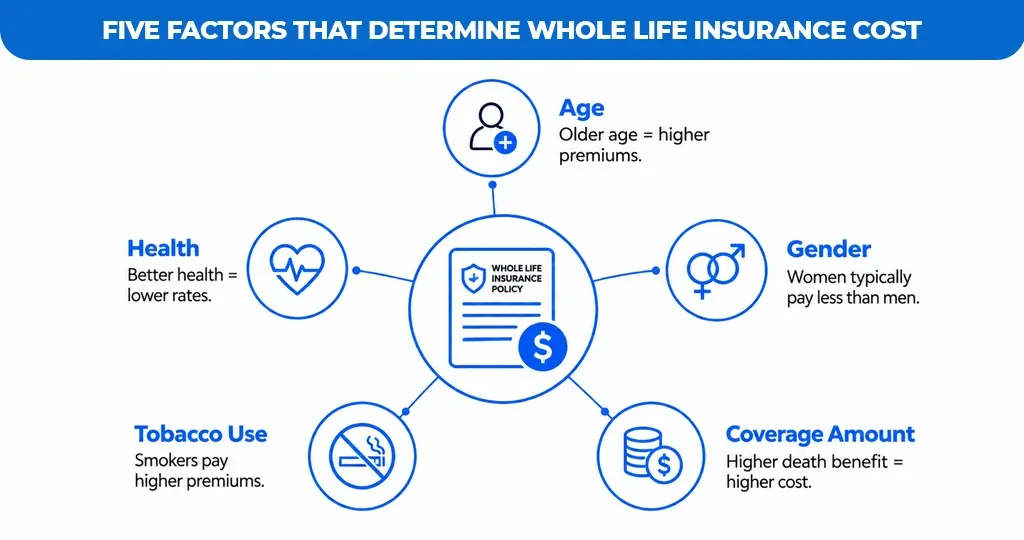
Age at Purchase
Age is the single largest factor in your premium because life expectancy declines as you get older. Based on 2026 sample rates for a $500,000 policy, average annual premiums for nonsmoking men rise from $1,539 at age 20 to $15,273 at age 70, nearly a tenfold increase. Because whole life premiums are fixed once the policy is issued, buying earlier locks in a lower rate for life.
Health and Underwriting Class
Insurers group applicants into risk classes such as Preferred Plus, Preferred, and Standard, based on medical history, current health, family history, and lab results such as blood pressure and cholesterol. Applicants in better health classes qualify for lower rates within the same age and gender group.
Gender
Women generally pay less than men of the same age and health because of differences in average life expectancy. The Centers for Disease Control and Prevention reports a U.S. life expectancy of 81.4 years for women compared with 76.5 years for men. In the 2026 sample-rate data, a 40-year-old nonsmoking woman pays about $2,849 per year for $500,000 in coverage, compared with $3,180 for a man of the same age and health, a difference of roughly 10%.
Tobacco and Nicotine Use
Smokers are underwritten separately from nonsmokers because tobacco use is linked to higher mortality risk. At age 40, the same sample-rate data shows a male smoker paying about $5,753 per year for $500,000 in coverage, compared with $3,180 for a nonsmoker, about 81% more for the same coverage.
Death Benefit Amount
Your premium rises with the size of the death benefit you choose. Larger face amounts generally cost more in total premium, though the cost per $1,000 of coverage can improve at higher amounts, since some insurers apply pricing discounts, sometimes called benefit tiers, at certain coverage thresholds. For smaller amounts meant mainly to cover funeral and burial costs, insurers also offer final expense insurance, a type of simplified whole life policy with a lower face amount and simplified underwriting.
Policy Design and Riders
How you structure the policy, level lifetime premiums versus a compressed payment schedule, and which optional riders you add, also affects your annual cost. These are covered in detail later in this guide.
Average Whole Life Insurance Rates by Age (2026)
The tables below show average annual whole life insurance rates for a $500,000 policy, for preferred applicants in good health, based on NerdWallet’s analysis of sample rates from the brokerage LifeStein.com. Monthly figures are calculated by dividing the annual rate by 12. Actual rates vary by insurer, medical history, and state.
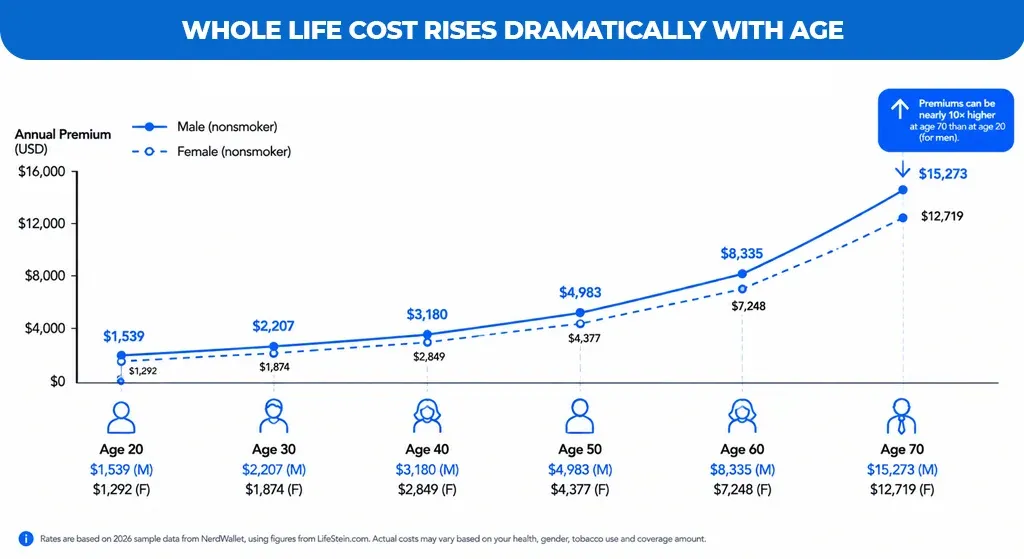
Whole Life Insurance Rates for Nonsmokers
For this specific profile, a 40-year-old nonsmoking man in good health, whole life insurance costs about $3,180 per year, compared with $321 per year for a 20-year term policy with the same $500,000 death benefit, nearly ten times more, based on the same 2026 sample-rate data. This gap exists mainly because term insurance only pays out if you die during a limited window, while whole life insurance is guaranteed to pay out eventually and builds cash value along the way.
Real-World Whole Life Insurance Quote Example
Sample rate tables show averages, but individual quotes vary by carrier. Northwestern Mutual, one of the largest mutual life insurers in the U.S., illustrates this with a real example: a healthy, nonsmoking 35-year-old man who chooses a $500,000 whole life policy, payable until age 100, can expect a quote between $542 and $708 per month, about $6,500 to $8,500 per year, depending on the insurer, based on an analysis that included Guardian, MassMutual, New York Life, and Northwestern Mutual.
A woman of the same age and health profile might see quotes closer to $700 per month for the same coverage. These figures show how much individual insurer pricing can vary even for a similar applicant, which is why comparing quotes from multiple companies matters.
Pros and Cons of Whole Life Insurance
Pros
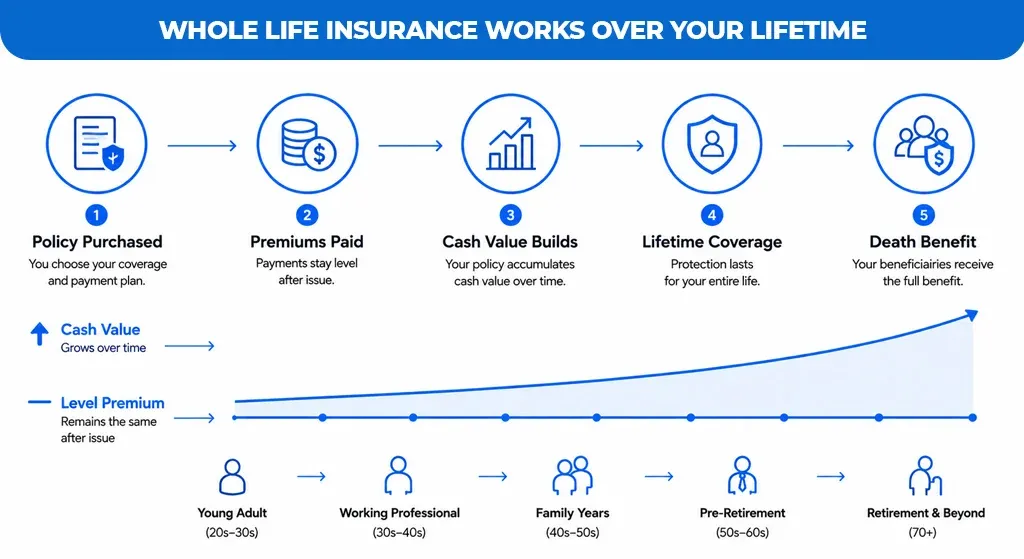
- Premiums are designed to stay level for the life of the policy, so your cost doesn’t rise as you age, unlike many term policies after renewal.
- The policy builds cash value on a tax-deferred basis that you can borrow against or, in some cases, withdraw during your lifetime.
- The death benefit is guaranteed as long as premiums are paid, giving the beneficiaries you name certainty that expiring term coverage cannot provide.
- Participating policies from mutual insurance companies may pay annual dividends, which policyholders can take as cash, use to reduce premiums, or use to buy additional coverage. Dividends are not guaranteed.
- Cash value can typically be accessed through policy loans without a credit check, though outstanding loans and interest reduce the death benefit if not repaid.
Cons
- Premiums cost substantially more than term life insurance for the same death benefit, roughly ten times more in the age-40 example above.
- Cash value typically grows slowly in the early years of the policy, and surrendering the policy early can mean receiving less than what you paid in premiums.
- Policies are more complex than term insurance, with moving parts like riders, dividend options, and loan provisions that require ongoing understanding.
- Some financial commentators, including Dave Ramsey, argue that buying term life insurance and investing the difference in premium cost can produce a larger sum than a whole life policy’s cash value over time.
- Outstanding policy loans that are not repaid reduce the death benefit, and if the policy lapses, the forgiven loan balance may become taxable income.
Optional Riders and How They Affect Cost
Riders let you customize a whole life policy, but each one typically adds to your premium. Common riders include:
- Waiver of Premium Rider: waives your premiums if you become totally disabled, so the policy stays in force.
- Guaranteed Insurability Rider: lets you purchase additional coverage at set points in the future without new medical underwriting.
- Accelerated Death Benefit (Living Benefit) Rider: allows you to access a portion of the death benefit early if you’re diagnosed as terminally or chronically ill, per the policy’s terms.
- Accidental Death Benefit Rider: pays an additional death benefit if death results from an accident; several insurers, including New York Life, note that this rider terminates automatically at a set age, such as 70.
- Option to Purchase Paid-Up Additions: lets you make extra premium payments that immediately increase both cash value and death benefit, generally subject to an upfront expense charge.
Before adding a rider, weigh its cost against how likely you are to use it. Riders like the waiver of premium or guaranteed insurability rider tend to be widely recommended for the protection they add, while accidental death benefit riders are worth evaluating carefully since they only pay out under narrow circumstances.
Is Whole Life Insurance Worth the Cost?
Whether whole life insurance is worth its higher cost depends on your goals. It tends to make the most sense for people who want lifelong coverage regardless of when they die, a source of tax-advantaged cash value they can access later in life, or a tool for estate planning and wealth transfer. It’s generally a less cost-efficient choice for people whose main need is temporary income replacement or covering a specific debt like a mortgage, since term life insurance can meet those needs at a much lower cost.
Life insurance in general remains underused relative to how many people say they need it. According to the 2026 Insurance Barometer Study from LIMRA and Life Happens, 51% of American adults report owning some form of life insurance, individual or group, while about 40% say they need life insurance or need more of it, representing close to 100 million adults.
The same study found that roughly three-quarters of adults overestimate the actual cost of life insurance, and that younger, healthy adults tend to overestimate term life premiums specifically by seven to twelve times the real cost. Whole life insurance is priced very differently from term life insurance, so it’s worth getting an actual quote rather than assuming a policy is unaffordable.
How to Lower Your Whole Life Insurance Premium
- Apply while you’re young and healthy. Since premiums are based on your age and health at issue and are designed to stay level afterward, buying earlier locks in a lower lifetime cost.
- Improve your risk class before applying. Insurers reward a healthy BMI, well-managed chronic conditions, and at least 12 months of tobacco cessation with better underwriting classes and lower rates.
- Choose the right coverage amount. Since the face amount has a direct relationship with premium, calculating the coverage you actually need, rather than defaulting to the highest amount available, keeps the policy affordable.
- Consider a limited-pay design carefully. Limited pay (10-pay or 20-pay) increases your annual premium during the payment period but eliminates payments afterward, so weigh it against your income timeline.
- Add riders selectively. Only add riders that address a real risk in your situation, since each one increases the premium.
- Compare quotes from multiple insurers. Because whole life pricing can vary significantly between carriers for the same applicant profile, as shown in the Northwestern Mutual example above, getting several quotes is one of the most effective ways to control cost.
Conclusion
Whole life insurance cost varies widely based on your age, health, gender, tobacco use, and the death benefit you choose, but 2026 sample-rate data puts the average annual cost for a healthy 40-year-old nonsmoker at $2,849 to $3,180 for $500,000 in coverage, or roughly $237 to $265 per month. That’s a meaningfully higher price than term life insurance for the same coverage, largely because whole life insurance is permanent, guarantees a payout, and builds cash value you can access during your lifetime.
Whether that trade-off is worth it depends on what you’re trying to accomplish. If your main goal is covering a mortgage or replacing income for a set number of years, term life insurance will typically meet that need at a much lower cost. If you’re looking for lifelong coverage, a source of guaranteed cash value, or a tool for estate planning, whole life insurance’s higher premium may be justified by the benefits it provides. Comparing quotes from several insurers, since pricing for similar applicants can vary meaningfully by carrier, is one of the most effective ways to find the right policy at the right cost.