



A burial plot is the specific parcel of cemetery land you buy to bury a casket or urn, and it is sold and billed by the cemetery itself, not by a funeral home. Because cemetery charges are separate from funeral home fees, families often underestimate the total cost of a traditional burial until the two bills are combined.
National plot prices vary widely. Public and rural cemeteries commonly price single plots in the few-hundred-to-low-thousand-dollar range, while private cemeteries in dense urban markets can charge well into five figures. This guide explains what a burial plot includes, what drives the price up or down, the steps to buy one, and the federal rule that protects you when you shop around.
| Quick Answer A burial plot is a purchased section of cemetery land, documented through an interment rights deed, where a casket or urn is buried. Reported national price ranges generally run from about $500 to $15,000 or more per single plot, with commonly cited U.S. averages landing near $2,600–$2,750. Location, whether the cemetery is public or private, and local land availability are the biggest drivers of price. |
Key Takeaways
- A burial plot is cemetery real estate you purchase separately from any funeral home services.
- Reported national plot costs generally range from about $500 to $15,000+, with public cemeteries typically cheaper than private ones.
- The FTC Funeral Rule guarantees itemized pricing rights, but it does not apply to cemeteries that have no on-site funeral home.
- A “plot” and a “grave” are related but not identical: a single plot can sometimes hold more than one grave.
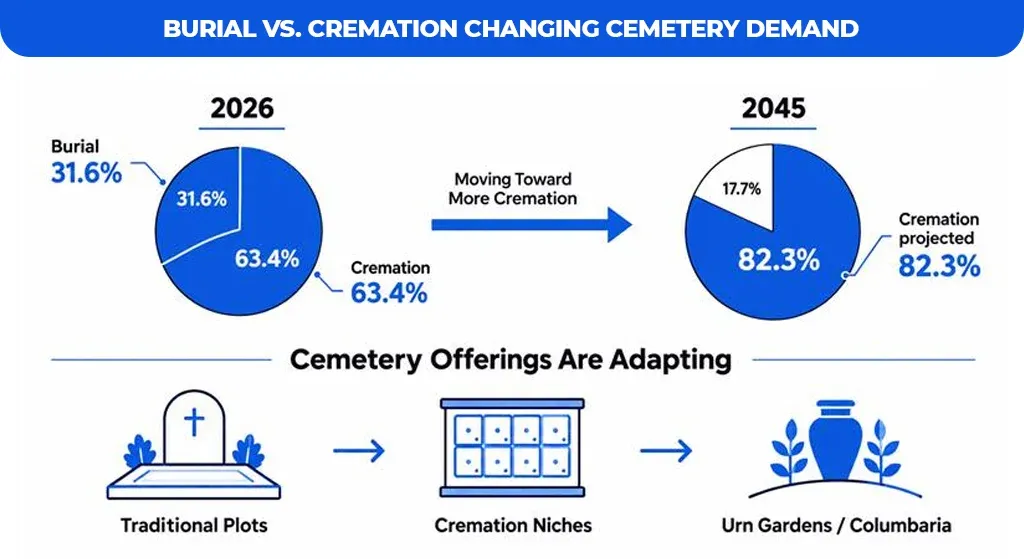
- NFDA projects that 31.6% of U.S. families will choose burial in 2026, compared with 63.4% choosing cremation, a trend that is reshaping demand for traditional plots.
What Is a Burial Plot?
A burial plot is a defined section of land inside a cemetery that a person or family buys the right to use for interment. Buying a plot does not transfer ownership of the land itself in most states; instead, the buyer receives
what’s typically called interment rights or a right of burial, documented in a deed or certificate issued by the cemetery or cemetery association. This distinction matters because it explains why plots usually cannot be resold freely the way a house can; transfer rules are set by the cemetery and, in many states, by cemetery law.
Related terms you’ll see used almost interchangeably include grave plot, cemetery plot, graveyard plot, and funeral plot. They all refer to the same underlying product: purchased cemetery ground for burial.
Burial Plot vs. Grave: What’s the Difference?
A plot is the parcel of land you purchase; a grave is the individual excavated space within that plot where one casket or urn is actually interred. A single plot can be sized and sold to hold only one grave, or it can be a larger family plot designed to hold multiple graves, including double-depth graves stacked in the same space. In everyday conversation, people often use “plot” and “grave” interchangeably, but cemetery contracts distinguish between the two because pricing, deeds, and capacity are based on the plot, while placement and depth are managed at the grave level.
Types of Cemetery Burial Plots
Cemeteries generally offer several categories of plots, and the option a family chooses affects both the price and the long-term arrangement:
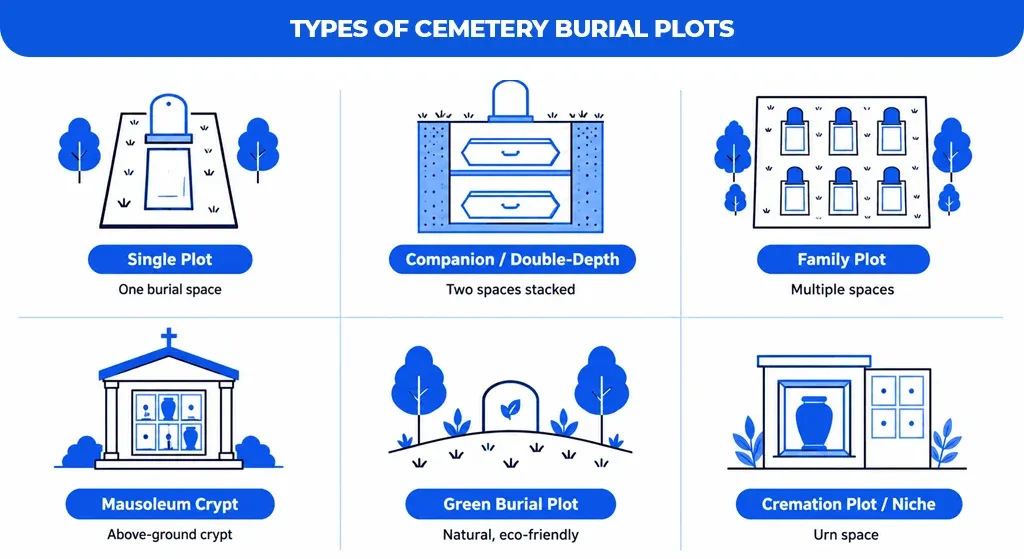
- Single or individual plot: sized for one casket burial.
- Companion or double-depth plot: one plot sized to hold two caskets, typically stacked, often chosen by couples.
- Family plot: a larger section reserved for several family members over time.
- Mausoleum crypt: an above-ground interment space inside a mausoleum structure rather than an in-ground plot.
- Green or natural burial plot: land set aside for burial without a vault, concrete liner, or embalming chemicals, following the cemetery’s natural burial rules.
- Cremation plot, niche, or urn garden: a smaller plot or wall niche sized for one or more cremation urns rather than a full casket.
How Much Does a Burial Plot Cost?
Cemetery plot pricing is not standardized nationally, and no single government agency publishes an official average. The figures below combine estimates reported by funeral-cost research firms, most of which build on National Funeral Directors Association (NFDA) data and Bureau of Labor Statistics (BLS) price trends; treat them as general ranges rather than a quote for any specific cemetery.
| Cemetery Setting | Typical Single-Plot Price Range | Source |
| Public or municipal cemetery | $500 – $2,750 | Choice Mutual; Finder |
| Private cemetery | $2,000 – $8,000+ | Choice Mutual |
| Rural cemetery | As low as $500 – $1,000 (e.g., roughly $775 reported in Alaska) | Choice Mutual |
| Dense urban cemetery (e.g., NYC, LA, SF) | $10,000 – $30,000+ | End-of-Life Tools; Choice Mutual |
The plot itself is usually only one line item. Depending on the cemetery’s rules, families may also need to budget for:
| Additional Cemetery Item | Typical Cost Range | Source |
| Grave liner or burial vault | $900 – $7,000 | Choice Mutual |
| Opening and closing (interment) fee | $300 – $1,500 | Choice Mutual |
| Headstone or grave marker | $1,000 – $3,000 (basic flat markers can run less) | Choice Mutual |
| Basic mausoleum crypt | roughly $4,000 – $10,000 for entry-level options | Choice Mutual |
These cemetery charges come on top of funeral home costs, which NFDA’s 2026 General Price List Study put at a $8,300 median for a funeral with viewing and burial, rising to $9,995 when a burial vault is included. Because the NFDA median covers funeral home services only, adding a plot and related cemetery fees is what pushes many families’ total burial cost several thousand dollars higher than the funeral home estimate alone.
What Affects Burial Plot Prices
- Location: urban cemeteries in land-constrained cities generally price plots far higher than rural cemeteries, reflecting limited available space.
- Public vs. private ownership: municipally run cemeteries are commonly less expensive than privately owned cemeteries offering more amenities or perpetual landscaping.
- Plot location within the cemetery: sections near a path, shade tree, or water feature are sometimes priced at a premium versus standard sections.
- Perpetual or endowment care contributions: many states require a portion of the plot price to fund a perpetual care fund covering long-term grounds maintenance.
- Cemetery capacity: cemeteries approaching full capacity in major metro areas have limited remaining inventory, which can push remaining plot prices higher.
How to Buy a Burial Plot: Step-by-Step
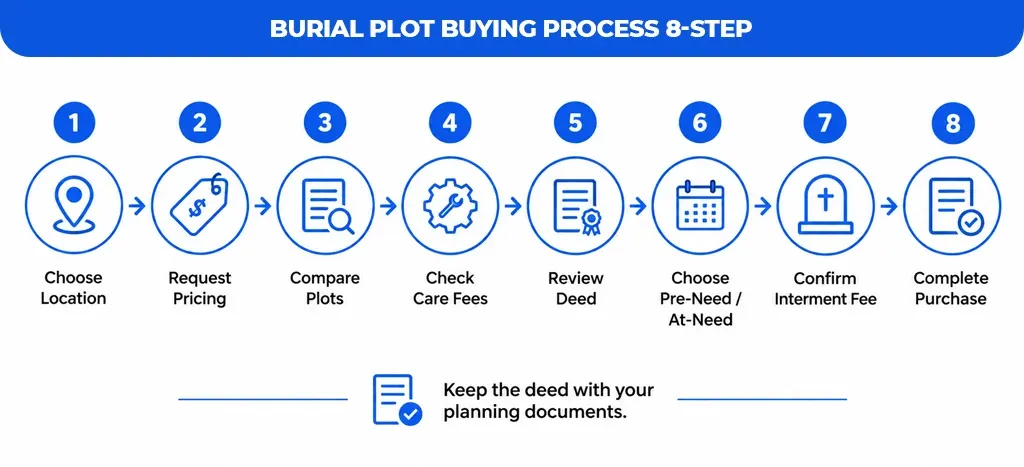
- Decide on a general location and cemetery type (public, private, religious, veterans’, or green burial ground) based on family preference and budget.
- Contact cemeteries directly to request current plot pricing; cemeteries without an on-site funeral home are not required to follow the FTC Funeral Rule, so ask in writing.
- Compare plot size, section, and any single, companion, or family plot options against your budget and family needs.
- Ask whether the price includes the perpetual care contribution, or whether that is billed separately.
- Review the interment rights deed or certificate before paying, including any rules on transferability, resale, and required vaults or liners.
- Decide between a pre-need purchase (buying in advance) or an at-need purchase (buying at the time of death); pre-need payments are generally required to be held in trust at a minimum of 70% to 100% of the retail price under state pre-need regulations.
- Confirm the opening and closing (interment) fee separately, since this is billed at the time of burial rather than at plot purchase.
- Complete the purchase, record the deed, and keep a copy with your estate or funeral planning documents.
Your Consumer Rights When Buying a Burial Plot
The FTC’s Funeral Rule, first issued in 1984 and last formally amended in 1994, gives consumers specific rights when working with funeral providers. Under the rule, you have the right to:
- Buy only the goods and services you want, rather than a bundled package.
- Get price information over the telephone without providing personal information.
- Receive a written, itemized price list (the General Price List) when you visit in person.
- See a written casket price list and outer burial container price list before viewing the items.
- Receive a written statement of everything you’ve selected, and its cost, before you pay.
One important limit applies directly to burial plots: the FTC Funeral Rule does not cover cemeteries that do not have an on-site funeral home, and it does not apply to third-party sellers such as monument companies. That means many stand-alone cemeteries are not legally required to hand you an itemized price list the way a funeral home is, so it is worth requesting pricing in writing before you commit.
How Long Does a Body Stay in a Burial Plot?
In most U.S. cemeteries, the interment rights sold with a burial plot are intended to be permanent, and a body remains in the plot indefinitely unless the family or a legal representative arranges for formal disinterment through the cemetery and, in most states, a permit from the local health or vital records authority. Rules on disinterment, grave reuse, and lease-based burial rights vary by state and by cemetery contract, so families should confirm the specific terms in their deed rather than assume a single national standard applies.
Burial vs. Cremation: How Shifting Trends Affect Plot Demand
Demand for traditional burial plots is shifting alongside a longer-term move toward cremation. NFDA’s 2025 Cremation & Burial Report projects a 31.6% burial rate and a 63.4% cremation rate for 2026, with cremation projected to reach 82.3% by 2045. This shift has expanded the range of plot-adjacent products cemeteries now offer, including cremation niches, urn gardens, and columbaria, alongside traditional single, companion, and family plots. Related planning tools families often research alongside plot purchases include pre-need funeral contracts and final expense insurance, a type of permanent life insurance policy commonly marketed to help cover funeral, burial, and cemetery costs.
Conclusion: Mastering Your Burial Plot Investment
Navigating cemetery logistics and securing a burial plot requires strategic foresight to protect your family from unexpected financial strain. Because land acquisition, perpetual care funds, and opening fees are billed separately from standard funeral home services, total expenses can escalate rapidly. By comparing public versus private options, demanding written itemizations, and understanding your consumer protections, you can lock in a dignified resting place without overpaying.
Ultimately, proactive end-of-life planning transforms an overwhelming emotional burden into an organized, empowered decision. Whether you choose a traditional ground plot, a companion space, or a modern cremation garden, taking action today guarantees peace of mind and financial clarity for the future. Secure your family’s legacy by requesting written price lists and comparing cemetery options today.