Funeral pre-planning is the process of deciding, and often paying for, your funeral or cremation arrangements before you need them. Instead of leaving service details, casket choices, and payment decisions to grieving family members, you record what you want in writing and, if you choose, fund a prepaid funeral plan through a licensed funeral home, a pre-plan funeral trust, or final expense insurance. This guide explains what funeral pre-planning actually involves, how much a prepaid funeral plan typically costs, the legal protections that apply under the FTC Funeral Rule, and a practical funeral pre-planning checklist you can use to get started. Whether you are comparing pre-arranged funeral plans for yourself or helping an aging parent set one up, the sections below cover the costs, contracts, and common mistakes worth understanding before you sign anything.
Quick Answer
Funeral pre-planning means documenting your funeral wishes, such as burial or cremation, service style, and preferred provider, before death occurs. It becomes a prepaid funeral plan when you fund those wishes in advance through a funeral home contract, a trust, or an insurance policy. The National Funeral Directors Association (NFDA) reports that a traditional funeral with viewing and burial had a median cost of about $8,300 in 2023, while a cremation with viewing averaged $6,280. Under the FTC Funeral Rule, any funeral home you contact, whether you are pre-planning or arranging a funeral immediately, must give you an itemized General Price List before you choose any goods or services.
Key Takeaways
Funeral pre-planning documents your wishes; pre-paying locks in pricing by placing funds into a trust or insurance product. The two steps are related but not identical.
NFDA data shows a median cost of roughly $8,300 for a burial with viewing and $6,280 for a cremation with viewing, based on the association’s most recent General Price List study.
The FTC Funeral Rule requires every funeral home to provide a written, itemized price list and to let you buy only the goods and services you actually want.
State law typically requires funeral homes to place 70% to 100% of prepaid funds into a trust or an insurance-funded account, according to Funeralwise’s summary of state pre-need regulations, though exact rules vary by state.
A written pre-planning checklist, shared with your executor or next of kin, matters just as much as how you choose to pay for the plan.
What Is Funeral Pre-Planning?
Funeral pre-planning is the practice of recording decisions about your own end-of-life service before that service is needed. A pre-planning conversation typically covers whether you want burial or cremation, the type of service you prefer, who should be involved, and which funeral home or cremation provider should carry out your wishes. The New Jersey State Funeral Directors Association (NJSFDA) notes that to formally prearrange a funeral, you generally meet with a licensed funeral director during a preplanning conference, where the director reviews a General Price List with you and records your choices on an itemized statement of goods and services selected.
This distinction matters because funeral pre-planning, on its own, does not require spending any money. You can write down your wishes in a notebook, in an online worksheet, or in a formal document held by a funeral home, without prepaying a cent. Prepayment is a separate, optional decision layered on top of the planning itself.
Pre-Planning vs. Prepaying vs. Pre-Need Funeral Plans
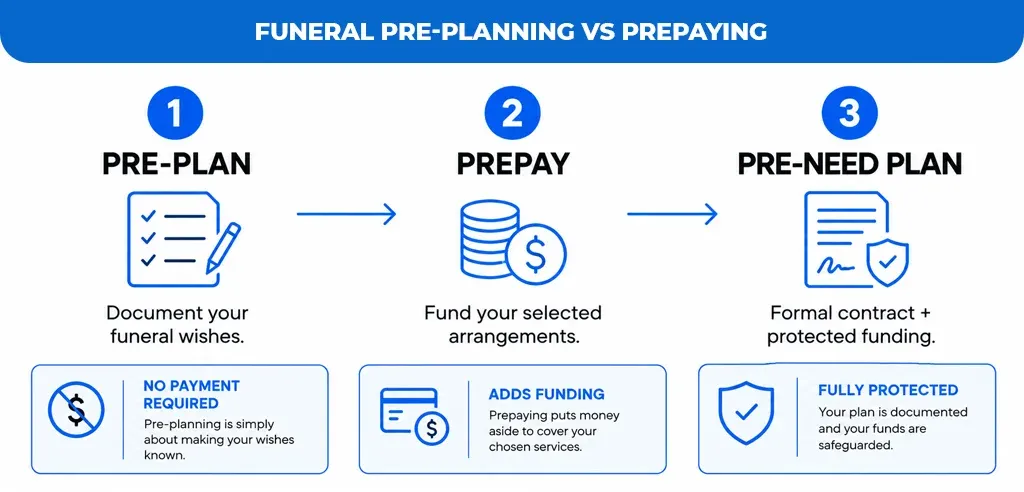
Pre-planning means writing down what you want: burial or cremation, service type, music, officiant, and similar details. No payment is required.
Prepaying means funding those wishes now, usually through a contract with a funeral home. The industry generally calls this a pre-need funeral plan or a prepaid funeral plan.
Pre-need funeral planning is the formal, licensed process: a funeral director, sometimes called a pre-need funeral plan representative, walks you through pricing, drafts a contract, and arranges for your payment to be trusted or insured under state law.
You can plan without prepaying, and many people do. However, combining both steps gives your family a documented plan and a funded plan, which removes both the guesswork and the financial burden at the same time.
Why Pre-Plan a Funeral? Key Benefits
Funeral pre-planning offers three practical advantages that come up consistently across consumer guidance from funeral associations and financial resources.
Emotional relief for your family. When your wishes are already recorded, your family does not need to guess whether you wanted a burial, a cremation, a religious service, or a simple gathering. They can follow your instructions instead of debating them while grieving.
Financial control and price protection. Pre-planning lets you set a budget and compare providers before you are under time pressure. If you also prepay through a guaranteed-price contract, you may lock in today’s price for the specific services and merchandise listed in that contract.
Personalization of your own service. Pre-planning gives you the chance to specify music, readings, an officiant, a location, and other details that reflect your life and values, rather than leaving those choices to relatives who may not know your preferences.
How Much Does Pre-Planning a Funeral Cost?
Funeral pre-planning itself is free if you only document your wishes. Costs apply once you decide to prepay for services, purchase final expense insurance, or fund a trust. The amount you prepay is generally tied to the type of disposition and service you select. The table below summarizes national median and average figures reported by the National Funeral Directors Association.
Service Type
Typical Cost
Notes
Basic (direct) cremation, no viewing
$2,202 average
Excludes memorial service and viewing
Cremation with viewing and service
$6,280 median
Includes basic services, facility use, and container
Direct burial, no viewing or embalming
$5,138 average
No ceremony or embalming included
Green burial
$2,250 average
Excludes embalming and metal casket
Traditional funeral with viewing and burial
$8,300 median
Includes basic services fee, embalming, casket
Traditional funeral with viewing, burial, and vault
$9,995 median
Adds a burial vault to the line above
Data Point
NFDA’s 2026 Cremation & Burial Report projects the U.S. cremation rate at 63.4% for 2025, compared with a 31.6% burial rate, and expects cremation to reach 82.3% by 2045. The lower average cost of cremation relative to traditional burial is one factor the NFDA and other industry researchers point to when explaining this shift.
These figures typically cover the funeral home’s basic services fee, transportation of remains, use of facilities, and a container, casket, or urn. They do not usually include cemetery plot fees, grave opening and closing charges, headstones, obituary publication, catering, or flowers. When you compare prepaid funeral plans, ask each provider for a written breakdown, so you know exactly which of these categories are included and which will still fall to your family.
️ PRE-PLANNING PROTECTION
Don’t leave your family to guess your end-of-life wishes or carry unexpected financial burdens. Secure an affordable policy featuring fixed rates and a simple application process—no medical exam required.
Prepaid Funeral Plans vs. Funeral Trusts vs. Final Expense Insurance
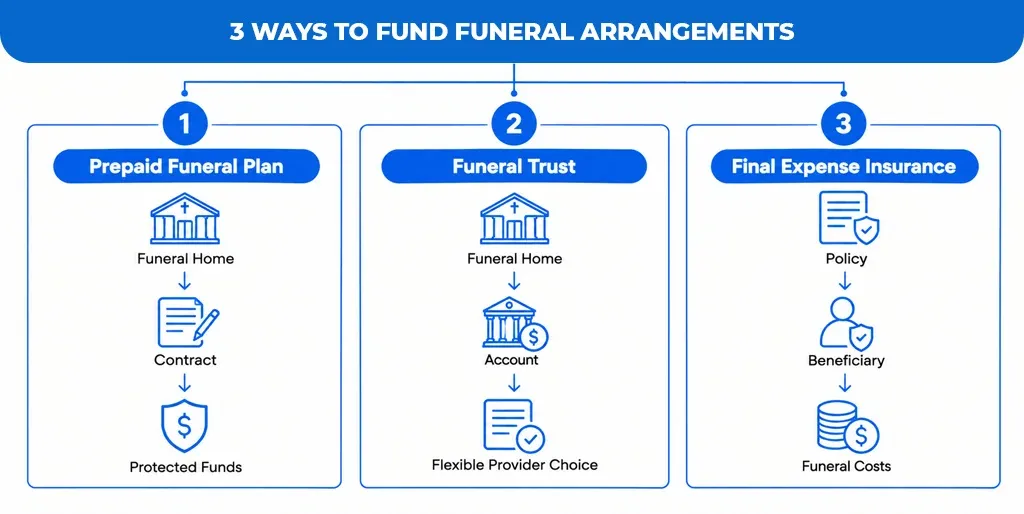
Once you decide to prepay, you generally have three structures to choose from. Each places your money in a different legal vehicle, and each has different implications for refunds, transfers, and flexibility.
Funding Method
How It Works
Key Consideration
Prepaid funeral plan (direct contract)
You sign a contract with a specific funeral home for defined goods and services; funds go into a state-mandated trust or insurance product.
Tied to one provider unless the contract is transferable; state law usually requires 70% to 100% of funds to be trusted.
Pre-plan funeral trust (independent)
Funds are placed in a trust account, sometimes revocable or irrevocable, that is not tied to one funeral home.
Offers more flexibility to change providers; growth and access depend on trust terms and state rules.
Final expense or burial insurance
A small whole life insurance policy names a beneficiary, who receives a death benefit to pay for funeral costs at their discretion.
The beneficiary, not the insurer, decides which provider to use; underwriting and premiums vary by insurer.
Source: Funeralwise consumer guidance on state pre-need trust requirements and the FTC’s public guidance on funeral pre-need funding options.
State Medicaid and Supplemental Security Income (SSI) rules sometimes treat an irrevocable prepaid funeral trust differently from a countable bank account, which is why some families consider this option as part of broader planning. Because these rules vary significantly by state, confirm current treatment with your state Medicaid office or an elder law attorney before relying on a funeral trust for eligibility purposes.
Funeral Pre-Planning Checklist
Use this funeral pre-planning checklist and worksheet as a starting point. Fill in what applies, leave the rest blank for now, and revisit it once a year.
Service and Disposition Preferences
Burial, cremation, green burial, or donation to science
Traditional funeral, memorial service, or simple direct disposition with no ceremony
Preferred funeral home, cemetery, or cremation provider, if you have one in mind
Personal Touches
Music, readings, or scripture you would like included
Officiant or speakers you would like to lead the service
Charitable donations in lieu of flowers, if desired
Financial and Payment Details
Budget range you are comfortable committing to
Whether you plan to prepay, purchase insurance, or leave it to your family to pay at the time of need
Provider name, contract number, and trust or insurance policy details, if you prepay
Documentation and Communication
A written or printed copy of this checklist stored with your will and important papers
A digital copy shared with your executor or next of kin
Contact information for your funeral provider, attorney, and financial advisor
Legal Protections: The FTC Funeral Rule and State Trust Laws
Funeral pre-planning is regulated at both the federal and state level, which is one reason it is worth understanding your rights before signing a contract.
The FTC Funeral Rule
The Federal Trade Commission’s Funeral Rule took effect in 1984 and applies to both pre-need and at-need funeral arrangements, according to Cornell Law School’s Legal Information Institute. Under the rule, a funeral provider must give you a written, itemized General Price List before showing you caskets or discussing services in detail, and that price list must be available on request over the phone as well as in person.
You may buy only the goods and services you want. Providers cannot require you to purchase a bundled package if you only want specific items.
You have the right to bring your own casket or urn purchased from a third party, and the funeral home cannot charge a handling fee for doing so.
You must receive a written statement of the total cost before you are asked to pay, listing every good and service you selected.
State Pre-Need Trust Requirements
Because the FTC Funeral Rule does not create a specific remedy for consumers if a provider mismanages prepaid funds, individual states regulate how that money must be held. According to Funeralwise’s consumer guidance, most states require funeral homes to place a minimum of 70% to 100% of the retail price of a pre-need contract into a trust account or an insurance-funded product, though the exact percentage and oversight agency vary by state.
How to Start Pre-Planning Funeral Arrangements: 5 Steps
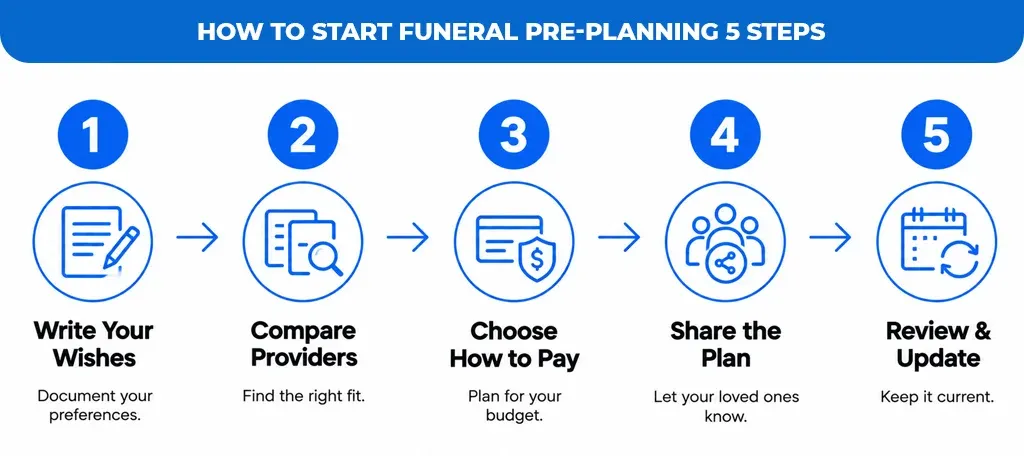
Write down your wishes in detail. Start with burial or cremation, then add service style, music, readings, and who should be involved. A one-page outline is a reasonable starting point.
Compare at least two providers. Request a General Price List from each, in person, by phone, or through their website, and compare what is included and excluded before you decide.
Decide whether to prepay or document only. You are not required to pay in advance. If you prepay, choose between a direct funeral home contract, an independent funeral trust, or final expense insurance based on the flexibility you want.
Share the plan with your family. Give your next of kin or executor the provider’s name, contract details, and the location of your written plan, both on paper and digitally.
Review the plan every three to five years. Update it after major life changes, such as a move, a marriage, or the loss of a spouse, and confirm the funding still matches current costs.
Conclusion and Next Steps
Funeral pre-planning gives you and your family a documented, and optionally funded, plan for one of life’s most difficult moments. Start by writing down your wishes, compare at least two providers using their General Price Lists, and decide deliberately whether a prepaid funeral plan, an independent funeral trust, or final expense insurance fits your circumstances. Whichever funding method you choose, or even if you choose none for now, store your plan where your family can find it and revisit it every few years so it continues to reflect your wishes.
If you are ready to take the next step, contact a licensed funeral home in your area for a written General Price List, or speak with a financial advisor about how a pre-plan funeral trust or final expense insurance policy fits into your broader estate plan. A short conversation today can spare your family a difficult set of decisions later.
Ready to secure your peace of mind and protect your family from future financial burdens? Take the next step today by exploring your options and getting a customized estimate tailored to your exact wishes.Click here to get a quote and start shaping your pre-planning strategy with confidence.
COMPLETE PEACE OF MIND
Take control of your pre-planning today with transparent pricing and tailored budgets. Let Assurance Gurus make securing your family’s future protection fast, transparent, and completely stress-free.
Pre-planning a funeral is generally considered a practical step because it documents your wishes and can reduce the number of decisions your family has to make during a period of grief. It does not obligate you to spend money; you can record your preferences without prepaying, and add a funding plan later if you choose.
Pre-planning itself, meaning writing down your wishes, does not have to cost anything. Costs apply only if you choose to prepay for services or purchase insurance to cover them. If you do prepay, expect the amount to track current NFDA median costs, roughly $6,280 for a cremation with viewing and $8,300 for a traditional burial with viewing, plus any items you add beyond the basic package.
A complete pre-planning list should include your disposition preference (burial or cremation), service style, personal details like music and readings, your budget, your chosen provider and contract information if you prepay, and instructions for where your family can find these documents. The checklist section above walks through each category in order.
Whether prepaying is worth it depends on your financial situation and priorities. Prepaying can lock in pricing on specific contract items and relieve your family of an immediate expense, but funds are usually tied to a trust, insurance policy, or a specific provider, and contracts vary in how transferable or refundable they are. Reviewing the trust or insurance terms in writing and confirming your state's consumer protections will help you decide if it fits your circumstances.




 This distinction matters because funeral pre-planning, on its own, does not require spending any money. You can write down your wishes in a notebook, in an online worksheet, or in a formal document held by a funeral home, without prepaying a cent. Prepayment is a separate, optional decision layered on top of the planning itself.
 Once you decide to prepay, you generally have three structures to choose from. Each places your money in a different legal vehicle, and each has different implications for refunds, transfers, and flexibility.