



| Quick Answer Funeral expenses are not tax-deductible on an individual’s personal income tax return (Form 1040), even if you paid out of pocket for a spouse, parent, or child. The IRS classifies burial and funeral costs as nondeductible personal expenses under IRS Publication 529.The only exception applies to estates. If the deceased person’s estate is large enough to owe federal estate tax and must file IRS Form 706, the executor can deduct qualifying funeral expenses on Schedule J, which reduces the taxable value of the estate. |
Are funeral expenses tax deductible? For most families, the answer is no. The Internal Revenue Service does not allow individuals to deduct funeral or burial costs on their personal tax return, regardless of how the expenses were paid or who is filing. This holds true even when you are settling a deceased spouse’s or parent’s final Form 1040.
There is one narrow exception. If the deceased person’s estate is valued high enough to owe federal estate tax, the executor can deduct qualifying funeral costs on IRS Form 706, the United States Estate (and Generation-Skipping Transfer) Tax Return. This deduction reduces the estate’s taxable value and, in turn, its estate tax liability.
This guide breaks down exactly when funeral expenses are deductible, which specific costs qualify under Schedule J, what the IRS excludes, how prepaid funeral plans are treated, and what financial assistance is available for families who cannot claim a deduction at all.
| Key Takeaways Individuals can never deduct funeral expenses on Form 1040, including the decedent’s final individual return.Funeral costs are deductible only on Form 706, and only if the estate is required (or elects) to file that return.For 2026, the federal estate tax exemption is $15 million per individual and $30 million for married couples, up from $13.99 million in 2025, according to IRS inflation adjustments.Deductible items include funeral home fees, casket or urn, burial plot, headstone, and transportation of remains, but only the portion not reimbursed by insurance or benefits.Families who don’t qualify for a tax deduction may still access help through Social Security’s lump-sum death payment, VA burial allowances, or final expense insurance. |
Are Funeral Expenses Tax Deductible for Individuals?
No. Individual taxpayers cannot deduct funeral or burial expenses on a personal income tax return under any circumstances. IRS Publication 529, Miscellaneous Deductions, specifically lists burial or funeral expenses, including the cost of a cemetery lot, as nondeductible personal expenses.
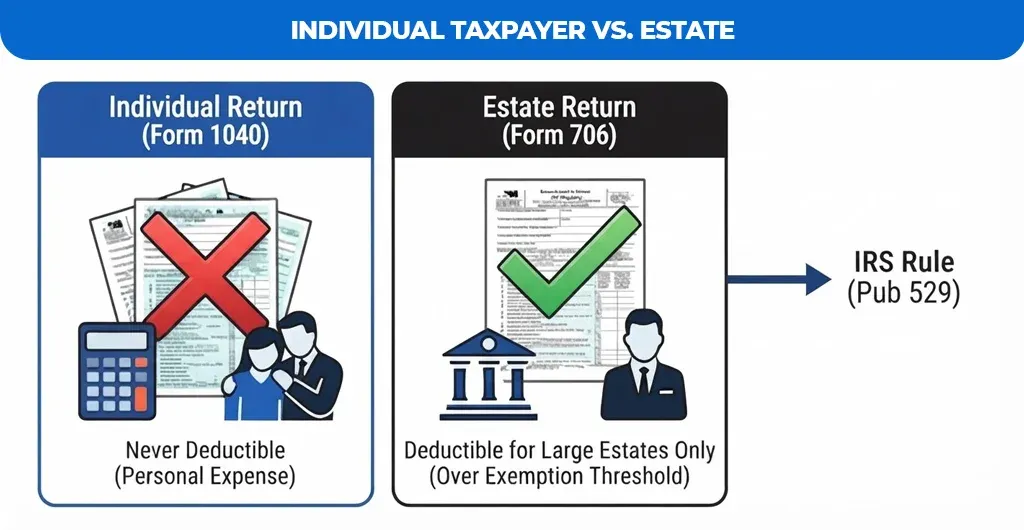
This rule applies whether you paid for the funeral personally, used funds from the deceased’s bank account, or are filing the decedent’s final Form 1040. Funeral costs also do not qualify as a medical expense deduction, because the IRS defines qualified medical expenses as costs to prevent or treat a medical condition, which a funeral does not meet.
Common misconception: Many people assume that because a funeral is a direct result of a death, it should function like a medical or final expense. The IRS draws a firm line here: funeral costs are treated as personal expenses, not deductible administrative or medical costs, for anyone filing an individual return.
When Are Funeral Expenses Tax Deductible? The Estate Tax Exception
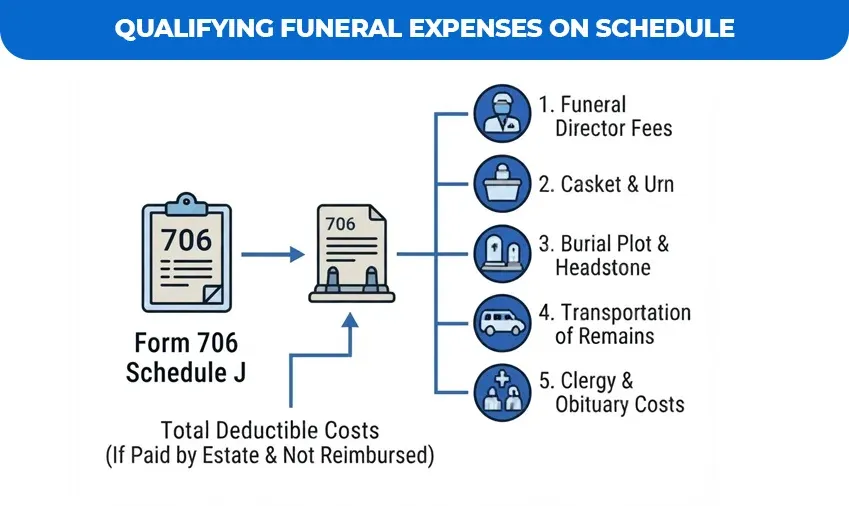
Funeral expenses become tax-deductible only when they are paid directly from estate funds, and the estate is subject to federal estate tax. In that case, the executor reports the expenses on Schedule J of Form 706, titled “Funeral Expenses and Expenses Incurred in Administering Property Subject to Claims.”
This deduction lowers the estate’s gross taxable value, which can reduce or eliminate the estate tax owed. It has no effect on the decedent’s personal income tax return or on the heirs’ individual returns.
Form 706 and Schedule J
Form 706 is filed by the executor of an estate to calculate whether federal estate tax is owed and, if so, how much. Executors must itemize funeral expenses individually on Schedule J and enter the total. Any amount the estate was reimbursed for from life insurance, Social Security, or VA benefits must be subtracted from the total before it is claimed.
Form 706 is generally due nine months after the date of death, with a six-month extension available if the executor files Form 4768 before the deadline.
2026 Federal Estate Tax Exemption Threshold
Only estates that exceed the federal exemption threshold are required to file Form 706 and, therefore, are eligible to claim the funeral expense deduction. The exemption increased for 2026 under IRS inflation adjustments.
| Year | Exemption Per Individual | Exemption Per Married Couple |
| 2025 | $13.99 million | $27.98 million |
| 2026 | $15 million | $30 million |
Source: IRS 2026 inflation-adjusted estate and gift tax exemption figures, as reported by IRS-tracking legal publications following the agency’s official October 2025 announcement.
Because the threshold is so high, the majority of estates fall well below it and are never required to file Form 706. Without a filing requirement, there is no mechanism to claim the funeral expense deduction, regardless of how much the family spent on the funeral.
Voluntary filing exception: Even when an estate is below the threshold, an executor can choose to file Form 706 anyway, most commonly to elect “portability,” which lets a surviving spouse use any unused portion of the deceased spouse’s exemption. When Form 706 is filed voluntarily, funeral expenses can still be reported on Schedule J.
What Funeral Expenses Can Be Deducted on Form 706?
Schedule J allows the estate to deduct funeral and burial costs that the IRS considers reasonable and necessary. Commonly accepted deductible items include:
- Funeral home service fees and staff charges
- Casket, urn, or cremation container
- Burial plot, mausoleum space, or cemetery lot
- Headstone, monument, or grave marker
- Transportation of the body to the place of burial
- Clergy or officiant honorarium for the funeral service
- Flowers, obituary notices, and other reasonable service-related costs
The IRS and tax courts require these costs to be “reasonable and necessary.” Extravagant or excessive charges that appear disproportionate to the estate’s size can be challenged and disallowed, leaving the estate liable for the unreimbursed portion.
What Funeral Expenses Are Not Deductible?
Certain costs are excluded from the Schedule J deduction, most often because another source already covered them:
- Any portion of the funeral paid by a life insurance payout
- Costs reimbursed through VA burial benefits
- Amounts covered by Social Security’s lump-sum death payment
- Personal expenses such as mourning clothing or travel by family members to attend the funeral
- Any funeral cost claimed on a personal income tax return (Form 1040) under any category
If a life insurance policy or government benefit pays for part of the funeral, the executor must subtract that reimbursed amount from the total before claiming the remainder on Schedule J. Claiming a reimbursed expense as a deduction is a documentation error that can trigger IRS scrutiny.
Deductible vs. Non-Deductible Funeral Expenses at a Glance
| Expense Category | Deductible on Form 706 Schedule J? |
| Funeral home and service fees | Yes, if paid by the estate |
| Casket, urn, or burial plot | Yes, if paid by the estate |
| Headstone or monument | Yes, if paid by the estate |
| Amount reimbursed by life insurance | No |
| Amount reimbursed by VA or Social Security | No |
| Funeral cost on individual Form 1040 | No, never deductible |
| Family travel to attend the funeral | No |
Are Prepaid Funeral Expenses Tax Deductible?
Prepaid funeral expenses follow the same rule as any other funeral cost: they are not deductible for an individual and only become relevant to Schedule J if the estate later pays for or is billed for the arrangement and the estate itself owes federal estate tax.
Prepaying a funeral is a financial planning tool, not a tax strategy. It can lock in today’s pricing and reduce stress for survivors, but it does not create a personal tax deduction at the time of purchase or at the time of death.
State Estate Taxes: A Separate Threshold to Watch
The $15 million federal threshold is not the only one that matters. Several states impose their own estate or inheritance tax with exemption levels well below the federal amount. An estate that owes no federal estate tax can still be required to file a state estate tax return, which may have its own rules for deducting funeral expenses.
Executors should check the specific state where the decedent resided, since state exemption thresholds and deductible expense categories vary and are updated independently of federal law.
Financial Help When Funeral Expenses Aren’t Tax Deductible
Since the vast majority of families cannot claim a tax deduction, several non-tax resources can offset funeral costs:
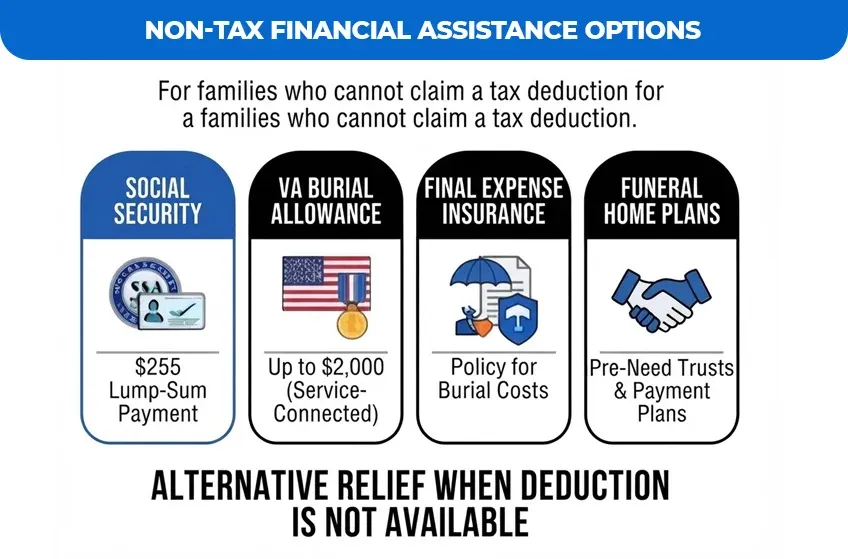
- Social Security lump-sum death payment: A one-time $255 payment to an eligible surviving spouse or child, according to the Social Security Administration.
- VA burial allowance: Up to $2,000 for a service-connected death, or up to $978 for a non-service-connected death plus a $978 plot allowance for deaths on or after October 1, 2024, according to the Department of Veterans Affairs.
- Final expense (burial) insurance: A small, permanent life insurance policy designed specifically to cover funeral and burial costs for beneficiaries.
- Funeral home payment plans and pre-need trusts: Structured payment options that spread costs over time without relying on a tax deduction.
For context on why these benefits matter, the median cost of a funeral with viewing and burial was $8,300, and the average cost of a funeral with cremation was $6,280, according to the National Funeral Directors Association.
The Bottom Line
For nearly every family, funeral expenses are a personal cost with no tax deduction available. The deduction exists only inside Form 706, and only for the small number of estates large enough to owe federal estate tax. If you are managing funeral costs directly, your best path to relief is not a tax strategy; it’s confirming eligibility for Social Security, VA, or insurance benefits before expenses are finalized.
Planning ahead is the one lever families can actually control. If you want to make sure a future funeral doesn’t become a financial burden for the people you love, talk to a licensed insurance professional about a final expense policy sized to your local funeral costs, or consult an estate planning attorney if your estate may approach the federal exemption threshold. Either conversation takes less than an hour and can save your family thousands of dollars and weeks of stress.