



This guide breaks down the best life insurance companies by category, including term, whole, universal, and senior coverage, and explains the rating systems (AM Best, NAIC, J.D. Power, and Comdex) that determine which insurers genuinely earn the label “best.” You’ll also find current 2026 pricing data for a $500,000 policy, a side-by-side comparison of term versus whole versus universal life insurance, and a step-by-step framework for choosing a company that fits your budget, health profile, and coverage goals.
No single insurer is the right choice for everyone. The company that works best for a healthy 30-year-old buying $500,000 of term coverage is rarely the same one that works best for a 70-year-old shopping for guaranteed-issue burial insurance. Use the comparisons below to match your situation to the right insurer instead of chasing a generic “top pick.”
| Quick AnswerNerdWallet’s 2026 rankings name Guardian, MassMutual, New York Life, and Northwestern Mutual as top overall life insurance companies based on financial strength, low complaints, and customer experience. Mutual of Omaha ranks highest for customer satisfaction (707/1,000) in J.D. Power’s 2026 study. Northwestern Mutual, New York Life, MassMutual, and Guardian all hold AM Best’s top A++ financial strength rating. |
Key Takeaways
- Guardian is NerdWallet’s top overall pick for 2026, largely for affordable term coverage and its acceptance of applicants with certain health conditions, including HIV. Source: NerdWallet.
- Mutual of Omaha scored highest in J.D. Power’s 2026 U.S. Individual Life Insurance Study (707/1,000), ahead of State Farm (697) and Nationwide (695). Source: J.D. Power, October 2026.
- Northwestern Mutual, New York Life, MassMutual, and Guardian all carry AM Best’s highest A++ (Superior) financial strength rating.
- A healthy 40-year-old pays an average of $47 a month (women) to $59 a month (men) for a $500,000, 20-year term policy. Source: MoneyGeek 2026 rate analysis.
- Only 51% of U.S. adults own a life insurance policy, and about 100 million adults say they need coverage or need more of it. Source: 2026 LIMRA/Life Happens Insurance Barometer Study.
What Makes a Life Insurance Company “the Best”?
| Quick Answer“Best” is not a single score. Independent reviewers combine AM Best financial strength ratings, NAIC complaint data, J.D. Power satisfaction surveys, and policy transparency to rank insurers. NerdWallet, for instance, weighs financial strength and consumer complaints at 35% each, consumer experience at 20%, and transparency at 10% of its overall rating. |
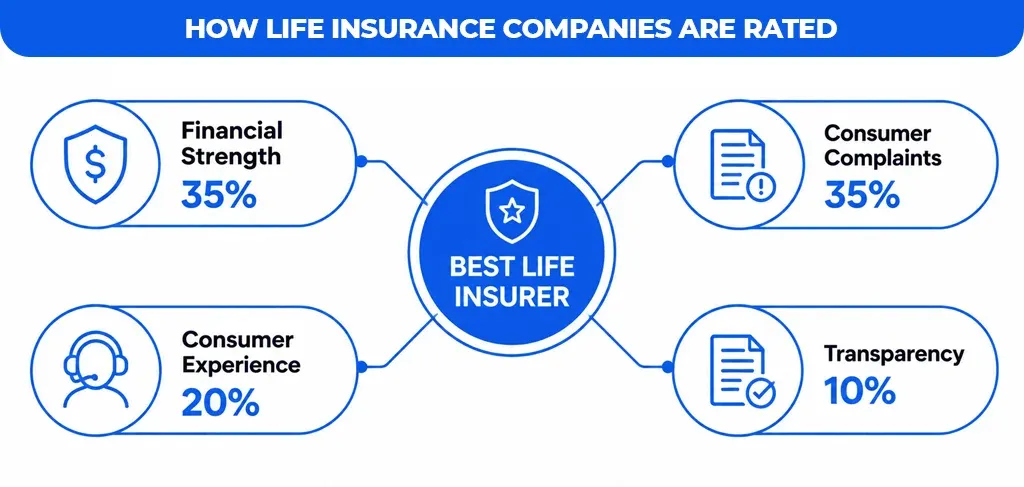
Four data sources drive most credible life insurance rankings, including NerdWallet’s methodology:
- Financial strength (AM Best): confirms an insurer’s ability to pay claims decades into the future. NerdWallet weighs this at 35% of its score.
- Consumer complaints (NAIC): tracks complaints filed with state regulators relative to a company’s size, also weighted at 35% by NerdWallet.
- Consumer experience: measures whether an insurer offers phone, chat, and online support for quotes, beneficiary changes, and claims (20% weight).
- Transparency: rewards insurers that clearly publish coverage amounts, term lengths, and riders on their websites (10% weight).
Underwriting also plays a role behind the scenes. When you apply for coverage, the insurer’s underwriting team reviews your age, health history, and lifestyle to set your premium and health class, which is a separate process from how third parties rate the company itself.
Best Life Insurance Companies in 2026: Comparison Table
The table below summarizes NerdWallet’s 2026 top picks alongside AM Best financial strength ratings and J.D. Power context, so you can compare the best life insurance companies at a glance before reading the full breakdown.
| Company | Best For | AM Best Rating | Notable Data Point |
| Guardian | Overall value & term life | A++ (Superior) | NerdWallet’s #1 overall pick for 2026; accepts some HIV-positive applicants. |
| MassMutual | Whole life cash value | A++ (Superior) | Average annual premium of $350, below the industry average of $377 (Insurance.com, 2026). |
| New York Life | Senior & burial coverage | A++ (Superior) | Comdex score of 99, the top composite financial-strength percentile. |
| Northwestern Mutual | Universal life & customer experience | A++ (Superior) | NAIC complaint index of 0.08, far below the expected industry level (Insurance.com, 2026). |
| Mutual of Omaha | Customer satisfaction | A+ (Superior) | Ranked #1 of 23 carriers in J.D. Power’s 2026 study with a 707/1,000 score. |
| USAA | Military members & veterans | A++ (Superior) | NerdWallet’s top pick for term life among military families. |
| Lemonade | Fast digital coverage | Not independently AM Best–rated (backed by reinsurers) | NerdWallet’s pick for instant, app-based approval. |
Top Life Insurance Companies for 2026, Reviewed
Guardian: Best Overall and Best for Term Life Insurance
Guardian tops NerdWallet’s 2026 overall ranking for a mix of term and permanent policies at competitive rates, plus tailored coverage for people living with HIV. NerdWallet also cites Guardian’s low complaint volume relative to its size as a key strength.
MassMutual: Best for Whole Life Insurance
MassMutual is a mutual company, meaning policyholders, not outside shareholders, own the business, which supports its ability to pay annual dividends on eligible whole life policies. AM Best assigns MassMutual its top A++ rating, and Insurance.com’s 2026 rankings note an average annual premium of $350, below the industry average of $377.
New York Life: Best for Seniors and Burial Insurance
New York Life Group ranked #1 in individual life insurance market share in the NAIC’s 2026 data, with a 7.40% share of countrywide direct premiums. Its AARP-branded whole life policies extend to issue ages of 80–85 in most states, making it a common pick for older buyers seeking final expense coverage.
Northwestern Mutual: Best for Universal Life and Customer Experience
AM Best has reaffirmed Northwestern Mutual’s A++ financial strength rating for more than three decades running, and the company shares a Comdex score of 99 with New York Life, among the highest composite ratings across AM Best, S&P, Moody’s, and Fitch combined. Insurance.com’s 2026 study also gave Northwestern Mutual a perfect trust score, with 100% of surveyed customers saying they trust the company.
Mutual of Omaha: Best for Customer Satisfaction
Mutual of Omaha ranked first among 23 carriers in J.D. Power’s 2026 U.S. Individual Life Insurance Study, scoring 707 out of 1,000 and finishing first in six of the study’s eight satisfaction categories, including trust and ease of doing business.
Lemonade: Best for Fast, Digital-Only Coverage
Lemonade is NerdWallet’s pick for instant coverage, offering fully online applications and rapid approval for smaller term policies. It suits buyers who prioritize speed and a mobile-first experience over in-person agent support.
Best Term Life Insurance Companies
- Guardian: affordable rates across multiple term lengths, plus coverage for applicants with certain health conditions.
- New York Life: term policies that can be renewed annually without a new medical exam in many cases.
- USAA: tailored for veterans and active-duty military members and their families.
- Thrivent: stands out for convertible term policies that can shift to permanent coverage later.
- Northwestern Mutual: scores well for customer experience among term life buyers.
Best Whole Life Insurance Companies
| Quick AnswerNorthwestern Mutual and MassMutual lead NerdWallet’s 2026 list of whole life insurers. Whole life insurance is a type of permanent life insurance that lasts your entire life, builds cash value on a fixed schedule, and can pay dividends if you buy from a mutual insurance company. |
Northwestern Mutual scores points for blended term-and-whole life policies, while MassMutual offers a comparatively high rate of cash value growth. Because both insurers are structured as mutual companies, eligible policyholders may receive annual dividends, though dividends are not guaranteed.
Best Life Insurance Companies for Seniors
| Quick AnswerGuardian, AARP/New York Life, USAA, Northwestern Mutual, and MassMutual top NerdWallet’s 2026 list for seniors, based on maximum issue age, payment flexibility, and whether a medical exam is required. |
| Insurer | Best For | Max Issue Age |
| Guardian Life | Payment flexibility | Term: 75 / Whole: 90 |
| AARP/New York Life | Burial insurance | Whole: 80–85 (75 in NY) |
| USAA | Convertible coverage | Term: 70 / Whole: 85 |
| Northwestern Mutual | Customer experience | Term: 70 / Whole: 85 |
| MassMutual | Older seniors | Term: 75 / Whole: 90 |
Insurers offering these policies generally require a medical exam, which makes them best suited to relatively healthy seniors. Adults with more serious health conditions may need to look at guaranteed-issue final expense insurance instead, which skips underwriting but caps coverage amounts and charges more per dollar of death benefit.
How Much Does Life Insurance Cost in 2026?
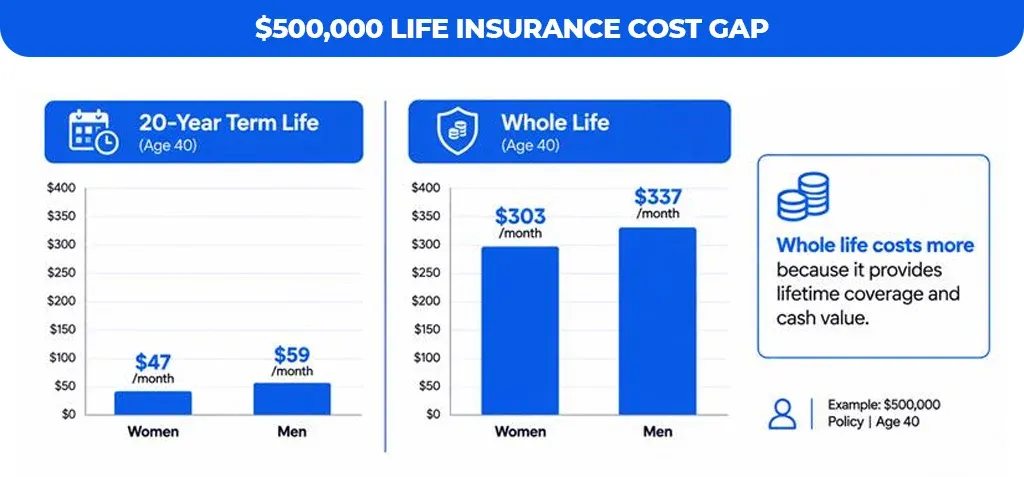
| Quick AnswerA healthy 40-year-old pays an average of $47 a month (women) to $59 a month (men) for a $500,000, 20-year term policy. The same coverage amount as a whole life policy averages $303 a month for women and $337 a month for men at the same age, since permanent coverage also builds cash value. |
| Age & Term | Term Life – Women | Term Life – Men |
| 20-year-old, 10-year term | $23/month | $29/month |
| 40-year-old, 20-year term | $47/month | $59/month |
At the same age (40), a $500,000 whole life policy averages $303 a month for women and $337 a month for men, since permanent coverage lasts a lifetime and builds cash value alongside the death benefit.
MoneyGeek’s review also found that Penn Mutual, Banner Life, and Transamerica offered some of the lowest term rates for $500,000 of coverage, with 10-year term premiums starting around $26 to $30 a month depending on gender.
Several factors move your premium up or down:
- Age: locking in a policy earlier generally means a lower locked-in premium for the life of the term.
- Gender: women typically pay less than men for the same coverage, reflecting differences in average life expectancy.
- Health class and tobacco use: nicotine use and certain health conditions raise premiums significantly during underwriting.
- Coverage amount and term length: higher death benefits and longer terms both increase the premium.
Cost perception is often the biggest barrier to buying coverage. Younger adults (ages 18–30) overestimate the cost of a $250,000, 20-year term policy by roughly 10 to 12 times its actual price, according to the 2026 LIMRA/Life Happens Insurance Barometer Study.
Term vs. Whole vs. Universal Life Insurance: Key Differences
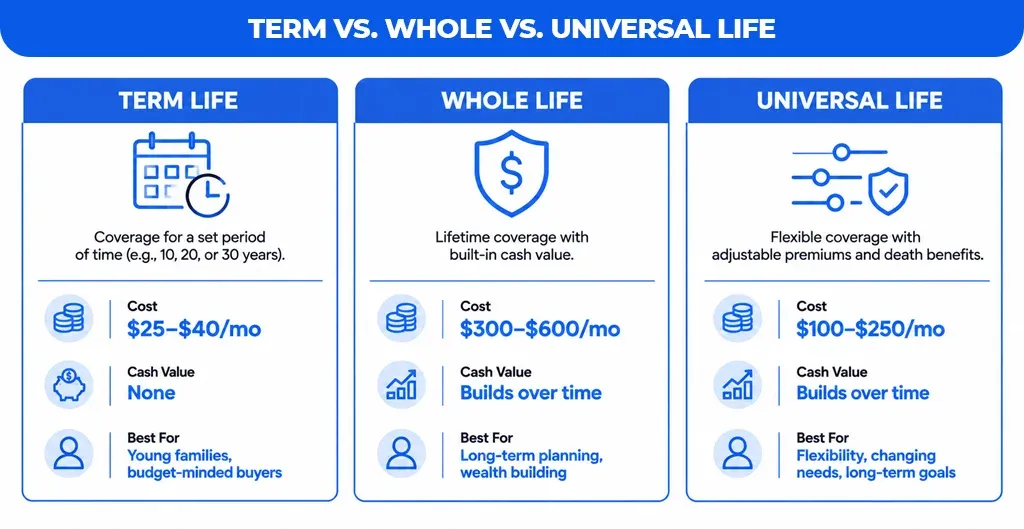
Choosing the right policy type matters as much as choosing the right company. Here’s how the three most common types compare for a healthy applicant in their 30s buying $500,000 of coverage.
| Policy Type | Typical Monthly Cost* | Cash Value? | Best For |
| Term life | $25–$40/month | No | Income replacement for a set period, such as while raising children or paying a mortgage. |
| Whole life | $300–$600/month | Yes, grows on a fixed schedule | Lifelong coverage plus a guaranteed cash-value component and possible dividends. |
| Universal life | $100–$250/month | Yes, flexible | Buyers who want lifelong coverage with adjustable premiums and death benefits. |
Every policy type shares the same core entities: a premium you pay on a schedule, a death benefit paid to your named beneficiaries, and underwriting that determines your health class. Term life is the only type without a cash-value component, which is why it’s typically the cheapest option for pure income-replacement coverage.
How to Choose the Best Life Insurance Company for You
Follow this framework instead of relying on a single “top pick” list:
- Calculate your coverage need. A common starting point is 10–12 times your annual income, adjusted for debts, mortgage balance, and future costs like college tuition.
- Decide on a policy type. Choose term life if you need coverage for a specific period; consider whole or universal life if you want lifelong coverage and cash value.
- Check the AM Best rating. Look for A- or higher to confirm the insurer can reliably pay claims decades from now.
- Review the NAIC complaint index. A score below 1.0 indicates fewer complaints than expected for the company’s size.
- Compare quotes from at least three insurers. Premiums for identical coverage can vary significantly between carriers for the same health profile.
- Evaluate riders. Common add-ons include a waiver-of-premium rider (waives premiums if you become disabled) and an accelerated death benefit rider (advances part of the payout if you’re diagnosed with a terminal illness).
- Name and update your beneficiaries. Review beneficiary designations after major life events like marriage, divorce, or the birth of a child.
Final Verdict: Which Life Insurance Company Should You Choose?
Choosing the right life insurance policy ultimately comes down to aligning your current life stage, financial obligations, and health profile with an insurer that excels in your specific category rather than chasing a generic top-ranked carrier. Whether you are securing a budget-friendly 20-year term policy to protect a growing family or evaluating whole life options for permanent estate planning, locking in coverage early shields you from inevitable rate increases driven by age. By evaluating independent financial strength ratings and comparing personalized quotes across the best life insurance companies, you can secure the policy structure that guarantees your family’s long-term financial stability.
Ready to find the ideal policy for your budget and coverage goals? Visit Assurance Gurus today to compare real-time quotes from top-rated, A-rated life insurance providers in minutes and lock in your rate before your next birthday increases your premium.