



Life insurance only has one job: making sure the people who depend on your income aren’t left in a financial free fall if you die. But between premiums, riders, cash value, underwriting, and beneficiary rules, it’s easy to lose sight of how the mechanics actually fit together.
This guide breaks down exactly how does life insurance works. From application to payout: what it covers, what it costs, how claims get paid, and how to decide how much coverage you actually need.
Key Takeaways: Who’s Who in a Life Insurance Policy
Before going further, it helps to know the three roles every policy defines, because how life insurance policies work depends on how these roles are assigned.
- The policyholder owns the policy and pays the premiums. This is often the same person as the insured, but not always.
- The insured is the person whose life is covered. The death benefit pays out based on this person’s death.
- The beneficiary is the person or entity who receives the death benefit. You can name multiple beneficiaries and split the payout by percentage.
You can also buy a policy insuring someone else, a spouse or aging parent, for example, as long as you can demonstrate an insurable interest in their life.
What Is Life Insurance and How Does It Work?
Life insurance is a contract between you and an insurance company: you pay premiums, and in exchange, the insurer pays a lump-sum death benefit to your chosen beneficiaries if you die while the policy is active. It works in three basic steps:
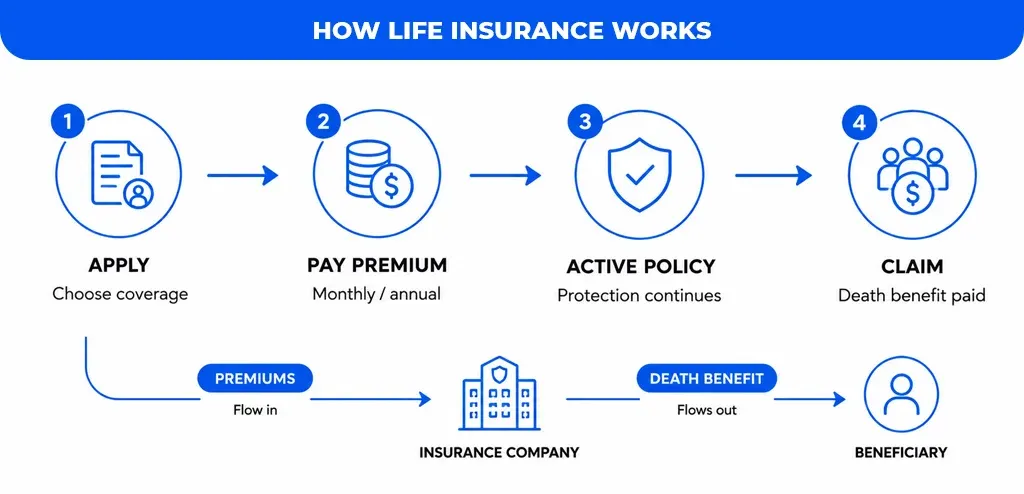
- Apply and get underwritten. You choose a coverage amount and policy type, answer health and lifestyle questions, and in many cases complete a medical exam. The insurer uses this information to price your risk.
- Pay your premium. You make regular payments, usually monthly or annually, to keep the policy in force. Miss enough payments and the policy can lapse, ending your coverage.
- Your beneficiary files a claim. If you die while the policy is active and your death meets the policy’s terms, your named beneficiary submits a claim and receives the death benefit, typically as a tax-free lump sum.
If you outlive a term life policy, nothing is paid out; the coverage simply ends unless you renew or convert it. That’s the trade-off: you’re paying for protection against a risk, not for a guaranteed future payment (unless you hold a permanent policy).
Types of Life Insurance Policies: How Each One Works
There are two broad categories of life insurance: term and permanent, and each works differently when it comes to cost, duration, and cash value. The table below compares how the most common policy types work side by side.
| Policy Type | How It Works | Coverage Length | Best For |
| Term Life | Pays a death benefit only if you die within the term; premiums stay level for the term | 10, 15, 20, 25, or 30 years | Income replacement while raising kids or paying a mortgage |
| Whole Life | Lifelong coverage; builds guaranteed cash value at a fixed rate | Your entire life | Lifelong coverage plus predictable, slow cash-value growth |
| Universal Life | Lifelong coverage with flexible premiums; cash value earns a variable interest rate | Your entire life | Buyers who want flexible payments and lifelong protection |
| Indexed Universal Life | Lifelong coverage; cash value growth is linked to a stock market index | Your entire life | Buyers comfortable with market-linked, capped growth potential |
| Final Expense | A small whole life policy sized to cover funeral and burial costs | Your entire life | Older adults who mainly want end-of-life costs covered |
Term Life Insurance
Term life insurance provides coverage for a fixed period, commonly 10 to 30 years. Premiums are locked in for that term, and the death benefit is paid only if you die during it. Because there’s no cash value component, term life is generally the least expensive way to buy a large amount of coverage.
Whole, Universal, and Indexed Universal Life Insurance
These are all forms of permanent life insurance; coverage lasts your entire life as long as premiums are paid. Each also builds a cash value account you can potentially borrow against or withdraw from, though loans reduce the death benefit if unpaid at death. The difference is how that cash value grows: whole life uses a fixed rate set by the insurer, universal life uses an insurer-declared rate with flexible premiums, and indexed universal life ties growth to a stock market index (typically with a cap and a floor).
What Does Life Insurance Cover?
Life insurance covers death from natural causes, accidents, and illness, and most policies also cover suicide after a contestability period (commonly the first two years of the policy). Coverage and exclusions vary by insurer and state, so always check your specific policy language.
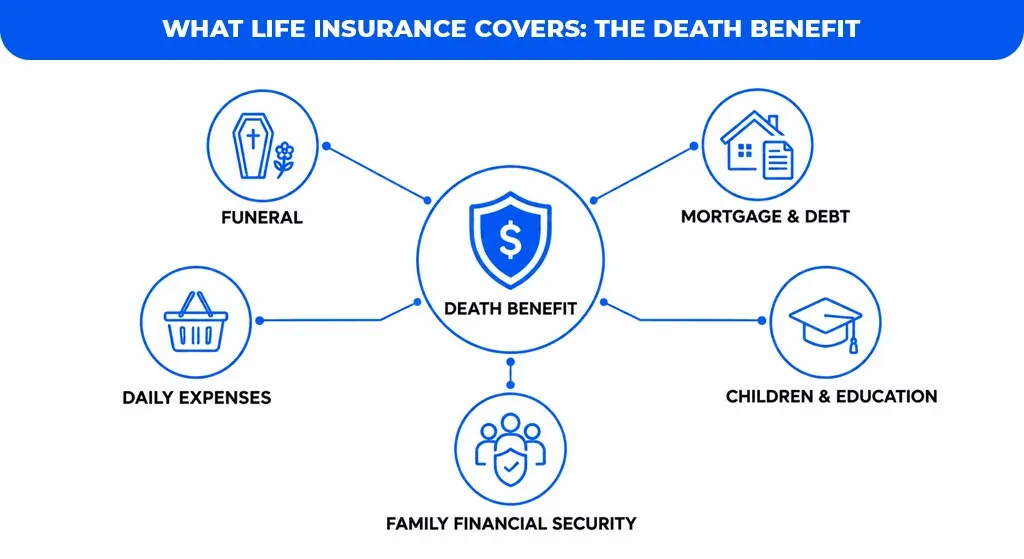
Beneficiaries can generally use the death benefit for anything, including:
- End-of-life costs, such as funeral and burial expenses
- Outstanding debts, including a mortgage, auto loans, or credit cards
- Everyday living expenses like groceries, utilities, and childcare
- Future costs, such as college tuition
- Charitable gifts, if a charity is named as a beneficiary
What a Policy Typically Doesn’t Cover
Insurers can deny a claim in specific circumstances, which is one reason it’s worth reading the exclusions section of any policy closely. Common reasons a claim may not pay out include:
- Death by suicide within the policy’s contestability period (usually the first two years)
- Material misrepresentation or fraud on the original application
- The beneficiary being found responsible for the insured’s death
- A lapsed policy due to missed premium payments
- Certain war-related or high-risk-activity exclusions written into the contract
How Much Does Life Insurance Cost? Factors That Affect Your Premium
Life insurance premiums are priced primarily on age, health, and coverage amount; younger, healthier applicants buying term life pay the least. Key pricing factors include:
- Age: premiums rise steadily the older you are when you apply.
- Health history: chronic conditions, family medical history, and exam results affect your rate class.
- Lifestyle habits: smoking, high-risk hobbies, and driving records (DUIs, for example) increase cost.
- Coverage amount: a $1,000,000 policy costs more than a $250,000 policy, all else equal.
- Policy type and term length: term life is cheaper than permanent life for the same death benefit; longer terms cost more per month than shorter ones.
How Much Does a $100,000 Life Insurance Policy Cost Per Month?
A $100,000 term life policy typically costs somewhere in the range of $10 to $25 a month for a healthy applicant in their 30s, and more for older applicants or those with health issues. Permanent life insurance for the same coverage amount usually costs several times more per month, since part of the premium funds the policy’s cash value account. Getting an exact number requires a personalized quote based on your age, health, gender, and state.
How Does the Life Insurance Claims Process Work?
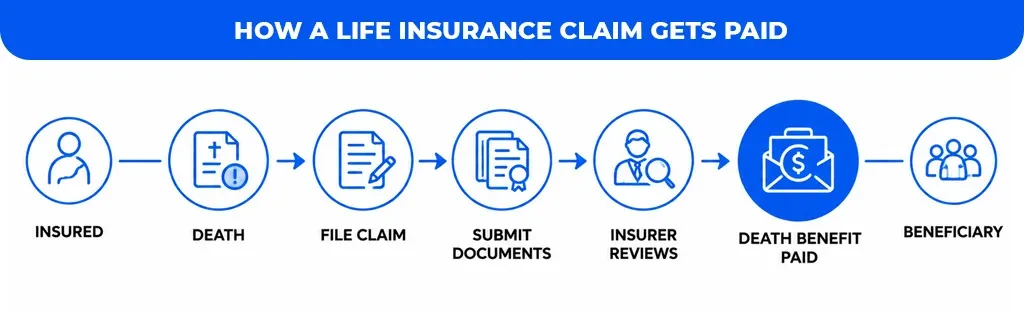
When the insured person dies, the beneficiary files a claim directly with the insurance company to receive the death benefit. Most insurers pay out within 30 to 60 days of receiving a complete claim. The typical process looks like this:
- Locate the policy and contact the insurance company to request a claim form.
- Gather required documents: the certified death certificate, the policy number, and the insured’s personal information.
- Complete and submit the claim form along with the death certificate.
- Choose a payout method, usually a lump sum, though some insurers offer installment or annuity-style options.
- Receive the death benefit, typically by check or direct deposit, once the claim is approved.
Death benefits paid to beneficiaries are generally not subject to federal income tax. However, any interest earned on cash value in a permanent policy, or on benefits held by the insurer before payout, can be taxable.
How Long Do You Have to Have Life Insurance Before It Will Pay Out?
Life insurance pays out from day one of an active policy for most causes of death; the only major waiting period is the suicide contestability clause, which commonly lasts two years from the policy’s start date. Outside of that clause and outright fraud on the application, a valid claim is payable no matter how recently the policy was purchased. Insurers can, however, investigate any death that occurs within the first two years more closely under a broader “contestability period,” during which they can void a policy for material misrepresentation on the application.
Who Needs Life Insurance, and How Much Coverage Should You Buy?
You need life insurance if someone else depends on your income or labor: a spouse, children, or another dependent. A common rule of thumb is to carry coverage worth 10 to 12 times your annual income, adjusted upward if you carry significant debt, a mortgage, or plan to fund a dependent’s future education.
- Primary earners need enough coverage to fully replace lost income for years, not months.
- Stay-at-home parents should still be insured, since replacing childcare, housekeeping, and related labor costs money.
- Retirees may need less coverage once debt is paid off and savings can support a surviving spouse, but coverage can still make sense if dependents remain.
- People with chronic health conditions typically pay more, but early application and well-managed conditions can still qualify for reasonable rates.
How Do Life Insurance Companies Work? Buying and Underwriting a Policy
Life insurance companies work by pooling premiums from many policyholders and using statistical mortality data to price risk, then paying claims from that shared pool when policyholders die. When you apply, the insurer’s underwriting process assesses your risk level and prices your premium accordingly. Buying a policy generally follows these steps:
- Decide on coverage type (term vs. permanent) and how much death benefit you need.
- Get quotes from multiple insurers or work with a licensed agent who can compare the market.
- Complete the application, including health questions and, for most policies, a medical exam.
- Wait for underwriting approval, which sets your final premium based on your risk classification.
- Sign the policy, name your beneficiaries, and set up premium payments.
Policies aren’t a “set it and forget it” purchase. Review your coverage after major life events marriage, a new child, a new mortgage, or divorce since these can all change how much death benefit your dependents actually need.
Is Life Insurance Worth It? Weighing the Pros and Cons
For most people with financial dependents, term life insurance is worth it because it replaces years of lost income for a relatively small monthly cost. Permanent life insurance is worth it for a smaller group of buyers: those who specifically want lifelong coverage or a cash-value component alongside their protection, but it comes at a materially higher price.
What Are the Downsides of Life Insurance?
Life insurance isn’t free of trade-offs, and understanding the downsides helps you buy the right amount of the right type. Common downsides include:
- Premiums rise sharply with age, so waiting to buy coverage generally costs more over time
- Permanent life insurance carries much higher premiums than term for the same death benefit
- Cash value in permanent policies often grows slowly in the early years after fees
- Unpaid policy loans reduce the death benefit and can even cause a policy to lapse
- Riders (optional add-ons like accidental death benefit) add cost and often provide limited extra value
- Coverage isn’t guaranteed if health changes significantly after a term policy expires and you need to requalify
How Much Money Do You Actually Get From Life Insurance?
Beneficiaries typically receive the full face value of the policy the death benefit amount chosen when the policy was purchased minus any outstanding policy loans or unpaid premiums, and the payout is generally received tax-free. For example, a $500,000 term policy pays $500,000 to the named beneficiaries if the insured dies while the policy is active, usually as a single lump-sum payment within 30 to 60 days of an approved claim.
The Bottom Line
How does Life insurance work? It trades a manageable monthly premium for a guarantee: if you die while your policy is active, the people who depend on you receive a payout large enough to replace your income and cover major financial obligations. Term life insurance covers most people’s actual need, protecting dependents during the years debt and childcare costs are highest, while permanent policies serve a narrower set of long-term or estate-planning goals.
Before you buy, get quotes from more than one insurer, size your coverage against your real income and debts, and revisit the policy every few years as your life changes. If you’re ready to see what coverage would cost for your age and health profile, request quotes from a few licensed life insurance providers today and compare the numbers side by side before you commit.