



Quick Answer: What Is Life Insurance With Living Benefits?
Life insurance with living benefits is a policy that lets the insured person access part of their own death benefit while still alive after a qualifying health event, such as a terminal, chronic, or critical illness. The money is paid as an advance against the face amount, and whatever is used reduces what beneficiaries receive later.
Key Takeaways
- Living benefits are delivered through riders, most commonly an accelerated death benefit (ADB) rider attached to a term, whole life, universal life, or indexed universal life policy.
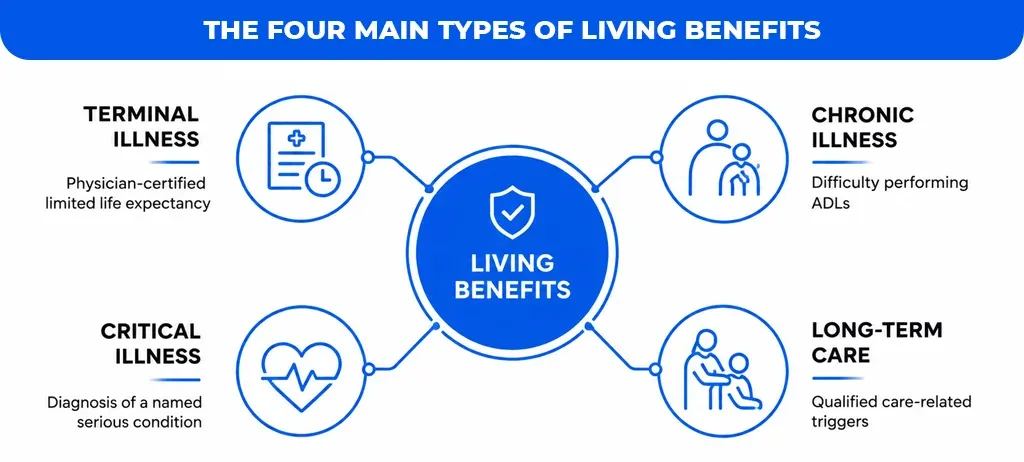
- Four triggers dominate the market: terminal illness, chronic illness, critical illness, and long-term care. Each has its own definition, payout method, and tax treatment.
- Terminal-illness acceleration is treated as a death benefit under IRC §101(g) and is generally excluded from gross income. Chronic-illness payments are excludable only up to the IRS per diem limit, which is $430 per day for 2026 (IRS Rev. Proc. 2025-32, §4.62).
- A living benefit is not free money and not a loan. It is an advance that permanently reduces the death benefit, and it can affect eligibility for Medicaid and other means-tested programs.
- The financial gap these riders address is real: Medicare does not pay for custodial long-term care when that is the only care you need (Medicare.gov, Medicare Coverage of Skilled Nursing Facility Care), and the 2026 national median cost of a private nursing-home room was $129,575 per year.
What Is Life Insurance With Living Benefits?
Living benefits in life insurance are contractual provisions that let the policyowner receive a portion of the death benefit before death, once a licensed physician certifies a qualifying condition. The benefit is “accelerated,” meaning the timing of the payout changes, not the amount of coverage you bought.
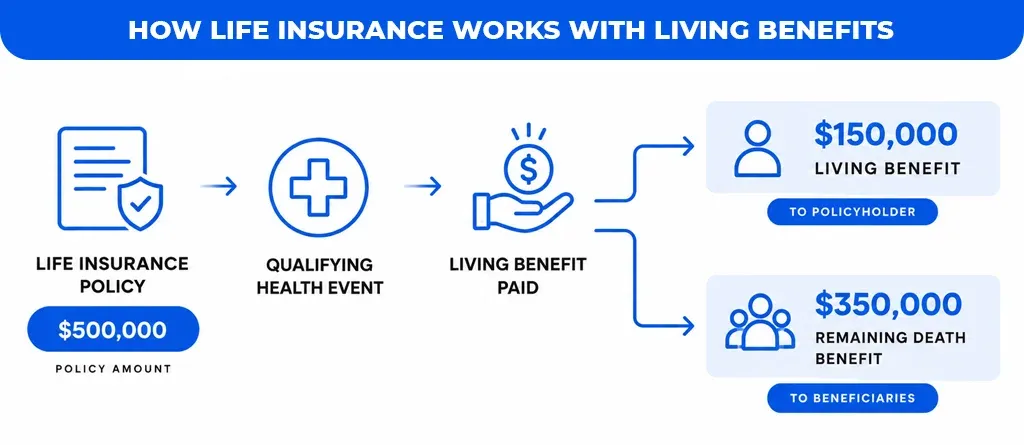
Traditional life insurance is a one-event contract: the insurer pays the death benefit to the named beneficiaries after the insured dies. A living benefits life insurance policy adds a second set of payout triggers tied to health status rather than death. That is why the industry term for these provisions is accelerated death benefits.
Three structural facts define how living benefits in life insurance behave:
- They are an advance, not an addition. Every dollar accelerated is subtracted from the face amount. A $500,000 policy that pays out $150,000 for a chronic illness claim leaves roughly $350,000 for beneficiaries, before any lien interest or administrative charge.
- They are governed by rider language, not by brand marketing. Terms such as “chronic illness” and “critical illness” have precise contractual definitions that vary by insurer and by state approval.
- They are regulated at the state level. The National Association of Insurance Commissioners (NAIC) Accelerated Benefits Model Regulation sets baseline disclosure and payout standards that states adopt, including the requirement that a lump-sum option be available to the claimant.
Living benefits vs. death benefit vs. cash value
These three terms are frequently confused, and the distinction matters when you compare policies.
| Feature | What it is | When you access it | Effect on the policy |
| Death benefit | The face amount paid to beneficiaries | After the insured dies | Ends the policy |
| Living benefit (ADB rider) | An advance of the death benefit after a qualifying illness | While the insured is alive and certified | Permanently reduces the remaining death benefit |
| Cash value | The savings component inside permanent policies | Any time, via loan or withdrawal | Loans accrue interest; unpaid loans reduce the death benefit |
Cash value access is sometimes marketed as a “living benefit,” and functionally it is one. But it is a feature of whole life insurance, universal life, and indexed universal life, not a health-triggered rider, and term life insurance has no cash value at all.
How Do Living Benefits Work? The Acceleration Mechanism Explained
When a living benefit claim is approved, the insurer advances an agreed portion of the face amount and reduces the remaining coverage to account for the early payment. Insurers use one of two accounting methods: a lien against the policy or a discounted acceleration, and both leave beneficiaries with less than the original face amount.
The two payout structures
- Lien method. The insurer pays the full requested amount and records a lien against the death benefit. The lien typically accrues interest until death, at which point it is deducted from the payout.
- Discounted (present value) method. The insurer reduces the accelerated payment to reflect the time value of money and the insured’s shortened life expectancy, then reduces the death benefit dollar-for-dollar by the amount accelerated.
Chronic-illness riders frequently use a discount-at-claim design in which no charge applies until the rider is exercised, while long-term care riders under IRC §7702B typically carry an explicit ongoing charge. This is one of the most consequential differences between two riders that look similar on a brochure.
The claim process, step by step
- Confirm the trigger. Review the rider to identify the exact certified condition required: a life expectancy threshold, a number of Activities of Daily Living (ADLs), or a named diagnosis.
- Obtain physician certification. A licensed health care practitioner must certify the condition in writing. Chronic-illness claims often require recertification on a periodic basis.
- Check the waiting and elimination periods. Some riders impose a contestability window or an elimination period before benefits become payable.
- Submit the claim and elect a payout form. Under the NAIC model regulation, a lump-sum option must be offered; chronic-illness and long-term care benefits are often structured as periodic monthly payments instead.
- Review the disclosure statement. Insurers must disclose the effect of the acceleration on the death benefit, cash value, and future premiums before the payment is issued.
- Confirm the residual death benefit. Many contracts preserve a minimum remaining death benefit. One published example is North American Company’s Chronic Illness Accelerated Benefit Rider, which defines the residual death benefit as the greater of 5% of the death benefit at the initial election date or $10,000 (North American Company, CIABR product disclosure).
The Four Main Types of Living Benefits
Most living benefits life insurance policies are built from four rider families. They are not interchangeable, and a policy that includes one does not necessarily include the others.
Terminal illness rider
Advances a portion of the death benefit after a physician certifies that the insured’s life expectancy falls below a contractual threshold. Under IRC §101(g)(4)(A), a “terminally ill individual” is one certified as having an illness reasonably expected to result in death within 24 months; individual contracts commonly use a 12-month or 24-month standard depending on state approval.
- Frequently embedded in both term and permanent policies at no additional premium
- Payment is generally excluded from gross income under IRC §101(g)
- Typically the simplest living benefit to claim, since the trigger is a single certification
Chronic illness rider
Advances benefits when the insured is certified as unable to perform a specified number of ADLs without substantial assistance, or has a severe cognitive impairment.
The six ADLs recognized across the industry are bathing, continence, dressing, eating, toileting, and transferring. Under the Interstate Insurance Compact uniform standards for accelerated death benefits, an insurer’s definition of chronic illness may not require the inability to perform more than two of these six activities (Insurance Compact, Uniform Standards for Accelerated Death Benefits).
- Usually requires the condition to be permanent, or certified for a period of at least 90 days where the contract follows federal §7702B/§101(g) definitions
- Often available on permanent policies; availability on term is narrower
- Benefits are excludable only up to the IRS per diem limit
Critical illness rider
Advances a portion of the death benefit upon diagnosis of a specifically named condition. Common listed conditions include heart attack, stroke, invasive cancer, major organ failure, and end-stage renal disease, but the covered list, severity definitions, waiting periods, and recurrence limits are set in the rider and differ by insurer and state.
- Trigger is diagnosis-based rather than function-based, so it can pay far earlier than a chronic illness rider
- Tax treatment is less uniformly favorable than terminal illness acceleration and depends on whether the payment qualifies under §101(g)
- Useful for the income disruption that follows a serious diagnosis, not just the medical bills
Long-term care rider (IRC §7702B)
A tax-qualified LTC rider attached to a life insurance policy. For tax and regulatory purposes, it functions as long-term care insurance rather than as a simple acceleration.
- Pays on a reimbursement or indemnity basis when ADL or cognitive triggers are met
- Carries an explicit, disclosed rider charge
- Subject to the same §7702B benefit-trigger rules as standalone LTC insurance
- Many insurers will not allow a §7702B LTC rider and a chronic illness ADB rider on the same policy
Related provisions that also pay while you are alive
Several other features are marketed under the living benefits umbrella. They are worth knowing because they change the real value of a policy:
- Waiver of premium rider: the insurer pays your premiums while you are totally disabled, keeping the coverage in force
- Disability income rider: pays a monthly benefit during a qualifying disability
- Policy loans and withdrawals: available from the cash value of permanent policies
- Return of premium: refunds premiums at the end of a term period on certain term products
- Viatical and life settlements: the sale of an existing policy to a third party, regulated separately under state viatical settlement acts and generally a last-resort alternative when no rider exists
Why Living Benefits Matter: The Gap They Actually Fill
The case for living benefits life insurance rests on a documented coverage gap between what health insurance pays for and what a prolonged illness actually costs.
Medicare does not cover custodial care. Medicare covers skilled nursing facility care only under specific conditions, including a qualifying inpatient hospital stay of at least three consecutive days, and provides up to 100 days of SNF coverage per benefit period, with beneficiaries paying nothing for the first 20 days and a daily coinsurance for days 21–100 (Medicare.gov, Medicare Coverage of Skilled Nursing Facility Care). Medicare does not cover custodial care, help with daily activities such as bathing, dressing, and eating when that is the only care needed.
The likelihood of needing that care is substantial. According to the U.S. Administration for Community Living, someone turning 65 today has almost a 70% chance of needing some type of long-term care services and supports in their remaining years; women need care longer on average (3.7 years) than men (2.2 years), and 20% will need it for longer than five years (ACL.gov, How Much Care Will You Need?).
The costs are documented and rising. From the CareScout 2026 Cost of Care Survey, which collected more than 25,000 provider rates between July and November 2026:
| Care setting | National median daily/hourly rate (2026) | Annual national median |
| Nursing home, private room | $355 per day | $129,575 |
| Nursing home, semi-private room | $315 per day | $114,975 |
| Assisted living community | $6,200 per month | $74,400 |
| Non-medical in-home caregiver | $35 per hour | $80,080 (44 hrs/week) |
| Adult day health care | $95 per day | $24,700 (5 days/week) |
And coverage itself is thin. LIMRA reported in January 2026 that about half of U.S. adults own life insurance and more than 100 million acknowledge a coverage gap (LIMRA, LIMRA Forecasts Individual Life Insurance Premium to Grow in 2026, January 2026).
Term Life Insurance With Living Benefits vs. Whole Life With Living Benefits
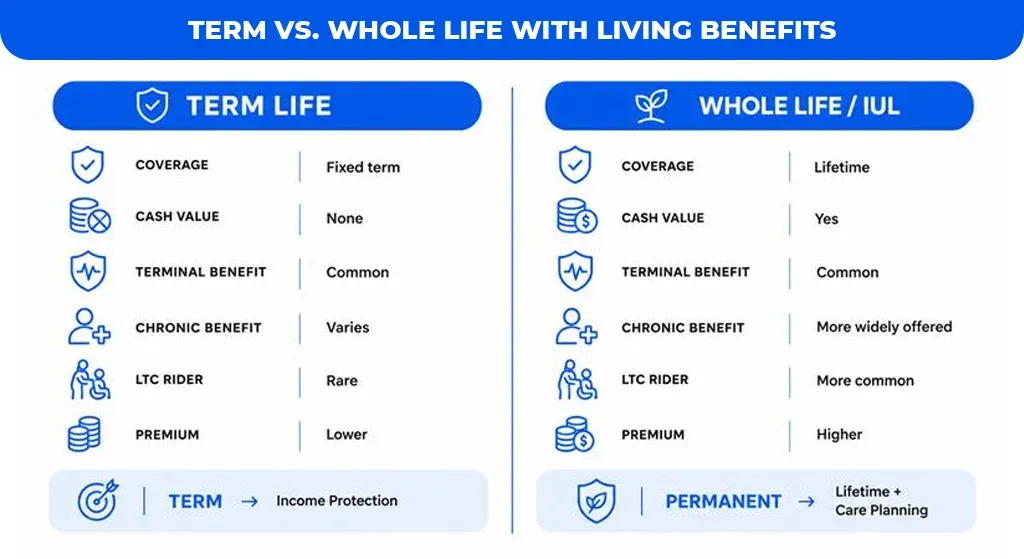
Both term and permanent policies can carry living benefit riders, but the rider menus differ in predictable ways.
| Term life with living benefits | Whole life / IUL with living benefits | |
| Coverage duration | Fixed term (commonly 10–30 years) | Lifetime, if premiums are paid |
| Cash value | None | Yes, accessible via loan or withdrawal |
| Terminal illness rider | Commonly available | Commonly available |
| Chronic illness rider | Availability varies by carrier and state | More widely offered |
| LTC rider (§7702B) | Rarely offered | More commonly offered |
| Relative premium | Lower | Higher |
| Best suited to | Income replacement during working and child-rearing years | Lifetime coverage, estate liquidity, and care-cost planning |
Living benefits term insurance is the lower-cost entry point, and terminal-illness acceleration is a common inclusion. If chronic illness or long-term care protection is the actual objective, a permanent policy or a convertible term policy that can later be exchanged for permanent coverage without new medical underwriting usually gives access to the fuller rider set.
One practical note: a term policy’s living benefits expire when the term does. A chronic illness rider on a 20-year term bought at 35 will no longer exist at 56, which is before most long-term care claims occur.
How Much Does Life Insurance With Living Benefits Cost?
There is no single national price, and any article quoting one is guessing. Premiums for life insurance with living benefits are determined by underwriting, and rider charges vary by insurer, state, product, and rider design. What can be stated accurately is the structure of the cost.
Cost drivers you control:
- Face amount: the larger the death benefit, the larger the premium and the larger the accelerable pool
- Term length or policy type: term is cheaper than permanent for the same face amount
- Age at issue: premiums are priced on attained age, so waiting raises cost
- Tobacco use and health class: underwriting classification is typically the single largest variable
- Which riders you add and whether they charge up front or at claim
Cost drivers set by the contract:
- Terminal-illness acceleration is frequently built in without a separate premium
- Chronic-illness ADB riders often use a discount-at-claim design, meaning no ongoing charge but a reduced payout when exercised
- §7702B long-term care riders carry an explicit, disclosed charge
- Administrative fees are commonly deducted from the accelerated payment or folded into the lien rather than billed separately
The honest comparison question: a rider with no visible charge is not free. If the insurer discounts the payout at claim, you pay at the worst possible time. Ask each carrier to illustrate the actual dollars payable at a realistic claim age, not the headline acceleration percentage.
How to Evaluate a Living Benefits Policy: A 7-Point Checklist
- Read the trigger definition, not the rider name. “Chronic illness” on one contract may require permanent incapacity; on another it may follow the 90-day federal standard.
- Identify the payout method. Lien with interest, or discounted acceleration? Ask for the effective reduction in dollars.
- Find the maximum acceleration and the residual death benefit. Both are stated in the contract, and both vary widely.
- Locate every charge. Rider charge, administrative fee at claim, and any change to the cost of insurance after acceleration.
- Check the interaction rules. Many carriers prohibit stacking a §7702B LTC rider and a chronic illness ADB rider on the same policy.
- Verify the insurer’s financial strength. Review ratings from AM Best, and check the carrier’s complaint record and licensing status through your state department of insurance and the NAIC Consumer Information Source.
- Confirm state availability. Rider availability and definitions are subject to state approval, so a rider offered in one state may be unavailable or differently worded in another.
Conclusion
Living benefits are decided in the rider language, not the brochure. Before you buy or renew, pull your current policy’s rider schedule and check three things: which triggers are covered, how the payout is calculated, and what the residual death benefit is. If any of those three are unclear, request a written illustration from your carrier or an independent agent showing the exact dollars payable at a realistic claim age. It takes one request, costs nothing, and is the difference between a policy you assume will help and one you know will.
Ready to see which living benefit policies fit your budget? Don’t leave your family’s financial future or your own long-term care planning to guesswork. Connect with an independent expert at Assurance Gurus today to review your current policy’s rider language or compare custom quotes from top-rated carriers.