



Introduction
Talking about death is uncomfortable, and planning for it can feel even harder. But funeral expense insurance turns an emotionally difficult topic into a manageable financial decision, one that spares grieving family members from scrambling to cover thousands of dollars in costs while they’re still processing the loss.
Funeral costs have climbed well above general inflation over the past decade, and most families have no dedicated savings set aside to cover them. Without a plan in place, the financial burden typically falls on whichever relative is closest, often paid for with credit cards, personal loans, or funds pulled from other priorities.
Funeral expense insurance (also called burial insurance or final expense insurance) is a specialized, affordable policy built specifically to cover these costs. Unlike traditional life insurance, it’s designed to be simple to qualify for, quick to pay out, and sized to match real funeral expenses rather than broader income-replacement needs.
This guide covers how insurance for funeral expenses works, the different policy types available, current 2026 cost data, and a practical framework for choosing the right plan for your family.
Understanding Funeral Expense Insurance: What Is It and How Does It Work?
How Final Expense Funeral Insurance Works
At its core, final expense funeral insurance is permanent life insurance, meaning coverage lasts your entire life as long as premiums are paid; it never expires or renews like term insurance. Premiums are fixed, coverage amounts are modest, and the underwriting process is streamlined, so approval doesn’t hinge on a clean bill of health.
Key Mechanics
- Lump-Sum Payment: When the policyholder passes away, the named beneficiary files a claim and receives the full death benefit as a single, tax-free payment, not itemized reimbursements tied to funeral home receipts.
- Flexibility: While the policy is marketed for funeral costs, the payout isn’t legally restricted to them. Beneficiaries can also apply it toward outstanding medical bills, credit card debt, or everyday living expenses.
- No Employer or Term Limits: Unlike group life insurance through an employer, coverage doesn’t disappear if you retire or change jobs.
Simplified Issue vs. Guaranteed Issue
Simplified Issue Policies
Simplified issue policies are ideal for applicants who are in average-to-fair health. These plans do not require a medical exam or blood work; instead, you only need to complete a short health questionnaire, which helps determine your rate class. The approval process for these policies is quite fast, often taking anywhere from the same day to a few days. Furthermore, waiting periods for these policies are rare and generally only apply to specific health conditions.
Guaranteed Issue Policies
Guaranteed issue policies are highly beneficial for individuals who have been declined for coverage elsewhere due to serious or chronic health conditions. There are no health questions to answer and no medical exams required, allowing for an instant or near-instant approval process. However, this accessibility comes with a “graded death benefit”—if the policyholder passes away from natural causes during the waiting period (typically two to three years), the beneficiaries will receive a refund of the premiums paid plus interest, rather than the full death benefit.
How Much Does Funeral Insurance Cost in 2026?
2026 Funeral Expense Estimates: Burial vs. Cremation
| Service Type | National Median Cost (2026) | Notes |
| Traditional burial with viewing | ~$8,300 | Excludes cemetery plot and vault |
| Traditional burial with vault | ~$9,995 | Vaults are often required by cemeteries |
| Cremation with viewing/service | ~$6,280 | Includes funeral home service charges |
| Direct cremation (no service) | $1,000 – $3,500 | Lowest-cost disposition option |
| Direct burial (no viewing/service) | $2,000 – $5,000 | Skips embalming and formal service |
What Hidden Costs Push the Total Higher?
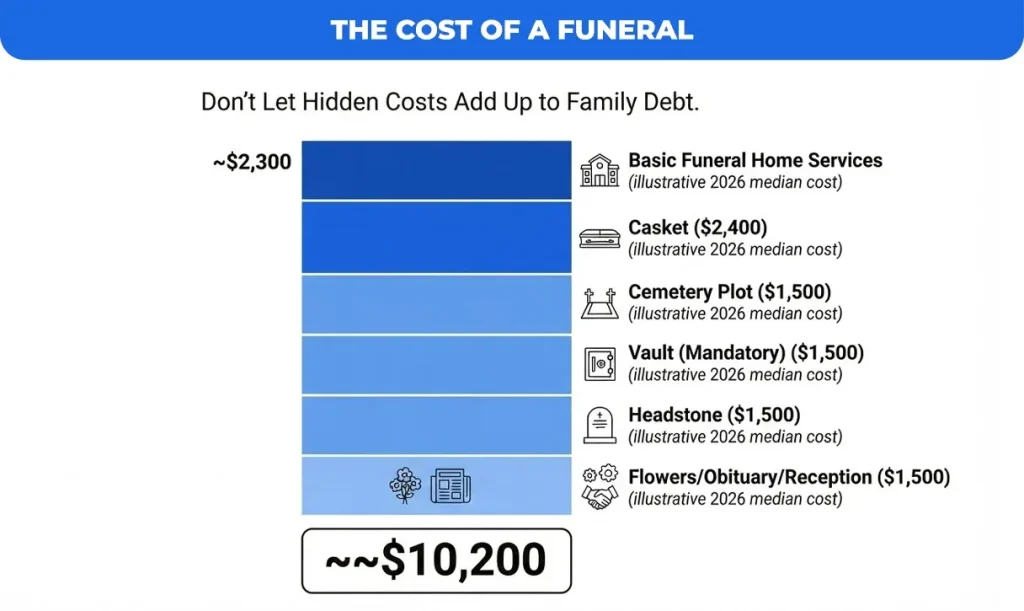
The NFDA’s headline figures cover only the funeral home’s own charges. Several recurring add-ons routinely raise the real out-of-pocket total by thousands of dollars:
- Cemetery plot: $1,000 in rural areas to $4,000+ in metro areas, with premium locations exceeding $10,000
- Headstone or grave marker: $1,000 – $3,000 depending on material and engraving
- Interment (opening/closing) fee: $300 – $1,500
- Grave liner or vault: $900 – $7,000, often mandated by the cemetery
- Flowers, obituary placement, and reception: $2,000 – $5,000 combined
Why Does Planning Today Matter?
Funeral costs have risen roughly 4–6% since 2023 alone, driven by inflation in labor, facility overhead, and casket materials such as hardwoods and metals. A policy purchased locks in a death benefit that doesn’t shrink, but because costs keep climbing, choosing coverage slightly above today’s local funeral home quote gives your family a buffer against future price increases.
Funeral Expense Insurance vs. Traditional Life Insurance
| Factor | Funeral Expense Insurance | Traditional Life Insurance |
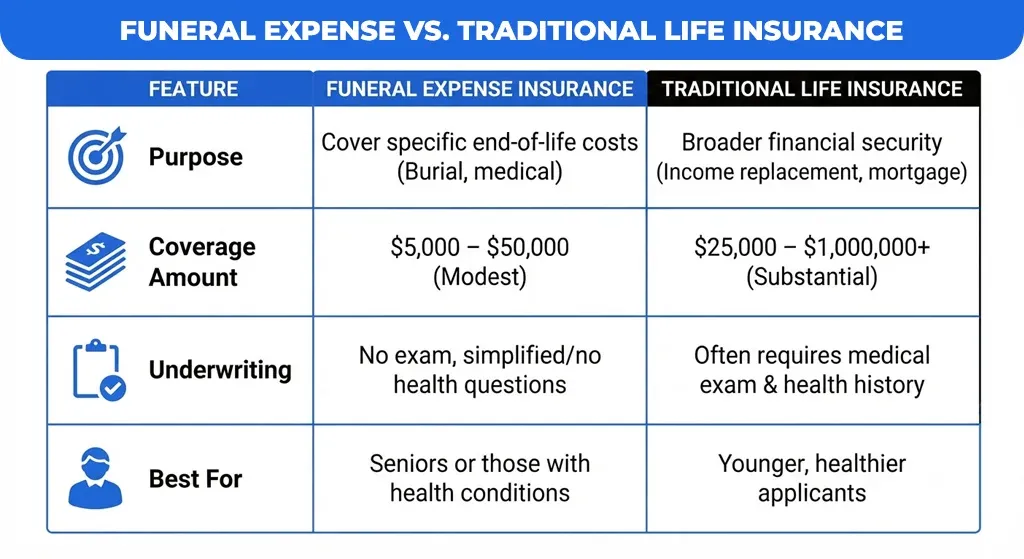
| Purpose | Covers specific final costs: funeral, burial, and medical bills | Broader family financial security: income replacement, mortgage, and education |
| Coverage amounts | $5,000 – $50,000 | $25,000 – $1,000,000+ |
| Underwriting | No exam; simplified or no health questions | Often requires a medical exam and a full health history |
| Premiums | Higher cost per $1,000 of coverage | Lower cost per $1,000 of coverage (for healthy applicants) |
| Approval speed | Days, sometimes instant | Weeks, pending exam results |
| Ideal applicant | Seniors or those with health conditions | Younger, healthier applicants needing larger coverage |
Quick Tip: Which Should You Choose?
Choose funeral expense insurance if you have health issues that would trigger a high premium (or a decline) on a traditional exam-based policy, you’re primarily focused on covering funeral costs without touching other assets, or you want coverage in place within days rather than weeks. Choose traditional life insurance if you’re younger, in good health, and need substantial coverage to replace income or protect dependents financially over the long term.
How to Choose the Right Funeral Expense Insurance Plan
Step-by-Step Checklist
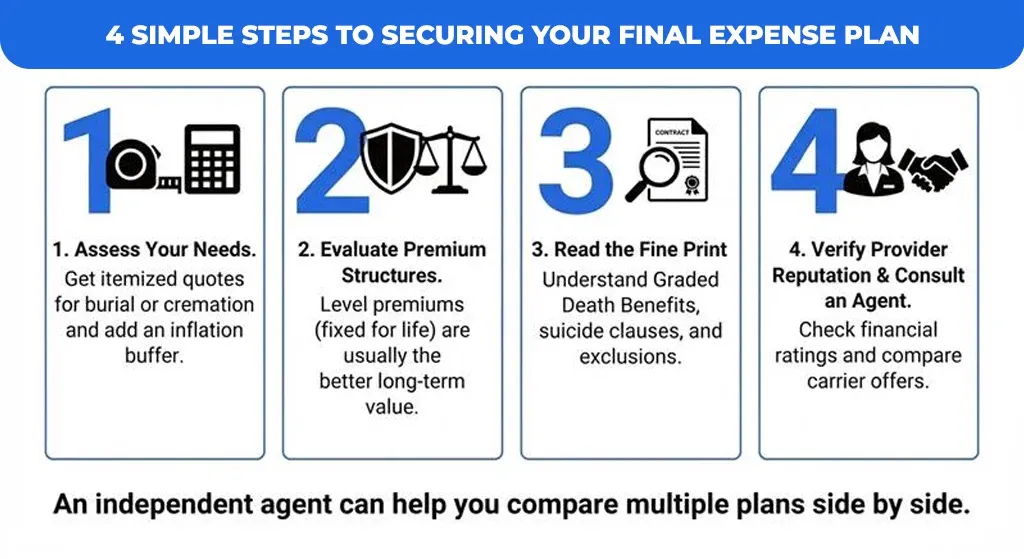
- Assess Your Needs. Decide whether you’re planning for burial or cremation, then request itemized quotes from two or three local funeral homes (required at no charge under the FTC Funeral Rule). Use that number, plus a cushion for inflation, as your coverage target.
- Evaluate Premium Structures. Level premiums stay fixed for life and are typically the better long-term value. Stepped premiums start lower but increase periodically as you age, which can make coverage harder to afford later in retirement.
- Read the Fine Print. Check for a graded or waiting period common in guaranteed issue policies during which a natural (non-accidental) death pays out only a refund of premiums rather than the full benefit. Also, review exclusions for suicide clauses and pre-existing condition limitations.
- Verify Provider Reputation. Check the insurer’s financial strength rating (A.M. Best, Moody’s, or S&P) and look at complaint ratios through your state insurance department before committing
Note on Working with an Agent
Because rates and underwriting rules vary significantly by carrier, even for applicants with identical health profiles, working with an independent agent who can quote multiple companies side by side is one of the most effective ways to avoid overpaying.
Conclusion
Final expense insurance is far more than a simple financial product; it serves as a transformative gift of clarity, effectively shielding your loved ones from the crushing weight of financial uncertainty during their most vulnerable and painful moments. By choosing to secure funeral expense insurance today, you proactively liberate your family from the agonizing, heart-wrenching dilemma of having to choose between honoring your final legacy
Do not wait for the inevitable to force a crisis; take decisive, empowered action right now to guarantee absolute peace of mind and permanently safeguard your family’s financial future with the right funeral expense insurance. The most effective path forward is to consult with a knowledgeable independent insurance agent who can strategically compare diverse premium structures and carrier offerings to identify the exact, comprehensive protection that perfectly aligns with your unique health profile