


Introduction
Accidental death and dismemberment insurance (AD&D) is a low-cost policy that pays a lump-sum benefit if you die in a covered accident, or a partial benefit if an accident costs you a limb, your sight, hearing, or speech. Unlike traditional life insurance, which pays out for nearly any cause of death, AD&D coverage triggers only under specific accidental circumstances, making it a targeted, budget-friendly supplement rather than a replacement for a full life insurance policy.
Imagine an unexpected accident that leaves you or your family facing steep medical bills, lost income, or a sudden and permanent change to your quality of life. That is the exact financial gap AD&D insurance is built to fill. This guide breaks down how AD&D coverage works, what it covers and excludes, how it compares to life insurance, and how to decide if it belongs in your financial safety net.
What Is Accidental Death and Dismemberment Insurance?
To define accidental death and dismemberment insurance in simple terms: it is a limited-indemnity policy that pays a lump sum when a covered accident causes death, or a scheduled percentage of that sum when it causes a catastrophic injury such as the loss of a limb, sight, hearing, or speech. It is sometimes labeled “life and accidental death and dismemberment insurance” when bundled with a base life policy, but on its own it functions quite differently from standard life insurance.
The core distinction is straightforward: AD&D only responds to specific accidental events. It does not pay out for death or disability caused by illness, natural causes, or age-related decline. That narrower scope is precisely what keeps premiums low.
Where You’ll Typically Find AD&D Coverage
- Group benefit through an employer, often bundled at little or no cost with basic life insurance
- A rider added to an existing life insurance accidental death and dismemberment package
- A standalone individual policy purchased directly from an insurer
- Credit union accidental death and dismemberment insurance, frequently offered as a low-cost add-on to a checking or membership account
How Does Accidental Death and Dismemberment Insurance Work?
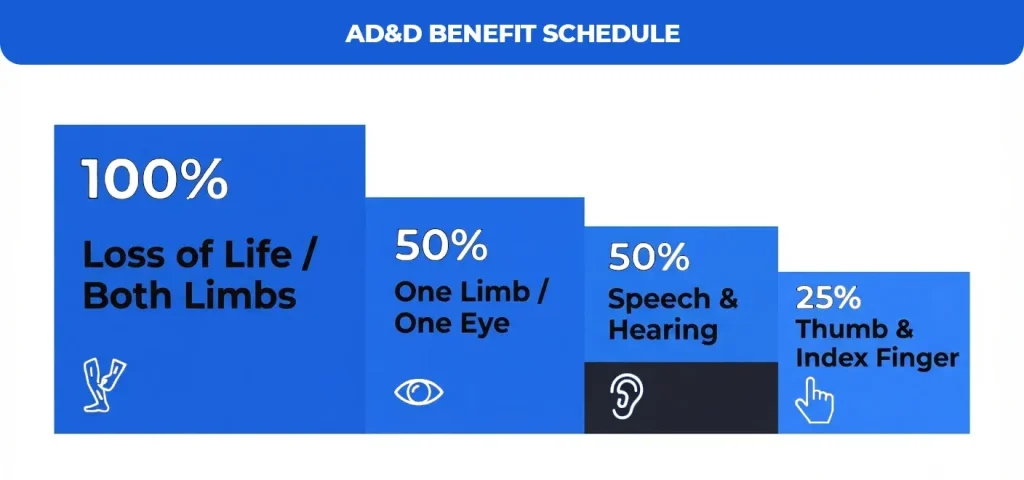
Every AD&D policy is based on a Principal Sum, which is the highest sum that can be paid in the event of a covered accidental death or a complete, irreversible loss, such as both limbs or full vision. Partial losses are paid according to a Benefit Schedule, which assigns a percentage of the Principal Sum to each type of injury.
Example Benefit Schedule Structure
Exact percentages vary by carrier and policy, but a typical schedule maps losses to payout tiers like this:
- Loss of life 100% of the Principal Sum
- Loss of both hands, both feet, or sight in both eyes 100% of the Principal Sum
- Loss of one hand, one foot, or sight in one eye 50% of the Principal Sum
- Loss of thumb and index finger on the same hand 25% of the Principal Sum
Common Add-On Benefits
Many modern AD&D plans include extra provisions beyond the base schedule, such as:
- Seatbelt and airbag benefits an additional payout if the insured was properly restrained during a fatal car accident
- Child care benefits funds toward dependent child care if a parent dies in a covered accident
- Rehabilitation benefits reimbursement for physical therapy or job retraining after a covered injury
- Education benefits support toward a spouse’s or dependent’s tuition costs.
What Does Accidental Death and Dismemberment Insurance Cover?
Understanding what is covered under accidental death and dismemberment insurance and what isn’t is essential before you rely on it as part of your financial plan.
Typically Covered Events
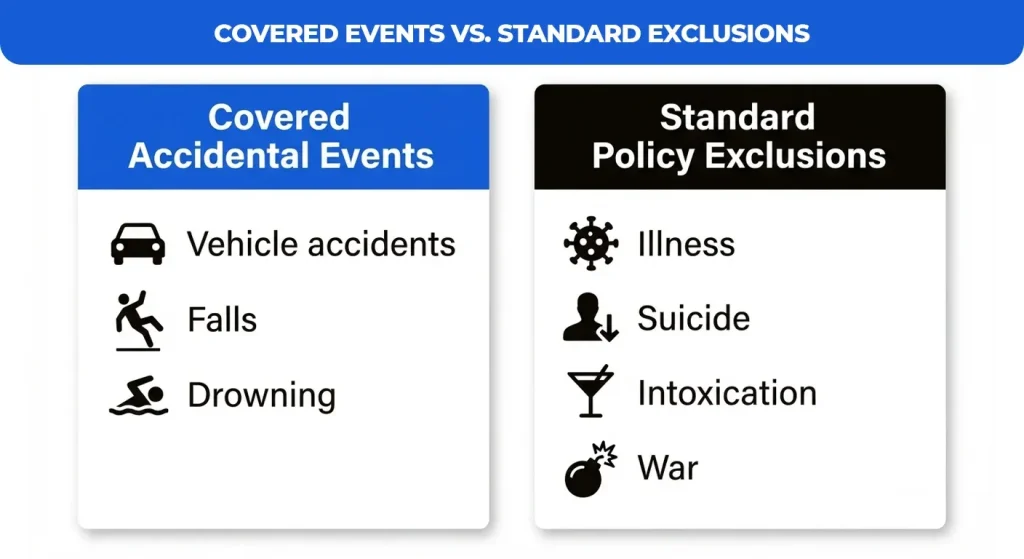
- Car, motorcycle, or other vehicle accidents
- Slips, trips, and falls
- Drowning
- Workplace or heavy machinery accidents
- Accidental exposure to the elements (extreme cold, heat, or weather-related injury)
Common Exclusions
AD&D policies are deliberately narrow. Standard exclusions include:
- Death or injury from illness, disease, or natural causes
- Suicide or self-inflicted injury
- Death or injury occurring while under the influence of non-prescribed drugs or alcohol
- Injuries sustained during high-risk, unauthorized sports or illegal activities
- Acts of war or military conflict
Because these exclusions are broad and vary by carrier, always read the certificate of coverage closely before assuming a scenario is included.
Life Insurance vs. Accidental Death and Dismemberment: Key Differences
A common point of confusion is the difference between life insurance and accidental death and dismemberment coverage. While both can pay a death benefit, the similarities largely end there.
| Feature | AD&D Insurance | Traditional Life Insurance |
| Cause of Payout | Accidental death or covered dismemberment only | Death from nearly any cause, including illness |
| Underwriting | Usually guaranteed acceptance, no medical exam | Often requires health questionnaire or medical exam |
| Premium Cost | Low, since risk scope is narrow | Higher, reflecting broader risk coverage |
| Partial Benefits | Yes, planned compensation for loss of hearing, sight, limb, etc. | No, life insurance pays only on death |
| Best Used As | A supplemental layer of protection | A foundational income-replacement policy |
Double Indemnity: Stacking the Two Together
Some life insurance policies include an AD&D rider that triggers “double indemnity“ if the insured dies in a covered accident; the AD&D benefit pays out on top of the regular life insurance death payment, thereby increasing the recipients’ compensation by double. This is one of the most common ways people combine life insurance and accidental death and dismemberment protection without buying two entirely separate policies.
Who Benefits Most from AD&D Insurance?
AD&D insurance isn’t essential for everyone, but it offers meaningful value for certain groups:
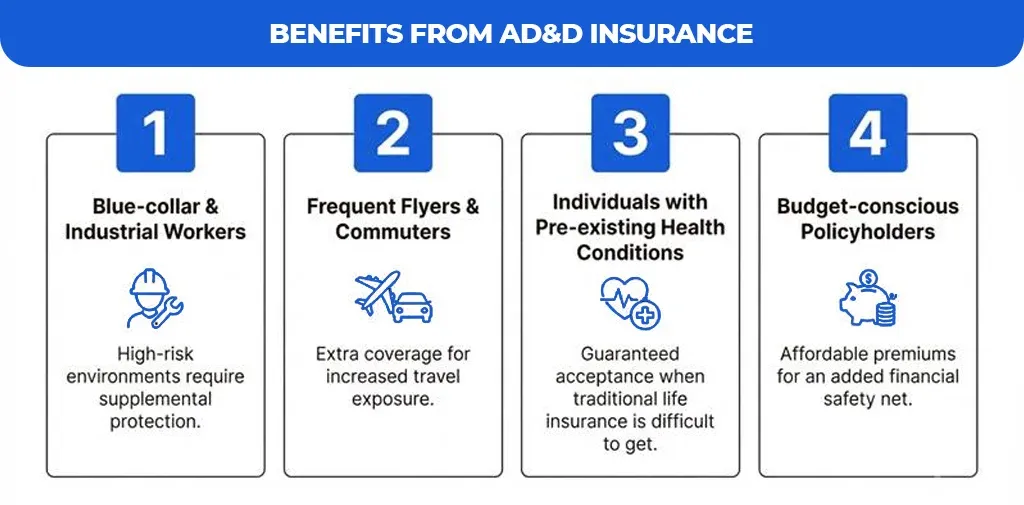
- Blue-collar and industrial workers, construction professionals, truck drivers, and anyone regularly operating heavy machinery
- Frequent flyers and commuters with above-average travel exposure
- Individuals who may struggle to qualify for traditional life insurance due to pre-existing health conditions, since AD&D typically requires no medical exam
- Anyone wanting an inexpensive layer of extra protection on top of an existing life insurance policy
Pros and Cons of Accidental Death and Dismemberment Insurance
Pros
- Low premiums relative to the coverage amount
- Guaranteed acceptance in most cases, with no medical underwriting
- Pays benefits for non-fatal, life-altering injuries, not just death
- Fast, straightforward to add through an employer or credit union
Cons
- Narrow coverage pays out only for specific accidental causes
- Not a substitute for comprehensive life or disability insurance
- Exclusions can be broader and stricter than policyholders expect
- Benefit schedules can be complex to interpret without guidance
Final Thoughts
Securing your family’s financial future requires a comprehensive approach, and accidental death and dismemberment insurance stands out as an exceptionally powerful, budget-friendly tool for bridging critical coverage gaps. While traditional policies protect against a broad spectrum of natural causes, adding a targeted AD&D policy or rider ensures you are shielded against the devastating financial fallout of unexpected, catastrophic trauma. By leveraging guaranteed acceptance and minimal premiums, you can instantly fortify your safety net without straining your monthly budget.
Taking the next step is crucial to ensuring your loved ones are never left vulnerable to unforeseen tragedies. Compare your options today, evaluate your policy’s benefit schedules closely, and integrate accidental death and dismemberment insurance into your financial planning to unlock ultimate peace of mind.