


Key Takeaways
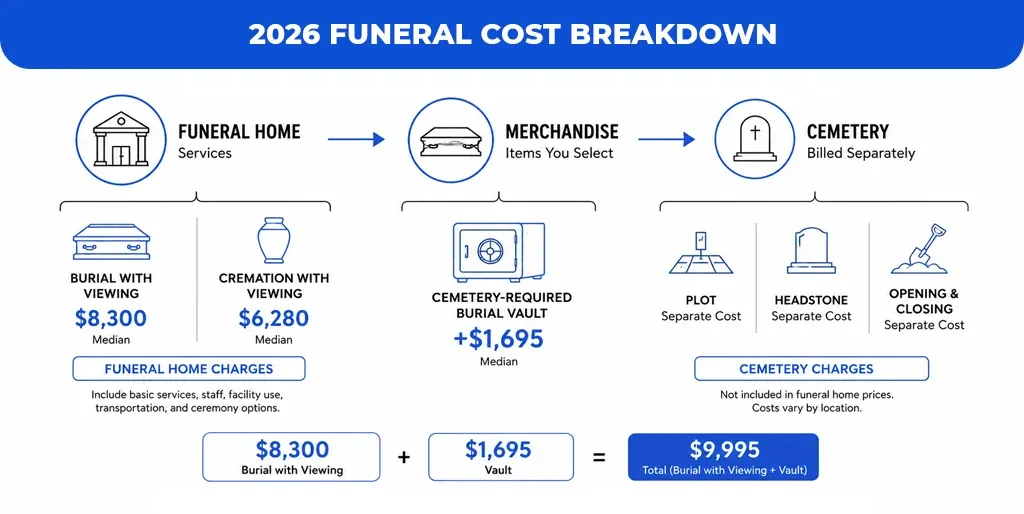
- NFDA’s 2026 General Price List Study, the most recent complete national data available, found a median of $8,300 for burial with viewing (before a vault) and $6,280 for cremation with viewing.
- Adding a cemetery-required burial vault raises the burial median to $9,995.
- The basic services fee is the only charge a funeral home cannot waive; its 2026 national median was $2,459.
- Cemetery costs for the plot, opening and closing, vault, and headstone are separate from the funeral home bill and are not included in NFDA’s national medians.
- Under the FTC Funeral Rule, consumers have the right to an itemized General Price List (GPL) and the right to supply their own casket without a handling fee.
Main Funeral Service Types and 2026 Price Ranges
Funeral cost breakdowns vary primarily based on the type of disposition and how much of the funeral home’s optional services a family selects. The table below outlines the main categories families choose from.
Service Type | What’s Typically Included | Typical Cost |
Direct Cremation | Transport, basic services, cremation, and a simple container. No viewing or ceremony. | Median ~$2,202 (Funeralocity) |
Direct Burial | Transport, basic services, and burial without embalming, viewing, or ceremony. | Median ~$5,138 (Funeralocity) |
Full-Service Cremation with Viewing | Viewing, memorial ceremony, and cremation with an urn. | Median $6,280 (NFDA, 2026) |
Traditional Burial with Viewing | Embalming, viewing, funeral ceremony, and a metal casket. | Median $8,300 funeral home only; $9,995 with vault |
Green/Natural Burial | No embalming; biodegradable casket or shroud in a natural burial ground. | Generally lower than traditional burial; national median not separately tracked by NFDA |
Note: NFDA has not published a newer complete national General Price List study as of 2026; local pricing should always be confirmed directly with a provider’s current General Price List.
What Does a Funeral Home Charge? Services vs. Merchandise Explained
Funeral home bills combine two different things: professional service fees (labor, facilities, and overhead) and merchandise (the casket, urn, and printed materials). Separating the two makes it easier to see where a bill can be trimmed and where it cannot.
The Basic Services Fee
The basic services fee is the only line item a funeral home is legally permitted to charge to every family regardless of the arrangements chosen. It covers the funeral cost breakdown, director’s professional time, permits, coordination, and general overhead. Its national median was $2,459 in 2026, up from $2,300 in 2021, according to NFDA’s General Price List Study.
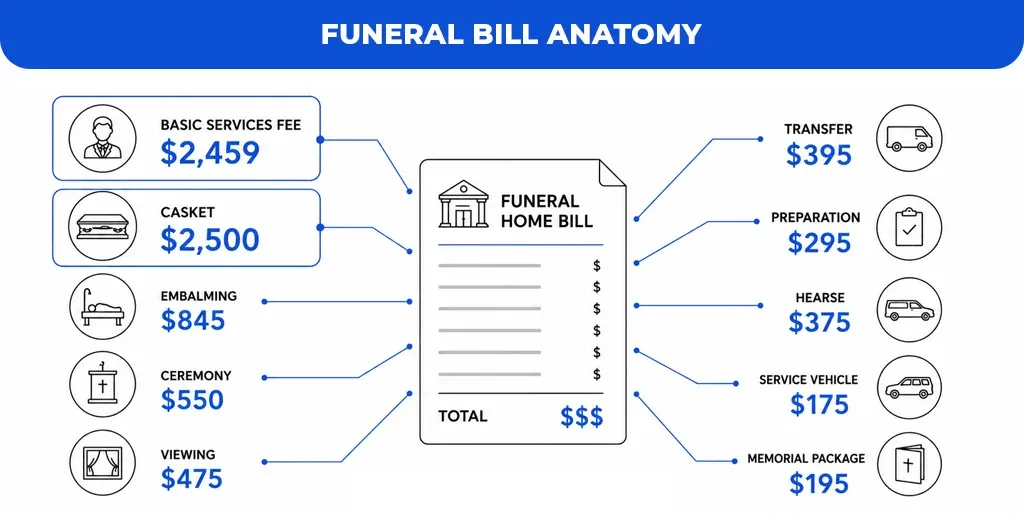
Itemized Funeral Home Charges (NFDA 2026 Median, Burial with Viewing)
Line Item | 2026 Median Cost |
Nondeclinable basic services fee | $2,459 |
Removal/transfer of remains to funeral home | $395 |
Embalming | $845 |
Other preparation of the body | $295 |
Use of facilities/staff for viewing | $475 |
Use of facilities/staff for funeral ceremony | $550 |
Hearse | $375 |
Service car/van | $175 |
Basic memorial printed package | $195 |
Metal burial casket | $2,500 |
Source: NFDA 2026 General Price List Study, as reprinted in NFDA-affiliated state association publications. These items combine to the $8,300 national median for a funeral with viewing and burial.
Cremation-Specific Line Items
For cremation, an alternative cremation container and a cremation fee replace the metal casket. NFDA’s 2026 study recorded a median of $160 for the container and $400 for the cremation fee, with embalming often skipped entirely, which is one reason the cremation median comes in below the burial median.
Merchandise: Caskets and Urns
- Caskets: The 2026 NFDA median for a metal casket was $2,500, though caskets sold by funeral homes commonly range from a few hundred dollars for cloth-covered models to well over $10,000 for premium hardwood or bronze models. Under the FTC Funeral Rule, families may legally purchase a casket from a third-party retailer, and the funeral home must accept it without charging a handling fee.
- Urns: Urn prices span from simple temporary containers included with cremation to custom handcrafted metal, ceramic, or wood pieces costing several hundred to a few thousand dollars, depending on materials and craftsmanship.
Cemetery Fees and Hidden Costs That Catch Families Off Guard
A funeral home’s price list does not include cemetery charges, because the cemetery is typically a separate business. NFDA has confirmed that when a required vault is added to its burial calculation, the total rises by more than $2,000 over the funeral-home-only figure. Beyond the vault, several additional cemetery charges are common and are not reflected in any funeral home estimate.
Cemetery Charge | What It Covers | Typical Range |
The privilege of using a certain cemetery. | $1,000 – $5,000+ (varies sharply by region and public vs. private cemetery) | |
Opening & Closing Fee | Labor to dig and close the grave. | $500 – $1,500 |
Burial Vault / Grave Liner | An outer container required by many cemeteries to prevent ground settling. | $1,000 – $5,000 |
Headstone or Marker | A flat marker or upright monument with engraving. | $500 – $5,000+ |
These ranges are compiled from cemetery and memorial-planning cost surveys and vary significantly by state, cemetery type, and material choice; always request an itemized quote directly from the cemetery before committing.
Your Rights Under the FTC Funeral Rule
The FTC Funeral Rule (16 CFR Part 453) has governed funeral cost breakdown pricing disclosures since it took effect on April 30, 1984. It was substantially amended in 1994, and the Federal Trade Commission reviewed the rule again in 2020 before determining in October 2022 that it should be retained. The rule exists specifically to protect families who are often arranging a funeral cost breakdown under emotional strain and on a short timeline.
Under the Funeral Rule, consumers have the right to:
- A General Price List (GPL): Funeral homes must provide a written, itemized price list before discussing arrangements, either in person or by phone, and you may keep it.
- Buy only what you want: Providers cannot require you to purchase a package that includes goods or services you did not ask for.
- Supply your own casket or urn: A funeral home must accept a casket or container purchased elsewhere and cannot charge a handling fee or penalty for doing so.
- See a separate outer burial container price list: If the funeral home sells vaults or grave liners, it must disclose pricing, including lower-cost options that may not be on display.
- Disclosure on cash-advance items: If a funeral home marks up third-party items such as flowers, obituary notices, or clergy honoraria, it must disclose that markup in writing.
Funeral homes that violate the Funeral Rule can face FTC penalties of up to $53,088 per violation, which gives providers a strong incentive to comply and gives families real leverage when requesting documentation.
4 Smart Strategies to Reduce Funeral Costs Without Sacrificing Dignity
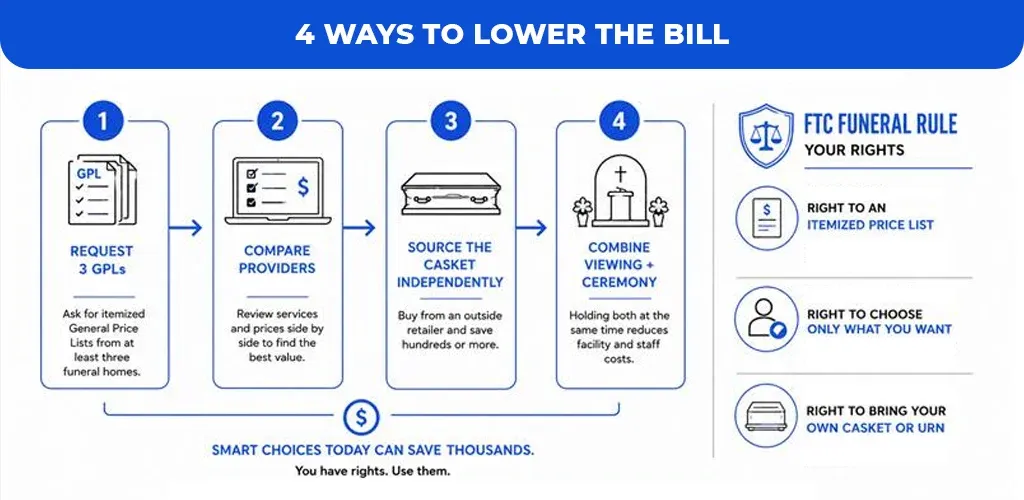
- Request the General Price List from at least three providers. Because the Funeral Rule guarantees access to an itemized GPL, comparing quotes from several funeral homes before committing is one of the simplest ways to see where prices differ for an equivalent set of services.
- Source the casket independently. Buying a casket from a third-party retailer instead of the funeral home’s showroom can produce substantial savings, since the funeral home cannot legally charge a fee for accepting an outside casket.
- Combine the viewing and the service into one day. Scheduling the viewing immediately before the funeral ceremony, on the same day and in the same facility, reduces the number of separate facility-use and staff-attendance charges on the bill.
- Consider pre-planning or final expense insurance. Pre-planning locks in today’s prices before annual increases and gives families time to compare options without pressure. Final expense insurance, a small whole life policy designed specifically to cover funeral and burial costs, is another way families prepare in advance so survivors are not left covering the bill out of pocket.
Conclusion
Navigating the financial realities of end-of-life arrangements requires careful planning, but no family has to do so without guidance. Understanding itemized costs, knowing your rights under the FTC Funeral Rule, and weighing options like direct cremation against traditional burial all help families honor a loved one meaningfully while protecting their financial well-being.
Ready to secure your family’s financial future? Visit Assurance Gurus today for expert guidance on final-expense insurance, estate-planning tools, and financial strategies that provide you and your family with lasting peace of mind.