

Key Takeaways
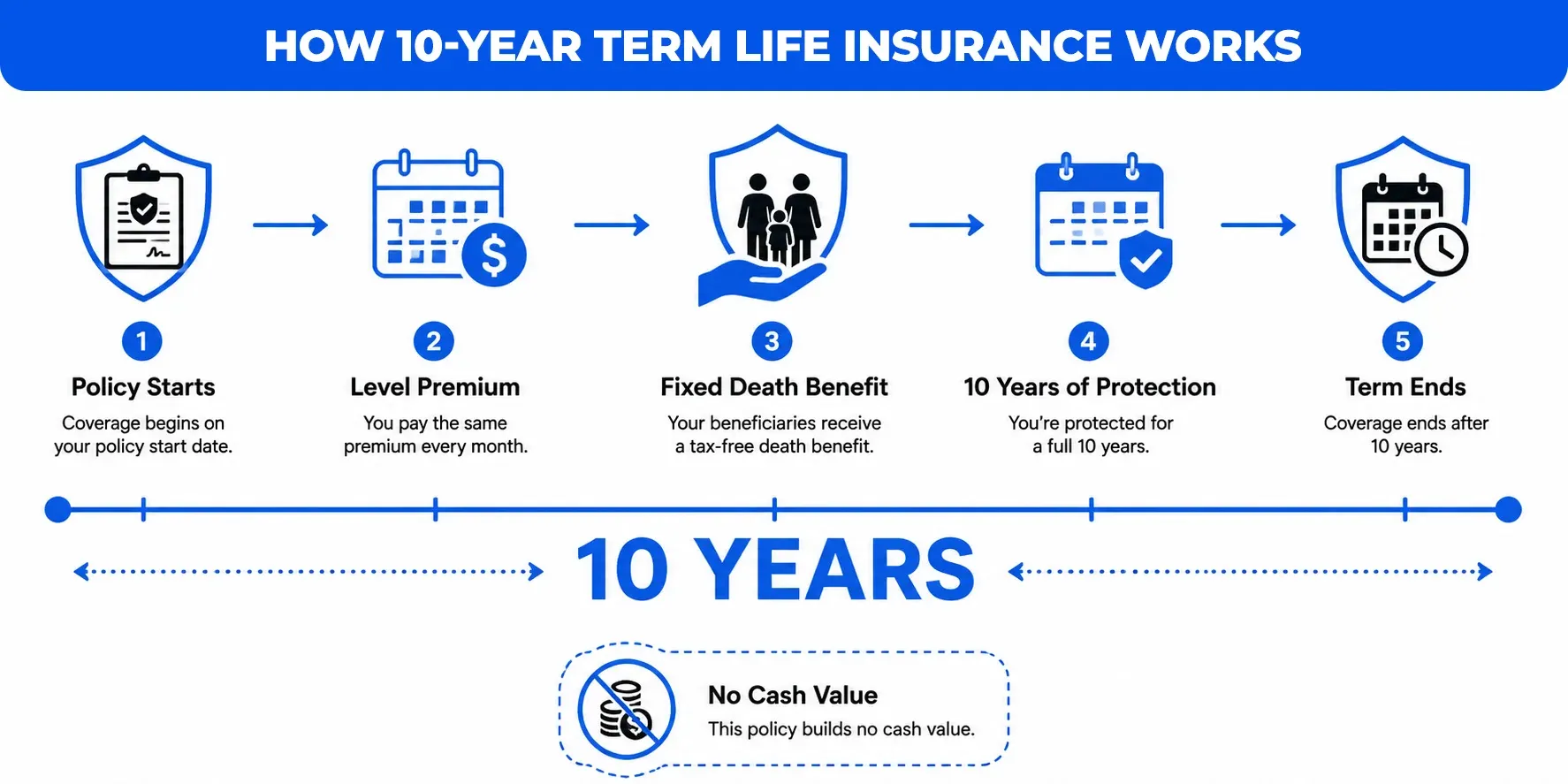
- Fixed term, fixed price. Your premium and death benefit stay the same for all 10 years; the policy has no cash value and is not an investment.
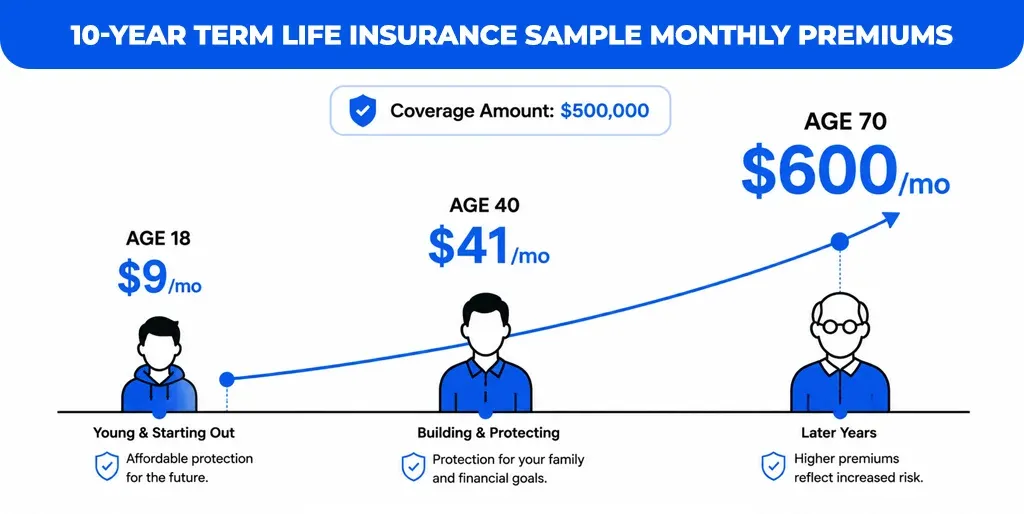
- Cost depends on age and health. According to a 2026 survey by MoneyGeek, a healthy 40-year-old paying for $500,000 of 10-year term coverage pays about $41 a month on average, while a healthy 18-year-old can pay as little as $9 a month for $100,000 in coverage.
- Roughly 4 in 10 households have a coverage gap. The 2025 Insurance Barometer Study from LIMRA and Life Happens found that about 40% of U.S. adults, representing close to 100 million people, say they need life insurance or need more of it.
- Coverage ends at year 10. Unless your policy includes a conversion privilege or you actively renew or replace it, your death benefit stops when the term expires.
- Comparing quotes matters. Premiums for otherwise identical coverage can vary significantly between carriers, which is why working with a broker like Assurance Gurus to compare multiple insurers is worth the extra few minutes.
What Is 10-Year Term Life Insurance?
10-year term life insurance is a category of term life insurance, meaning it is designed to provide coverage for a defined period rather than for your entire life. If you pass away during the 10-year term, the insurance company pays a tax-free death benefit to the beneficiaries you named on the policy. If you outlive the term, the coverage simply ends unless you take action to extend or convert it.
This structure makes 10-year term life insurance a pure protection product. It exists to replace income or cover a debt for a specific window of time, not to build savings or serve as an investment vehicle.
Term vs. Permanent Life Insurance
The main distinction in the life insurance market is between term life insurance and permanent life insurance, such as whole life insurance. Term life insurance, including the 10-year version, provides coverage for a set number of years and does not accumulate cash value. Permanent life insurance is designed to last your entire lifetime, typically costs more for the same death benefit, and builds a cash value component you can borrow against or withdraw from over time. A related product, final expense insurance, is a smaller permanent policy usually sized to cover funeral and end-of-life costs rather than income replacement.
Because 10-year term life insurance carries no cash value and no lifetime guarantee, insurers can price it more affordably than permanent coverage, which is a major reason it appeals to people managing a specific, time-limited financial responsibility.
How a 10-Year Term Life Insurance Policy Works
Once your 10-year term life insurance policy is issued, two things are locked in for the full 10 years: your premium and your death benefit. Insurers price the policy at issue based on your age, health, and risk profile, and, barring a policy lapse for nonpayment, that price does not increase during the term even if your health changes later.
The Application and Underwriting Process
Before a carrier issues a policy, it evaluates your risk through underwriting. Depending on the insurer, your coverage amount, and your age, this can include a health questionnaire, a review of your prescription and medical history through the Medical Information Bureau, and in many cases a paramedical exam that checks height, weight, blood pressure, and blood and urine samples. Some carriers now offer accelerated or no-exam underwriting for healthy applicants seeking lower coverage amounts, which can shorten the process from several weeks to a matter of days.
Choosing the Right Death Benefit Amount
Your death benefit should be sized to the obligation you are protecting. Common approaches include matching the benefit to your outstanding mortgage balance, the remaining balance on a business loan, or a multiple of your annual income intended to replace earnings for your dependents until a specific milestone, such as a child finishing school. Because the cost difference between coverage tiers is often modest relative to the protection gained, it is worth calculating your actual need rather than defaulting to a round number.
How Much Does 10-Year Term Life Insurance Cost?
10-year term life insurance is generally one of the more affordable term lengths available because the insurer is taking on risk for a shorter, more predictable window. Your actual 10-year term life insurance rate depends primarily on your age, sex, health classification, tobacco use, and the coverage amount you select.
Based on MoneyGeek’s 2026 survey of major life insurance carriers, a healthy 40-year-old man with average health pays an average of $41 per month for a 10-year term policy with $500,000 in coverage, while the lowest available rate in the survey was $9 per month for an 18-year-old healthy female nonsmoker carrying $100,000 in coverage. The same survey found that a 70-year-old man pays an average of $600 per month for $500,000 of coverage, that applicants in poor health pay an average of $46 per month, and that smokers pay an average of $133 per month for identical coverage.
The table below summarizes these figures as a general reference for what 10-year level term life insurance rates by age can look like. Your own quote will depend on the underwriting decisions of the specific carriers you apply with.
Age | Sex / Health | Coverage Amount | Approx. Monthly Premium* |
18 | Female, healthy nonsmoker | $100,000 | $9 |
18 | Female, healthy nonsmoker | $500,000 | $22 |
40 | Male, average health | $500,000 | $41 (national average) |
40 | Male, poor health rating | $500,000 | $46 |
40 | Smoker | $500,000 | $133 |
70 | Male | $500,000 | $600 |
Sample monthly premiums for healthy nonsmokers unless otherwise noted, based on MoneyGeek’s 2026 survey of major life insurance carriers. Actual rates vary by insurer and individual underwriting.
Because pricing can differ meaningfully between carriers for the same applicant profile, getting a 10-year term life insurance quote from more than one company is one of the simplest ways to control your cost.
How to Get a 10-Year Term Life Insurance Policy
Applying for a 10-year term life insurance policy generally follows the same four stages regardless of which carrier you choose.
- Assess your financial needs. Calculate the debt, income replacement, or obligation you want the policy to cover, and use that figure to set your target death benefit.
- Compare quotes from multiple carriers. Rates for identical coverage can vary by insurer, so requesting quotes from several top-rated companies, or working with a broker such as Assurance Guru, who can do this for you, helps confirm you are not overpaying.
- Complete the application and underwriting. Submit your health and lifestyle information, and complete any required exam or interview so the insurer can assign your final risk class.
- Review and accept your policy. Once approved, read the policy contract, confirm your death benefit and premium, and formally accept coverage to put the policy in force.
What Happens After a 10-Year Term Life Insurance Policy Ends?
At the end of the 10-year term, your guaranteed level premium period is over, and what happens next depends on your policy’s terms and the choice you make.
- If you do nothing: many policies either lapse, ending your coverage entirely, or continue on an annually renewable basis at a substantially higher premium that increases each year you keep it, since your risk class is now recalculated closer to your current age.
- If your policy includes a conversion option: many term policies allow you to convert some or all of the coverage to a permanent policy, such as whole life insurance, without a new medical exam, typically within a specified window while the term policy is still active. This can be valuable if your health has changed and you would no longer qualify for affordable coverage on the open market.
- If you apply for new coverage, you can shop for a new term or permanent policy at your current age and health status, which may or may not be more affordable than converting, depending on your circumstances.
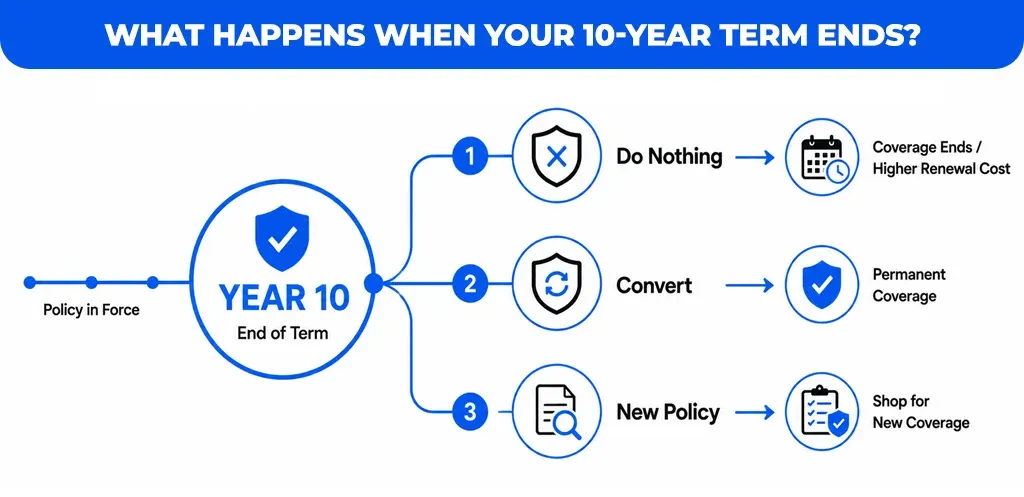
What to Do After Your 10-Year Term Life Insurance Policy Ends
The best time to plan for the end of your term is before you reach it, not after. In the final year or two of your policy, it is worth revisiting whether you still need the coverage at all.
- Reassess your need. If the mortgage is paid off, the business loan is settled, or your children are financially independent, you may no longer need the same amount of protection.
- Renew or convert if a gap remains. If you still have dependents or debt, look at renewing the existing policy, exercising a conversion privilege, or replacing it outright.
- Shop for a new policy early. If ongoing needs remain, comparing 10-year term life insurance quotes, or quotes for a longer term or permanent policy, a few months before expiration helps you avoid a coverage gap while the current policy is still in force.