

Key Takeaways
- Life insurance provides broader death protection than accident-only coverage.
- Qualifying accidental death and specific accidental injuries are the main focus of AD&D insurance.
- Even though their premiums and benefit amounts seem comparable, term life insurance and AD&D are not interchangeable.
- Depending on the contract, AD&D may include benefits for specific losses such as a hand, foot, limb, eyesight, hearing, or other losses.
- Life insurance may be particularly important when other people depend on your income.
- The exact definition of a covered accident, exclusions, benefit percentages, and claim requirements vary by policy.
- AD&D is often best considered as supplemental protection, rather than assuming it can replace comprehensive life insurance.
What Is the Difference Between Life Insurance and AD&D?
The simplest way to understand what is accidental death insurance vs life insurance is to look at the event that activates the benefit. A life insurance policy is designed primarily around the insured person’s death. If the insured dies from a covered cause during the policy period, the insurer generally pays the death benefit to the named beneficiaries, subject to the policy’s provisions.
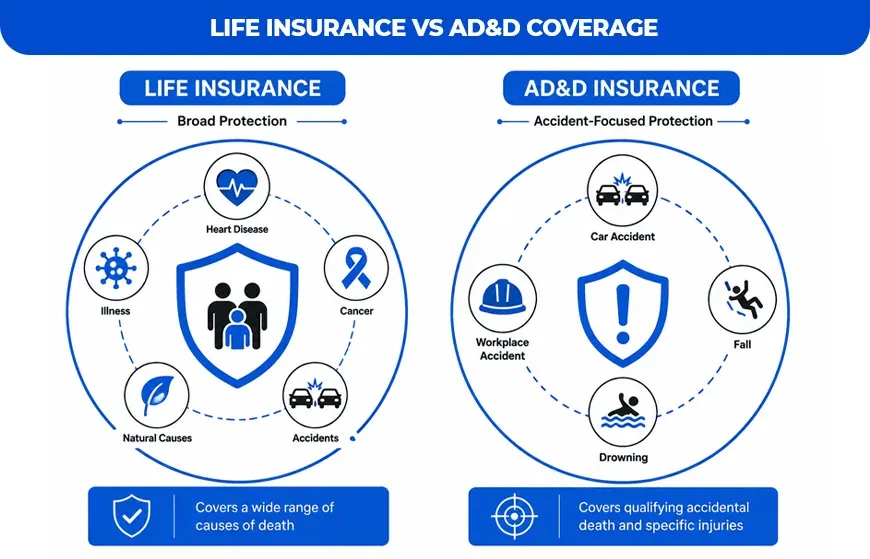
AD&D insurance is structured around accidental events. It may provide a benefit if a covered accident causes death and may also provide a separate benefit when a covered accident causes certain severe injuries.
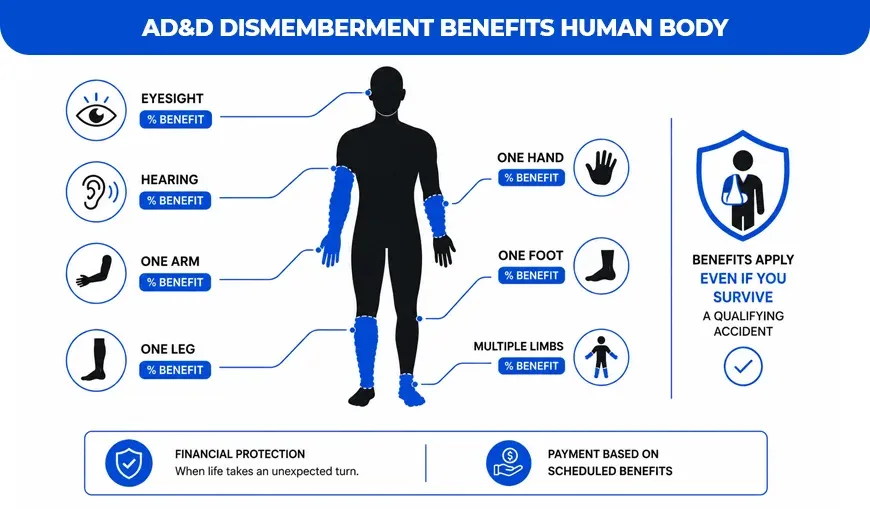
A policy may provide a percentage of the maximum benefit for a covered loss involving a limb, eyesight, hearing, or another body function specified in the contract.
For example, a policy might establish one benefit percentage for the loss of one limb and a different percentage for multiple qualifying losses.
What Does Accidental Death Insurance Not Cover?
This is one of the most important questions when comparing accidental death insurance vs life insurance. AD&D generally does not provide the broad death protection associated with traditional life insurance. An AD&D policy might not pay if a disease or other non-qualifying cause causes death.
Common limitations can include deaths or injuries associated with:
- Illness or disease
- Natural causes
- Suicide or self-inflicted injury, depending on policy language
- Intoxication or substance-related exclusions
- Criminal or illegal activities
- War or military-related risks
- Certain hazardous activities
- Other exclusions specifically stated in the contract
Life Insurance vs. Accidental Death Insurance: Pros and Cons
When deciding how to protect your family’s financial future, understanding the distinct advantages and drawbacks of each policy type is critical. Here is how traditional life insurance and Accidental Death & Dismemberment (AD&D) stack up side by side.
Traditional Life Insurance
Pros:
- Comprehensive Protection: Unlike accident-only plans, life insurance covers a broad spectrum of mortality risks, including illnesses, natural causes, terminal diseases, and accidents.
- Guaranteed Income Replacement: The tax-free death benefit provides a reliable financial safety net to replace lost wages, cover daily living expenses, and secure your family’s standard of living.
- Flexible Policy Options: You can choose between affordable term life insurance for a specific timeframe or permanent life insurance (like whole life) for lifelong coverage.
- Cash Value Growth: Permanent policies build a cash value component over time, which you can borrow against or use for long-term financial planning.
Cons:
- Higher Cost: Because the coverage is comprehensive and pays out more frequently, monthly premiums are generally higher than accident-only policies.
- Underwriting Requirements: Most policies require a medical exam and health history review, which can result in higher rates or denial if you have pre-existing conditions.
- Complexity: Permanent life insurance features intricate structures, cash-value dynamics, and fees that require careful management.
- Risk of Lapse: Policies require continuous premium payments to remain active, meaning coverage can lapse if payments stop.
Accidental Death & Dismemberment (AD&D) Insurance
Pros:
- Affordable Supplemental Layer: AD&D policies feature significantly lower monthly premiums, making them an inexpensive way to add extra financial cushion.
- No Medical Exams Needed: These policies typically require no health questions or medical underwriting, guaranteeing acceptance regardless of your medical history.
- Dismemberment Payouts: Unlike standard life insurance, AD&D provides payouts for non-fatal catastrophic injuries, such as the loss of a limb, eyesight, or hearing.
- Convenient Employer Perks: Many companies offer basic AD&D coverage automatically or as a low-cost add-on through employee benefits packages.
Cons:
- Narrow Coverage Triggers: The policy only pays out if death or injury results strictly from a qualifying, accidental event—offering zero protection against illness or old age.
- Not a True Substitute: Because it excludes natural causes and disease, AD&D can never safely replace a comprehensive life insurance policy for families with financial dependents.
- Strict Exclusions and Fine Print: Claims can be heavily contested or denied based on strict definitions of what qualifies as an “accident,” or if substances/hazardous activities were involved.
- Variable Injury Payouts: The amount you receive for a dismemberment claim is rarely 100% of the policy value; instead, it scales down based on a rigid schedule of benefits.
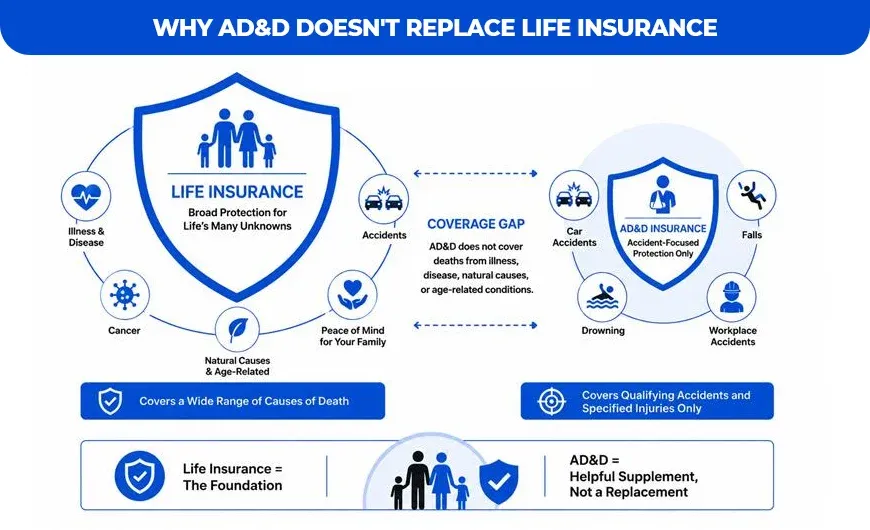
Life Insurance vs Accidental Death: Side-by-Side Comparison
Feature | Life Insurance | AD&D Insurance |
Primary purpose | Broad death protection | Accidental death and specified injury protection |
Death from illness | Generally covered if within policy terms | Generally not covered |
Death from qualifying accident | Generally covered if within policy terms | May be covered |
Dismemberment benefit | Generally not a standard feature | Common feature |
Coverage structure | Term or permanent | Accident-focused coverage |
Beneficiary death benefit | Yes, when payable under policy | Yes, for qualifying accidental death |
Cash value | Possible with permanent policies | Generally not a cash-value product |
This comparison explains why accidental death insurance vs life insurance should not be viewed simply as two versions of the same product. Their purposes are different.
Conclusion
The choice between life insurance vs. accidental death insurance becomes much easier when you stop viewing the products as direct substitutes. While life insurance is designed to provide comprehensive financial protection against a wide range of qualifying causes, including illness and natural death, AD&D is a much narrower product focused exclusively on qualifying accidents and specified injuries. For any household that depends on your ongoing income, relying solely on accident-only coverage leaves a massive, vulnerable gap if a non-accidental event occurs.
For many consumers, the most practical strategy is to establish a solid foundation of traditional life insurance first, and then treat AD&D as a supplemental layer of protection if it fits your budget. When you are ready to explore your options, visit Assurance Gurus to compare personalized coverage choices and speak with licensed professionals who can help you weigh policy types, underwriting requirements, and exclusions before you make a decision.