



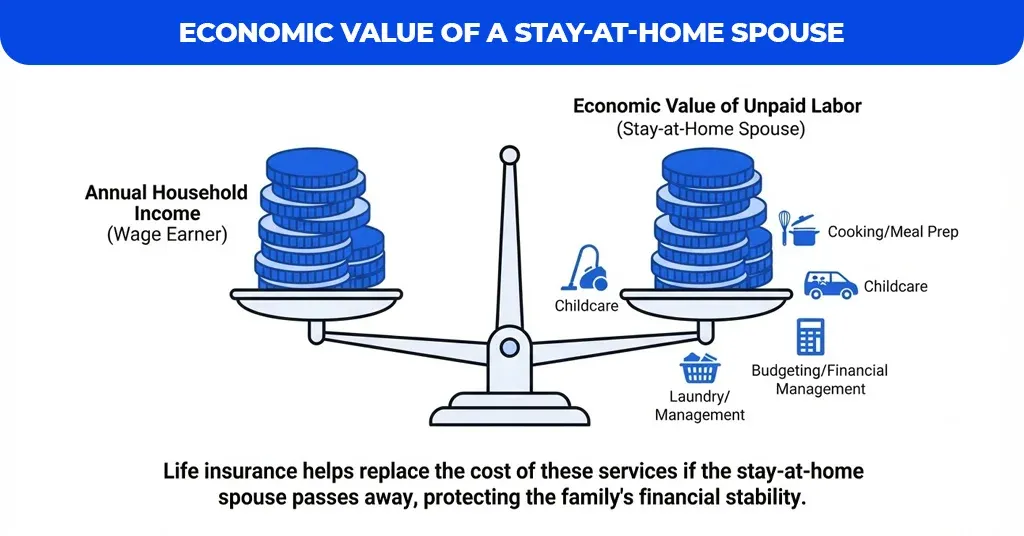
A life insurance policy or rider added to an already-existing policy that provides a death benefit in the event of your spouse’s death is known as spouse life insurance. Losing a spouse is a financial event as well as a personal one: a working spouse’s income stops, and a stay-at-home spouse’s unpaid labor, including childcare, cooking, and household management, has to be replaced or paid for out of pocket.
This guide explains what spouse life insurance is, how it works, what a typical schedule of benefits includes, what it costs based on current industry pricing data, and how to calculate the coverage amount your household actually needs.
| Quick Answer Spouse life insurance is coverage on your spouse’s life, purchased either as its own standalone policy or added as a rider to your existing life insurance policy. If your spouse passes away while the policy is in effect, you will receive a tax-free death benefit. It can be term (temporary) or permanent coverage, and the payout is meant to replace lost income, pay off shared debt, cover final expenses, and fund services a stay-at-home spouse provided, such as childcare. |
| Key Takeaways Spouse life insurance is available as a standalone policy or as a rider attached to a primary policyholder’s plan.A rider is usually less expensive but has lower coverage limits and, in many policies, ends if the primary policy lapses or the primary insured dies. Review the rider’s exact terms before relying on it.A standalone policy typically costs more than a rider but is not dependent on someone else’s coverage staying in force.47% of U.S. adults say their household would have trouble paying living expenses within six months of a primary wage earner’s death (LIMRA, 2026 Insurance Barometer Study).The price of term life insurance is often overestimated. LIMRA’s 2026 study found that respondents guessed a $250,000, 20-year term policy for a healthy man in his early thirties would cost roughly seven times its actual price.A stay-at-home spouse’s unpaid work has measurable economic value, which is worth factoring into a coverage decision even when that spouse has no salary. |
What Is Spouse Life Insurance?
Spouse life insurance, sometimes called spousal life insurance, is life insurance coverage where your husband or wife is the insured person and you (or another named beneficiary) receive the death benefit if they die. It is not a distinct product category with a set structure. It can take two forms.
Standalone policy: A term or permanent life insurance policy purchased directly in your spouse’s name, independent of anyone else’s coverage. This is what people usually mean by “life insurance for spouse” or “life insurance policy for spouse” when they are shopping for a full policy rather than an add-on.
Spouse rider: An optional add-on attached to a primary policyholder’s own term or permanent policy. The rider extends a smaller amount of coverage to the policyholder’s spouse without requiring a separate application in many cases.
To buy a policy on a spouse, the applicant generally needs to demonstrate insurable interest, meaning a financial or emotional relationship where the applicant would suffer a genuine loss if the insured person died. Marriage satisfies this requirement in virtually every U.S. state. The insurer also underwrites the insured spouse based on age, health, tobacco use, and other risk factors, and the policy names a beneficiary, typically the surviving spouse, who receives the death benefit.
How Does Spouse Life Insurance Work?
With a few exceptions for insuring a spouse, the mechanics are the same as for any other individual life insurance policy.
- Application and underwriting: The insured spouse applies (or is added as a rider) and answers health and lifestyle questions. Many riders use simplified or guaranteed issue underwriting with no medical exam, while standalone policies with larger death benefits usually require full underwriting.
- Premiums: The policyholder pays premiums, monthly or annually, to keep the coverage active. Missed payments beyond a grace period can cause the policy or rider to lapse.
- Beneficiary designation: The surviving spouse, or another named beneficiary such as a trust or the couple’s children, is designated to receive the death benefit.
- Claim and payout: When the insured spouse dies, the beneficiary files a claim with documentation, typically a certified death certificate, and the insurer pays the death benefit, which is generally received income-tax-free.
Standalone Policy vs. Spouse Rider
| Feature | Standalone Policy | Spouse Rider |
| Coverage amount | Can be sized to full income-replacement needs (often hundreds of thousands of dollars) | Usually capped at a smaller amount and often limited relative to the primary policy’s face value |
| Underwriting | Typically full medical underwriting for larger amounts | Often simplified or guaranteed issue |
| Cost | Higher, priced on the insured spouse’s own age and health | Generally lower per dollar of coverage |
| Independence | Stays in force on its own as long as premiums are paid | May terminate if the primary policy lapses or the primary insured dies; terms vary by insurer |
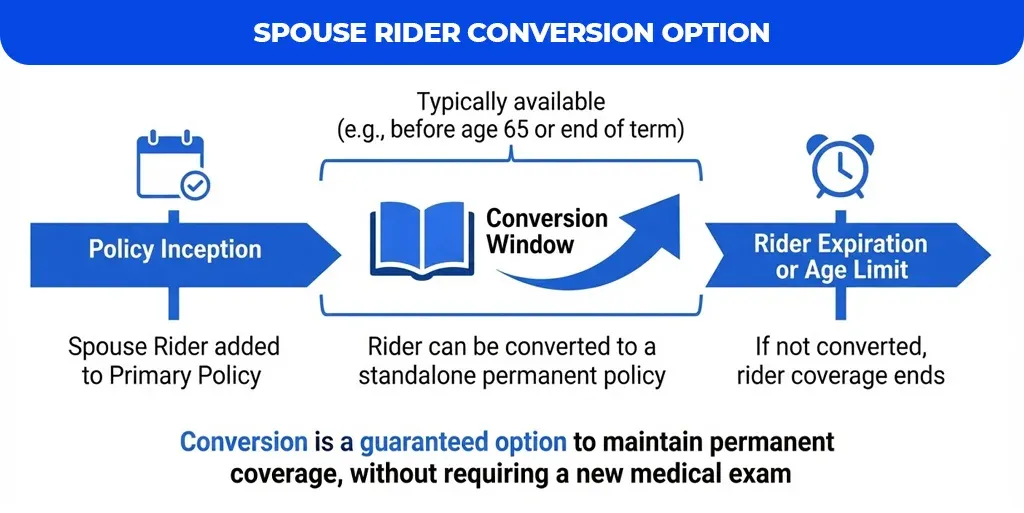
| Conversion | Term policies can often be converted to permanent coverage | Many riders include a conversion option to a standalone policy, often without new medical underwriting |
Spouse Life Insurance Schedule of Benefits
A schedule of benefits is the section of a policy contract that lists exactly what is covered, what optional riders are attached, and what is excluded. Components commonly found in spouse life insurance policies and riders include the following.
- Base death benefit: The core, tax-free lump sum paid to the beneficiary when the insured spouse dies.
- Accelerated death benefit rider: Lets the policyholder access part of the death benefit early if the insured spouse is diagnosed with a qualifying terminal illness.
- Waiver of premium rider: Waives future premiums if the primary policyholder becomes totally disabled, so the coverage does not lapse.
- Accidental death benefit rider: Pays an additional amount if death results from a covered accident.
- Conversion privilege: The option to convert term coverage, including a spouse rider, into a permanent policy, often without a new medical exam, usually within a defined age or time window.
- Exclusions: Standard contract provisions such as the contestability period described above and, in many policies, a suicide exclusion during the first one to two years of coverage.
The table below is a hypothetical example only, meant to illustrate how these components typically relate to each other within a single policy. It does not represent an actual product, insurer, or quote. Contact a licensed insurance agent or insurer for real policy figures.
| Benefit Component | Illustrative Primary Coverage | Illustrative Spouse Rider Coverage | Typical Payout Trigger |
| Base death benefit | $500,000 | $100,000 | Death of the insured while the policy is in force |
| Terminal illness advance | Up to 50% of the death benefit | Up to 50% of the rider amount | Diagnosis of a qualifying terminal illness |
| Accidental death benefit | Additional amount, if elected | Additional amount, if elected | Death caused strictly by a covered accident |
| Waiver of premium | May be included | May be included | Total disability of the primary policyholder |
How Much Does Spousal Life Insurance Cost?
Term life insurance is generally inexpensive for younger, healthy applicants, and cost rises with age. According to the Policygenius Life Insurance Price Index, a healthy, nonsmoking 30-year-old woman paid an average of $23.10 per month for a $500,000, 20-year term policy as of October 2026, while a man of the same age and health class paid an average of $29.56 per month.
For smaller death benefits, Guardian reports that a $100,000 term policy can cost as little as $11 a month for a healthy 30-year-old woman, with rates rising for older applicants and larger coverage amounts.
Average Monthly Term Life Premiums by Age
| Age | Male, Nonsmoker (Preferred) | Female, Nonsmoker (Preferred) |
| 30 | $28.00 | $23.50 |
| 40 | $34.50 | $35.27 |
| 50 | $76.50 | $78.30 |
| 60 | $298.50 | $216.00 |
Many people significantly overestimate what this coverage actually costs. LIMRA’s 2026 Insurance Barometer Study found that, on average, respondents estimated a $250,000, 20-year term policy for a healthy 31-to-35-year-old man in good health would cost around $1,486 per year, roughly seven times more than the actual average premium.
A spouse rider is usually cheaper than a comparable standalone policy because it rides on the primary policy’s underwriting and administrative structure, but exact pricing depends on the insurer, the rider’s coverage limit, and the insured spouse’s age and health.
How Much Coverage Do You Need? The DIME Method
The DIME method is a widely used financial-planning framework for estimating a life insurance need. It stands for Debt, Income, Mortgage, and Education, and it works by adding four figures together.
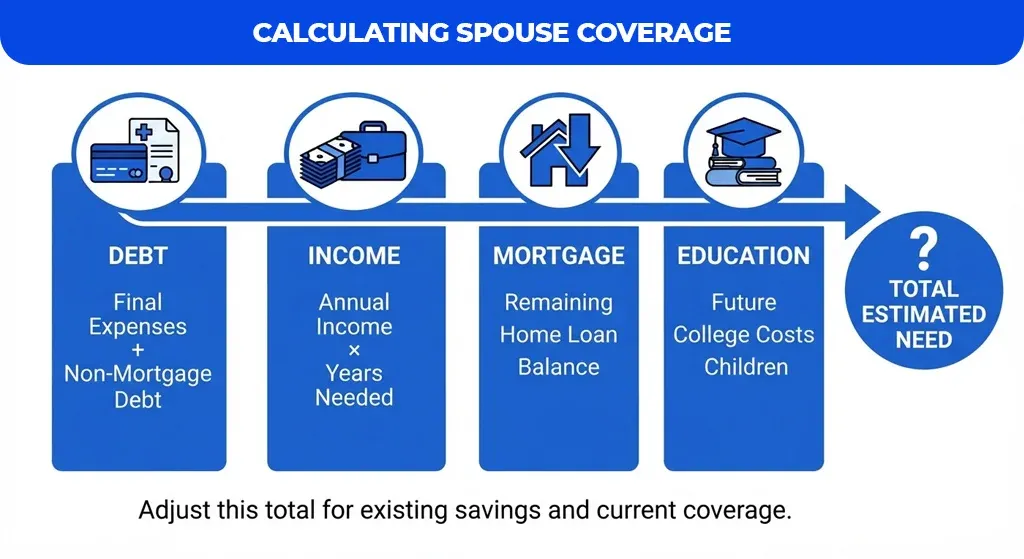
- Debt: Non-mortgage debt, such as credit cards, auto loans, and personal loans, plus an estimate of final expenses.
- Income: Annual income multiplied by the number of years your household would need that income replaced.
- Mortgage: The remaining balance on the mortgage, so the surviving spouse can keep the home without refinancing under pressure.
- Education: Projected education costs for any children, such as future college expenses.
Final expenses are a meaningful part of the debt component. According to the National Funeral Directors Association (NFDA), the median cost of a funeral with viewing and burial was approximately $8,300 in 2026, while a funeral with viewing and cremation averaged about $6,280.
The DIME total is a starting estimate, not a final number. It should be adjusted for existing savings, current life insurance coverage, and any income or benefits the household would still receive, and it is worth running separately for each spouse, including a spouse who does not earn a paycheck.
Pros and Cons of Spouse Life Insurance
Pros
- A rider is often less expensive than buying two entirely separate standalone policies.
- Many riders use simplified underwriting, which can speed up approval.
- Coverage helps protect against sudden income and household-labor disruption, supporting stability for a surviving spouse and children.
Cons
- Riders often carry coverage caps and cannot always match the primary policy’s face value.
- A rider attached to a primary policy can terminate if that primary policy lapses or the primary policyholder dies; the exact trigger depends on the insurer’s contract language.
- Term riders and term standalone policies both expire at the end of their term, which can leave older couples without coverage unless they convert to a permanent policy.
Secure Your Family’s Financial Future Today
Spouse life insurance serves as an essential financial safeguard, bridging the gap between personal grief and unexpected economic hardship. Whether you choose a cost-effective rider or a robust standalone policy, securing this coverage ensures that your household can manage immediate debts, maintain its standard of living, and comfortably handle the replacement costs of vital domestic labor.
Taking the time to evaluate your family’s specific needs through frameworks like the DIME method empowers you to make an informed decision tailored to your budget and long-term goals. To take the next step in protecting your household’s financial future, explore personalized options and secure a custom quote today. Ready to see personalized rates for you and your spouse? Get a custom quote from Assurance Gurus.