



An annuity is one of the few financial products that can guarantee you an income for life, which is why it comes up so often in retirement planning. The word covers a wide range of contracts, though, from simple fixed annuities to complex variable ones with layers of fees.
Quick answer: An annuity is a contract with an insurance company: you pay a lump sum or a series of payments, and the insurer pays you income, either right away (immediate annuity) or later (deferred annuity), often for the rest of your life. In October 2026, a $100,000 immediate annuity bought at 65 pays roughly 590–700 a month for life, depending on gender and the insurer.
What is an annuity?
In finance and insurance, an annuity is a contract with an insurance company designed for retirement and other long-term goals. You pay the insurer a lump sum or a series of payments, and it makes periodic payments to you, either starting soon or at a future date. Many annuities can guarantee income for life, protecting you against outliving your savings.
The core mechanism
An annuity has up to two phases:
1. Accumulation phase: In a deferred annuity, your money grows tax-deferred, through a fixed rate, an index-linked formula, or market investments.
2. Annuitization (payout) phase: You convert the value into a stream of payments for a set period or for life.
The insurer pools longevity risk across many customers, which is how it can promise lifetime income: people who live longer are paid partly by those who die sooner.
Key contract roles
| Role | What they do |
| Owner | Buys the annuity, controls it, and makes decisions such as withdrawals |
| Annuitant | The person whose life expectancy sets the payments; often the same as the owner |
| Beneficiary | Receives any remaining death benefit or payments after death |
| Insurance company | Issues the contract and guarantees payments, backed by its financial strength |
Note: An annuity’s guarantees are only as strong as the insurer behind them. Check financial strength ratings before you buy.
See Assurance Gurus’ guide to life insurance and annuities.
Types of annuities: fixed vs. indexed vs. variable
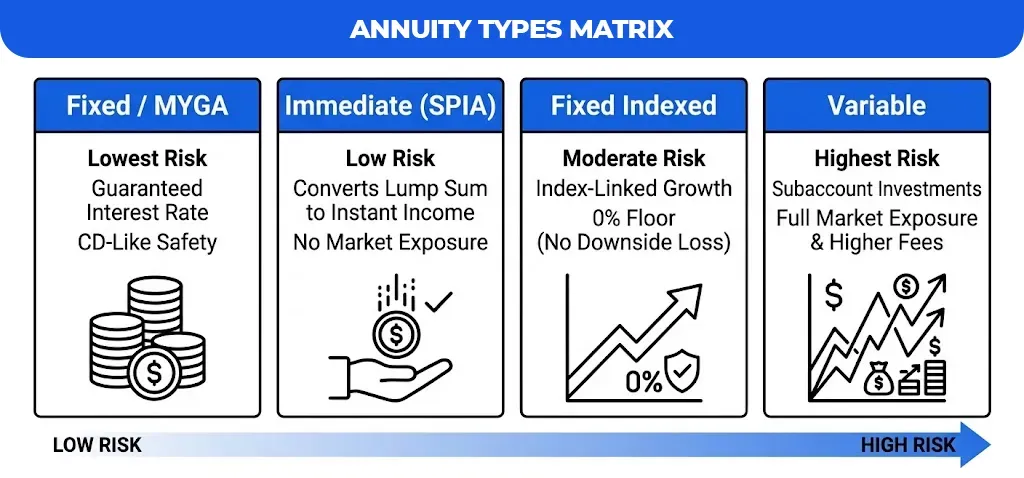
Annuities are classified two ways: by when payments start (immediate or deferred) and by how the money grows (fixed, fixed indexed, or variable). According to the SEC’s Investor.gov, fixed annuities carry the least risk, fixed indexed annuities sit in the middle, and variable annuities carry full market risk.
Fixed annuity definition
A fixed annuity earns at least a guaranteed minimum interest rate set by the insurer, with no market risk to your principal. A multi-year guaranteed annuity (MYGA) is a type of fixed annuity that locks in one rate for a set number of years, similar to a CD. Fixed annuities are regulated by state insurance departments.
Immediate annuity definition (SPIA)
A single premium immediate annuity (SPIA) turns a lump sum into income that typically starts within one year of purchase. There’s no accumulation phase; you trade the lump sum for guaranteed payments, usually for life or a set period.
Deferred annuity definition
A deferred annuity has an accumulation phase in which money grows tax-deferred, followed by a payout phase that starts later, often in retirement. You can fund it with one premium or, in a flexible premium annuity, with multiple payments over time.
Fixed index annuity definition (equity indexed annuity)
A fixed indexed annuity, also called an equity indexed annuity, credits interest based partly on a market index such as the S&P 500, but never less than zero, according to Investor.gov. Your upside is limited by:
• Caps: the maximum interest credited in a period
• Participation rates: the share of the index gain you receive
• Spreads: a percentage subtracted from the index gain
You don’t own the index or receive dividends; the formula only determines the interest credited.
Variable annuity definition
A variable annuity invests your money in subaccounts similar to mutual funds, with no limit on gains or losses, so you carry the market risk. Variable annuities are securities registered with the SEC. They typically carry the highest fees, including mortality and expense (M&E) risk charges of about 1.25% a year, administrative fees, and underlying fund fees. A variable life annuity pays lifetime income that rises or falls with subaccount performance.
Master annuity type matrix
| Annuity type | Growth mechanism | Downside risk | Fee level | Ideal investor |
| Fixed / MYGA | Guaranteed interest rate | None to principal (backed by insurer) | Low | Conservative savers wanting CD-like safety |
| Immediate (SPIA) | Converts lump sum to income | No market risk; little or no liquidity | Built into the payout | Retirees wanting income now |
| Fixed indexed | Index-linked interest, 0% floor, caps | No market loss; limited upside | Moderate, mostly implicit | Savers wanting some upside with protection |
| Variable | Subaccount investments | Full market risk | Highest | Investors comfortable with risk who want tax deferral |
| Deferred (any of the above) | Grows before payout | Depends on type | Depends on type | Pre-retirees planning future income |
Note: Registered index-linked annuities (RILAs) are a separate type in which you can lose money; they’re SEC-registered securities.
Annuity payout structures and settlement options
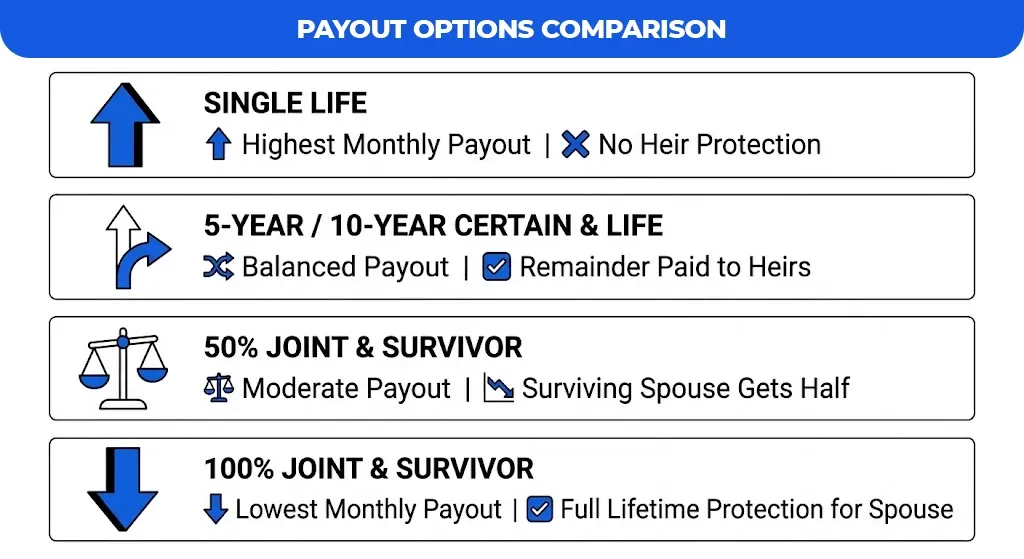
When you turn an annuity into income, you choose how long payments last and who receives them. Single life pays the most each month but stops at death. Joint and survivor options cover two people for less per month. Period certain options guarantee payments for a minimum number of years.
Ordinary annuity vs. annuity due
In finance math, an ordinary annuity is a series of equal payments made at the end of each period, like most loan payments. An annuity due pays at the beginning of each period, like rent. These are math terms for valuing payment streams, separate from insurance annuity products.
Single life annuity definition
A single life annuity (life only) pays income for as long as the annuitant lives, then stops, with nothing left for heirs. Because the insurer has no obligation after death, it pays the highest monthly amount of any lifetime option.
Joint and survivor annuity definitions
• 100% joint and survivor: Pays the same amount for as long as either spouse is alive. Lower starting payment, full protection for the survivor.
• 50% joint and survivor: Pays a set amount while both are alive, then 50% to the survivor. Higher starting payment than 100%, but the survivor’s income is cut in half.
Certain and life annuity definitions
• 5 year certain and life: Pays for life, with payments guaranteed for at least five years. If the annuitant dies in year 2, the beneficiary receives the remaining three years.
• 10 year certain and life: The same, with a 10-year guarantee. CBS News, citing Annuity.org, reports that a 65-year-old man would get about $625 a month from $100,000 on a life-only basis versus about $608 with a 10-year guarantee.
Other definitions
• Single premium immediate annuity (SPIA): One lump-sum payment, income usually within a year.
• Flexible premium annuity: Allows multiple contributions over time, usually a deferred annuity.
• Retirement annuity: A general term for any annuity used to provide retirement income, including annuities inside IRAs or employer plans.
• Charitable gift annuity: A contract with a charity, not an insurer: you donate assets and the charity pays you fixed income for life; part of the gift may be tax-deductible.
• Simple annuity: In finance math, an annuity where payment periods match interest compounding periods.
Payout option comparison
| Option | Monthly payment | Survivor or heir protection | Best for |
| Single life | Highest | None | Single people, maximum income |
| 10 year certain and life | Slightly lower | Heirs receive the rest of the 10 years | People worried about dying early |
| 50% joint and survivor | Lower | Survivor gets half | Couples where the survivor has other income |
| 100% joint and survivor | Lowest | Survivor gets full payment | Couples who rely on this income |
Annuity payout calculations: $50,000 and $100,000
An annuity’s monthly payout depends mostly on your age, gender, the payout option, and interest rates when you buy. Older buyers get more per month because payments are expected to last fewer years. In October 2026, top quotes for a $100,000 lifetime immediate annuity ranged from about $638 a month at 60 to about $895 at 75.
How insurers set payout rates
• Age: The older you are, the higher the payout.
• Gender: Women usually receive slightly less because they live longer on average.
• Interest rates: Higher prevailing rates mean higher payouts.
• Payout option: Joint, period certain, and refund options pay less than single life.
• Insurer: Quotes for identical contracts can differ noticeably between companies.
The basic relationship:
Monthly payout = (Principal × Annual payout rate) ÷ 12
For example, a quote of $701 a month on 100,000impliesanannualpayoutrateofabout8.4%(701 × 12 ÷ $100,000). The payout rate isn’t an investment return: part of each payment is your own principal coming back.
Estimated monthly payouts: lifetime immediate annuities (October 2026)
| Age | $100k, man | $100k, woman | $100k, joint (same-age couple) | $50k, man | $50k, woman | $50k, joint |
| 60 | $658 | $638 | $597 | $329 | $319 | $299 |
| 65 | $701 | $672 | $622 | $351 | $336 | $311 |
| 70 | $771 | $738 | $661 | $386 | $369 | $331 |
| 75 | $895 | $849 | $732 | $448 | $425 | $366 |
$100,000 figures are top quotes from carriers rated A- or better (MyAnnuityStore, October 2026), life only, with joint payments continuing 100% to the survivor. $50,000 figures are half the $100,000 quotes; actual small-contract quotes may differ slightly.
Note: These are top quotes. Average quotes are lower: CBS News, citing Annuity.org (September 2026), reported about $530 (man) and $503 (woman) at 60, $625 and $590 at 65, $750 and $703 at 70, and $920 and $859 at 75. Always compare several insurers.
How much does a $100,000 annuity pay each month?
For a lifetime immediate annuity bought in 2026, roughly 500–660 a month at 60, 590–700 at 65, 700–770 at 70, and 850–920 at 75, depending on gender and insurer. A joint-life contract for a 65-year-old couple paid about 536–622.
How much does a $50,000 annuity pay per month?
About half as much: roughly 250–330 a month at 60, 295–350 at 65, 350–385 at 70, and 425–460 at 75 on a single-life basis.
Annuity vs. 401(k) and the downsides of annuities
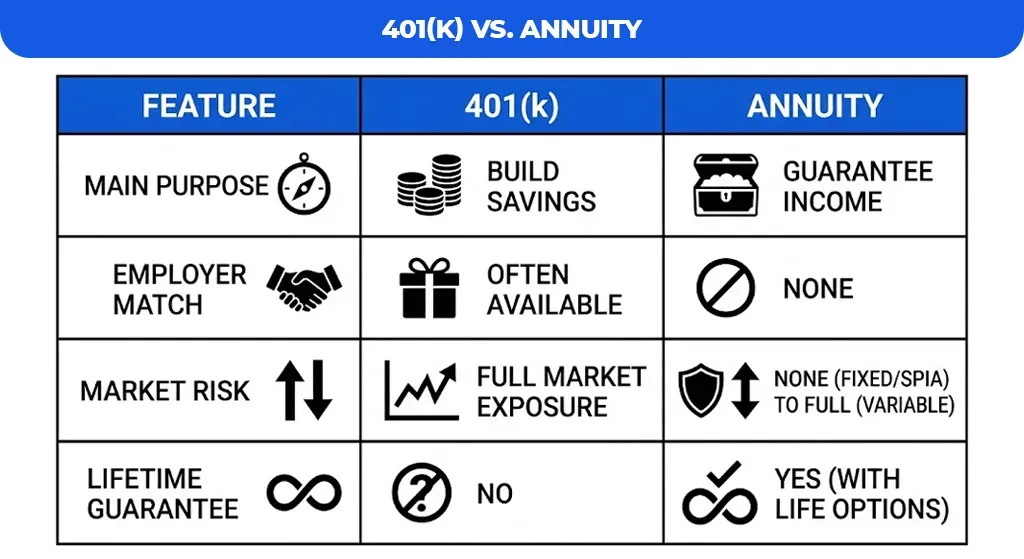
A 401(k) is usually the better tool for building retirement savings, especially with an employer match. An annuity is a tool for turning savings into guaranteed income. They aren’t direct substitutes, and many retirees use a 401(k) to save and an annuity to secure part of their income.
What is better, a 401(k) or an annuity?
| Feature | 401(k) | Annuity |
| Main purpose | Build savings | Provide guaranteed income (or tax-deferred growth) |
| Employer match | Often available | No |
| Growth potential | Market-based; can be high | Fixed, index-linked, or market-based depending on type |
| Market risk | Yes | None for fixed and SPIAs; limited for fixed indexed; full for variable |
| Lifetime income guarantee | No | Yes, if annuitized or with an income rider |
| Liquidity | Withdrawals allowed (taxes and possible penalties) | Limited; surrender charges in early years |
| Fees | Fund expenses, plan fees | Can be higher, especially variable annuities |
| Required minimum distributions | Yes, for traditional 401(k)s | Apply if the annuity is held in an IRA or plan; generally not for non-qualified annuities |
For most workers, the order is: contribute enough to get the full employer match, then consider other options. Holding an annuity inside a 401(k) or IRA adds no extra tax deferral, per Investor.gov.
What is the downside of an annuity?
• Surrender charges: Withdrawals in the early years, often within six to eight years, trigger charges that typically decline over time. Many contracts allow a limited free withdrawal each year.
• Limited liquidity: Once you annuitize, you usually can’t get your lump sum back.
• Fees: Variable annuities often charge a mortality and expense (M&E) risk charge of about 1.25% a year, plus administrative fees (about 25–30 or 0.15% a year) and fund fees. Riders such as a guaranteed minimum income benefit (GMIB) cost extra.
• Implicit costs: Caps and participation rates on indexed annuities limit your upside.
• Inflation: Fixed payments lose purchasing power over time unless you buy an inflation-adjusted option, which pays less at first.
• Insurer risk: Guarantees depend on the insurer’s financial strength.
• Complexity: Contracts can be hard to compare, and some “guaranteed” benefits apply only in limited situations.
How annuities are taxed
• Qualified annuities (held in an IRA or employer plan and funded with pre-tax money): Payments are generally fully taxable as ordinary income.
• Non-qualified annuities (bought with after-tax money): Growth is tax-deferred. When you annuitize, each payment is split into a tax-free return of your investment and a taxable portion, using IRS rules (the General Rule in Publication 939).
• Early withdrawals: Taxable withdrawals before age 59½ may face a 10% IRS penalty on top of ordinary income tax.
• Gains are taxed as ordinary income, not at lower capital gains rates.
How to avoid common annuity pitfalls
1. Know exactly what problem the annuity solves: income, safety, or tax deferral.
2. Read the surrender schedule and free withdrawal rules before signing.
3. Add up every fee, including rider and fund fees.
4. Compare quotes from several highly rated insurers.
5. Use the free-look period, usually 10 to 30 days, to review the contract.
6. Be wary of exchanging one annuity for another; it can restart surrender charges.
7. Don’t put all your savings in an annuity; keep an emergency fund and liquid investments.
Conclusion:
An annuity is a contract that turns savings into income, sometimes for life. Fixed and immediate annuities offer safety and predictability; indexed annuities trade some upside for protection; variable annuities offer market growth with higher fees and risk. For most retirees, the best plan combines guaranteed income for essential expenses with liquid investments for growth and emergencies.
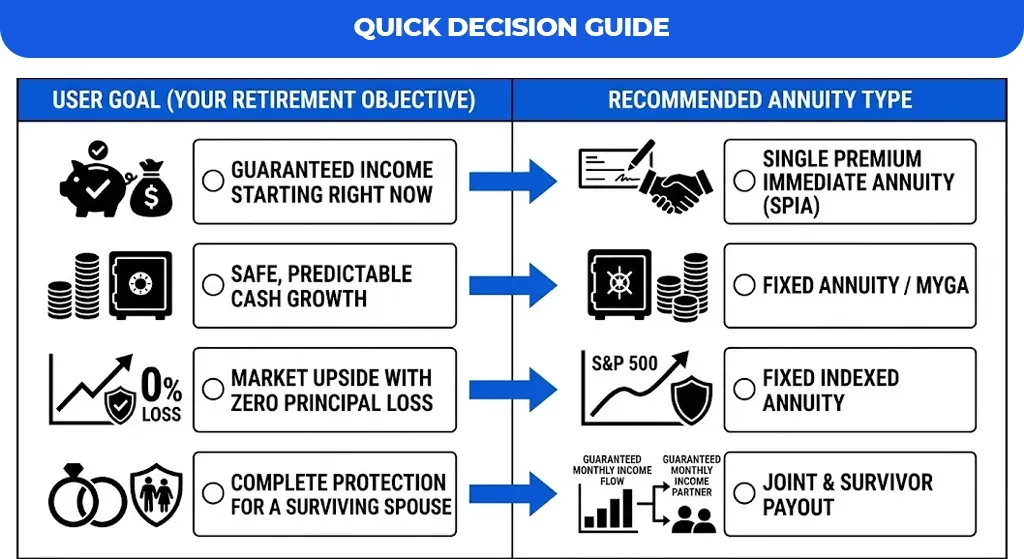
| Your goal | Annuity type to consider |
| Guaranteed income starting now | Single premium immediate annuity (SPIA) |
| Safe, CD-like growth for a set term | Fixed annuity / MYGA |
| Some market upside with no loss of principal | Fixed indexed annuity |
| Tax-deferred market growth (after maxing retirement accounts) | Variable annuity, with fees reviewed carefully |
| Income that protects a spouse | Joint and survivor payout |
| Income now plus protection for heirs if you die early | Period certain and life payout |
Compare annuity rates at Assurance Gurus
Assurance Gurus helps pre-retirees and retirees across the United States compare annuity and life insurance options, so you can see how guaranteed income could fit alongside your 401(k), IRA, and other savings. Assurance Gurus annuity specialists can walk you through payout options and compare quotes from multiple carriers.
Get custom annuity quotes on Assurance Gurus or call 888-363-1938.