



A healthy 30-year-old woman can buy $500,000 of 20-year term life insurance for about $31 a month in 2026, while the same coverage as whole life costs about $405. That gap is the single most important fact about affordable life insurance. This guide shows what coverage really costs at every age from 20 to 60, why the term is the budget champion, what Colonial Penn’s $9.95 offer actually buys, which carriers price lowest, and seven ways to cut your premium.
Quick answer: The most affordable life insurance for most adults is level term life from a highly rated insurer, bought young and in good health. In 2026, $500,000 of 20-year term averages about 47–59 a month at age 40, and $100,000 about 16–19, versus roughly 10 times more for whole life. Seniors who only need funeral money may find small whole life (final expense) policies more practical.
What is affordable life insurance?
Affordable life insurance is coverage that gives your family the largest possible death benefit for the smallest premium you can comfortably keep paying. In practice, that almost always means term life insurance: pure protection for a set number of years, with no cash value and no investment component, which is why it costs so little.
Why term life is the most affordable
• No cash value: every premium dollar buys protection, not savings.
• Temporary: coverage ends when you’re older and the risk of death is higher, so insurers can charge less.
• Level premiums: the price is locked for 10, 15, 20, or 30 years.
• Huge leverage: a 30-year-old can buy $500,000 of coverage for about $1 a day.
Permanent policies (whole and universal life) last for life and build cash value, but that guarantee makes them far more expensive. They make sense for lifelong needs like estate planning or final expenses, not for replacing income during the working years.
An affordable policy also has to be one you’ll keep. A cheap policy that lapses because the premium strains your budget protects no one. See Assurance Gurus’s guide to cheap life insurance and affordable term life insurance.
Average cost of life insurance: 2026 rate benchmarks
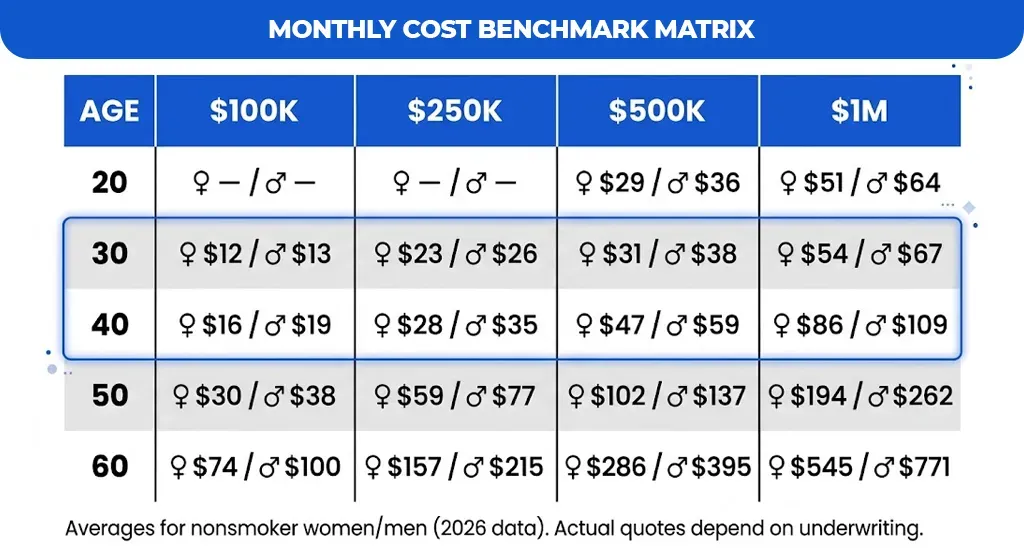
In 2026, a $500,000 20-year term policy averages about 31–38 a month at age 30 and 47–59 at age 40 for nonsmokers in average health. Rates roughly double every decade after 40, and a 60-year-old pays about nine to ten times what a 30-year-old pays for the same coverage.
Key rate drivers
| Factor | Impact |
| Age | The biggest driver; rates rise faster after 40 |
| Health class | Preferred Plus (best health) pays far less than Standard; ratings are based on blood pressure, cholesterol, BMI, medical history, and family history |
| Tobacco or nicotine use | Smokers often pay several times nonsmoker rates |
| Sex | Women pay less at most ages |
| Coverage amount | Cost per $1,000 falls as coverage rises |
| Term length | Longer terms cost more each month |
| Hobbies, job, driving record | Dangerous activities and DUIs can raise rates |
Monthly 20-year term rates (women / men, nonsmoker, average health)
| Age | $100,000 | $250,000 | $500,000 | $1,000,000 |
| 20 | — | — | $29 / $36 | $51 / $64 |
| 30 | $12 / $13 | $23 / $26 | $31 / $38 | $54 / $67 |
| 40 | $16 / $19 | $28 / $35 | $47 / $59 | $86 / $109 |
| 50 | $30 / $38 | $59 / $77 | $102 / $137 | $194 / $262 |
| 60 | $74 / $100 | $157 / $215 | $286 / $395 | $545 / $771 |
Sources: MoneyGeek average rates, updated September–October 2026. Age-20 rates for $100,000 and $250,000 aren’t published; expect them to be close to age-30 rates.
Term length comparison (age 40)
| Coverage | 10-year | 20-year | 30-year |
| $500,000 (women / men) | $34 / $41 | $47 / $59 | $82 / $104 |
| $1,000,000 (women / men) | $60 / $74 | $86 / $109 | $154 / $198 |
Note: These are averages for average health. Preferred Plus applicants can pay noticeably less, and people with health conditions more. Your actual quote depends on underwriting. See how much is life insurance per month.
Term life vs. whole life: which is more affordable?
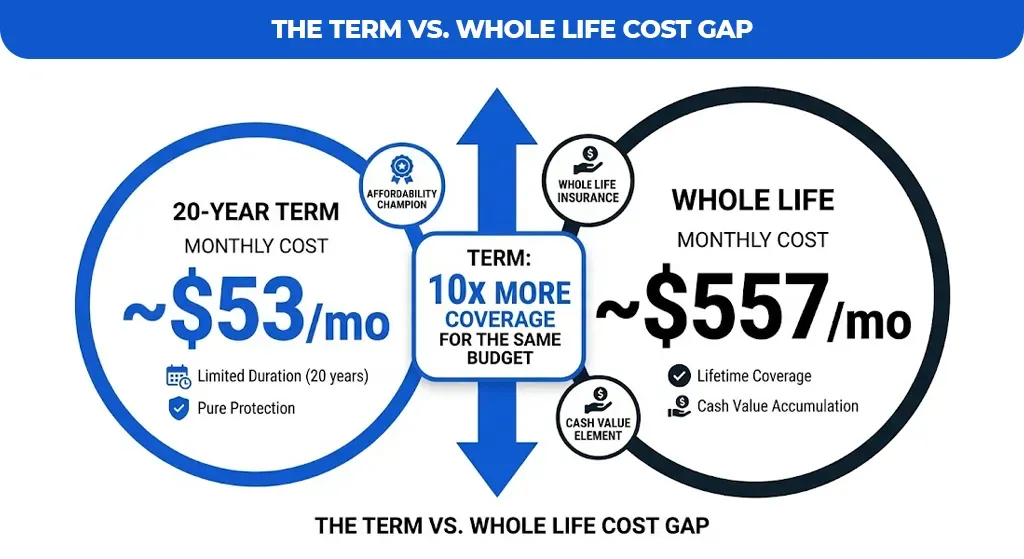
Term life is far more affordable. For a 40-year-old, $500,000 of whole life averages about 540–574 a month, compared with 47–59 for 20-year term, roughly 10 to 11 times more. Put another way, the same monthly budget buys about 10 times more coverage with term.
Why whole life costs so much more
• Lifetime guarantee: the insurer is certain to pay a claim eventually, so premiums must fund it.
• Cash value: part of each premium builds a guaranteed savings component.
• Front-loaded costs: commissions and expenses are higher in early years.
Term vs. whole life (age 40, nonsmoker)
| Coverage | 20-year term (women / men) | Whole life (women / men) | Whole life multiple |
| $100,000 | $16 / $19 | $127 / $130 | About 7–8× |
| $250,000 | $28 / $35 | $274 / $294 | About 8–10× |
| $500,000 | $47 / $59 | $540 / $574 | About 10–11× |
Source: MoneyGeek term and whole life averages (2026).
What $100 a month buys at age 40 (men)
• 20-year term: close to $1 million (the average for $1 million is $109).
• Whole life: under $100,000 (average $130 for $100,000).
When is whole life still affordable?
Whole life can be the more practical choice when the need is small and permanent, such as final expenses. A healthy 60-year-old woman can buy $10,000 of whole life final expense coverage for about $33 a month, and the coverage never expires. For older adults, term may be unavailable or very expensive, so small whole life policies fill the gap. See final expense insurance and whole life insurance cost.
Note: Many term policies include a conversion rider that lets you convert to permanent coverage later without new health questions. That gives you affordable term now and the option of lifelong coverage later. See convertible term life insurance.
What Colonial Penn’s $9.95 a month really buys
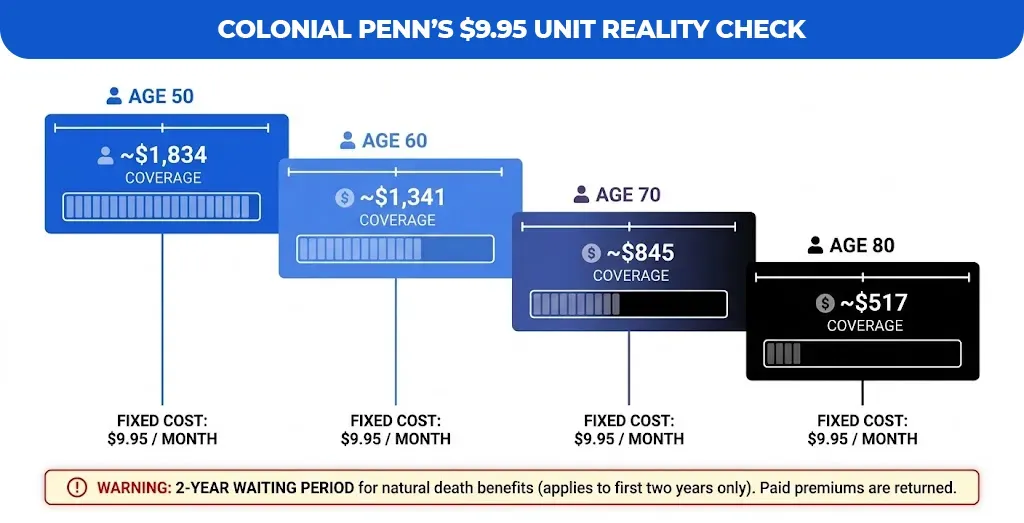
Colonial Penn’s TV offer is a guaranteed acceptance whole life plan sold in “units” at $9.95 per unit per month. The price per unit stays the same, but the coverage each unit buys falls sharply with age, and there’s a two-year waiting period. For a 70-year-old man, one unit buys only $689 of coverage.
How the unit system works
| Age | Coverage per $9.95 unit (men) | Coverage per $9.95 unit (women) |
| 50 | $1,669 | $2,000 |
| 60 | $1,167 | $1,515 |
| 70 | $689 | $1,000 |
| 80 | $426 | $608 |
You can buy up to 25 units (12 in New York). At 70, a man paying the maximum, 25 units at $248.75 a month, gets only about $17,225 of coverage.
The two-year waiting period
Because there are no health questions, natural deaths in the first two years pay back only premiums, not the face amount.
Why other carriers often offer better value
A healthy 70-year-old man can buy $10,000 of level final expense coverage, with full coverage from day one, for about $70 a month. The same $10,000 from Colonial Penn would take about 15 units, roughly $149 a month, with a two-year wait. Colonial Penn can still make sense for someone whose health rules out other options, but most applicants should compare simplified issue policies first.
Sources: Colonial Penn unit values from Choice Mutual’s rate chart (retrieved March 9, 2026); level rates from Choice Mutual (March 9, 2026).
7 ways to get cheap, high-quality life insurance
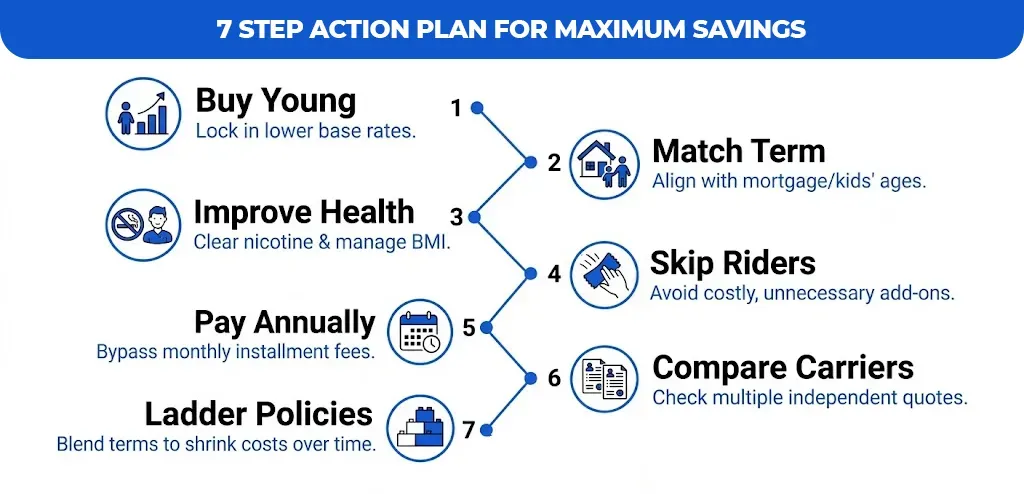
The biggest savings come from buying young, buying the right term length, applying in the best possible health, and comparing several carriers. Smaller savings come from paying annually and skipping riders you don’t need.
1. Buy as young as possible. Rates are locked in when you buy; a 30-year-old pays about a third of what a 50-year-old pays for $500,000 of 20-year term.
2. Match the term to your obligations. Choose the term that covers your mortgage and the years until your youngest child is independent. Longer terms cost more each month, so don’t buy 30 years if 20 will do.
3. Improve your health class before applying. Quit nicotine (insurers typically require 12 months smoke-free for nonsmoker rates), manage blood pressure and cholesterol, and avoid applying during a temporary health issue.
4. Skip riders you don’t need. Waiver of premium, accidental death, and return-of-premium riders add cost. Keep the conversion option; it’s often included at no extra charge.
5. Pay annually. Monthly payments usually cost a few percent more over a year than paying once.
6. Compare multiple carriers. The same applicant can get very different prices: for a 40-year-old man, $500,000 of 20-year term ranged from $46 to $75 a month across major insurers in MoneyGeek’s 2026 data. An independent agency compares many at once.
7. Ladder policies. Instead of one large 30-year policy, combine, for example, a 30-year policy for long-term needs with a 15-year policy for the years with the most debt. You pay for less coverage as obligations shrink.
Not sure how much you need? Use the how much life insurance do I need guide or Assurance Gurus’s life insurance calculator.
Best affordable life insurance companies (2026)
In MoneyGeek’s 2026 comparison of $500,000 20-year term for a 40-year-old nonsmoker, Banner Life and Transamerica had the lowest average rates, followed closely by Pacific Life and Protective. Price isn’t everything, though: check financial strength, complaint records, and whether the carrier offers no-exam options or a conversion privilege.
Affordable carrier comparison ($500,000, 20-year term, age 40)
| Company | Women / month | Men / month | Term lengths | Issue ages | Notes |
| Banner Life | $37 | $46 | 10–40 years | 20–75 | AM Best A+; NAIC complaint index 0.16; up to $4M without an exam |
| Transamerica | $37 | $46 | 10–30 years | 18–80 | AM Best A; complaint index 3.86 (above average); up to $2M no exam |
| Pacific Life | $38 | $54 | 10–30 years | 18–80 | Low rates especially for women |
| Protective | $42 | $54 | 10–40 years | 18–75 | Long term options up to 40 years |
| Lincoln Financial | $46 | $60 | — | — | Mid-range price in this comparison |
| Mutual of Omaha | $49 | $60 | 10–30 years | 18–80 | Also strong for final expense coverage |
Source: MoneyGeek term life rates and company profiles (updated October 2026). A complaint index of 1.00 is average; higher means more complaints relative to size.
What makes a carrier a good affordable choice
• Price for your profile: the cheapest carrier differs by age, sex, health, and coverage amount.
• Financial strength: look for AM Best A or better.
• Complaint record: check the NAIC complaint index.
• Underwriting fit: some carriers are more lenient on specific conditions like diabetes or high BMI.
• Conversion options: the ability to convert term to permanent coverage later.
See Assurance Gurus’s best life insurance companies and life insurance without a medical exam.
Conclusion
Affordable life insurance isn’t about finding the lowest price on the smallest policy; it’s about buying enough protection at a price you’ll keep paying. For most working adults, that’s level term life bought early, in the right length, after comparing several carriers. For older adults with smaller needs, final expense whole life offers permanent coverage at a manageable monthly cost.
| Your situation | Most affordable option |
| Age 20–45, healthy, dependents | 20–30 year term, 10–12× income |
| Mortgage plus young kids | Ladder a 30-year and a 15- or 20-year policy |
| Tight budget now, lifelong need later | Convertible term |
| Age 50–60 | 10–20 year term, compared across several carriers |
| Age 60+, need funeral money | Final expense whole life (5,000–25,000) |
| Serious health issues | Simplified issue, or guaranteed issue as a last resort |
Compare affordable quotes at Assurance Gurus
The fastest way to find your lowest rate is to compare carriers for your age and health. Assurance Gurus is an independent agency that compares term, whole life, and final expense policies from multiple carriers. Assurance Gurus insurance specialists can help you choose the right amount and term and avoid paying for riders you don’t need.
Get instant life insurance quotes on Assurance Gurus via the quote page, try term life insurance quotes, or call 888-363-1938.