



What Counts as Cheap Life Insurance?
“Cheap” life insurance isn’t a specific product; it’s an outcome. It means paying only for the coverage you genuinely need, in the policy structure that costs an insurer the least to provide, so the savings pass on to you. Two broad categories sit underneath that idea:
- Term life insurance: coverage for a fixed period (10, 20, or 30 years) with no cash value. This is the least expensive way to get a large death benefit and the backbone of almost every low-cost life insurance strategy.
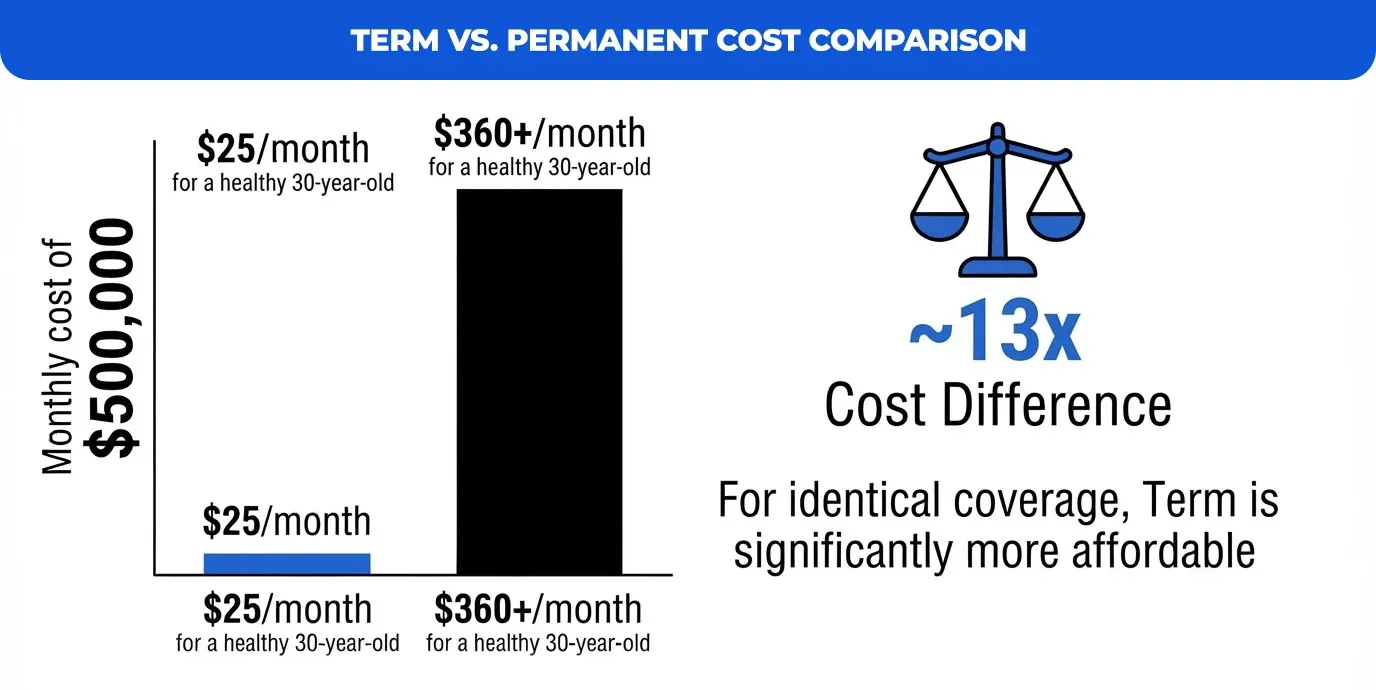
- Permanent life insurance (whole or universal life): lifetime coverage that builds cash value. It never expires, but typically costs five to fifteen times more per dollar of coverage than term.
Beyond those two, a few specialized products are worth knowing: simplified issue policies swap the medical exam for a short questionnaire; guaranteed issue policies skip health questions altogether (at a higher price and lower coverage cap); and no-exam term policies now cover many applicants under $500,000 using algorithmic underwriting instead of a blood draw.
Is the Cheapest Policy Always the Right Choice?
Chasing the lowest premium on the page can quietly cost you more later. Before you buy based on price alone, weigh these trade-offs:
- Lower coverage caps: the cheapest policies on the market are often capped at amounts too small to actually replace your income or pay off a mortgage.
- Fewer riders: budget policies frequently drop optional benefits like critical illness, disability, or a waiver-of-premium rider that let you access value while you’re still alive.
- Stricter underwriting: a rock-bottom rate can come with tighter health rules, which raises the odds of a denial rather than just a higher price.
- Carrier strength: a policy is a decades-long promise. Always check an insurer’s financial strength rating (AM Best or Standard & Poor’s) before choosing on price alone; you want the company solvent when your family eventually files a claim.
None of this means avoid affordable coverage; it means treat the premium as one input, not the whole decision.
What Actually Drives Your Premium Up or Down
Insurers price risk, not people. Every factor below is really a proxy for one question: how likely is this policy to pay out soon?
Age
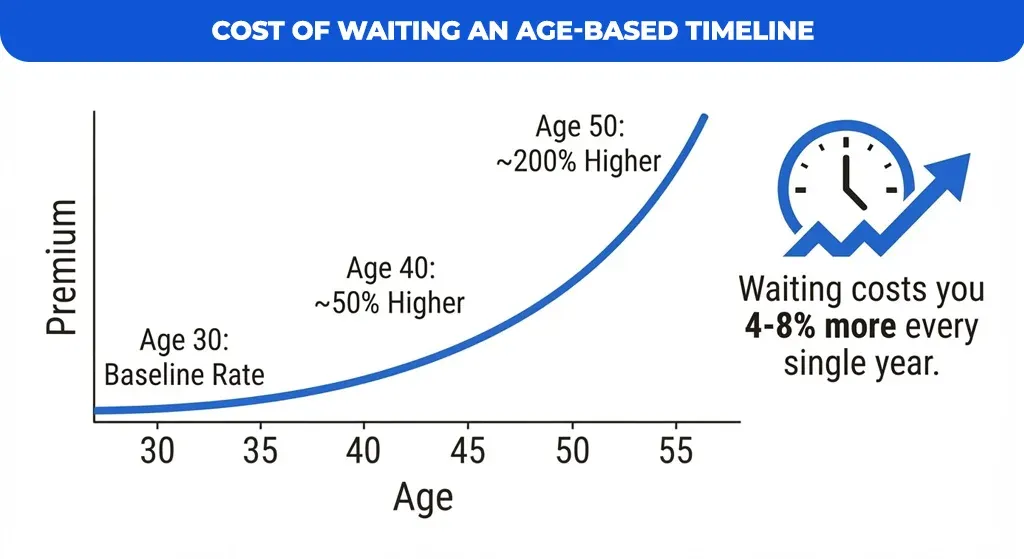
Age is the single biggest lever you control. Rates typically climb 4–8% for every year you wait, and that increase compounds the longer you delay. Locking in coverage at 30 instead of 40 can save tens of thousands of dollars over a 20-year term.
Gender
Because women statistically have a longer life expectancy than men, female applicants are usually quoted lower premiums than male applicants of the same age, health class, and coverage amount, often a meaningful gap on identical policies.
Health and Medical History
Underwriters weigh height-to-weight ratio (BMI), blood pressure and cholesterol, family history of heart disease, cancer, or diabetes, and any existing prescriptions or past diagnoses.
Lifestyle Habits
Tobacco use is the single biggest lifestyle factor in pricing; smokers routinely pay two to three times more than non-smokers for identical coverage. High-risk hobbies (piloting, scuba diving, motor racing), a hazardous occupation, and a poor driving record also push rates upward.
Policy Type and Term Length
Term life insurance is consistently the cheaper structure because it covers a fixed window and never builds cash value. Within term, a 10-year policy costs less than a 30-year policy, but it also expires sooner, so match the length to the actual obligation it’s meant to cover: a mortgage payoff, years until retirement, or the years until kids reach financial independence.
Coverage Amount
A $250,000 policy costs less than a $500,000 policy, but the relationship isn’t perfectly linear; many insurers have pricing “breakpoints” at round numbers ($250k, $500k, $1M) where the per-dollar cost actually improves once you cross the threshold.
The Cheapest Ways to Get Real Coverage
Not every low-cost option requires shopping the open market. Consider these routes in order:
- Employer-sponsored group life insurance is often the least expensive coverage available, and sometimes provided free as part of your benefits package. The catch: payouts are commonly capped at one or two times your annual salary, rarely enough to fully protect a family long-term, and coverage typically ends if you leave the job.
- Individual term life insurance is the most reliable way to get a large, portable death benefit at a low cost; it can stand alone or supplement a workplace policy.
- Simplified or guaranteed issue policies: useful when health history makes fully underwritten term difficult to qualify for, trading a higher rate for faster or guaranteed approval.
How to Lower Your Premium
Here’s the practical checklist, roughly in order of impact:
- Buy now, not later: every birthday you wait through adds 4–8% to your locked-in rate.
- Right-size your death benefit: buying more coverage than your family actually needs inflates the premium for no added protection; calculate the real number first.
- Improve controllable health metrics before your exam: losing 10–15 pounds, lowering blood pressure, or getting cholesterol into a normal range in the 60–90 days before underwriting can move you into a better rate class.
- Quit nicotine and wait it out: most carriers offer non-smoker rates after 12 tobacco-free months; some accept nicotine-replacement users even sooner.
- Drop riders you don’t need: optional add-ons increase the premium, so keep only the ones that genuinely fit your situation.
- Choose annual billing over monthly: many insurers add a processing fee to monthly installments, so paying yearly can shave a small but real percentage off the effective rate.
How to Compare Quotes the Right Way
Not all quote sources are equal, and the way you compare matters as much as the number on the screen.
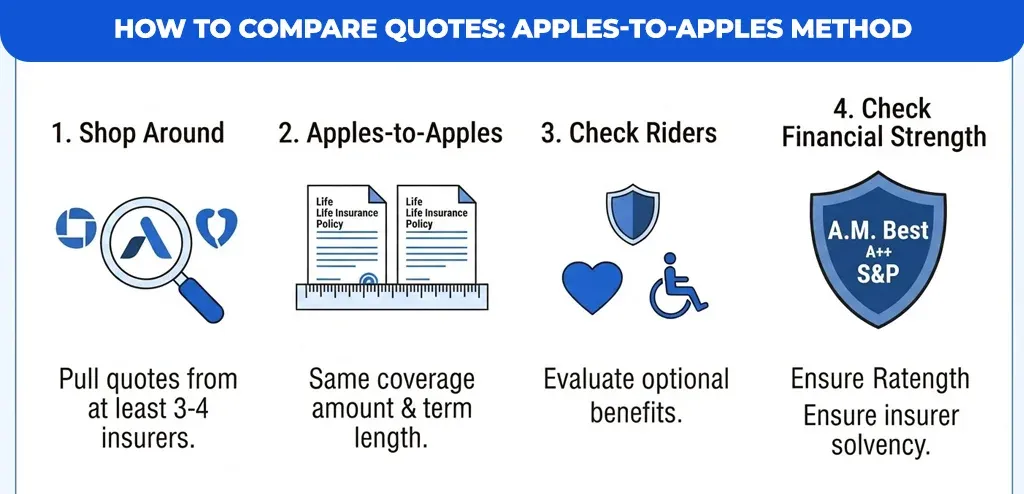
- Shop around; pull quotes from at least three to four insurers; rate classes differ enough between carriers that the same applicant can see a wide spread.
- Compare apples-to-apples: only compare quotes for the identical coverage amount and term length; a $250,000 quote and a $500,000 quote tell you nothing against each other.
- Ask about add-ons before you decide: some riders are genuinely worth the extra cost, so review what each carrier offers rather than assuming cheaper is always better.
Before requesting quotes, have your height, weight, current medications, basic family medical history, and tobacco use over the last 12 months ready; it speeds up underwriting and gets you a more accurate number the first time.
Cheap Life Insurance for Seniors
Pricing shifts meaningfully once you’re shopping in your 60s, 70s, or beyond. Fully underwritten term becomes harder to qualify for, so most seniors choose between simplified issue policies (a health questionnaire only, moderate cost, faster approval) and guaranteed issue whole life (no health questions, smaller face amounts, often $5,000–$25,000, designed for final-expense coverage rather than income replacement).
Widely advertised guaranteed-acceptance plans around the $9.95-a-month mark typically buy a small guaranteed-issue whole life policy, often in the $1,000–$2,500 face-value range at entry pricing, scaling up with age and higher premium tiers. These are built to cover funeral and final expenses, not to replace income or pay off a mortgage. Always confirm the exact face amount for your age directly with the carrier.