



A 65-year-old man who puts $100,000 into an immediate annuity in October 2026 receives about $643 a month for life on average, according to ImmediateAnnuities.com, while the same money in life insurance would pay his family a tax-free lump sum when he dies.
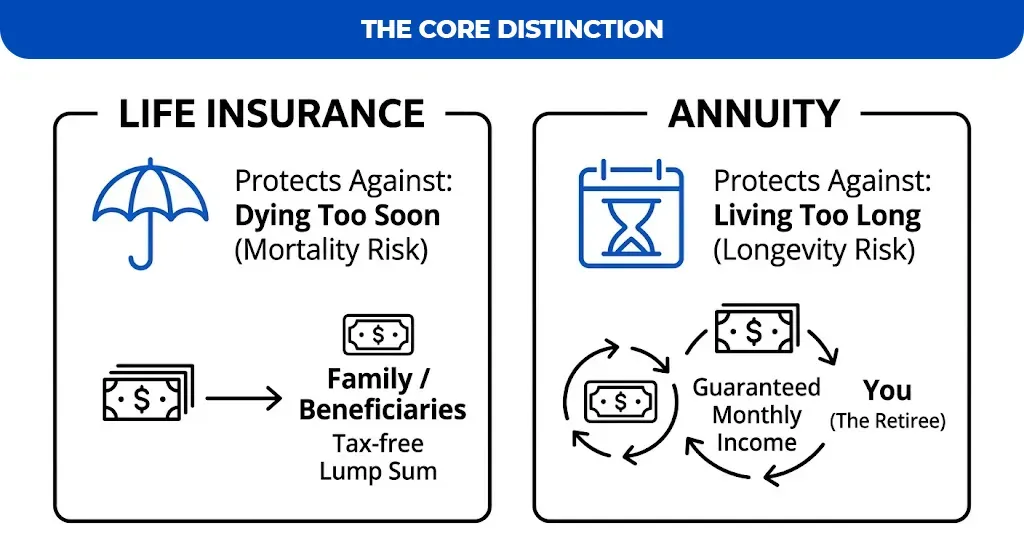
Quick answer: A life insurance annuity usually means an annuity sold by a life insurance company: a contract that turns your savings into guaranteed income you cannot outlive. Life insurance protects your family if you die too soon; an annuity protects you if you live a long time. Many retirees use both.
What Is a Life Insurance Annuity?
Life insurance and annuities are two sides of the same financial safety net. Life insurance protects against mortality risk, the chance you die before your family is financially secure; an annuity protects against longevity risk, the chance you outlive your savings. Both are issued by life insurance companies and backed by their claims-paying ability.
Clarifying the terminology
People search for “life insurance annuity” or “annuity life insurance” to mean three different things:
| What people mean | What it actually is | Example |
| An annuity from a life insurer | A standalone annuity contract issued by a life insurance company | A single premium immediate annuity bought at retirement |
| An annuity payout option in a life policy | A settlement option that pays a death benefit, or cash value, as a stream of income instead of a lump sum | A beneficiary choosing monthly payments for 10 years |
| A hybrid or combination product | A policy that blends both, such as an income rider on permanent life insurance or a death benefit rider on an annuity | Converting whole life cash value into lifetime income |
In plain terms, the meaning of annuity in life insurance is a series of guaranteed payments made by an insurance company, usually for life or for a set number of years. An annuity life policy is simply that contract. If you are new to the insurance side, Assurance Gurus explains the basics in how does life insurance work.
Note: Annuities and life insurance are not bank deposits and are not FDIC-insured. Guarantees depend on the financial strength of the issuing insurer, backed up to state limits by state guaranty associations, so insurer ratings matter.
Core Differences: Life Insurance vs. Annuity
Life insurance pays when you die; an annuity pays while you live. You buy life insurance to leave money to others, usually as a tax-free lump sum, and you buy an annuity to create income for yourself that lasts as long as you do.
Primary objective
Life insurance creates or transfers wealth at death: it replaces income, pays off debts, and provides an inheritance. An annuity converts a lump sum or a series of deposits into reliable cash flow during retirement, filling the gap between Social Security and your spending.
Risk mitigation
Life insurance covers premature death risk. An annuity covers longevity risk, which grows as people live longer and fewer workers have traditional pensions. The insurer pools many lives: those who die early help fund payments to those who live longest, which is why a lifetime annuity can pay more than you could safely withdraw on your own.
Feature matrix
| Feature | Life insurance | Annuity |
| Purpose | Protect dependents, transfer wealth | Guaranteed income, tax-deferred growth |
| Risk covered | Dying too soon | Living too long |
| Payout trigger | Death of the insured | Annuitization date or income start date chosen by the owner |
| Who benefits | Beneficiaries | Annuitant (owner), then any survivor or beneficiary |
| Tax on main payout | Death benefit generally income-tax-free | Earnings portion of payments is taxed as ordinary income |
| Beneficiary rules | Beneficiary receives tax-free lump sum or installments | Heirs owe income tax on any untaxed gain they receive |
| Underwriting | Medical and financial underwriting | Usually none; age and gender set the payout |
| Liquidity | Cash value loans in permanent policies | Limited; surrender charges in early years |
Note: Because annuity pricing rewards longevity, healthy people who expect to live a long time get the most value from lifetime annuities, while life insurance is cheapest for people in good health. A healthy retiree may qualify for both on good terms.
How Life Insurance Annuities Work
An annuity has up to two phases: an accumulation phase, when your money grows tax-deferred, and a distribution phase, when the insurer pays you income. Immediate annuities skip straight to income; deferred annuities grow first and pay later. The type of annuity decides how your money grows, and the payout option decides how long income lasts and what your heirs receive.
Accumulation phase vs. annuitization
During accumulation, you fund the contract with one premium or several, and earnings compound without current income tax. At annuitization, you exchange the account value for a guaranteed stream of payments; after that, the lump sum is generally no longer available. Many deferred annuities also let you take withdrawals without annuitizing, often through an income rider.
SPIAs vs. deferred income annuities
A single premium immediate annuity (SPIA) turns a lump sum into income that starts within about a year. A deferred income annuity (DIA) works the same way but starts income later, often 5 to 20 years out, so each premium dollar buys more income. A qualified longevity annuity contract (QLAC) is a DIA bought inside an IRA or 401(k) that can delay required minimum distributions.
Fixed, variable, and fixed index annuities
| Type | How it grows | Risk | Typical use |
| Multi-year guarantee annuity (MYGA) | Fixed rate guaranteed for the term, often 3 to 10 years | Low | CD alternative for safe, tax-deferred growth |
| Fixed index annuity (FIA) | Credited by a market index, subject to caps or participation rates, with a floor against losses | Low to moderate | Growth potential without market losses; often paired with an income rider |
| Variable annuity | Invested in subaccounts | Full market risk | Long-term growth for investors who accept volatility |
| SPIA / DIA | No account growth; pays guaranteed income | Low (insurer credit risk) | Turning savings into a pension-like paycheck |
In October 2026, the best published MYGA rates ranged from about 5.1% for 2 years to around 6.45% for 8 years, according to ImmediateAnnuities.com. Rates change often and depend on the insurer.
A guaranteed lifetime withdrawal benefit (GLWB) is a rider, usually on an FIA or variable annuity, that guarantees a set percentage of a benefit base each year for life, even if the account value runs out. The roll-up rate grows that benefit base, not your actual cash, so compare riders on the guaranteed income they produce, not the headline roll-up rate.
Annuity payout structures
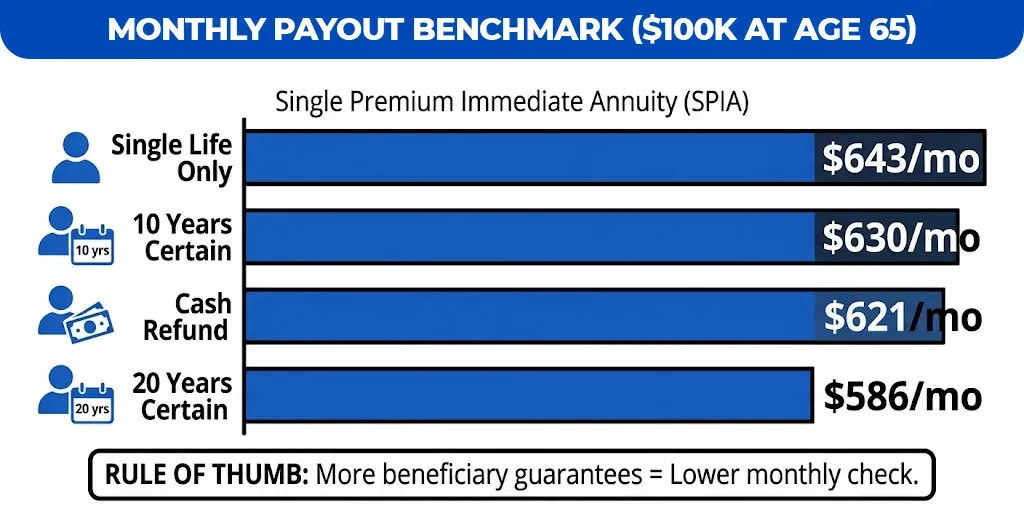
| Payout option | How it works | Monthly income, $100,000 at 65 (male avg.) |
| Single life only | Pays for your life; stops at death | $643 |
| Life with 10 years certain | Pays for life; if you die within 10 years, a beneficiary gets the rest of the 10 years | $630 |
| Life with 20 years certain | Same, with a 20-year guarantee | $586 |
| Cash refund | Pays for life; heirs get any unpaid premium in a lump sum | $621 |
| Installment refund | Pays for life; heirs keep receiving payments until premium is returned | $623 |
| Joint and survivor | Pays for two lives, often at 50% to 100% to the survivor | Lower than single life |
Average quotes surveyed October 2, 2026, from ImmediateAnnuities.com. Each added guarantee for heirs lowers your monthly check.
Hybrid Policies and Cash Value Conversions
You can combine life insurance and annuities in three main ways: take income from a permanent life policy’s cash value, add riders that blend both benefits, or move cash value into an annuity through a tax-free Section 1035 exchange. Each trades some death benefit for retirement income, so the right choice depends on whether your heirs or your paycheck matters more.
Annuity income options on whole and universal life
Permanent life insurance builds cash value you can tap in retirement through withdrawals, policy loans, or the policy’s settlement options, which can pay the cash value as a stream of income. Some universal life and indexed universal life policies also offer riders that guarantee income or accelerate the death benefit for chronic illness. Assurance Gurus covers these features in its guides to cash value life insurance and life insurance with living benefits.
Converting life insurance cash value to an annuity: Section 1035 exchange
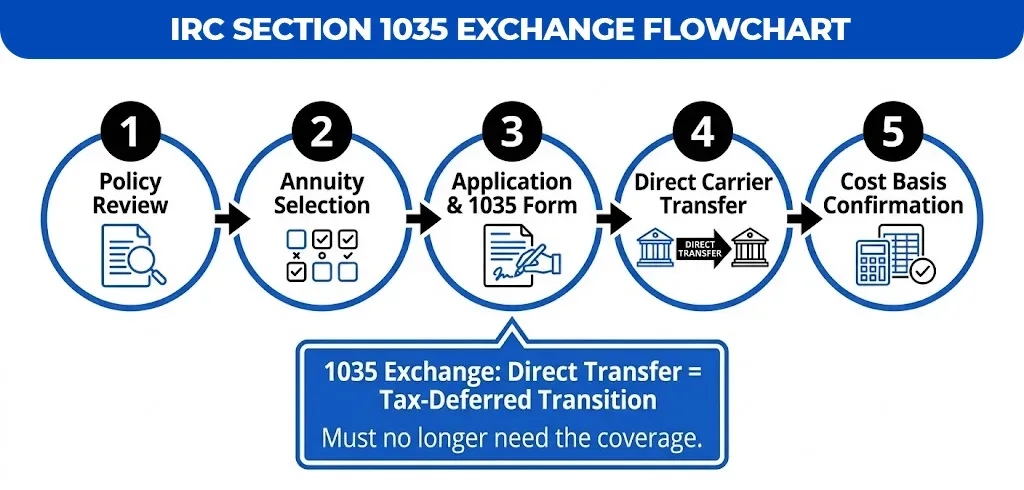
Under IRC §1035, you can exchange a life insurance policy for another life policy, an annuity, or a qualified long-term care contract without recognizing a gain. The reverse is not allowed: an annuity can be exchanged only for another annuity or a qualified long-term care contract, not for life insurance.
1. Review the existing policy. Get the current cash value, cost basis (premiums paid), surrender charges, and any outstanding loans.
2. Compare the new annuity. Look at payout rates or credited rates, surrender schedule, fees, riders, and the insurer’s financial strength.
3. Apply for the new contract and sign the carrier’s 1035 exchange form; never cash out the old policy yourself.
4. Let the insurers transfer the money directly. The old carrier sends the cash value straight to the new one.
5. Confirm the transfer and keep records showing your original cost basis carried over.
Note: A 1035 exchange ends the life insurance death benefit, and an outstanding policy loan can create taxable income if it is paid off in the exchange. Make sure you no longer need the coverage, or have replacement coverage in force, before you exchange.
Indexed and cash value growth strategies
Indexed universal life and indexed whole life credit cash value based on a market index, subject to caps and floors, and some owners deliberately fund them heavily to build a tax-advantaged supplement for retirement. These strategies can work for high earners with long time horizons, but they depend on staying well funded and avoiding modified endowment contract status. Assurance Gurus explains the mechanics in how an IUL account works and max-funded IUL. Standard term life, by contrast, has no cash value, so it cannot be converted into an annuity.
Real-World Payout Benchmarks: $100k and $500k Annuities (2026)
In October 2026, a $100,000 single premium immediate annuity paid a 65-year-old about $615 to $643 a month for life on average, and up to about $698 with the best-paying insurer, according to ImmediateAnnuities.com. A $500,000 annuity pays roughly five times as much, about $3,075 to $3,215 a month on average at 65.
Key drivers of payout rates
• Interest rates: insurers invest premiums largely in high-grade bonds, so higher long-term bond yields mean higher payouts.
• Age at purchase: older buyers have shorter life expectancy, so each dollar buys more monthly income.
• Gender: women receive slightly less because they live longer on average.
• Payout option and riders: period-certain guarantees, refunds, joint lives, and inflation adjustments all lower the starting check.
• Insurer: the gap between the best and average quote is often 8% to 10% or more, so shopping matters.
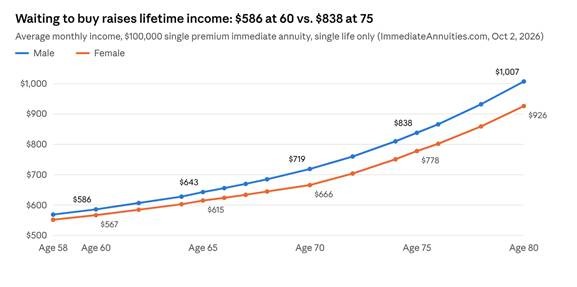
Average $100,000 SPIA income by age, single life only
Estimated monthly payouts for a $100,000 annuity
| Age | Gender | Life only (average) | Life only (best quote) | Life with 10 years certain (average) |
| 60 | Male | $586 | $655 | $580 |
| 60 | Female | $567 | $634 | $563 |
| 65 | Male | $643 | $698 | $630 |
| 65 | Female | $615 | $669 | $607 |
| 70 | Male | $719 | $769 | $694 |
| 70 | Female | $666 | $726 | $652 |
| 75 | Male | $838 | $900 | $779 |
| 75 | Female | $778 | $836 | $743 |
Source: ImmediateAnnuities.com, rates surveyed October 2, 2026; excludes state premium taxes.
Estimated monthly payouts for a $500,000 annuity
| Age | Gender | Life only (average) | Life only (best quote) | Life with 10 years certain (average) |
| 60 | Male | $2,930 | $3,275 | $2,900 |
| 60 | Female | $2,835 | $3,170 | $2,815 |
| 65 | Male | $3,215 | $3,490 | $3,150 |
| 65 | Female | $3,075 | $3,345 | $3,035 |
| 70 | Male | $3,595 | $3,845 | $3,470 |
| 70 | Female | $3,330 | $3,630 | $3,260 |
| 75 | Male | $4,190 | $4,500 | $3,895 |
| 75 | Female | $3,890 | $4,180 | $3,715 |
The $500,000 figures are estimates calculated by multiplying the $100,000 quotes by five; actual quotes at larger premiums can differ slightly.
Note: Fixed lifetime payments lose purchasing power to inflation. An annuity with a cost-of-living increase starts lower but rises each year; compare the trade-off against how long you expect to live.
Tax Implications of Life Insurance and Annuities
Life insurance death benefits are generally income-tax-free to beneficiaries, while annuity earnings are taxed as ordinary income when they come out. Both grow tax-deferred inside the contract, but the order in which withdrawals are taxed, and what heirs owe, differs sharply.
Death benefits: life insurance vs. annuities
Under IRC §101(a), the IRS confirms that life insurance proceeds received because of the insured’s death are generally not included in gross income, though any interest paid on them is taxable. An annuity death benefit is different: a non-spouse beneficiary owes ordinary income tax on any gain above the owner’s after-tax contributions. A surviving spouse can often continue the annuity and keep deferring tax.
Withdrawals: LIFO for annuities, FIFO for life insurance
| Situation | Tax order | What it means |
| Withdrawal from a non-qualified deferred annuity | Gain first (LIFO) | Withdrawals are taxable until all earnings are out; a 10% penalty may apply before age 59½ |
| Withdrawal from life insurance cash value (non-MEC) | Basis first (FIFO) | Tax-free up to premiums paid; policy loans generally not taxed while the policy stays in force |
| Modified endowment contract (MEC) | Gain first (LIFO) | Treated like an annuity, with a possible 10% penalty before 59½ |
| Annuity held in an IRA or 401(k) | Fully taxable | Every dollar is taxed as ordinary income, because contributions were pre-tax |
These ordering rules come from IRC §72. Assurance Gurus explains the life insurance side in do you pay taxes on life insurance.
Exclusion ratio for immediate annuities
Payments from a non-qualified immediate annuity are part tax-free return of your premium and part taxable earnings. The exclusion ratio sets the tax-free share:
Example: a 65-year-old man pays $100,000 for a life-only annuity paying 643amonth(7,716 a year). Using the IRS life expectancy multiple of 20.0 for age 65 from Publication 939, the expected return is about $154,320, so roughly 65% of each payment, about $417 a month, is tax-free. Once he recovers the full $100,000, all later payments are fully taxable. This is an illustration; your insurer’s Form 1099-R and a tax advisor will confirm your figures.
Note: Annuities bought inside an IRA, 401(k), or other qualified plan do not use the exclusion ratio. Payments are fully taxable, and required minimum distribution rules apply.
Pros and Cons: Is a Life Insurance Annuity a Good Investment?
An annuity is best viewed as insurance, not an investment: it buys certainty of income rather than maximum growth. It is a good fit when guaranteed income would let you sleep at night and spend more confidently, and a poor fit when you need liquidity or want the highest long-term return.
Advantages
• Guaranteed income floor: lifetime payments cover essential expenses no matter how long you live or how markets perform.
• Protection from market downturns: fixed, MYGA, and SPIA contracts are not exposed to stock losses; FIAs protect principal from index declines.
• Tax-deferred growth: earnings in deferred annuities are not taxed until withdrawn.
• No contribution limits: unlike IRAs and 401(k)s, non-qualified annuities have no annual cap.
• Inflation options: some contracts offer cost-of-living increases in exchange for a lower starting payment.
Disadvantages
• Illiquidity: once you annuitize, the lump sum is gone; deferred annuities usually carry surrender charges for several years.
• Fees on complex products: variable annuities and income riders can carry significant annual charges for mortality, administration, and rider guarantees.
• Lower growth potential: guaranteed products generally return less than a diversified stock portfolio over long periods.
• Inflation erosion: level payments buy less every year.
• Ordinary income tax: gains are taxed at ordinary rates, not capital gains rates.
Who benefits most
| Profile | Why an annuity may help |
| Pre-retirees without a pension | Creates a pension-like paycheck to pair with Social Security |
| Conservative investors | Removes sequence-of-returns risk from essential spending |
| Healthy retirees with longevity in the family | Lifetime payments are worth more the longer you live |
| People who already have enough life insurance | Can shift some cash value or savings toward income |
The combination often works best: life insurance protects a spouse or heirs, and an annuity covers essential income. If long-term care costs are a concern, Assurance Gurus also covers long-term care insurance costs.
Conclusion: Building Your Retirement Roadmap
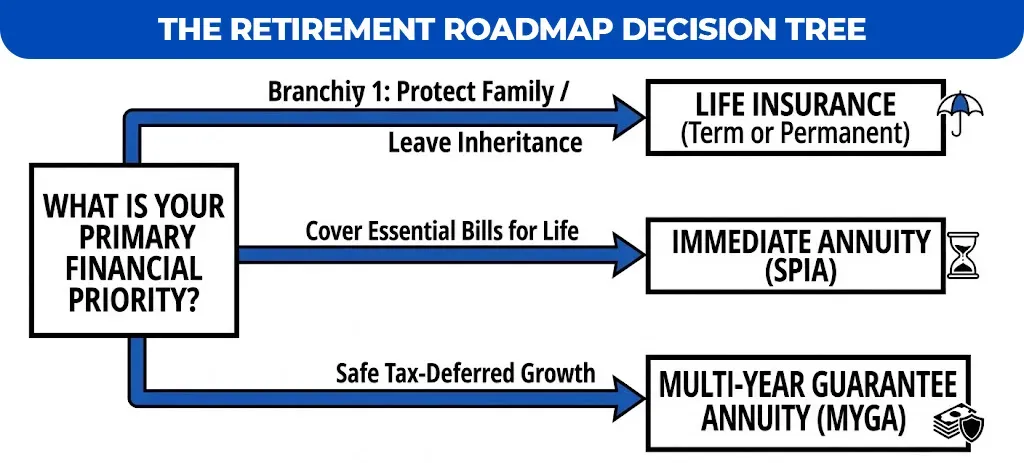
Life insurance and annuities solve opposite problems, which is why they work so well together. Life insurance makes sure the people you love are protected if you die early; an annuity makes sure you never run out of income if you live a long time. The right mix depends on your dependents, your savings, and how much guaranteed income you need.
| Your priority | Tool to consider first |
| Protecting a spouse or children | Term or permanent life insurance |
| Leaving a tax-free inheritance | Permanent life insurance |
| Covering essential bills for life | Single premium immediate annuity |
| Higher income later in retirement | Deferred income annuity or QLAC |
| Safe, tax-deferred growth | Multi-year guarantee annuity |
| Turning unneeded cash value into income | Section 1035 exchange into an annuity |
Review Your Coverage With Assurance Gurus
Before you move money into an annuity, make sure your family’s protection is right. Assurance Gurus helps families compare life insurance plans, including term, universal, indexed universal, and cash value coverage, with expert guidance.
• Review whether your current life insurance still fits your family and retirement plan.
• Compare term and permanent options, including cash value policies.
• Estimate how much coverage you need with the free calculator.
• Get clear, honest pricing with no pressure.