



Nearly half (47%) of insured Americans have life insurance through work, and 27% have workplace coverage with no individual policy, according to LIMRA’s 2026 Insurance Barometer Study. For many U.S. families, supplemental life insurance is the main tool for closing that gap.
Quick answer: Supplemental life insurance is optional, employee-paid coverage you buy on top of your employer’s basic group life policy, usually through payroll deduction. It lets you add more coverage for yourself, plus smaller amounts for a spouse and children, often with no medical questions up to a set limit.
What Is Supplemental Life Insurance?
Supplemental life insurance, also called voluntary, optional, or supplementary life coverage, is extra group term life insurance you choose and pay for through your employer. It sits on top of the basic group life policy your employer provides, and it pays a tax-free death benefit to your beneficiaries if you die while covered.
Most employer plans are group term life, so supplemental coverage typically has no cash value and lasts only while you remain eligible through the job. You elect an amount during your enrollment window, and premiums come out of each paycheck.
Basic group life vs. supplemental life
Basic group life is usually employer-paid and modest, often a flat amount or one to two times your salary. A common design is $50,000, in part because IRS Publication 525 excludes the cost of up to $50,000 of employer-provided group-term coverage from your income; the employer-paid cost of coverage above that is taxable to you.
That level rarely matches what a family needs. A common planning guideline is 10 to 12 times annual income, per MoneyGeek, which is why supplemental elections exist.
| Feature | Basic group life | Supplemental (voluntary) life |
| Who pays | Usually the employer | You, by payroll deduction |
| Typical amount | Flat amount or 1x to 2x salary | Elected in multiples of salary or fixed increments |
| Enrollment | Often automatic | You opt in during an enrollment window |
| Health questions | None | None up to the guaranteed issue limit; EOI above it |
| Family coverage | Rarely | Spouse and child options are common |
| Leaves with you? | Usually ends with the job | Often portable or convertible, at new rates |
Note: Example: on a $70,000 salary, 1x basic coverage pays $70,000. A 10x guideline suggests about $700,000, leaving a $630,000 gap for supplemental or individual coverage to fill.
Types of Supplemental Life Insurance Plans
Most employers offer four related options: extra coverage on the employee, coverage on a spouse or domestic partner, coverage on children, and accidental death and dismemberment (AD&D). You usually must buy employee supplemental life before you can add a spouse or child.
Supplemental employee life insurance
This is the core election. Plans let you choose a multiple of salary or fixed increments. Washington State’s public-employee plan, insured by MetLife, is one real example: employees can elect $10,000 increments up to $500,000 guaranteed issue, and up to $1,000,000 with evidence of insurability.
Supplemental spouse life insurance
Spouse coverage protects against losing a partner’s income or unpaid caregiving work. Plans typically cap it as a share of the employee’s supplemental amount, commonly 50%, and set a lower guaranteed issue limit for the spouse. If you leave the employer or divorce, spouse coverage usually ends unless it is ported or converted.
Supplemental child and dependent life insurance
Child coverage is small and inexpensive, often $10,000 to $20,000 per child, and one premium usually covers all eligible children. It mainly helps with funeral costs and time off work, not income replacement.
AD&D vs. supplemental term life
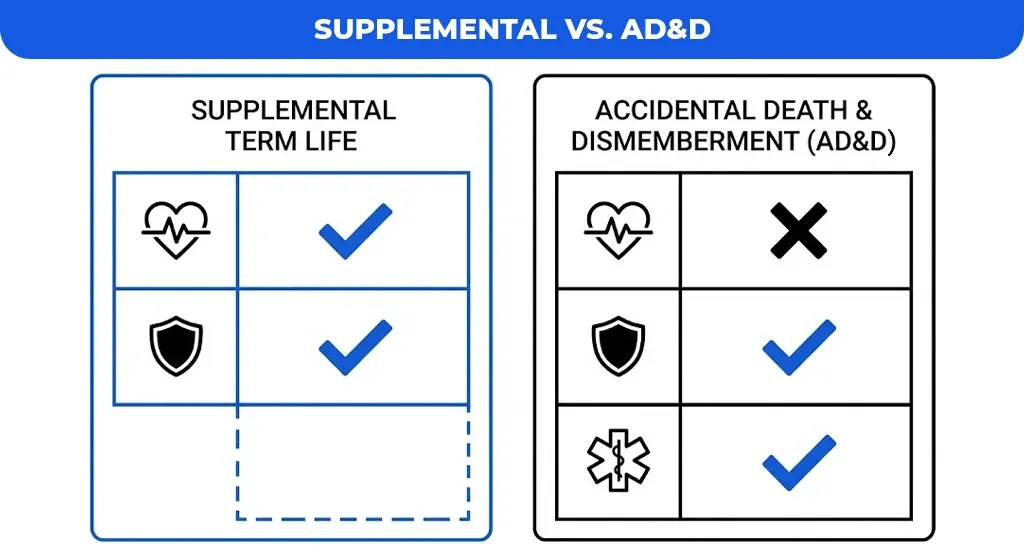
AD&D is not the same as life insurance. It pays only if death or a listed injury, such as loss of a limb or eyesight, results from a covered accident. Illness, the most common cause of death, is not covered.
| Coverage | Pays for death from illness? | Pays for accidental death? | Pays for dismemberment? | Typical underwriting |
| Supplemental term life | Yes | Yes | No | Guaranteed issue up to a limit, then EOI |
| AD&D | No | Yes | Yes, partial amounts | Usually none |
Note: AD&D is cheap because claims are rare. Treat it as a low-cost add-on, never as a substitute for supplemental life coverage.
How Does Employee Supplemental Life Insurance Work?
You enroll during your first eligibility window or open enrollment, choose an amount, and pay through payroll deduction. Coverage up to the plan’s guaranteed issue limit is approved without health questions; amounts above it require evidence of insurability. When you leave the job, you can usually keep coverage only by porting or converting it within a short deadline.
Open enrollment and payroll deductions
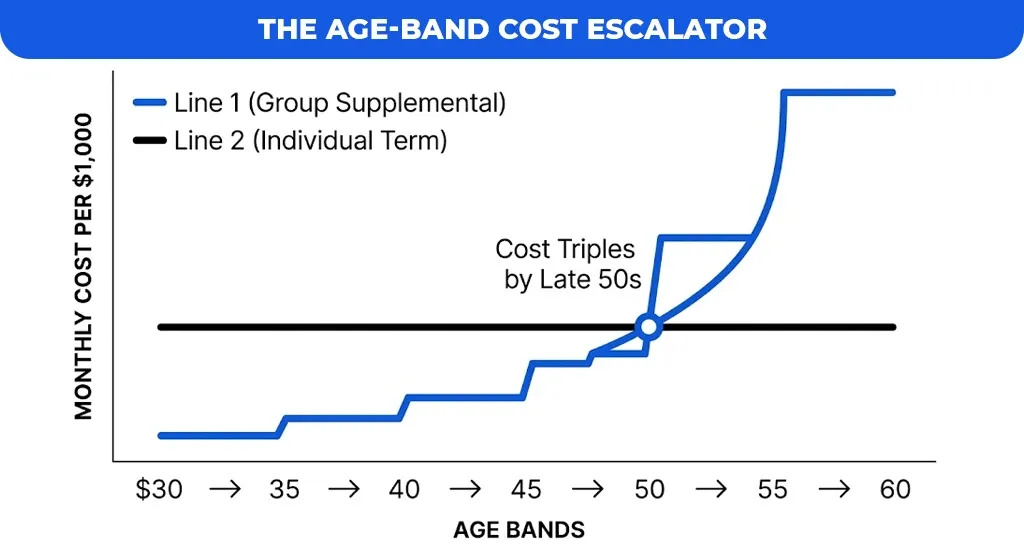
Premiums are set per $1,000 of coverage and usually rise with age in five-year bands. A plan summary from Westmont College shows the standard formula:
For example, $200,000 of coverage at an illustrative $0.15 per $1,000 rate costs $30 a month. Your plan’s actual rate table is in your enrollment materials.
Guaranteed issue limits vs. evidence of insurability (EOI)
The guaranteed issue (GI) limit is the most you can buy without health questions, and it usually applies only when you first become eligible, often within 31 days of hire. Above it, or if you enroll late, the insurer requires evidence of insurability: a health questionnaire and sometimes medical records. In the MetLife plan cited above, if the extra amount is declined, you still keep the guaranteed issue amount.
Note: Elect as much as you need at your first opportunity. Waiting until a later open enrollment can mean answering health questions for the same coverage you could have had automatically.
Portability and conversion when you leave a job
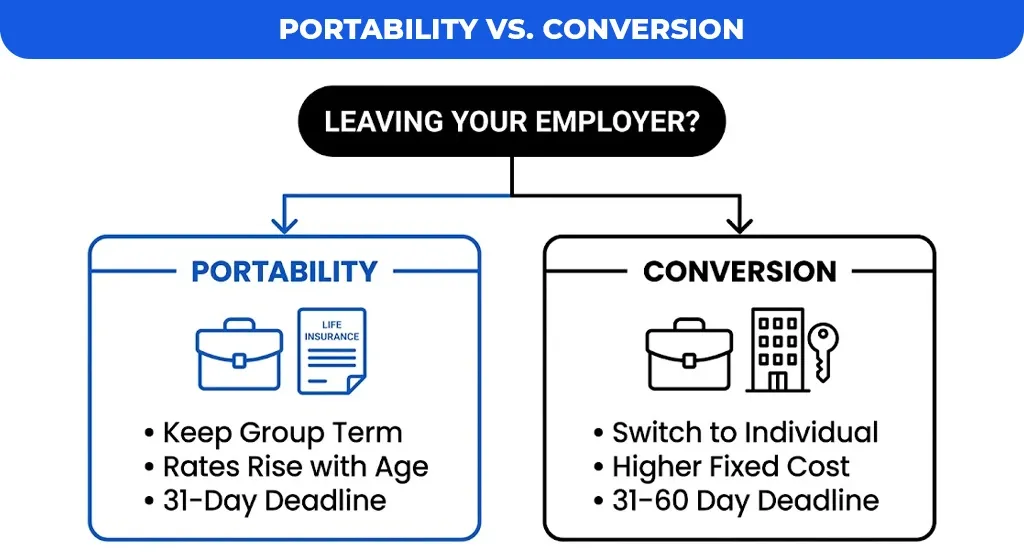
Group coverage normally ends when employment ends. Two features may let you keep it, but deadlines are short and missing one usually forfeits the right.
| Feature | What you get | Health questions? | Typical deadline | Cost trajectory |
| Portability | Continue group term coverage directly with the insurer | No | Often 31 days | Group-style term rates that keep rising with age |
| Conversion | Switch to an individual policy, usually permanent life | No | 31 to 60 days, plan-specific | Individual rates at your current age, often much higher |
Portability often has conditions; one county plan, for instance, offered it only to employees who were under Social Security normal retirement age, not disabled, and not retired, with the first premium due within 31 days. Check your own certificate of coverage before your last day.
Benefits and Drawbacks of Employer Supplemental Life Insurance
Employer supplemental life is easy to buy and can be the best deal available if your health makes individual coverage expensive or unavailable. Its weaknesses are cost increases as you age and the risk of losing coverage when you change jobs, retire, or are laid off.
Pros
• Convenience: premiums come out of payroll, so coverage never lapses for a missed bill.
• Guaranteed issue: you can get meaningful coverage with no health questions if you enroll on time.
• Group pricing: rates are pooled, which can favor older employees and those with health conditions.
• Family options: spouse and child coverage in one place, often at small cost.
Cons
• Age-banded increases: your rate typically steps up every five years.
• Tied to the job: coverage ends with employment unless you port or convert it in time.
• Limited customization: few riders, fixed increments, and plan terms the employer can change.
• Not always cheapest: young, healthy people can often lock a lower, level rate on an individual term policy.
The age effect is steep. The IRS uniform cost table that employers use to value group-term coverage shows how sharply the cost of term protection climbs:
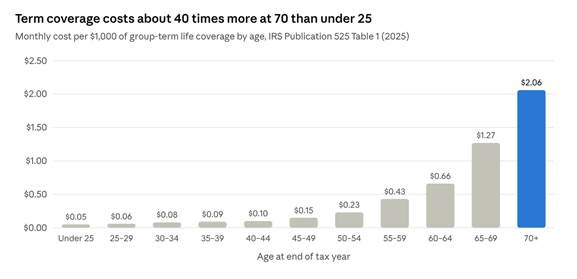
IRS Publication 525 (2025), Table 1: cost of $1,000 of group-term life insurance for one month
The cost per $1,000 nearly doubles from the early 50s to the late 50s, then roughly triples again by the late 60s, per IRS Publication 525.
Note: These IRS figures value employer-paid coverage for tax purposes; they are not your plan’s premiums. Still, most supplemental rate tables follow the same steep curve, so compare a level-premium individual policy before your 50s.
Employer Supplemental Life vs. Private Individual Term Life
Employer supplemental life wins on convenience and on access for people with health issues. A private individual term policy usually wins on long-term price for healthy buyers, on portability, and on control, because the coverage and the rate belong to you, not your employer.
| Feature | Employer supplemental life | Individual term life |
| Cost trajectory | Age-banded; rises every few years | Level premium locked for the term (10 to 30 years) |
| Portability | Ends with the job unless ported or converted in time | Stays with you regardless of employer |
| Coverage limits | Capped by plan, often in salary multiples | Set by income and underwriting; often much higher |
| Underwriting | None up to guaranteed issue; EOI above | Full or simplified underwriting; health affects price |
| Riders and options | Few; plan-defined | Choice of term length, conversion, riders such as waiver of premium |
| Who controls terms | Employer and group insurer | You and your insurer |
| Best for | Quick, no-questions coverage; health conditions | Healthy buyers wanting a fixed rate for 10 to 30 years |
Many households use both: keep the free basic coverage and some low-cost supplemental, then buy an individual term policy for the core income-replacement need so it survives a job change.
Note: Do not drop group coverage until a new individual policy is approved and in force. A lapse in between leaves your family unprotected.
How Much Supplemental Life Insurance Do You Need?
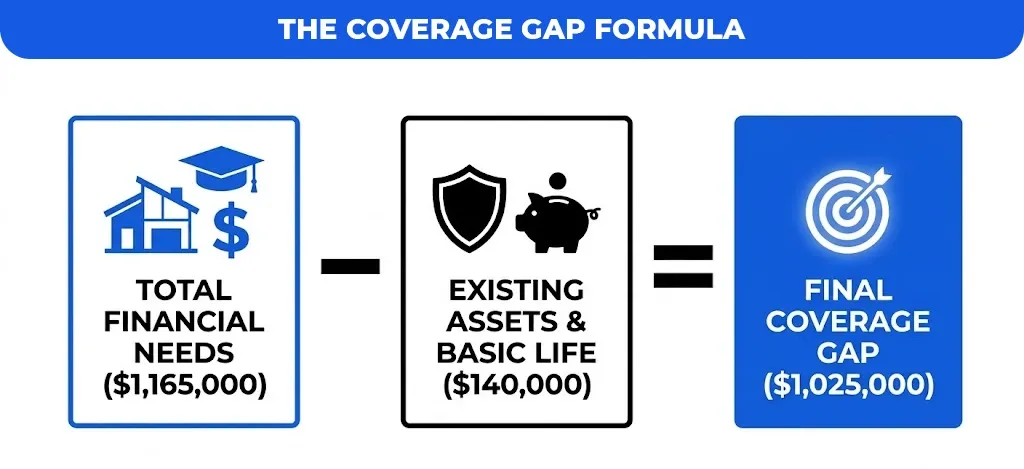
Start with what your family would need if your income stopped, subtract the coverage and assets you already have, and fill the gap. The 10x-income guideline is a quick check, but adding your actual debts and goals gives a more reliable number.
Coverage calculation matrix
| Line item | Example household |
| Income replacement (10 × $80,000) | $800,000 |
| Mortgage balance | $250,000 |
| College and childcare goals | $100,000 |
| Final expenses | $15,000 |
| Total need | $1,165,000 |
| Less basic group life (1x salary) | −$80,000 |
| Less savings and investments | −$60,000 |
| Coverage gap | $1,025,000 |
If this employer’s supplemental plan caps at 5x salary ($400,000), about $625,000 of the gap would still need another source, such as an individual term policy.
When to choose group supplemental vs. an independent policy
• Choose group supplemental when you have health conditions that would raise individual rates, need coverage quickly with no questions, or expect to stay with the employer.
• Choose an individual policy when you are healthy and under about 50, want a level rate, or might change jobs, retire early, or start a business.
• Use both when the gap is larger than your plan’s maximum, which is common for families with a mortgage and young children.
To run your own numbers, use the Assurance Gurus life insurance calculator, then compare the result with your plan’s guaranteed issue limit.
Conclusion: Build a Safety Net That Outlasts Your Job
Supplemental life insurance is a useful, convenient layer of protection, especially at your first enrollment, when guaranteed issue coverage requires no health questions. Its limits are rising age-banded rates and coverage that depends on your job, so the strongest plans pair it with coverage you own.
| Your situation | Likely best fit |
| New hire, healthy, needs coverage now | Elect up to the guaranteed issue limit; price an individual term policy |
| Health conditions make individual coverage costly | Maximize group supplemental at first eligibility |
| Spouse has little or no coverage | Add spouse supplemental, within plan caps |
| Planning a job change or early retirement | Individual term life you control; know your port and convert deadlines |
| Gap exceeds the plan maximum | Combine group supplemental with an individual policy |
Compare Private Supplemental Life Options at Assurance Gurus
Your employer’s plan is a starting point, not a complete strategy. Assurance Gurus helps you evaluate your coverage gaps, compare term and permanent life insurance plans from its carrier partners, and choose protection that stays with you if your job changes.
• Estimate your coverage gap with the free life insurance calculator.
• Compare term, universal, and family life insurance options in one place.
• Get guidance on how individual coverage fits alongside your workplace benefits.
• Request a free quote online or by phone.