


More than half of Americans turning 65 today will need some form of long-term care during their lifetime, yet Medicare and standard health insurance stop well short of covering it. That gap is exactly what long-term care insurance costs are meant to address, and it’s why so many people approaching retirement start pricing out a policy the moment a parent or spouse needs help at home.
The trouble is that quotes vary enormously from one applicant to the next. A healthy 55-year-old and an average 70-year-old can be looking at premiums that differ by a factor of three or more for similar coverage. This guide breaks down average long-term care insurance premiums by age and gender, the underwriting factors that move your price up or down, how traditional policies compare with newer hybrid options, and what self-funding actually costs if you decide to skip coverage altogether.
What Is Long-Term Care Insurance and What Does It Cover?
Long-term care insurance pays for help with everyday custodial tasks once a chronic illness, injury, or cognitive decline makes independent living difficult. Insurers typically trigger benefits when a policyholder needs hands-on or standby assistance with at least two of these Activities of Daily Living (ADLs):
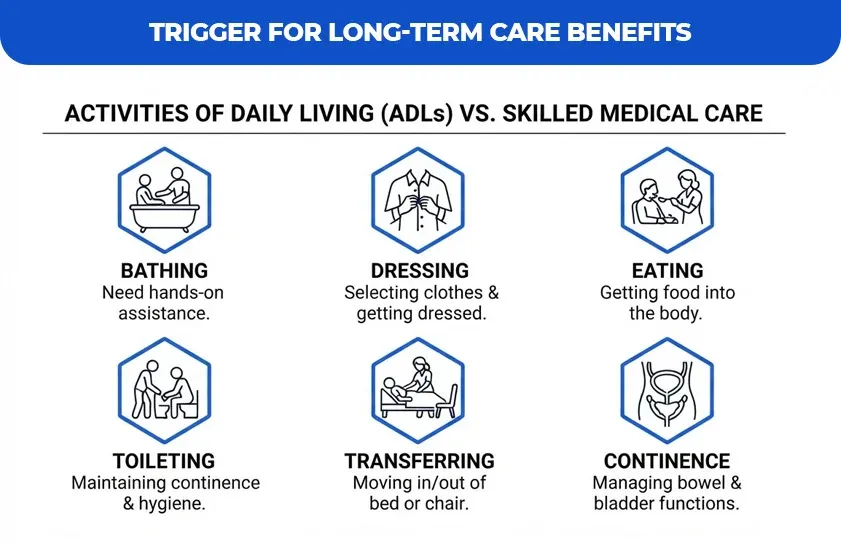
- Bathing
- Dressing
- Eating
- Toileting
- Transferring (moving in and out of a bed or chair)
- Continence management
This is a critical distinction because standard health insurance, disability insurance, and original Medicare are built around medical treatment and recovery, not ongoing custodial support. Medicare covers up to 100 days of skilled nursing care following a qualifying hospital stay, but it was never designed to pay for years of home health aides or an assisted living apartment. According to the American Association for Long-Term Care Insurance (AALTCI), roughly 70% of people turning 65 will need some level of long-term care services.
Average Long-Term Care Insurance Cost by Age
Long-term care insurance cost by age is the single biggest lever in your premium, and the AALTCI’s annual Price Index is the industry’s most cited benchmark. The table below shows average annual premiums for a $165,000 initial benefit pool with 3% compound inflation protection, which is the configuration most financial planners recommend so your coverage keeps pace with rising care costs over a 20-to-30-year horizon.
| Age at Purchase | Single Male | Single Female | Couple (Both Same Age) |
| 55 | $2,200/year | $3,750/year | $5,050/year |
| 60 | $2,610/year | $4,550/year | $7,000–$7,800/year |
| 65 | $3,280/year | $5,290/year | $7,800+/year |
Without any inflation protection, the same $165,000 benefit runs closer to $950 a year for a 55-year-old man and $1,500 for a 55-year-old woman, according to AALTCI data cited by the National Council on Aging. That level-premium version looks cheaper today, but it leaves your benefit pool stuck at 2026 dollars while nursing home and home care costs keep climbing, which is why most advisors treat inflation protection as close to mandatory rather than optional.
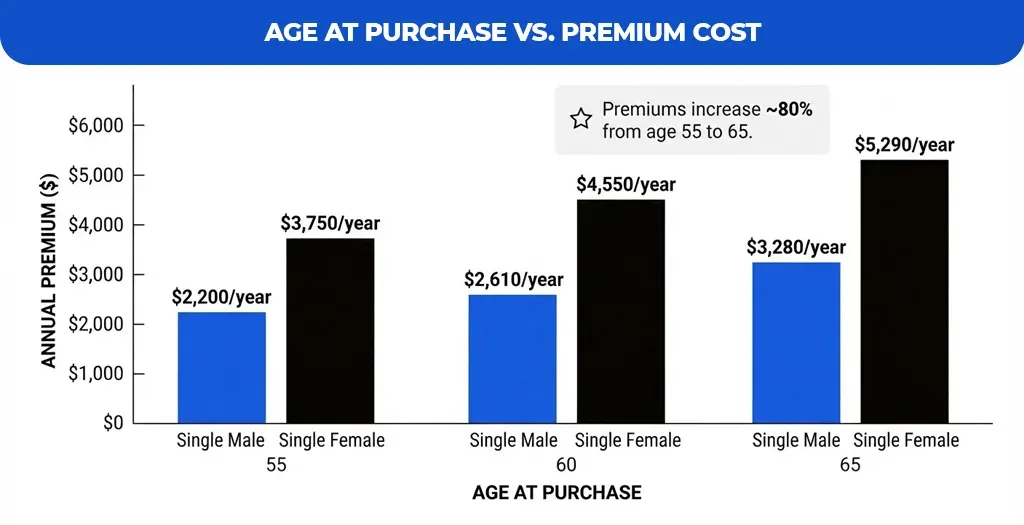
Notice the gender gap: women consistently pay 50% to 75% more than men for identical coverage. That’s because women statistically live longer and file long-term care claims more often and for longer average durations, so insurers price the added risk directly into long-term health care insurance cost calculations.
What Affects Your Long-Term Care Insurance Cost Estimate
Beyond age and gender, a handful of variables determine where your specific quote lands within the ranges above.
Age at Application
Every year you wait to buy compounds two problems at once: your starting premium rises, and your odds of a health event that raises the price further (or disqualifies you entirely) increase. AALTCI data shows premiums at age 60 run roughly 26% higher than at age 55, and by 65 they can be 80% or more above the age-55 baseline. Locking in coverage in your mid-50s to early 60s, while you’re still insurable, is consistently the cheapest window.
Health History and Underwriting
Carriers like Mutual of Omaha and Nationwide use full medical underwriting, reviewing your height-to-weight ratio, prescription history, family history of conditions like dementia, and tobacco use. A clean bill of health can qualify you for preferred rates, while conditions such as diabetes, Parkinson’s, or a recent cancer diagnosis can trigger higher premiums or an outright decline.
Policy Design Choices
The way you structure the policy itself moves the price as much as your health does:
- Maximum benefit pool: The total lifetime dollar amount the policy will pay out. A larger pool costs more but shrinks the odds you’ll exhaust benefits mid-claim.
- Elimination period: The deductible waiting window (commonly 30, 90, or 180 days) before benefits begin. Choosing a longer elimination period lowers your premium in exchange for covering more of the early costs yourself.
- Inflation protection: Compound inflation riders (typically 3% to 5%) keep your benefit pool growing over decades, which is essential given that nursing home costs have historically outpaced general inflation.
Traditional vs. Hybrid Long-Term Care Insurance
There are three main product categories on the market today, and each handles the long-term care insurance cost equation differently.
Traditional Long-Term Care Insurance
Traditional LTCI has the lowest starting premium of the three options, but it operates on a use-it-or-lose-it basis: if you never file a claim, your heirs see none of that money back. Traditional policies are also subject to future rate increases if the insurer’s claims experience runs worse than projected, which has happened industry-wide over the past two decades.
Hybrid or Linked-Benefit Policies
Hybrid policies attach a long-term care rider to permanent life insurance or an annuity. Premiums are typically fixed for life, and if you never need care, your beneficiaries still receive a death benefit, which is why these products have grown quickly according to industry data from CareScout and BuddyIns even though the upfront premium (or single lump-sum payment) is usually higher than a comparable traditional policy.
Short-Term Care Insurance
Short-term care policies cap coverage at roughly 12 to 36 months rather than providing lifetime or multi-year benefit pools. Underwriting standards are typically easier to clear, making this a fallback option for applicants who are declined for traditional coverage.
Long-Term Care Insurance Cost vs. the Cost of Care Itself
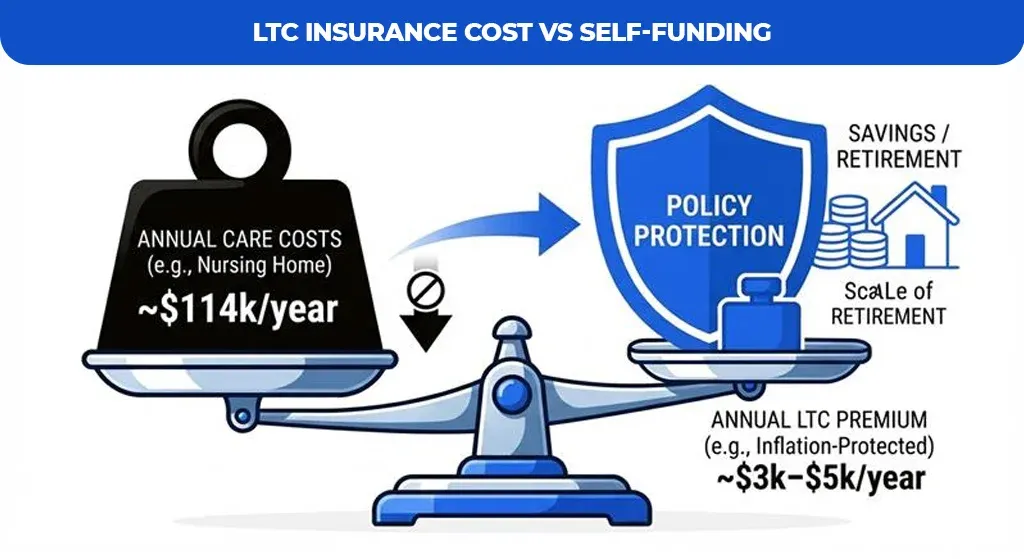
The clearest way to judge whether a premium is worth paying is to compare it against what long-term care actually costs without insurance. The 2025 CareScout/Genworth Cost of Care Survey and 2026 data from A Place for Mom put national median costs at:
| Type of Care | Monthly Cost | Annual Cost |
| In-home care (non-medical aide, ~$35/hr) | ~$6,700+ | ~$80,000+ |
| Assisted living facility | ~$6,200 | ~$74,400 |
| Memory care | ~$6,690 | ~$80,280 |
| Nursing home, semi-private room | ~$9,581 | ~$114,972 |
| Nursing home, private room | ~$10,798 | ~$129,576 |
Set against those figures, even an inflation-protected premium of $3,000 to $5,000 a year looks modest, especially for a couple trying to protect a retirement nest egg from a single extended nursing home stay. The alternative to insurance is self-funding, which usually means spending down personal assets until you qualify for Medicaid, a process that can also restrict your choice of care facility and put a lien on your home in many states.
Actionable Ways to Lower Your Long-Term Care Insurance Costs
If the premiums above feel steep, these strategies can bring your long-term care insurance cost estimate down without gutting your coverage:
- Buy in your mid-50s: Locking in a policy before health changes occur is the single biggest lever you control.
- Use a shared-care rider: Married couples can pool benefits into one shared policy, which is often cheaper than two fully separate policies.
- Extend your elimination period: Choosing a 90- or 180-day waiting period instead of 30 days can noticeably lower your monthly premium.
- Look into State Partnership programs: Many states run Long-Term Care Partnership programs that let you shield an equivalent dollar amount of personal assets from Medicaid spend-down rules for every dollar your policy pays out.
- Work with a Certified Financial Planner (CFP): A planner who specializes in retirement can compare traditional, hybrid, and self-funding scenarios against your actual balance sheet rather than a generic rule of thumb.
Conclusion
Long-term care insurance premiums represent a real, recurring line item in your retirement budget, but they exist to protect you from something far more expensive: an open-ended, six-figure care bill that can unravel decades of careful saving in a matter of months. Whether a traditional policy, a hybrid life/LTC product, or a disciplined self-funding strategy is the right fit depends on your age, health, and overall balance sheet.
Long-term care insurance cost represents a critical safeguard for your retirement savings, shielding your hard-earned nest egg from devastating, open-ended healthcare expenses. Taking decisive action today transforms uncertainty into ultimate security. Consult an independent broker immediately to compare personalized rates, evaluate hybrid alternatives, and guarantee a bulletproof financial future before it is too late.