Globe Life is a nationally licensed life insurance company known for its $1 first-month promotional offer, no-medical-exam underwriting, and direct-to-consumer marketing. It carries an A (Excellent) financial strength rating from AM Best, which means it has a strong ability to pay claims. Globe Life is a legitimate carrier, but its National Association of Insurance Commissioners (NAIC) complaint index of 2.74 shows it draws more than double the complaints expected for an insurer of its size, and its coverage caps of $100,000 for term policies and $50,000 for whole life policies make it a poor fit for anyone who needs a larger death benefit.
This review covers what Globe Life actually sells, what the $1 offer turns into after the first month, how its ratings and complaint data compare to the rest of the industry, and the 2024–2025 fraud allegations and regulatory investigations that shoppers keep asking about.
Quick Answer: Is Globe Life Insurance Good?
Legitimacy: Yes. Globe Life is licensed with the NAIC to sell life insurance in all 50 states and Washington, D.C., and holds an A (Excellent) rating from AM Best.
Best for: People who cannot pass a medical exam and want modest, guaranteed-acceptance or simplified-issue coverage between $5,000 and $100,000.
Not ideal for: Households that need $250,000+ in coverage, or healthy applicants who would qualify for cheaper, fully underwritten term life elsewhere.
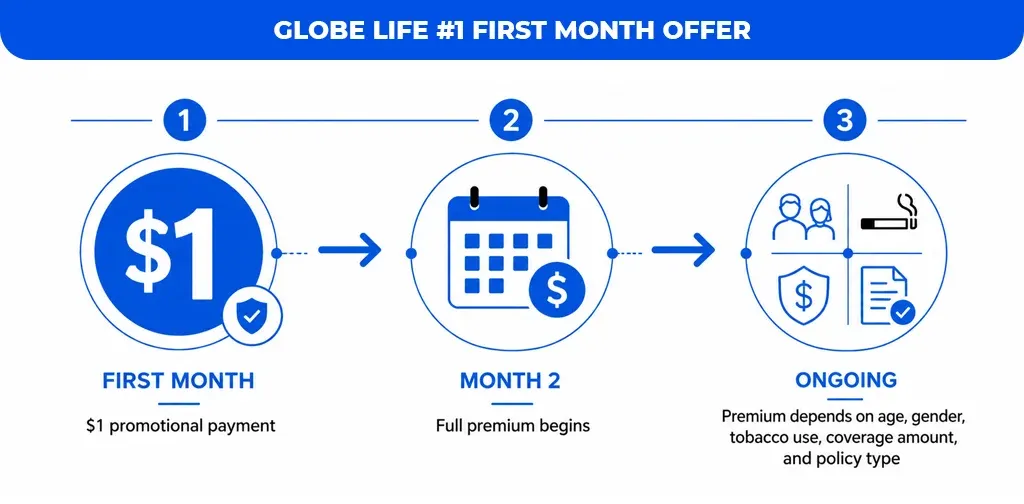
The $1 catch: The dollar only covers the first month. Full premiums start in month two and are based on age, gender, coverage amount, and tobacco use.
Complaint level: Above average. Globe Life’s NAIC complaint index of 2.74 means it received roughly 2.7 times the complaint volume expected for its size.
2024 fraud allegations: Both the SEC (July 2025) and the Department of Justice (July 2025) closed their investigations into Globe Life without pursuing enforcement action.
Key Takeaways
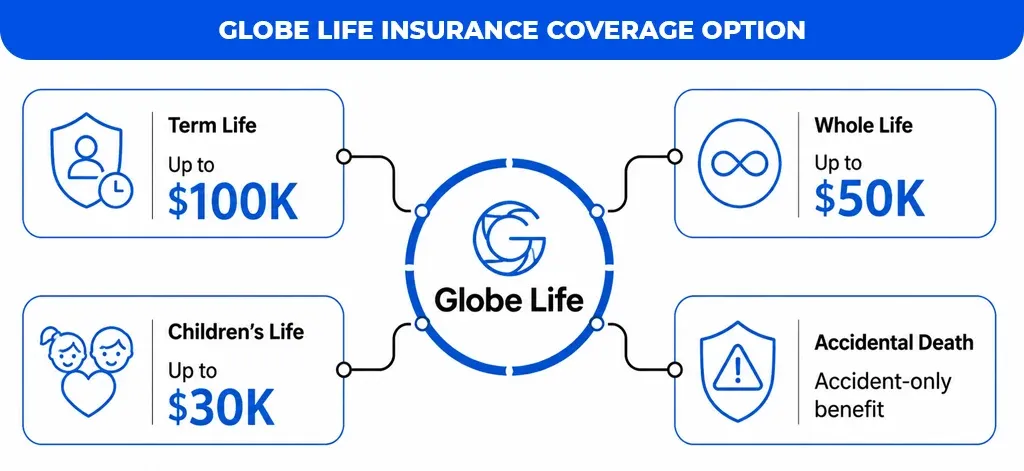
Globe Life sells term, whole, children’s, and accidental death policies without requiring a medical exam, only a health questionnaire.
In November 2026, AM Best confirmed Globe Life’s major subsidiaries at A (Excellent) with a stable outlook; S&P rates the group AA-, and Fitch rates it A+.
Term coverage tops out at $100,000 and is sold as a five-year renewable term, meaning premiums increase every five years rather than staying level for the full term.
Whole life coverage is capped at $50,000 for adults
($25,000 in New York)
and $30,000 for children, and can only be purchased by phone or mail, not online.
The 2026 short-seller allegations against Globe Life’s American Income Life subsidiary led to SEC and DOJ investigations; both were closed in July 2026 without enforcement action.
Because of its complaint history and coverage limits, comparison shopping against fully underwritten carriers is worth the extra ten minutes for most healthy applicants.
Globe Life Insurance Overview
Globe Life traces its roots to 1900, with its flagship direct-to-consumer subsidiary, Globe Life And Accident Insurance Company, founded in 1951. The parent holding company was known as Torchmark Corporation until August 2019, when it renamed itself Globe Life Inc. and changed its New York Stock Exchange ticker from TMK to GL as part of a brand-consolidation strategy. According to S&P Global Market Intelligence, Globe Life, which has its headquarters in McKinney, Texas, had more than 17 million active life insurance contracts as of 2026. Any other life insurer in the country.
The company operates through several underwriting subsidiaries, each with its own distribution channel:
Globe Life and Accident Insurance Company: direct-to-consumer term, whole, and children’s policies sold online, by mail, and by phone.
Labor union members and their families purchased American Income Life Insurance Company policies through career agents.
Through independent and exclusive agents, United American Insurance Company and Family Heritage Life Insurance Company offered supplemental health and life insurance products.
️ COMPARE OPTIONS
Looking for coverage that exceeds Globe Life’s caps without a complex medical exam? Compare fully underwritten and simplified term policies from top-rated carriers at Assurance Gurus today.
Financial strength ratings tell you how likely an insurer is to still be solvent and paying claims decades from now. Globe Life’s core life and health subsidiaries carry the following third-party ratings:
Rating Agency
Rating
Outlook / Date
AM Best (Financial Strength Rating)
A (Excellent)
Stable; affirmed November 2025
AM Best (Long-Term Issuer Credit Rating)
a+ (Excellent)
Stable; affirmed November 2025
S&P Global Ratings
AA-
Reported by Globe Life and third-party review sites
Fitch Ratings
A+
Reported by Globe Life and third-party review sites
AM Best’s scale runs from A++ (Superior) down to D (Poor). An A (Excellent) rating sits one full grade below the top tier held by mutual insurers such as Northwestern Mutual and New York Life, but it is still considered a strong, investment-grade rating that reflects Globe Life’s solid balance sheet strength and consistent operating performance.
Who Globe Life Is Built For
Globe Life markets almost exclusively direct-to-consumer, using television ads, direct mail, and an online quote engine rather than independent brokers. Its target customer is a middle-income or lower-middle-income family, or a senior, who wants small, guaranteed-acceptance or simplified-issue coverage without a medical exam. If you are in excellent health and want a large death benefit, you will typically find better pricing from a fully underwritten term carrier.
Life Insurance Options From Globe Life
Globe Life sells four main product lines, all underwritten through a short health questionnaire rather than a paramedical exam or blood test.
Whole Life Insurance
Globe Life’s flagship offer is permanent life coverage with a $1 first-month premium. After the promotional month, premiums are fixed for life and coverage builds cash value over time, which policyholders can eventually borrow against. Coverage amounts run from $5,000 to $50,000 for adults ($1,000 to $25,000 in New York), and this product is only available by calling an agent or responding to a mail offer; it cannot be purchased through Globe Life’s online quote tool.
Term Life Insurance and the Children’s Education Fund
Adult term coverage is sold in amounts from $5,000 to $100,000 and is structured as a five-year renewable term rather than traditional level term. That distinction matters: instead of one fixed rate for a 10-, 20-, or 30-year term, Globe Life reprices the policy every five years as the policyholder moves into a new age bracket, so the premium rises at each renewal. Maximum available coverage also shrinks with age, up to $100,000 for applicants under 60, up to $50,000 for ages 60 to 69, and up to $30,000 for applicants 70 and older, subject to state variation.
Globe Life also sells whole life coverage for children and grandchildren, marketed in some materials as a Children’s Education Fund, in face amounts from $5,000 to $30,000. Some child policies include a conversion feature that allows the coverage to convert to an adult whole life policy without new underwriting once the child reaches a specified age.
Accidental Death Insurance
Globe Life’s accidental death policies pay a benefit only if the insured dies from a covered accidental injury. They do not build cash value, and they exclude deaths from natural causes such as heart attack, stroke, or illness. Because acceptance is typically guaranteed regardless of health history, this product is priced and structured very differently from Globe Life’s whole and term life policies, and it should not be treated as a substitute for a policy that also covers natural death.
How Much Does Life Insurance From Globe Life Cost?
The $1 First-Month Offer, Explained
Every Globe Life product term, whole, and children’s coverage is marketed with the same hook: $1 pays for the first month of coverage, regardless of the face amount you choose. Starting in month two, you pay the actual premium, which is calculated using your age, gender, tobacco use, and the coverage amount you selected at application. Globe Life advertises that whole life premiums never increase for the life of the policy once that first full premium is set. Term life premiums, by contrast, are only fixed within each five-year age bracket and increase at every renewal.
What Drives the Premium
Age at issue: Globe Life groups applicants into age brackets, and premiums step up each time you move into a new bracket.
Coverage amount: Policies are sold in set increments, commonly $5,000, $10,000, $20,000, $30,000, $50,000, $75,000, and $100,000.
Tobacco use: Smokers and other tobacco users are quoted higher rates than non-users, as with virtually every life insurer.
Product type: Whole life premiums are typically higher per dollar of coverage than term, since whole life includes lifetime coverage and cash value accumulation.
Sample Term Life Rates
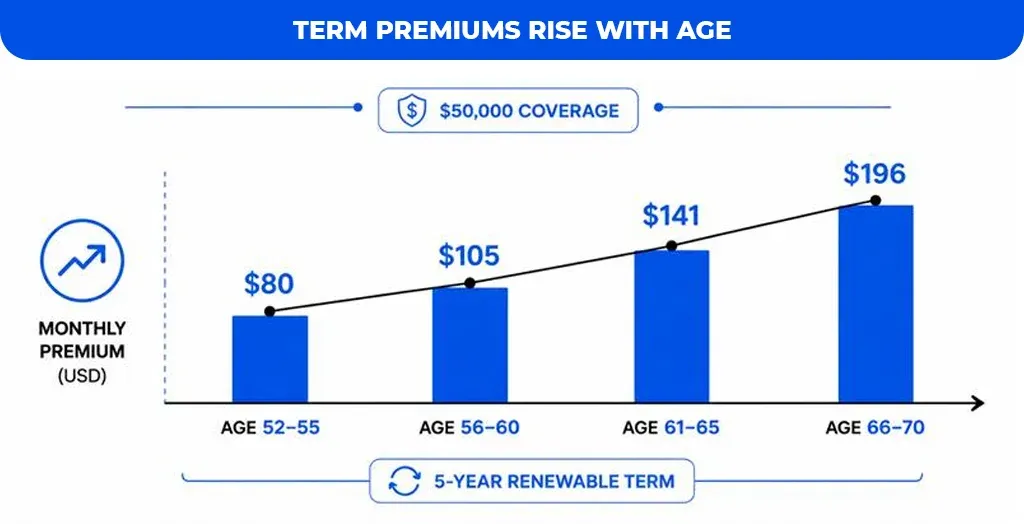
Independent rate research from ValuePenguin illustrates how a Globe Life term policy’s premium rises over time. The following example shows sample monthly rates for a policyholder who buys $50,000 of coverage at age 52 and keeps it in force as the five-year age brackets renew:
Age Bracket
Policy Length
Sample Monthly Rate
52–55
3 years (to next 5-year mark)
$80
56–60
5 years
$105
61–65
5 years
$141
66–70
5 years
$196
Sample rates vary by state, gender, health questionnaire answers, and the exact coverage amount, so treat this table as an illustration of the renewal pattern rather than a quote. Globe Life’s own promotional materials advertise adult whole life rates starting as low as $3.49 per month and children’s whole life starting around $2.17 per month, though the amount of coverage that buys will be modest.
How Globe Life’s Pricing Compares to Fully Underwritten Term
Because Globe Life does not require a medical exam or blood work, it accepts a wider range of health histories, but it prices that convenience into the premium. A healthy 40-year-old who would qualify for a fully underwritten 20-year level term policy from a traditional carrier will typically pay less per $1,000 of coverage there than for Globe Life’s simplified-issue, five-year renewable term. Simplified and guaranteed-issue coverage like Globe Life’s tends to make the most financial sense for applicants who have a health condition that would otherwise disqualify them, or substantially raise their rates, with a fully underwritten insurer.
RATE EVALUATION
Want to see how renewal-based pricing compares to a fixed-rate level term policy? Let independent experts at Assurance Gurus find a cost-effective plan that won’t spike every five years.
No medical exam required for any policy; only a set of health questions.
Fast, simple application process available online, by phone, or by mail, with coverage starting the first day and no waiting period.
Low advertised entry price, with the $1 first-month offer applying to every product line.
Strong, investment-grade financial strength ratings across all three major agencies (AM Best, S&P, Fitch).
Fixed lifetime premiums on whole life policies once the first full payment is set.
Cons
NAIC complaint index of 2.74, more than double the number of complaints expected for an insurer of Globe Life’s size, according to complaint-index data cited by Policygenius and other review sites.
Coverage caps are low: $100,000 maximum for term and $50,000 maximum for whole life, which will not meet the needs of most income-replacement or mortgage-protection buyers.
Term policies are five-year renewable term, not level term, so premiums rise at every renewal rather than staying fixed for the full term length.
No accelerated death benefit rider is available on Globe Life’s term policies, unlike many competing no-exam products.
Whole life policies cannot be purchased online and must be requested by phone or mail.
Cash value in whole life policies accumulates slowly in the early policy years, which is typical of simplified-issue whole life but worth knowing going in.
The Bottom Line
Globe Life is a legitimate, financially stable company that fills a specific niche: fast, no-exam coverage for people who might otherwise struggle to get approved. It is not the cheapest or highest-rated option for a healthy applicant who needs a large death benefit, and its complaint history and coverage caps are real trade-offs worth weighing before you commit. The right move for most shoppers is to see what Globe Life actually quotes for their age and health profile, then compare it against at least one fully underwritten alternative before deciding.
Globe Life can be a reasonable option if you need modest, guaranteed-acceptance or simplified-issue coverage and cannot qualify for a fully underwritten policy elsewhere due to your health history. Its financial strength ratings are solid, but its above-average NAIC complaint index and low coverage caps mean healthy applicants who need larger death benefits usually get better value from a fully underwritten term policy.
No open federal investigation is currently known. The SEC closed its investigation into Globe Life without enforcement action in July 2025, and the Department of Justice closed its related investigation the same month. Private shareholder lawsuits tied to the underlying 2024 allegations have continued in civil court, and Globe Life disputes the claims.
Yes, Globe Life pays valid claims and holds an A (Excellent) financial strength rating from AM Best that reflects its ability to do so. Payouts depend on the policy staying active and the cause of death matching what that specific policy type covers; accidental death policies, for example, do not pay for deaths from natural causes.
There isn't a single universally agreed "most trusted" insurer, because different ranking organizations weigh financial strength, complaint data, and customer satisfaction differently. Insure.com's 2026 consumer survey ranked Northwestern Mutual first overall, citing its A++ AM Best rating and the lowest NAIC complaint level in its study, with Guardian Life and New York Life close behind.