


Imagine a career with uncapped earning potential, a flexible schedule you control, and the daily reward of protecting families when they need it most. That’s the reality for a growing number of professionals who hold a life and health insurance license. Yet the path to earning one can feel confusing, since pre-licensing hours, exam content, and renewal rules shift from state to state.
This guide cuts through that confusion. Below, you’ll find the exact steps to go from unlicensed to fully credentialed, whether you’re pursuing a life and health insurance license in Texas, chasing a life and health insurance license in Florida, or applying anywhere else in the country. We’ll cover eligibility, coursework, the exam, the application, and what happens after you pass, so you can walk into your first client meeting with confidence instead of guesswork.
What Is a Life and Health Insurance License and Why Get One?
A life and health insurance license, sometimes written as a health and life insurance license, is a state-issued credential that authorizes you to sell specific categories of insurance products, formally called a “line of authority.” Every state’s Department of Insurance (DOI) grants this authority separately from other lines, such as property and casualty, which is why the combined life and health line is one of the most popular entry points into the industry.
What Products Can You Sell?
- Life Insurance: Term, whole life, universal life, and fixed or variable annuities fall under this authority.
- Health Insurance: Individual and family medical plans, ACA/Marketplace coverage, Medicare supplements, disability income, and long-term care policies all require this line.
Career Advantages Worth Considering
- High earning potential: Commission-based compensation means income is only as capped as your client base and renewal book allow.
- Recession-resistant work: People need life and health coverage in every economic climate, which insulates agents from many market downturns.
- Flexible business models: You can build as a captive agent tied to one carrier, or as an independent broker representing many, depending on how much autonomy you want.
According to the U.S. Bureau of Labor Statistics (BLS), insurance sales agents earn a median pay that regularly outpaces many entry-level professional roles, and the BLS projects continued, steady employment growth for the occupation over the coming decade. Because these figures update annually, check the current BLS Occupational Outlook Handbook entry for insurance sales agents before finalizing any income projections.
Step-by-Step Requirements to Qualify
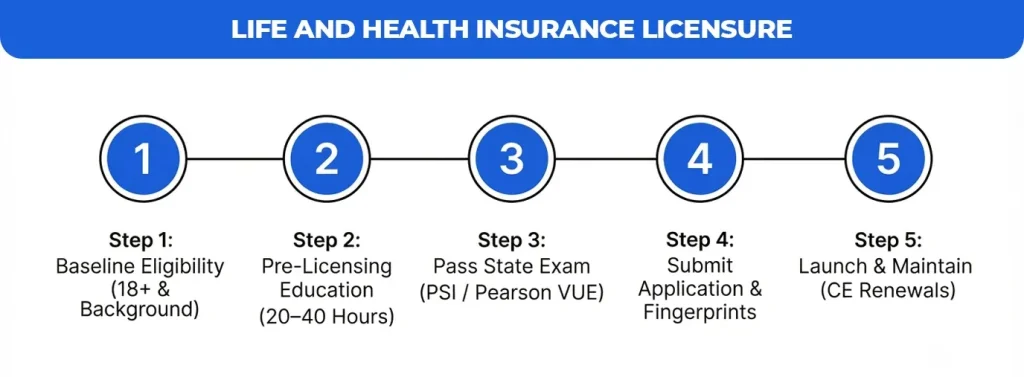
Before you enroll in a single course, confirm you meet your state’s baseline eligibility. While specifics vary, most states share a common foundation.
Background Checks and Fingerprinting
Each state DOI mandates that applicants provide their criminal history and have their fingerprints taken by an authorized vendor. This isn’t a formality; moral character guidelines mean certain felony convictions, especially those involving fraud or dishonesty, can delay or disqualify an application. If you have a record, it’s worth contacting your state DOI directly before investing in coursework.
Home-State vs. Non-Resident Licensing
Your home-state license lets you sell where you legally reside. Many agents later add non-resident licenses in other states to expand their book of business. Because reciprocity agreements and state-specific rules vary, an agent building both a life and health insurance license in Georgia and a life and health insurance license in New York simultaneously will need to track two separate sets of requirements and renewal calendars.
Completing Your Pre-Licensing Education (PLE)
Nearly every state mandates a set number of pre-licensing education hours before you can sit for the exam. Requirements commonly range from about 20 to 40 hours per line, or combined for the life and health package, though exact hours are set individually by each DOI and can change.
What the Coursework Covers
- General insurance principles: Insurance terminology, contract law basics, and the regulatory framework governing the industry.
- Product mechanics: Product structures for life and health lines, including policy provisions, riders, and exclusions.
- State-specific insurance law: Rules unique to the jurisdiction where you’re applying, often the section most heavily tested on exam day.
Choosing an Approved Provider
Look for state-approved course providers such as Kaplan, XCEL Solutions, or ExamFX. Most offer self-paced online formats, which suit working adults juggling a full-time job while studying for a life and health insurance license exam. Before enrolling anywhere, confirm the provider’s approval status and your state’s exact hourly requirement through the National Insurance Producer Registry (NIPR) or your local DOI portal, since these details are updated by regulators and shouldn’t be assumed from general guides like this one.
Mastering and Passing the State Licensing Exam
Once your PLE hours are complete, you’ll schedule your exam through a state-approved testing vendor, typically PSI Services or Pearson VUE. Understanding the format ahead of time removes a lot of unnecessary test-day anxiety.
Exam Structure
The exam is entirely multiple-choice and split into two portions: general knowledge covering national life and health topics, and a state-specific section covering local regulations. A candidate studying for a life and health insurance license Texas exam, for instance, will see Texas Insurance Code questions layered on top of the national content.
Core Topics Tested
- Underwriting rules: How insurers evaluate risk and determine insurability.
- Beneficiary designations: Rules for naming and changing beneficiaries on a policy.
- Retirement vehicles: Annuities and other retirement-focused insurance products.
- Group insurance: Employer-sponsored coverage and how it differs from individual policies.
- Ethics: Fiduciary duty, disclosure requirements, and professional conduct standards.
Submitting Your Application and Background Clearance
Passing the exam isn’t the finish line; it’s the trigger for the paperwork stage. Most testing centers transmit your passing score electronically, and you’ll then file your formal license application with your state’s Department of Insurance.
Fees and Final Clearance
You’ll pay an application fee (amounts vary by state) and complete any remaining fingerprint or background check requirements if they weren’t finalized earlier. Processing timelines commonly run about 7 to 10 business days once every document has cleared, though this can extend if your background check flags anything requiring additional review.
Launching Your Career: Captive vs. Independent Pathways
With a license in hand, your next major decision is business model. This choice shapes your training, your product access, and your income structure for years to come.
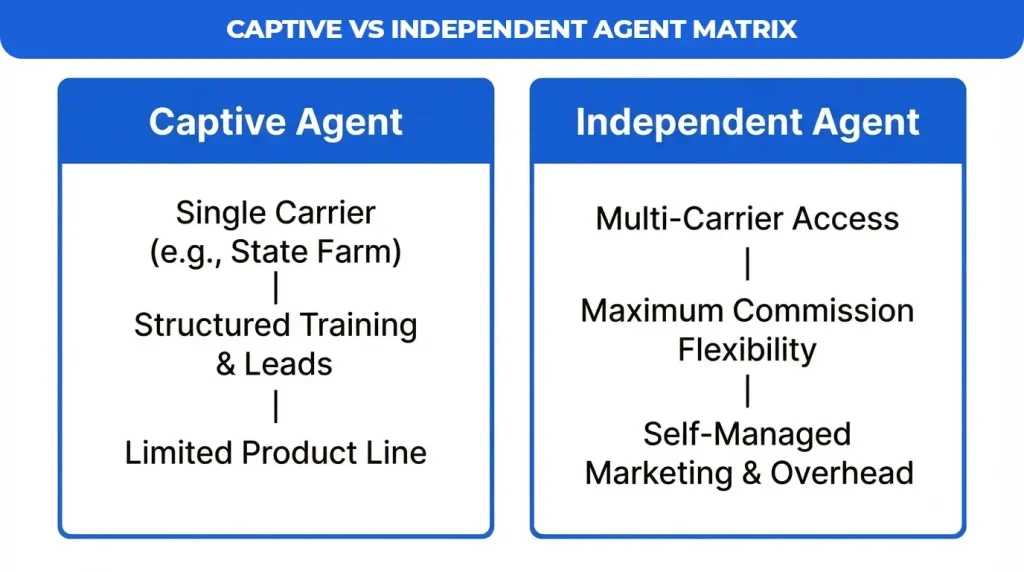
Captive Agents
- Structure: You represent one carrier exclusively think State Farm or Northwestern Mutual.
- Benefits: Structured onboarding, built-in leads, and ongoing carrier support.
- Trade-off: You’re limited to that carrier’s product lineup, which can restrict how you serve certain clients.
Independent Agents
- Structure: You partner with multiple carriers rather than one.
- Benefits: Broader product access and typically stronger commission flexibility.
- Trade-off: You own all your marketing, overhead, and lead generation from day one.
Immediate Next Steps After Licensing
- Secure carrier appointments: Most carriers require a signed appointment agreement before you can sell their products.
- Get E&O insurance: Errors and Omissions coverage protects you against claims of professional negligence; many carriers require it before appointing you.
- Join a professional association: Groups like the National Association of Insurance and Financial Advisors (NAIFA) offer mentorship, continuing education, and referral networks.
Maintaining Your License: Continuing Education (CE) and Renewals
Getting licensed is a milestone, not a finish line. Every state requires ongoing continuing education to keep your license active, and letting it lapse means starting significant portions of the process over.
Renewal Cycles
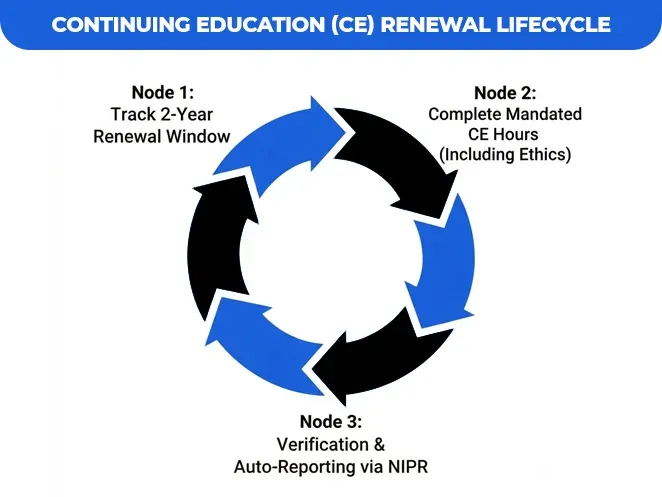
Most states require renewal every two years, though a handful use different cycles. Mark your renewal date the moment you’re licensed; auto-renewal reminders help, but the license holder is ultimately responsible for tracking the deadline.
CE Credit Requirements
States set a minimum number of CE hours per renewal cycle, and nearly all require at least one course specifically on ethics. Course providers report completed hours directly to your state, usually through the NIPR renewal warehouse, so there’s rarely paperwork on your end beyond finishing the coursework itself.
Avoiding a Lapse
- Track your deadline early: Set calendar reminders well ahead of your renewal date, not the week of.
- Verify completion: Confirm your CE hours are reported before assuming you’re compliant.
- Know the cost of lapsing: A lapsed license often requires reinstatement fees or, in some states, retaking the exam entirely.
Conclusion
Securing your life and health insurance license is a transformative career step that unlocks unlimited earning potential, professional autonomy, and the profound power to safeguard families against financial devastation. By carefully navigating state pre-licensing education, mastering rigorous exam principles, and choosing the optimal captive or independent business model, you establish a resilient foundation for long-term market success.
Take decisive action today by visiting your state Department of Insurance portal or checking the NIPR network to verify exact hourly mandates, enroll in an approved study provider course, and launch your lucrative journey toward becoming a trusted industry leader. Your future in financial services begins the moment you commit to taking that crucial first step.