



Imagine getting approved for a comprehensive life insurance policy in minutes or days without ever stepping foot in a doctor’s office, rolling up your sleeve for a blood draw, or sitting through an awkward medical exam. That’s exactly what no physical life insurance makes possible.
For many people, traditional underwriting is the biggest roadblock between them and the coverage their family needs. Fear of needles, an inconvenient schedule, or an underlying health condition can turn a simple insurance purchase into a months-long ordeal, and too often, it gets put off indefinitely.
The good news: life insurance with no physical exam, including simplified issue and guaranteed issue policies, has become one of the fastest-growing corners of the insurance market. This guide breaks down exactly how no-exam coverage works, the different types available, who benefits most, and a step-by-step approach to choosing the right policy without the medical red tape.
What Is No-Physical Life Insurance and How Does It Work?
No physical life insurance (sometimes called no physical exam life insurance) is a policy that skips the traditional paramedical exam: no blood draw, no urine sample, no height-and-weight check, no in-person nurse visit.
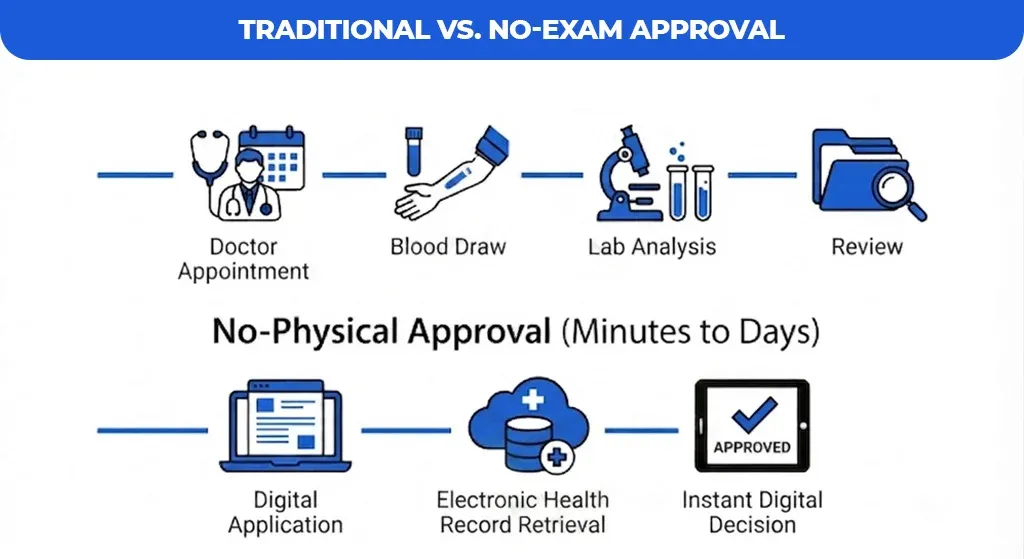
Instead of a physical, insurers lean on data they can pull or verify digitally, including:
- Electronic health records (EHR) shared by your physicians and pharmacies.
- Prescription database (Rx) history, which flags medications tied to certain conditions.
- Motor vehicle reports (MVR), used to assess risk factors like reckless driving or DUIs.
- Answers to a detailed medical and lifestyle questionnaire completed during the application.
Because underwriters are cross-referencing existing records instead of scheduling and waiting on a new exam, approval timelines shrink dramatically from instant decisions to a few business days, compared to four to eight weeks for a fully underwritten traditional policy.
Industry research from LIMRA (Life Insurance Marketing and Research Association) has consistently found rising consumer demand for faster, digital-first insurance buying experiences a trend that has pushed more carriers to expand their no-physical life insurance offerings in recent years.
Types of No-Exam Life Insurance Policies Available
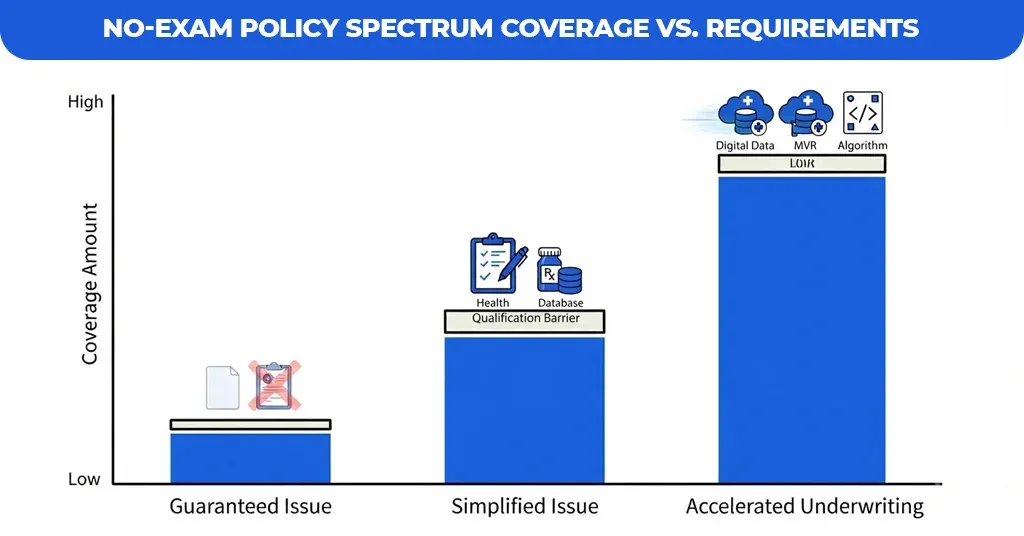
Not all no-exam coverage works the same way. The three primary categories are compared as follows:
| Policy Type | Medical Exam? | Health Questions? | Typical Coverage | Best For |
| Simplified Issue | No | Yes (health questionnaire) | Up to ~$500,000 | Healthy applicants wanting term or whole life fast |
| Guaranteed Issue | No | No | $10,000–$25,000 | Seniors, final expense/burial coverage |
| Accelerated Underwriting | No (for qualifiers) | Yes, plus data modeling | Same as fully underwritten term/whole life | Healthy applicants who want traditional-size policies fast |
Simplified Issue Term or Whole Life
Simplified issue no physical term life insurance requires you to answer a set of health questions, but there’s no exam. Applicants in good health typically qualify for higher coverage amounts and more competitive rates, with policies commonly capping out around $500,000.
Guaranteed Issue Whole Life
This is true life insurance: no physical, no questions asked. Acceptance is guaranteed based on age eligibility, usually between 45 and 85. Coverage amounts are modest, generally $10,000 to $25,000, and are designed to cover final expenses like funeral and burial costs.
Accelerated Underwriting
This approach applies to traditional term or whole life policies. For candidates who fulfill certain low-risk criteria, algorithmic data modeling evaluates your application, medication history, and public records to completely waive the exam, providing you with full-size coverage with no waiting period.
Pros and Cons: Is Skipping the Medical Exam Worth It?
Like any financial product, no-exam coverage is a trade-off. Weigh these factors before you buy.
The Benefits
- Fast approval: some carriers offer same-day or instant decisions.
- Convenience and privacy: no nurse visits, no fasting, no scheduling hassles.
- Accessible for people with minor, well-managed health issues through simplified issue underwriting.
The Drawbacks
- Higher premiums per thousand dollars of coverage, since insurers take on more uncertainty without exam data.
- Lower maximum coverage limits compared to fully underwritten policies.
- Guaranteed issue policies often include a graded death benefit and a waiting period (commonly two years) before the full payout applies for non-accidental deaths.
As a general benchmark, no-exam simplified issue premiums often run noticeably higher than a comparable fully underwritten term policy for the same healthy applicant, since the insurer is pricing in the risk of what an exam might have revealed.
Who Benefits Most from No-Physical Life Insurance?
Not everyone needs life insurance with no physical exam, but for certain groups, it’s the clear best fit:
- Busy professionals or parents who need coverage in place quickly, without scheduling delays.
- Individuals with minor, well-controlled chronic conditions who worry about rejection under traditional underwriting.
- Seniors seeking final expense or burial insurance through a guaranteed issue policy.
- Anyone with a needle phobia or strong privacy concerns about sharing biometric data.
Consumer research from firms like McKinsey & Company has repeatedly shown that modern insurance buyers increasingly prioritize speed and digital convenience over price alone, a shift that has made no-physical life insurance companies some of the fastest-growing players in the industry.

How to Qualify and Apply for a No-Exam Policy
Applying for coverage is more straightforward than most people expect. Follow these steps:
Assess your needs. Decide on a coverage amount and term length (10, 20, or 30 years) or determine your final expense needs if you’re considering guaranteed issue.
Gather your information. Have your Social Security number, basic medical history, current medications, and beneficiary details ready before you start.
Be honest on the application. Even without a physical exam, carriers cross-reference the MIB (Medical Information Bureau) database and prescription histories. Misrepresenting your health can lead to a denied claim later.
Compare quotes. Shop multiple top-tier carriers; pricing and underwriting criteria for the same applicant can vary significantly between insurers.
What You’ll Typically Need to Apply
- Government-issued ID and Social Security number.
- List of current medications and dosages.
- Height, weight, and self-reported health history.
- Beneficiary names and contact information.
- Payment method for your first premium.
Conclusion
Securing comprehensive protection no longer requires an invasive medical hurdle or weeks of stressful waiting. Ultimate financial peace of mind is now entirely within reach through streamlined no physical life insurance options that eliminate traditional delays. Whether you select a simplified issue plan, a guaranteed whole life policy, or accelerated underwriting, taking decisive action today safeguards your loved ones’ future with unmatched speed, absolute convenience, and guaranteed security.
Do not let procrastination or fear of needles jeopardize your family’s financial stability any longer. Take charge of your legacy right now by comparing top-tier carriers and locking in the proven protection you deserve. Get your exclusive, personalized, no-obligation quote today or speak with an independent insurance advisor to find the ideal no physical life insurance policy tailored specifically to your budget.