



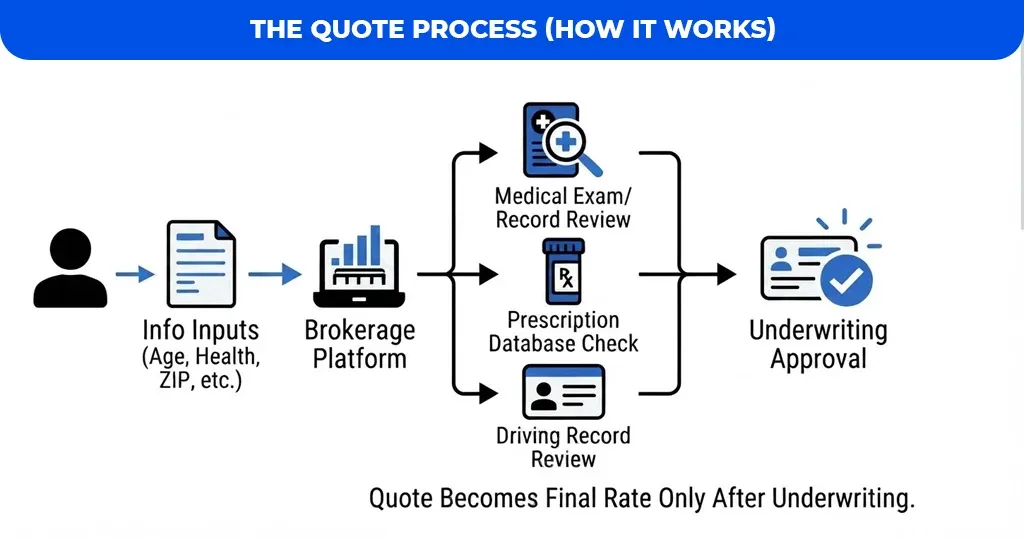
A life insurance quote is a free, non-binding price estimate for coverage, based on details you provide such as your age, height, weight, ZIP code, general health history, and desired coverage amount. Most online brokerage platforms let you compare quotes from multiple carriers in one place, and requesting a quote does not affect your credit score or commit you to buying a policy. The number you see online is an estimate; your final premium, called your rate, is confirmed only after the insurance company completes underwriting, which may include a medical exam, a prescription database check, or a review of your driving record.
Term life insurance, the most widely purchased type, typically costs a healthy 40-year-old between roughly $47 and $109 per month for $500,000 to $1,000,000 in 20-year coverage, based on MoneyGeek’s 2026 survey of more than 30 life insurance carriers. This guide walks through exactly how quotes work, what drives your final rate, and how to compare policies so you can secure appropriate coverage at a fair price.
| Quick Answer A life insurance quote is a free, instant, non-binding estimate based on your age, health, and desired coverage amount.Quotes are available online in minutes, and requesting one does not affect your credit score.Your final premium (the “rate”) is confirmed only after underwriting, which can include a medical exam.A healthy 40-year-old typically pays about $47–$59 per month for $500,000 in 20-year term coverage, per MoneyGeek’s 2026 carrier survey.Term life insurance is generally far less expensive than whole life insurance for the same death benefit. |
Key Takeaways
- Life insurance quotes are free, instant, and non-binding; you can request as many as you want without affecting your credit.
- About three-quarters of U.S. adults overestimate the actual cost of life insurance, per LIMRA and Life Happens’ 2026 Insurance Barometer Study.
- Term life insurance is the more affordable option for most families; whole life costs several times more per month but builds cash value.
- Your quoted price can change after underwriting if a medical exam, prescription check, or driving record reveals new information.
- Smoking substantially increases premiums; independent analyses put the increase anywhere from roughly 150% to more than 200% above non-smoker rates, depending on the study and carrier.
- Comparing quotes across multiple carriers, rather than buying from a single company, is one of the most effective ways to lower your premium.
What Is a Life Insurance Quote?
A life insurance quote is a preliminary price estimate generated from the information you self-report when you start shopping for coverage. Insurers and comparison platforms typically ask for your date of birth, gender, ZIP code, height and weight, tobacco use, general health history, and the coverage amount and term length you’re considering. Because this information is self-reported and not yet verified, the quote is an estimate rather than a guaranteed price.
Online brokerage platforms have made this process significantly faster than it used to be. Rather than contacting several companies individually, you can enter your details once and see estimated pricing from a range of carriers side by side, which makes it easier to spot meaningful differences in cost for comparable coverage.
How to Get Free Life Insurance Quotes Online in Minutes
Getting a quote online generally takes only a few minutes. You answer a short set of questions, and the platform returns estimated monthly or annual premiums across several coverage amounts and term lengths so you can see how price scales with your choices.
Information You’ll Need Before You Start
- Date of birth and gender
- ZIP code and state of residence
- Height and weight
- Tobacco or nicotine use, including vaping
- General health history and any current medications
- Desired coverage amount and term length
- Estimated annual income and outstanding debts, to help calculate how much coverage you actually need
- Beneficiary information
What Your Online Quote Does (and Doesn’t) Guarantee
An online quote gives you an immediate, non-binding estimate so you can compare options without pressure. It does not lock in a price, does not affect your credit score, and does not obligate you to purchase a policy. Your actual rate is set only after the insurer reviews your formal application.
Life Insurance Quote vs. Rate: What’s the Difference?
A quote is the initial, self-reported estimate you receive when you first request pricing online. A rate, also called your premium, is the official price the insurance carrier assigns after completing formal underwriting, which typically includes verifying your health information and, in many cases, a paramedical exam or a check of prescription and medical records databases.
For healthy applicants who accurately report their information, the final rate often lines up closely with the initial quote. However, an initial quote can change if the underwriting process turns up something you weren’t aware of or didn’t disclose, such as an undiagnosed health condition flagged during a medical exam or a discrepancy found in a prescription history check. This is why it’s worth being as accurate as possible when requesting a quote, even though the number isn’t final.
Term Life Insurance Quotes: Average Costs by Coverage Amount
Term life insurance provides coverage for a fixed period, commonly 10, 20, or 30 years, and is generally the most budget-friendly way to secure a large death benefit. Because pricing scales with the coverage amount you choose, the table below shows average monthly costs for a healthy, non-smoking 40-year-old on a 20-year term policy, based on MoneyGeek’s 2026 survey of more than 30 life insurance carriers.
| Coverage Amount | Average Monthly Cost (Nonsmoker, Age 40, 20-Year Term) |
| $100,000 | $16 – $19 per month |
| $500,000 | $47 – $59 per month |
| $1,000,000 | $86 – $109 per month |
Per dollar of coverage, larger policies actually cost less. MoneyGeek’s analysis found that a $100,000 policy for a 40-year-old nonsmoking man costs about $0.19 per $1,000 of coverage, while a $1,000,000 policy for the same profile costs closer to $0.11 per $1,000, meaning buyers who under-insure to save money are often paying more per dollar of protection, not less.
Age has a significant effect on price as well. Guardian Life’s own published 2026 term rates for a preferred-health, non-smoking male illustrate how a $500,000, 20-year term policy climbs with age: $28 per month at age 30, $34.50 at age 40, $76.50 at age 50, and $298.50 at age 60. Because these figures come directly from one carrier’s rate card rather than a market-wide average, they’re best used to show the shape of the age curve rather than as a universal benchmark.
Whole Life Insurance Quotes: What to Expect
Whole life insurance is a form of permanent coverage that lasts your entire lifetime rather than expiring after a set term, and it builds cash value you can potentially borrow against. Because it combines lifelong protection with a savings component, whole life premiums run considerably higher than term life premiums for the same death benefit.
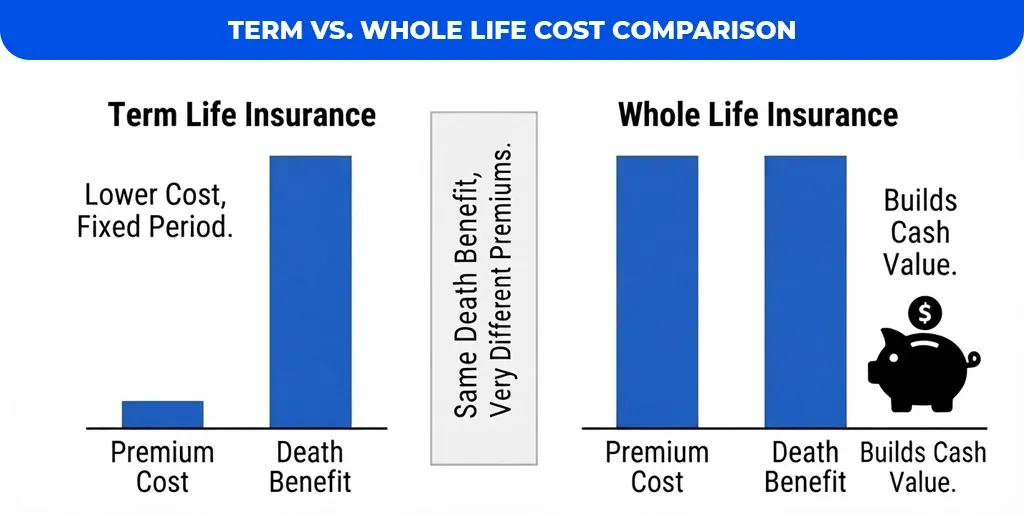
According to MoneyGeek’s 2026 whole life insurance rate survey, a healthy 40-year-old nonsmoking woman pays an average of $127 per month for $100,000 in whole life coverage, $540 per month for $500,000, and $1,065 per month for $1,000,000. Men in the same survey pay a similar amount at the lower coverage tiers, about $130 per month for $100,000, rising to roughly $1,115 per month for $1,000,000.
Age affects whole life pricing even more sharply than it affects term life pricing. MoneyGeek’s data shows that a 40-year-old woman’s $500,000 whole life premium of $540 per month climbs to nearly five times that amount, around $2,617 per month, by age 70, with the steepest single-decade jump, a 98% increase occurring between ages 50 and 60.
Key Factors That Affect Your Life Insurance Quote
Age and Gender
Premiums rise every year you wait, because insurers price policies according to statistical life expectancy. MoneyGeek’s data on $1,000,000 term policies shows a 40-year-old man paying $109 per month for a 20-year term, with that same coverage costing $262 per month if he waits until age 50 an increase of more than $1,800 per year for identical coverage. Because men statistically have shorter average life expectancies than women, they generally pay somewhat more for the same coverage amount at a given age.
Health and Medical History
Underwriters evaluate your current health, medical history, and family health history to assign you to a risk class, commonly labeled tiers such as Preferred Plus, Preferred, or Standard. Conditions like high blood pressure, elevated cholesterol, diabetes, or a family history of certain diseases can move you into a higher-cost risk class, while a clean bill of health and healthy BMI generally qualify you for the lowest available rates.
Tobacco and Lifestyle Habits
Tobacco use has one of the largest effects on price of any single factor. ValuePenguin’s analysis of quotes from five national insurance companies found that smokers paid an average of 215% more than nonsmokers for the same coverage, with the increase ranging from 164% to 343% depending on the carrier and applicant profile. Separately, MoneyGeek’s own smoking-specific analysis found smokers paying roughly two to three times more than nonsmokers for identical coverage, adding well over $1,000 per year in premiums for a typical $500,000 policy. These figures come from different studies and methodologies.
Hazardous hobbies, high-risk occupations, and a poor driving record can also push your risk class and therefore your quote higher.
Medical Exams vs. No-Exam Options
Traditional fully underwritten policies typically require a paramedical exam, including blood and urine samples. A growing share of insurers now offer accelerated or simplified underwriting that skips the exam in favor of electronic health data, prescription records, and a shorter questionnaire, which can significantly speed up approval.
No-Medical-Exam Life Insurance Quotes Explained
No-exam life insurance generally falls into three categories, each with different coverage limits and pricing. Accelerated underwriting uses electronic health and prescription data to approve healthy applicants quickly, with some top carriers approving up to $1 million to $2 million in coverage without a physical exam. Simplified issue policies ask a shorter set of health questions and typically cap out around $500,000 in coverage, according to Guardian Life. Guaranteed issue policies accept virtually all applicants regardless of health, but coverage is usually limited to $25,000–$50,000 and often includes a two- to three-year graded benefit period.
For healthy applicants, skipping the exam doesn’t necessarily mean paying more. Forbes Advisor compared rates for no-exam and fully underwritten term policies for healthy 30-year-old buyers and found a $500,000, 20-year no-exam policy averaged $18 per month, versus $19 per month for the same policy with a full medical exam a negligible difference. The gap widens for applicants with health conditions the insurer can’t verify without an exam, where no-exam premiums tend to run higher.
How Much Life Insurance Coverage Do You Need?
A widely used starting point is the D.I.M.E. framework, which totals four categories of financial obligation to estimate a reasonable coverage amount:
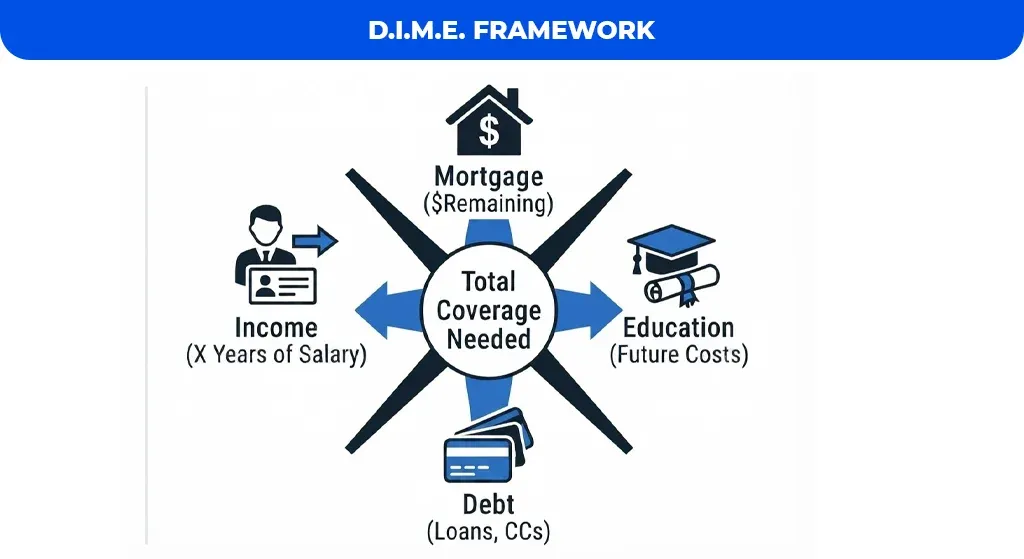
- Debt: Credit cards, car loans, student loans, and other outstanding balances your family would otherwise have to cover.
- Income: The number of years of income your dependents would need replaced, often calculated as a multiple of your annual salary.
- Mortgage: Your remaining mortgage balance, so your family isn’t forced to sell the home.
- Education: Estimated future costs of your children’s education.
As a general rule of thumb, MoneyGeek suggests targeting roughly 10 to 12 times your annual salary as a starting benchmark, then adjusting up or down based on your specific debts, dependents, and education goals.
How to Buy Life Insurance: A Step-by-Step Guide
- Calculate your coverage needs. Use the D.I.M.E. framework, or an income-multiple benchmark, to arrive at a target death benefit.
- Compare quotes from multiple carriers. Evaluate price, financial strength ratings, and policy features rather than price alone.
- Choose your policy type and term length. Decide between term and whole life, and select a term length (10, 20, or 30 years) that matches how long your dependents will need protection.
- Complete the formal application. This may include a paramedical exam or accelerated underwriting, depending on the policy type and your health profile.
- Review your policy contract and activate coverage. Confirm your beneficiaries, death benefit, and premium schedule, then sign and set up recurring payments.
Get Your Free Life Insurance Quotes Today
Protecting your loved ones shouldn’t feel like a guessing game. Once you know roughly how much coverage you need and understand what drives your price, the fastest way to find a fair rate is to compare real quotes from multiple A-rated carriers side by side rather than relying on a single company’s advertised price.
Ready to see your own numbers? Compare free, no-obligation life insurance quotes from top-rated carriers with Assurance Guru’s quote and find coverage that fits your budget in minutes.