


Burial Insurance With No Waiting Period

Burial Insurance With No Waiting Period: 2026 Guide

Burial insurance with no waiting period pays the full death benefit starting on the first day the policy is active, instead of making your family wait one to three years for full coverage. It is a type of whole life insurance, often called final expense insurance or immediate burial insurance, and it is built specifically to cover funeral costs, cremation expenses, and other end-of-life bills without delay.

This differs from a graded, guaranteed-issue, or final expense plan, which typically pays only a partial benefit or a return of premiums if the policyholder dies from natural causes within the first two to three years. No-waiting-period policies, sometimes called “day-one” or “level benefit” plans, generally require answering a short set of health questions rather than skipping underwriting altogether, which is how insurers can offer full coverage immediately while still managing risk.

Quick Answer
Burial insurance with no waiting period is a whole life final expense policy that pays 100% of the death benefit immediately, with no delay, as long as the policy is active when the insured passes away. It typically requires answering health questions (no medical exam), is available to most applicants roughly ages 50–85, and commonly provides coverage amounts between $2,000 and $50,000.
Monthly premiums for a $10,000 policy commonly range from about $20 to over $100, depending on age, gender, tobacco use, and health, according to published industry rate data from carriers and licensed agencies such as Choice Mutual and Lincoln Heritage Funeral Advantage.

Key Takeaways

  • No-waiting-period policies pay the full face value from day one, unlike graded or guaranteed-issue plans that phase in coverage over two to three years.
  • Qualifying generally requires a short health questionnaire, not a medical exam, though certain conditions can lead to a decline or a referral to a graded plan.
  • The national median cost of a funeral with viewing and burial was $8,300 in 2026, up from $7,848 in 2021, according to the National Funeral Directors Association (NFDA).
  • Comparing multiple carriers matters: the same applicant can receive meaningfully different quotes from different insurers for identical coverage.

What Is Burial Insurance With No Waiting Period?

Burial insurance with no waiting period is a small whole life insurance policy designed to help a family cover funeral, burial, or cremation costs without a delay in coverage. It is also marketed as final expense insurance, funeral insurance, or immediate burial insurance. The defining feature is the day-one, level death benefit: from the moment the policy is in force, the full face amount is payable if the insured dies of natural or accidental causes, with no reduction and no multi-year phase-in period.

This is different from a graded benefit or modified benefit policy, which typically pays only a partial benefit (often a refund of premiums paid plus interest) if death from natural causes occurs during the first two to three years. It is also different from a guaranteed-issue policy, which asks no health questions at all but almost always includes that same waiting period as a trade-off for automatic acceptance.
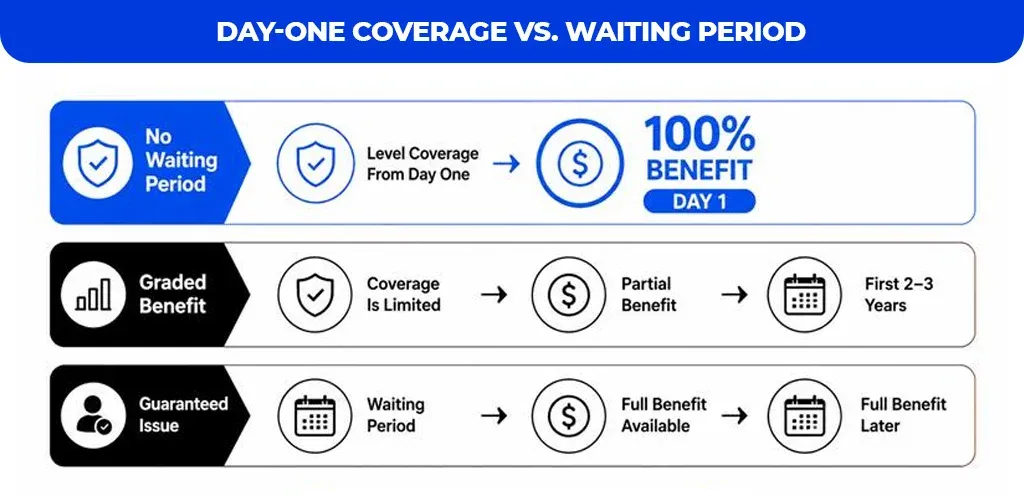
Day-One Coverage vs. Waiting Period

  • Level death benefit: The payout amount is locked in on day one and never decreases as long as premiums are paid, which is the core advantage over graded plans.
  • Immediate vs. graded coverage: Immediate plans require simplified underwriting (health questions); graded and guaranteed-issue plans trade a waiting period for a lower underwriting bar.

State insurance regulators, coordinated through the National Association of Insurance Commissioners (NAIC), require insurers to clearly disclose whether a final expense policy is a level, graded, or guaranteed-issue product, since this distinction directly affects when a family can actually access the funds.

How No-Waiting-Period Policies Work

Application and Underwriting Process

Most no-waiting-period final expense policies use simplified issue underwriting. Instead of a medical exam, blood work, or paramedical visit, applicants answer a short list of yes-or-no health questions covering things like current diagnoses, hospitalizations, and tobacco use. Answers that don’t disqualify the applicant outright typically lead to approval within days, and some carriers approve applications the same day.

Day-One Coverage Guarantee

Once the policy is issued and the first premium is paid, the full face value becomes payable immediately if the insured dies from a covered cause, including natural causes such as heart disease or a stroke, not just accidents. This is the central selling point of a no-waiting-period plan and the main reason it costs more than a graded or guaranteed-issue policy with comparable coverage.

Premiums and Permanence

These policies use a whole life structure, meaning premiums are fixed for life and do not increase with age, and the policy does not expire as long as premiums are paid, typically up to age 100 or beyond depending on the carrier. Many policies also build modest cash value over time, which the policyholder may be able to borrow against, though the primary purpose remains the death benefit rather than cash accumulation.
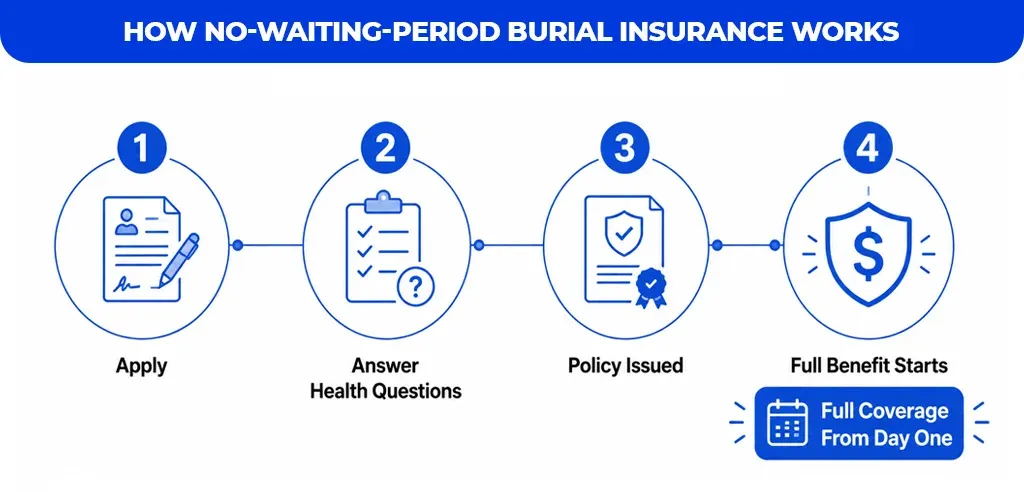
How No-Waiting-Period Burial Insurance Works

Pros and Cons of Immediate Coverage Burial Insurance

Weighing the advantages against the trade-offs helps determine whether a no-waiting-period policy, a graded plan, or another option fits your situation best.

Advantages

Trade-offs

Full death benefit payable from day one, including natural causes

Stricter health qualification than guaranteed-issue plans

Fixed premiums that never increase with age

Higher monthly premium than a comparable graded or guaranteed-issue policy

No medical exam; approval based on health questions

Applicants with certain serious conditions may be declined outright

Builds modest cash value over time

Coverage amounts are smaller than typical term or permanent life policies

Consumer-facing guidance, including comparisons published by Consumer Reports on weighing policy costs against benefit timelines, generally recommends matching the policy type to your health profile and timeline rather than defaulting to the cheapest advertised premium, since a lower price on a graded plan can mean a multi-year gap in real protection.

️ DAY-ONE PROTECTION

Want to secure immediate day-one coverage without a multi-year waiting period? Compare top-rated level benefit plans to find financial security tailored to your health profile.

A Note on Financial Advice

Financial commentator Dave Ramsey and his team at Ramsey Solutions generally advise against buying permanent life insurance, including burial insurance, solely to cover funeral costs, recommending instead that families build savings or an emergency fund for that purpose. Ramsey’s team does acknowledge, however, that a burial policy can be a reasonable option for older individuals who have no savings and would not qualify for term life insurance because of age or health.

Who Qualifies for No-Waiting-Period Final Expense Insurance?

Health Criteria

Applicants with well-controlled, common conditions such as managed high blood pressure, mild type 2 diabetes, or a stable history of anxiety or depression are generally able to qualify for a level, no-waiting-period plan. Conditions that more commonly lead to a decline or a referral to a graded or guaranteed-issue plan include a terminal diagnosis, active cancer treatment, home oxygen use, recent organ transplant, or a recent stroke or heart attack. Exact underwriting guidelines vary by carrier, which is why comparing more than one company matters.

Age Eligibility

Burial insurance for seniors with no waiting period is typically available to applicants roughly age 50 to 85, though the exact range varies by carrier and by state. Some insurers extend guaranteed-issue options to applicants in their late 80s, but those plans almost always include a waiting period.

Medical Database Checks

Even without a medical exam, insurers commonly verify what applicants report against two data sources: the prescription history database, which shows medications on file, and the Medical Information Bureau (MIB), which holds a record of past insurance applications and their outcomes. Inconsistencies between what an applicant states and what these databases show can result in a delayed decision or a change in the offered policy type.
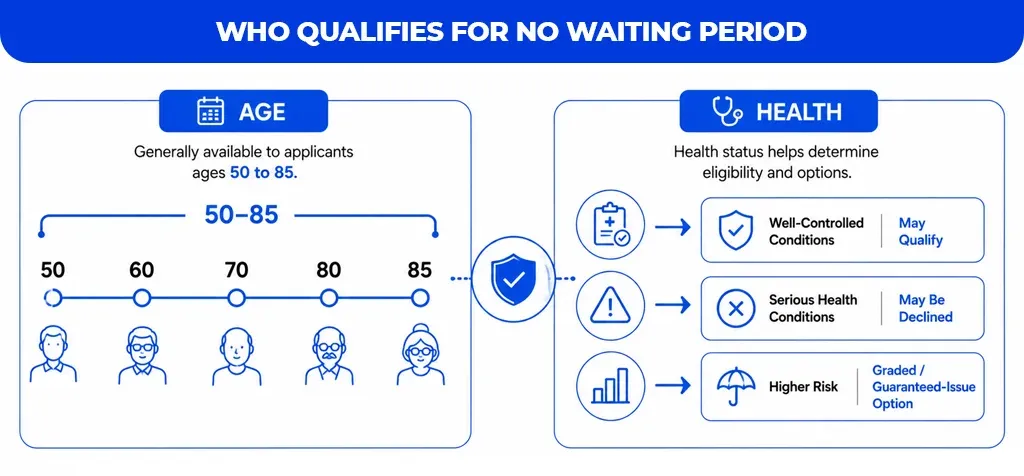
Who Qualifies for No Waiting Period

According to LIMRA’s life insurance research, covering burial costs and final expenses is consistently cited as one of the top reasons Americans buy life insurance in the first place, reported at roughly 60% of policyholders in recent LIMRA fact sheets, which underscores how central this single need is to the final expense insurance market.

What Expenses Does Burial Insurance Cover?

Because the death benefit is paid directly to the beneficiary named on the policy rather than to a funeral home, the money can be used for any purpose the family chooses, though it is most often applied toward:

  • Funeral and burial costs: caskets, embalming, use of the funeral home’s facilities and staff, viewing or visitation services, and cemetery plot or interment fees.
  • Cremation alternatives: direct cremation fees, urns, and memorial or celebration-of-life services in place of a traditional funeral.
  • End-of-life medical bills: out-of-pocket healthcare costs, copays, and hospice care balances not covered by Medicare or other insurance.
  • Miscellaneous debts: outstanding credit card balances, personal loans, or probate and estate administration fees left behind.

Burial Insurance With No Waiting Period: What Does It Cost?

Premiums for burial insurance with no waiting period depend primarily on age, gender, tobacco use, health, and the coverage amount selected. Published industry rate data from licensed agencies, including Choice Mutual and Lincoln Heritage Funeral Advantage, shows that a $10,000 policy commonly costs somewhere between $20 and $100 or more per month, with premiums rising steadily at older ages and for male applicants, who typically pay somewhat more than female applicants of the same age due to differences in life expectancy.
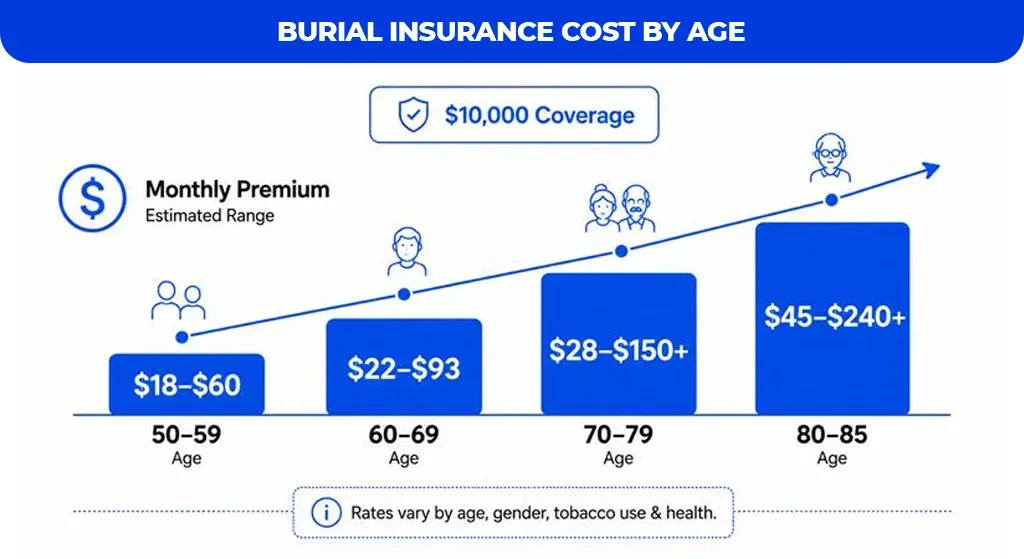

Burial Insurance Cost by Age

Age Range

Typical Monthly Range (Female)

Typical Monthly Range (Male)

50–59

$18 – $50

$20 – $60

60–69

$22 – $77

$29 – $93

70–79

$28 – $116

$38 – $150+

80–85

$45 – $180+

$60 – $240+

These figures are illustrative ranges compiled from publicly published carrier and agency rate guides for a $10,000 death benefit and are not a quote. Because pricing for the cheapest burial insurance with no waiting period varies by carrier, and because the same applicant can receive noticeably different offers from different insurers for identical coverage, the only reliable way to find the best affordable burial insurance with no waiting period for your situation is to compare real, personalized quotes.

How to Choose the Right No-Waiting-Period Policy

Assess Your Actual Financial Need

Start by estimating a realistic total based on current funeral pricing in your area rather than a round number. The national median cost of a funeral with viewing and burial was $8,300 in 2023, and the median cost of a funeral with cremation was $6,280, according to the NFDA’s most recent General Price List Study, though actual costs vary by region and by the specific services chosen.

Compare Carrier Financial Strength

A final expense policy is only as reliable as the company standing behind it decades from now. Independent rating agencies such as A.M. Best evaluate insurers’ financial strength and claims-paying ability, and checking a carrier’s current rating before applying is a reasonable due-diligence step alongside comparing premiums.

Work With an Independent Broker

Independent agencies can compare quotes across multiple carriers at once, rather than presenting a single company’s rates, which matters because underwriting outcomes and pricing for the same applicant can differ meaningfully from one insurer to the next. This is the core value an independent broker like Assurance Gurus provides: matching your specific age, health profile, and budget against a range of no-waiting-period options instead of a single fixed product.

Conclusion

Choosing burial insurance with no waiting period comes down to matching your health profile, budget, and coverage needs to the right carrier, since pricing and underwriting standards vary meaningfully across the industry. Immediate, level-benefit coverage offers the strongest protection from day one, while graded and guaranteed-issue plans remain a fallback for applicants who don’t qualify for a level plan.

At Assurance Gurus, we specialize in helping seniors and families compare no-waiting-period final expense options across multiple carriers, so you can find coverage that fits your health and your budget without the guesswork. Visit Assurance Gurus to get a quote, compare free, no-obligation quotes, and secure a burial insurance policy with no waiting period today.

EXPERT GUIDANCE

Ready to protect your family from end-of-life financial stress with a trusted independent broker? Visit Assurance Gurus today to compare personalized options and get your free quote in minutes.

Frequently Asked Questions (FAQs)

Dave Ramsey and the Ramsey Solutions team generally recommend against buying permanent life insurance, including burial insurance, purely to cover funeral costs, arguing that a fully funded emergency fund or savings should handle those expenses instead. Their stated exception is that a burial policy can still make sense for an older individual who has no savings and would not qualify for term life insurance.

Based on published carrier and agency rate data, a $10,000 no-waiting-period burial policy commonly costs somewhere between $20 and $100 or more per month, depending mainly on the applicant's age, gender, tobacco use, and health at the time of application. Premiums are typically lowest for applicants in their 50s and rise at each successive age bracket, which is why locking in a policy earlier generally results in a lower lifetime premium.

Yes. Burial insurance is sold directly to individuals, typically ages 50 to 85, through licensed insurance agents, independent brokers, or directly from carriers, and it does not require an employer or group plan. Most applications can be completed over the phone or online in under thirty minutes, since simplified issue underwriting relies on health questions rather than a medical exam.

Yes, an applicant can be denied a simplified-issue, no-waiting-period policy if their health questionnaire reveals a disqualifying condition, such as a terminal illness, active cancer treatment, or recent major cardiac event. In most cases, a decline for a level-benefit policy does not mean the applicant is uninsurable altogether; it typically means they are redirected toward a guaranteed-issue policy, which accepts nearly all applicants within the eligible age range but includes a waiting period before the full death benefit applies.