


Guaranteed universal life insurance (GUL) gives you a fixed premium and a death benefit that’s guaranteed for life, or to an age you choose, at a lower price than whole life. It does that by stripping out most of the cash value, which makes it a popular choice for seniors, estate planning, and anyone who wants permanent coverage without paying for a savings feature they don’t need.
Quick answer: Guaranteed universal life is permanent life insurance with a level premium and a death benefit guaranteed to a chosen age, usually between 90 and 121, as long as premiums are paid on time. It builds little or no cash value, so it costs less than whole life. NerdWallet’s 2026 sample rates for $100,000 of GUL run about $54 to $63 a month at 40 and $137 to $150 at 60.
What Is Guaranteed Universal Life Insurance?
Guaranteed universal life insurance is a type of permanent universal life policy designed mainly to provide a guaranteed death benefit for life at a fixed premium, with little or no emphasis on cash value. You choose a coverage amount and a guaranteed age when you buy it. As long as you pay the scheduled premium on time, the death benefit stays in force until that age.
Because most of the premium goes toward keeping the guarantee in place rather than building savings, GUL is often described as “term insurance that lasts for life.” The death benefit is generally income-tax-free to beneficiaries under IRC Section 101(a).
How the no-lapse guarantee works
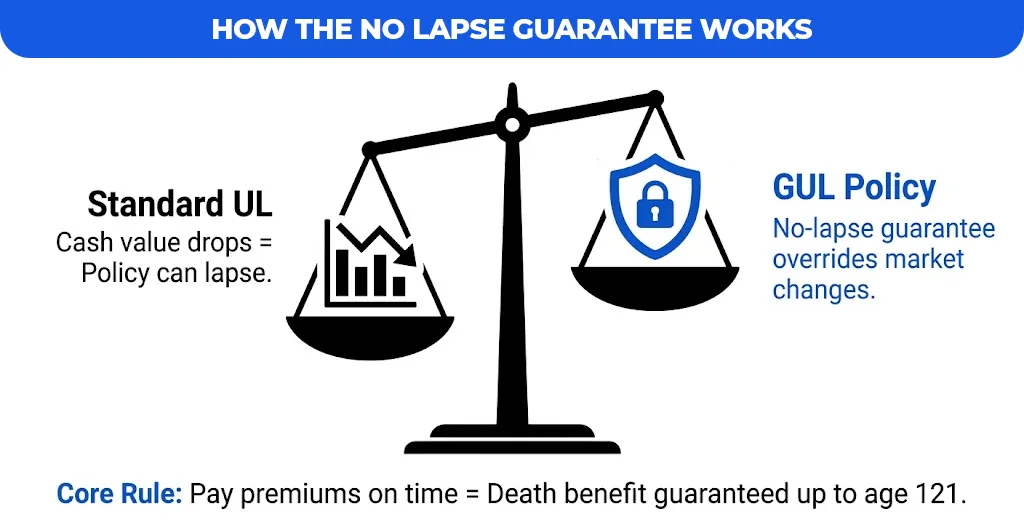
The core of a GUL policy is its no-lapse guarantee: a contractual promise that the policy won’t lapse, even if its cash value drops to zero, as long as the required premiums are paid on time. In a standard universal life policy, the policy can lapse if cash value runs out because interest rates fall or insurance charges rise. In a GUL policy, the guarantee overrides that, so market interest rates don’t affect whether you stay covered.
The guarantee lasts to the age you choose at purchase. Ethos lists common options of 90, 100, or 121; NerdWallet describes the range as 90 to 121. Choosing 121 effectively guarantees coverage for life.
Note: The guarantee depends on paying the full scheduled premium, on time. Paying late or paying less can shorten the guarantee or cause it to end, even if the policy itself doesn’t lapse right away. Set up automatic payments.
Is guaranteed universal life insurance worth it?
GUL is worth it if you want lifelong coverage at the lowest permanent price and don’t need cash value; it’s not worth it if your need is temporary or you want a savings component.
GUL tends to fit:
• Seniors who want a guaranteed inheritance or estate liquidity at a predictable cost
• Couples protecting a surviving spouse when a pension ends at death
• Parents of a lifelong dependent
• Business owners funding a buy-sell agreement with no end date
• People whose term policy is ending but who still need coverage
It’s a weaker fit for young families with temporary needs (term is far cheaper) and for buyers who want cash value growth or flexibility (whole life or another UL type fits better). See our guides to universal life insurance and permanent life insurance.
How Guaranteed Universal Life Works
You pick a death benefit and a guarantee age, the insurer sets a level premium, and as long as you pay it on schedule, the death benefit is guaranteed to that age. There are no market investments to manage and very little cash value to track.
Lifelong coverage at a term-like structure
GUL behaves much like a level term policy that runs to a very old age, such as 121. You pay a fixed premium, the death benefit doesn’t change, and the policy’s value is in the guarantee itself rather than in savings. If you live to the end of the guarantee period, what happens depends on the insurer: Ethos notes that some pay a small maturity benefit and others end coverage. That’s why many buyers choose age 121 for a true lifetime guarantee.
You choose: The insurer sets:
Death benefit ($100,000) -> Level premium for the guarantee period
Guarantee age (90 to 121) -> Shorter guarantee = lower premium
You pay on schedule -> Death benefit guaranteed to that age
You pay late/less -> Guarantee can shorten or end
Why interest rates don’t affect your coverage
In standard universal life, cash value earns interest set by the insurer, and if rates fall, the policy can need higher premiums to stay in force; GUL’s no-lapse guarantee removes that risk. The insurer takes on the interest rate and investment risk, which is part of why GUL premiums are higher than term. Because the policy isn’t built to accumulate cash, you also don’t get the upside if rates rise.
GUL vs. whole life vs. other universal life
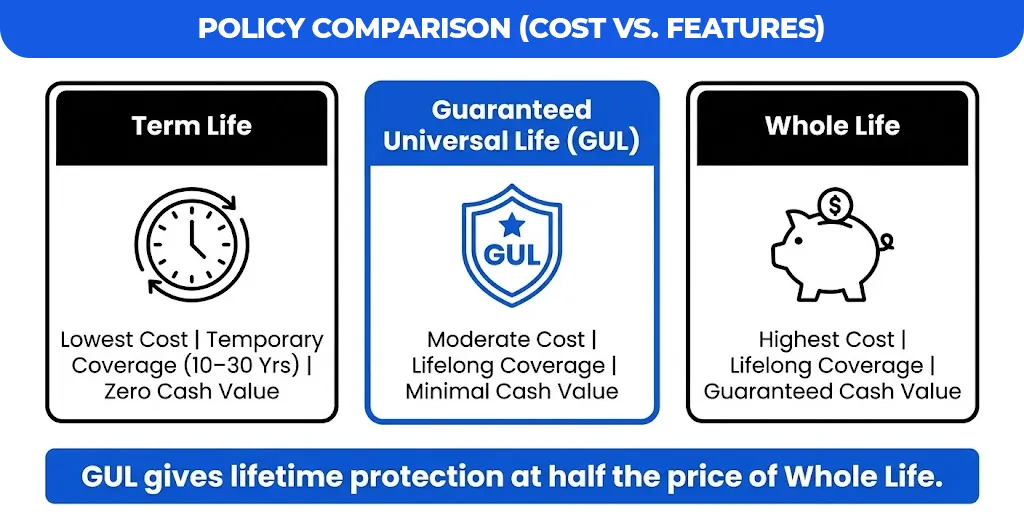
• Whole life: fixed premium, guaranteed death benefit, and guaranteed cash value growth, often with dividends. Costs more than GUL because you’re also buying savings.
• Traditional universal life: flexible premiums and cash value earning a credited rate; coverage can lapse if underfunded.
• Indexed universal life (IUL): cash value linked to a market index with a floor and cap; more growth potential, but coverage depends on adequate funding.
• Term life: cheapest; coverage ends after 10 to 30 years.
How GUL compares with other policy types
| Feature | Guaranteed universal life | Whole life | Traditional or indexed UL | Best for pure lifetime protection |
| Coverage length | To chosen age, up to 121 | Lifetime | Lifetime if funded | GUL or whole life |
| Premium | Level, scheduled | Level, highest | Flexible | GUL (lower than whole life) |
| Death benefit guarantee | Yes, if paid on time | Yes | Only with a no-lapse rider or full funding | GUL or whole life |
| Cash value | Minimal or none | Guaranteed growth plus possible dividends | Credited or index-linked | Not a GUL goal |
| Interest rate risk to owner | None for coverage | None | Yes | GUL or whole life |
| Flexibility | Low | Low | High | Not GUL |
| Typical cost for the same death benefit | Middle | Highest | Varies with funding | GUL |
Read more about indexed universal life and whole life insurance cost.
Guaranteed Universal Life Insurance Rates by Age in 2026
For a healthy non-smoker, $100,000 of GUL costs roughly $54 to $63 a month at 40, $81 to $93 at 50, $137 to $150 at 60, and $238 to $275 at 70, based on NerdWallet’s 2026 sample rates. That’s usually a fraction of the whole life price for the same coverage, but several times the cost of term.
What affects GUL rates
• Age at purchase: the biggest factor; premiums rise steeply after 60.
• Sex: women pay less.
• Health class: preferred-plus applicants pay the least; standard and rated classes pay more.
• Tobacco use: significantly raises premiums.
• Guarantee age: a guarantee to 90 costs less than one to 100 or 121, according to Ogletree Financial.
• Coverage amount: larger policies cost more overall but often less per $1,000.
• Payment schedule: some carriers offer limited-pay GUL (for example, paid over 10 or 20 years), which costs more per year.
Monthly GUL rates for $100,000 and $250,000
| Age | $100,000 (F / M) | $250,000 to age 121 (F / M) |
| 40 | $54 / $63 | 167–200 / 200–242 |
| 50 | $81 / $93 | 258–308 / 317–375 |
| 60 | $137 / $150 | 417–500 / 517–617 |
| 70 | $238 / $275 | 733–875 / 917–1,125 |
| 80 | $480 / $559 | Not listed |
Sources: $100,000 rates from NerdWallet (preferred applicants, sample rates valid March 26, 2026, sourced from LifeStein.com). $250,000 ranges converted to monthly from Ogletree Financial’s annual estimates for preferred non-smokers guaranteed to age 121 (updated January 27, 2026). Ethos lists lower estimates for $250,000 (about $164 to $182 a month at 40 and $247 to $275 at 50), which shows how much prices vary by carrier and guarantee design.
How much does a $100,000 life insurance policy cost per month?
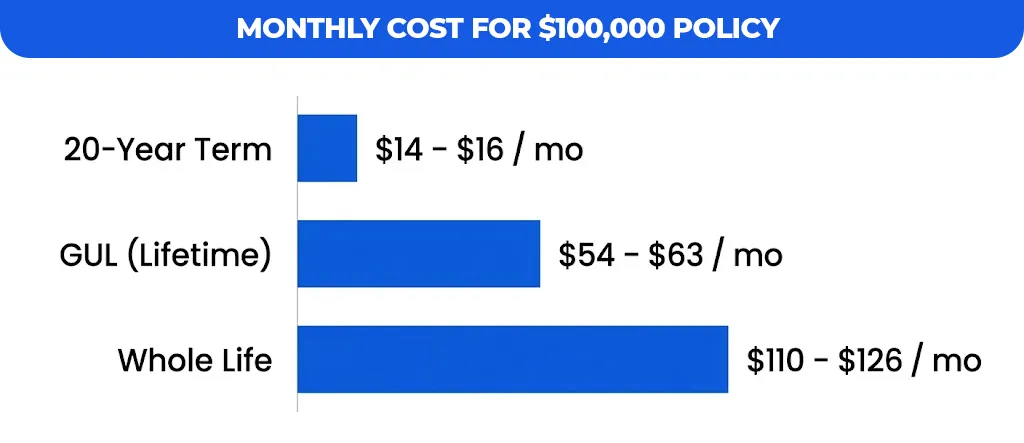
It depends on the type: about $14 to $16 a month for a 20-year term at 40, about $54 to $63 for GUL, and about $110 to $126 for whole life.
| Age | 20-year term (F / M) | GUL (F / M) | Whole life (F / M) |
| 40 | $14 / $16 | $54 / $63 | $110 / $126 |
| 50 | $25 / $31 | $81 / $93 | $168 / $192 |
| 60 | $58 / $72 | $137 / $150 | $283 / $318 |
| 70 | $56 / $82 (10-year term) | $238 / $275 | $506 / $566 |
Sources: term and whole life from Choice Mutual published sample rates (preferred non-tobacco, valid March 9, 2026); GUL from NerdWallet’s sample rates. Different sources use different carriers, so treat the comparison as approximate.
The pattern is consistent: GUL costs roughly half as much as whole life and two to four times as much as term at these ages. You’re paying for a lifetime guarantee without paying for savings.
Note: A GUL quote is only meaningful with its guarantee age. When comparing quotes, make sure each one is guaranteed to the same age (for example, 121) and assumes the same health class.
GUL for Seniors, Top Carriers, and Common Criticisms
GUL is one of the most common permanent policies for people in their 60s and 70s because it delivers a guaranteed death benefit at a lower cost than whole life. Most carriers issue GUL to about age 80 or 85, with full medical underwriting.
Guaranteed universal life insurance for seniors
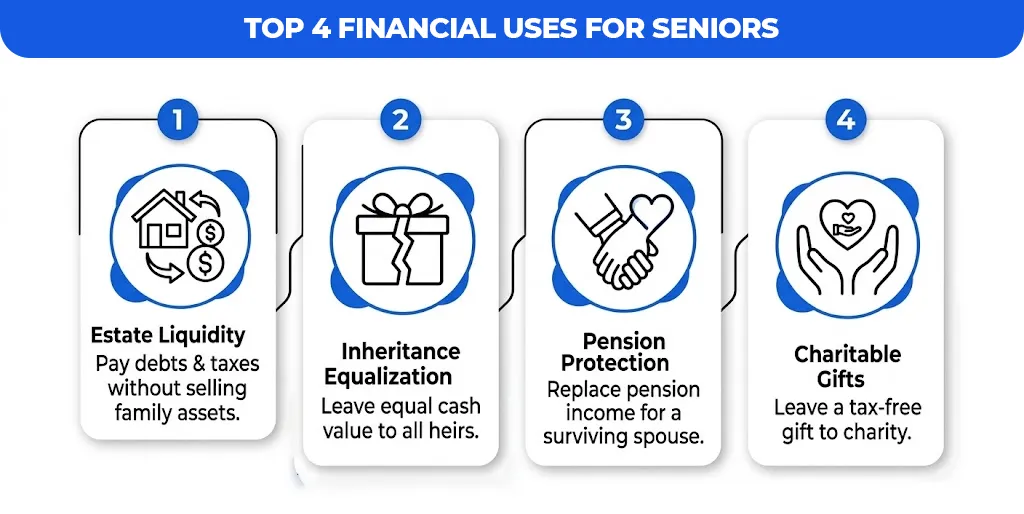
For seniors, GUL is usually bought to leave a set amount behind, not to build savings. Common uses:
• Estate liquidity: cash to pay taxes, debts, or settlement costs without selling a home or business. The 2026 federal estate tax basic exclusion is $15 million per person, so most estates owe no federal estate tax, but some states have lower thresholds.
• Inheritance equalization: leaving one child cash when another inherits a business or property.
• Pension protection: if you choose a single-life pension payout for its higher monthly amount, a GUL policy can replace that income for a surviving spouse.
• Charitable gifts: naming a charity as beneficiary.
Guaranteed universal life insurance for seniors over 70
After 70, GUL is still widely available to healthy applicants, but premiums rise steeply. NerdWallet’s sample rates for $100,000 are about $238 to $275 a month at 70 and $480 to $559 at 80. Ogletree Financial lists a maximum issue age of 80 to 85 for the carriers it reviewed. Expect a medical exam or detailed health records, and compare the total premiums you’d pay against the death benefit at your life expectancy.
Note: If you’re over 70 and only need to cover a funeral, a small final expense whole life policy may be simpler, though GUL is often cheaper per $1,000 for larger amounts if you qualify medically. See final expense insurance.
Best guaranteed universal life insurance companies
Several major insurers offer GUL, and the best one for you depends on your age, health, and how long you want the guarantee. Ogletree Financial’s 2026 review lists these products (product names and terms change, so confirm current details with the carrier):
| Carrier | GUL product | Maximum issue age | Guarantee options |
| Corebridge Financial (formerly AIG) | Secure Lifetime GUL 3 | 85 | Ages 90 to 121 |
| Pacific Life | PL Promise GUL | 85 | Ages 90 to 121 |
| Protective Life | Lifetime Assurance UL | 85 | To 121 |
| Banner Life | LifeStep UL | 85 | To 121 |
| John Hancock | Protection UL | 85 | To 121; coverage to 90 also available |
| Penn Mutual | Guaranteed Protection UL | 85 | Lifetime coverage guarantee |
| Columbus Life | Voyager UL | 85 | Lifetime no-lapse guarantee |
Source: Ogletree Financial, updated January 27, 2026. Ratings, underwriting, and prices vary; an independent agent can compare current products across these carriers.
AIG guaranteed universal life insurance: AIG’s U.S. life insurance business now operates as Corebridge Financial, and its Secure Lifetime GUL is the product most people mean when they search for AIG guaranteed universal life.
What does Dave Ramsey say about universal life insurance?
Ramsey Solutions recommends only term life insurance and calls whole life, indexed universal life, and similar products “just different names for mixing life insurance and investing,” which it considers a bad idea. Its argument focuses on cash value: it says cash value accounts average a 1% to 3% return and that early growth is eaten up by fees.
That critique applies most to cash-value-focused policies. GUL is different in one key way: it isn’t sold as an investment, and it builds little or no cash value. It’s closer to buying term insurance for life. Ramsey’s broader view still applies, though: if your need for life insurance ends once your children are grown and your debts are paid, term is far cheaper. GUL makes sense only when you truly need coverage for life.
What are the drawbacks of guaranteed universal life insurance?
The main drawbacks are rigid premium rules, little or no cash value, and a guarantee that depends entirely on paying on time.
• Strict payment timing: missing or underpaying premiums can shorten or end the guarantee.
• Minimal cash value: there’s little to borrow against or receive if you cancel, so surrendering early returns little or nothing.
• Less flexibility: premiums are set to maintain the guarantee; you can’t easily skip payments the way you can with traditional UL.
• Coverage can end at the guarantee age: if you choose 90 or 95 and outlive it, coverage may end or become very expensive.
• Higher cost than term: two to four times the price of 20-year term at ages 40 to 60, based on the sample rates above.
• Fewer insurers: Ethos notes fewer companies offer GUL than term or whole life.
How to Choose and Buy a Guaranteed Universal Life Policy
Decide how long you need the guarantee, price that guarantee across several carriers, and buy while you’re healthy. Because GUL has little cash value, the main thing you’re comparing is the price of the same guarantee.
Step 1: Choose the right guarantee age
Pick the guarantee age based on how long the need lasts, not just the lowest premium.
| Guarantee age | Lower premium? | Best for |
| 90 | Yes, cheapest | Needs that end in your 80s, such as a business loan or a spouse’s income gap |
| 95 or 100 | Moderate | Most estate and legacy goals, with some risk of outliving coverage |
| 121 | Highest | True lifetime coverage; the right choice for estate liquidity or a lifelong dependent |
If you’re in good health and your family tends to live long, choosing 121 avoids the risk of outliving your coverage.
Step 2: Use a calculator to set the death benefit
A guaranteed universal life insurance calculator, or any life insurance needs calculator, helps you decide how much coverage your permanent goals require. Our life insurance calculator estimates your total need. For GUL, focus on permanent goals only: final expenses, a target inheritance, estate settlement costs, or a buy-sell amount. Temporary needs like income replacement are usually cheaper to cover with term.
Step 3: Compare independent brokers and single-company agents
An independent agency can price the same GUL guarantee across many carriers; a single-company agent can show only one. GUL pricing varies widely by insurer, as the different published estimates above show, and underwriting rules for conditions like diabetes or heart disease differ between companies. Comparing several carriers is often the biggest single way to lower your premium.
Questions to ask for every quote:
• What age is the death benefit guaranteed to at this premium?
• What happens if I pay late or pay less one year?
• What’s the maximum issue age and which health class am I quoted in?
• Is there any maturity benefit if I outlive the guarantee?
Comparing GUL quotes with Assurance Gurus
Assurance Gurus is an independent agency that compares guaranteed universal life and other permanent and term policies from multiple carriers. A typical process:
1. Define the goal: what the coverage is for and how much you need.
2. Choose a guarantee age that matches the goal.
3. Compare quotes from several carriers at the same guarantee age and health class.
4. Apply and complete underwriting, which may include an exam and medical records.
5. Set up automatic payments to protect the guarantee, and review the policy every few years.
Conclusion:
Guaranteed universal life gives you a guaranteed, lifelong death benefit for about half the cost of whole life, as long as you pay on time. It’s best for permanent needs where you value certainty over cash value; for temporary needs, term costs far less.
| Your situation | Best fit |
| Want lifelong coverage at the lowest price | GUL guaranteed to 121 |
| Need coverage only into your 80s | GUL guaranteed to 90, or a long term policy |
| Want cash value and dividends | Participating whole life |
| Want market-linked growth | Indexed universal life |
| Young family, temporary need | 20- or 30-year term |
| Over 70 and healthy | GUL, priced across several carriers |
| Only need funeral coverage | Final expense whole life |
| Pension ending at death | GUL to protect a surviving spouse |
Compare Guaranteed Universal Life Quotes at Assurance Gurus
GUL prices for the same guarantee can vary significantly between carriers, so comparing quotes is the best way to save. Assurance Gurus specialists can compare guaranteed universal life, whole life, and term options from multiple carriers at the guarantee age you choose.
• Compare guaranteed universal life quotes at Assurance Gurus
• Estimate your coverage with the life insurance calculator
• Call 888-363-1938 to consult with Assurance Gurus