


Permanent Life Insurance Cost

Permanent Life Insurance Cost: Rates, Calculators & Types

Permanent life insurance cost is the main reason most families end up buying term instead. Coverage that lasts for life and builds cash value is valuable, but it costs far more each month, and the price climbs quickly with age.

Quick answer: For a healthy non-smoker, whole life costs about $176 to $202 a month for $250,000 at age 30, $496 to $583 for $500,000 at 40, and $1,531 to $1,783 for $1 million at 50, based on Choice Mutual’s 2026 sample rates. Universal life usually costs less than whole life, and both cost many times more than 20-year term.

How Much Does Permanent Life Insurance Cost?

Most healthy buyers pay roughly $175 to $900 a month for $250,000 to $500,000 of whole life coverage between ages 30 and 50, and more after that. The exact price depends on your age, sex, health, tobacco use, coverage amount, and which type of permanent policy you choose.

Why permanent coverage costs so much

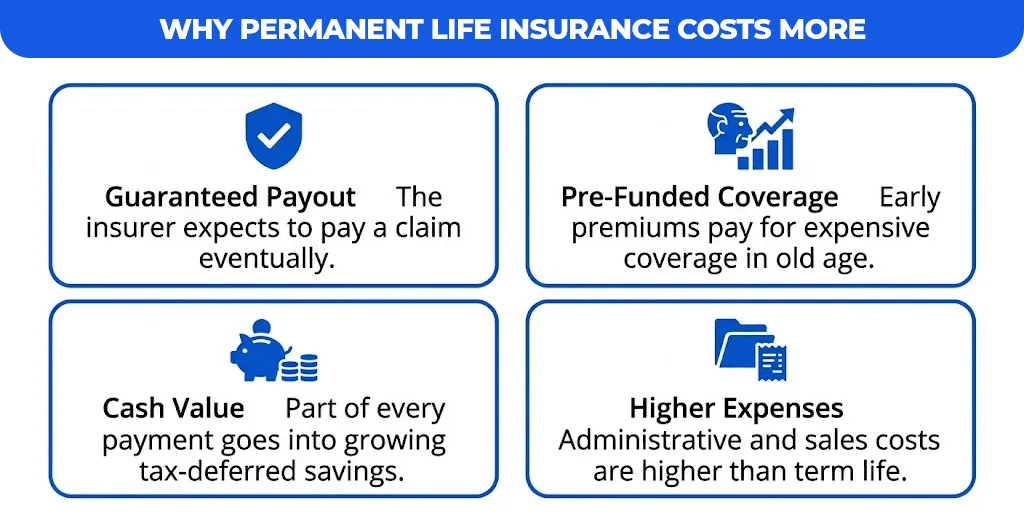
Four things drive the price: the insurer expects to pay the claim, the premium has to fund coverage at very old ages, part of every premium builds cash value, and expenses are higher than for term.

•         A claim is expected: a permanent policy that stays in force will pay out eventually, while many term policies end without a claim. The insurer has to price for that.

•         Pre-funding the cost of insurance: the cost of insuring someone rises sharply with age. A level lifetime premium charges more than the current cost in early years, and that surplus pays for coverage in later decades.

•         Cash value: part of each payment goes into a savings component that grows tax-deferred and that you can borrow against.

•         Expenses: underwriting, sales, and administrative costs are higher than for term and are concentrated in the first years, which is why early surrender values are low.

For how cash value works, see our cash value life insurance guide.
why permanent life insurance costs more

Is a permanent life insurance policy worth it?

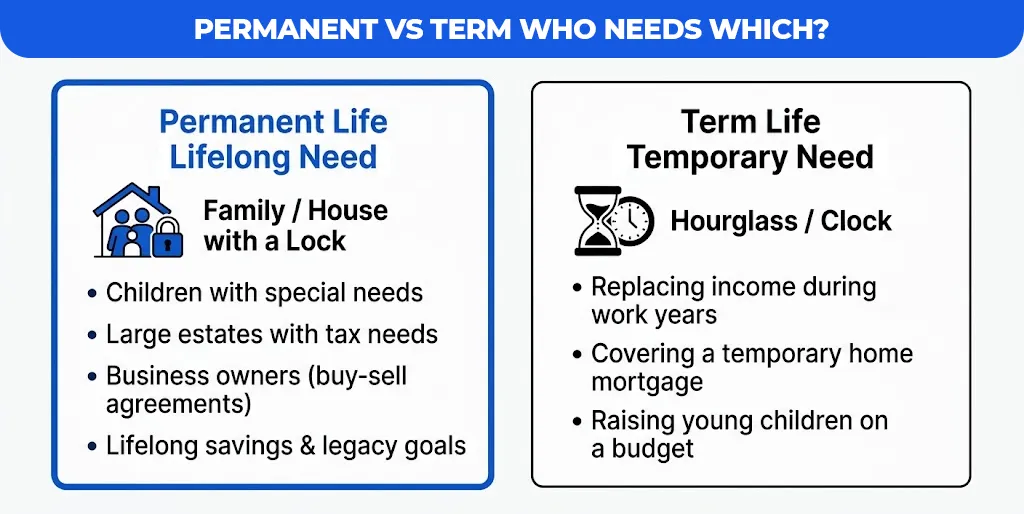
It’s worth it when you have a need that lasts for life and the premium fits your budget for decades; for most families whose need is temporary, term is the better value.

Permanent coverage often makes sense for:

•         Parents of a child with special needs who will need support for life

•         Estates large enough to face federal estate tax (the 2026 basic exclusion is $15 million per person) or with illiquid assets like a business or land

•         Business owners funding a buy-sell agreement with no end date

•         People who want guaranteed final expense coverage

•         High earners who have already maxed out retirement accounts and want guaranteed, tax-deferred savings

Term usually makes more sense when the goal is replacing income while children are young or covering a mortgage. See our term or whole life insurance comparison.
permanent vs term who needs which

The Four Types of Permanent Life Insurance and How Their Costs Differ

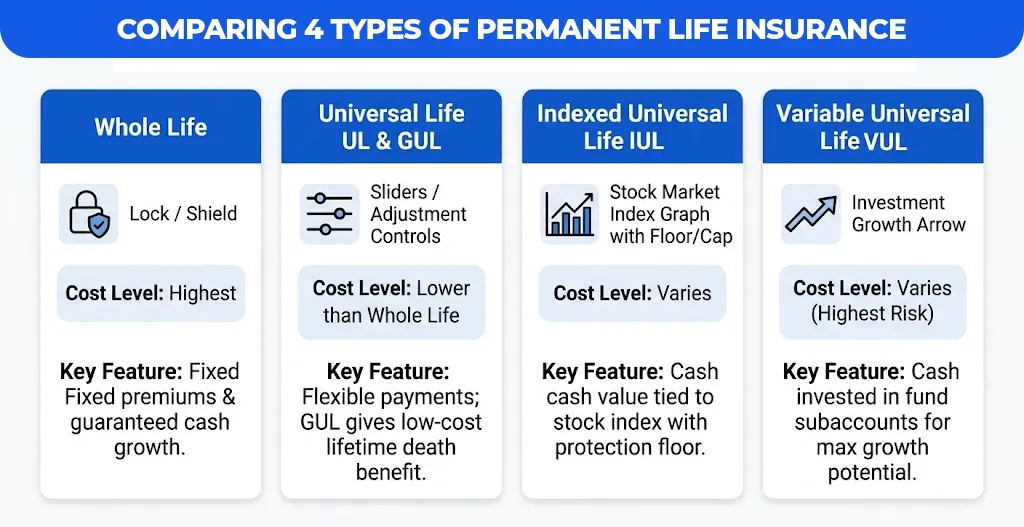
The four main types are whole life, universal life, indexed universal life (IUL), and variable universal life (VUL). Whole life is usually the most expensive because everything is guaranteed; universal life types cost less upfront but shift more risk to you.

Whole life insurance

Whole life has fixed premiums for life, a guaranteed death benefit, and cash value that grows at a guaranteed rate. Participating policies from mutual insurers may also pay dividends, which aren’t guaranteed. It’s the simplest permanent option to understand and the most expensive per dollar of coverage. Read more about whole life insurance cost.

Universal life and guaranteed universal life

Universal life (UL) lets you adjust premiums and the death benefit, with cash value earning an interest rate the insurer sets. Guaranteed universal life (GUL) is a version built mainly for a guaranteed lifetime death benefit with minimal cash value, which usually makes it the cheapest way to buy permanent coverage. The risk with standard UL: the cost of insurance deducted each month rises with age, and if premiums and interest credits don’t keep up, the policy can lapse late in life. See our universal life insurance guide.

Indexed universal life (IUL)

IUL credits interest based on a stock market index, with a floor (often 0%) that protects against losses and a cap or participation rate that limits gains. Premiums are flexible like UL. Costs include monthly insurance and policy charges, plus the opportunity cost of caps; the insurer can usually change caps over time. Sales illustrations use assumed rates, so ask to see results at lower rates too. Learn more about indexed universal life insurance.

Variable universal life (VUL)

VUL invests cash value in subaccounts similar to mutual funds, so it offers the most growth potential and the most risk. Subaccounts carry investment management fees on top of insurance charges. Poor market returns can reduce the cash value and require higher premiums to keep coverage in force. VUL is a securities product, sold with a prospectus by a licensed representative. See variable life insurance.
comparing 4 types of permanent life insurance

How the four types compare on cost and risk

Policy typePremium flexibilityCash value riskRelative monthly cost (same death benefit)
Whole lifeFixedLowest; guaranteed growthHighest
Universal lifeFlexibleModerate; depends on credited ratesLower than whole life
Guaranteed universal lifeFixed schedule for the guaranteeMinimal cash valueUsually lowest permanent option
Indexed universal lifeFlexibleModerate; index-linked with floor and capVaries with funding level
Variable universal lifeFlexibleHighest; market-basedVaries with funding level and fees

Note: Comparing UL, IUL, and VUL premiums is tricky because you choose how much to pay. A lower premium may buy coverage that’s only guaranteed to a certain age. Always ask how long coverage is guaranteed at the premium you’re quoted.

What You Get for the Higher Premium: Cash Value Over Time

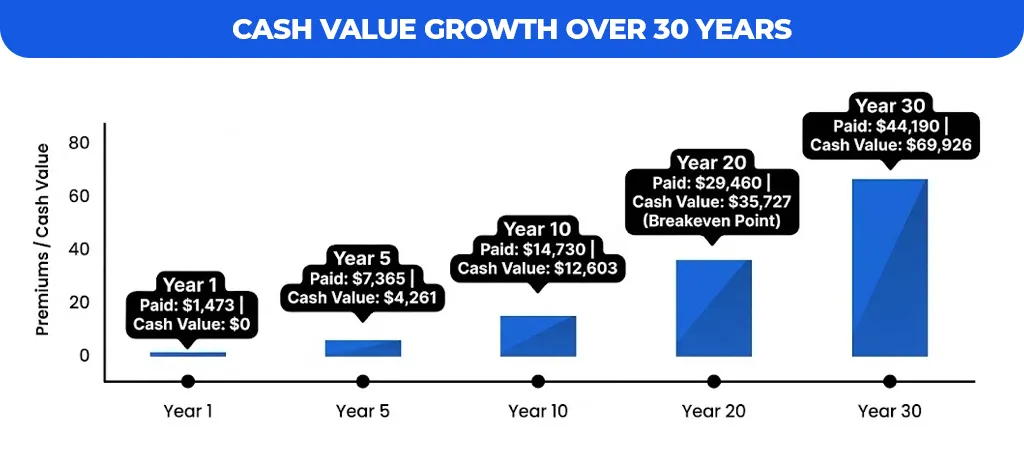
Part of the higher permanent premium comes back to you as cash value, but slowly: in published projections, a whole life policy’s cash value usually stays below total premiums paid for the first 10 to 20 years. Cash value grows tax-deferred, and you can borrow against it or surrender the policy for it.

Choice Mutual’s 2026 projections for a $100,000 participating whole life policy (preferred non-tobacco, expected values including dividends) show how this works for a man who buys at 40 and pays $1,473 a year:

Policy yearTotal premiums paidProjected cash value
1$1,473$0
5$7,365$4,261
10$14,730$12,603
20$29,460$35,727
30$44,190$69,926

These values aren’t guaranteed; guaranteed values are lower. The pattern is typical: early premiums go mostly to insurance costs and the insurer’s expenses, and growth picks up later as the cash value compounds.
cash value growth over 30 years

Ways owners use cash value:

•         Policy loans: borrow against the cash value without a credit check. For a policy that isn’t a modified endowment contract (MEC), loans generally aren’t taxable while the policy stays in force, but unpaid loans and interest reduce the death benefit.

•         Withdrawals or partial surrenders: generally tax-free up to the premiums you’ve paid in a non-MEC policy; gains above that are taxable.

•         Paying premiums: some owners use dividends or cash value to reduce or cover premiums later in life.

•         Surrender: cancel the policy for its cash surrender value; gains above premiums paid are taxable as ordinary income.

If you pay more into a policy in its first seven years than the IRS “7-pay test” allows (IRC Section 7702A), it becomes a MEC, and loans and withdrawals are taxed gains-first, with a possible 10% additional tax before age 59½. Insurers track this limit and usually warn you before it’s crossed.

Note: Whether a policy’s loans are “direct recognition” or “non-direct recognition” affects dividends on borrowed money in participating whole life. If you plan to borrow often, ask which type a policy uses before you buy.


PROTECT WHAT MATTERS MOST

Looking for the Right Protection for Your Future?

Choosing the right insurance coverage doesn’t have to be complicated. Assurance Gurus makes it easier to explore coverage options, compare plans, and find protection that fits your needs and budget. Let our team help you take the next step toward greater financial peace of mind.

Average Permanent Life Insurance Cost by Age in 2026

Whole life premiums rise about 50% to 70% with every 10 years of age at purchase: for $500,000, a healthy man pays about $393 a month at 30, $583 at 40, $895 at 50, and about $1,500 at 60 in Choice Mutual’s 2026 sample rates. Women pay about 10% to 15% less at the same age.

What affects your premium

•         Age: the biggest factor; buying earlier locks in a lower lifetime premium.

•         Sex: women generally pay less because they live longer on average.

•         Health and underwriting class: blood pressure, cholesterol, weight, medical history, and family history decide your rate class.

•         Tobacco use: smokers pay significantly more.

•         Coverage amount: more coverage costs more, though the price per $1,000 often drops at higher amounts.

•         Policy type and design: whole life costs the most; guaranteed universal life with minimal cash value is usually the cheapest permanent option.

•         Payment schedule: paying over 10 or 20 years, or to age 65, costs more each year than paying for life.

Monthly whole life rates for $250,000, $500,000, and $1,000,000

Age$250,000 (F / M)$500,000 (F / M)$1,000,000 (F / M)
30$176 / $202$342 / $393$678 / $779
40$253 / $297$496 / $583$985 / $1,160
50$391 / $455$768 / $895$1,531 / $1,783
60$664 / $761$1,310 / $1,500$2,613 / $2,994
70$1,193 / $1,364$2,356 / $2,694$4,705 / $5,382

Source: Choice Mutual published whole life sample rates, preferred non-tobacco, valid March 9, 2026. The $1 million figures at age 30 are converted from Choice Mutual’s published annual premiums. Choice Mutual’s pages list the $500,000 male rate at 60 as $1,450 on one page and $1,500 on another; expect small differences between quotes.

Universal life rates for comparison

Universal life usually costs less than whole life for the same death benefit. MoneyGeek’s 2026 averages across 20 insurers (nonsmoker, average health) for $500,000 of universal life:

AgeFemaleMale
30$216$246
40$310$362
50$406$551
60$765$930

At age 40, MoneyGeek lists about $160 (female) and $187 (male) for $250,000, and $594 and $692 for $1 million. Because MoneyGeek uses average health and Choice Mutual uses preferred health, the gap between whole life and universal life is likely larger than these tables suggest for healthy buyers.

How much is a $500,000 life insurance policy a month?

For a healthy non-smoker, $500,000 costs about $16 to $28 a month as 20-year term at ages 30 to 40, versus about $342 to $583 a month as whole life. At 50, it’s about $54 to $69 for term and $768 to $895 for whole life.

How much is a $1,000,000 life insurance policy a month?

$1 million of 20-year term costs about $23 to $48 a month at 30 to 40 for a healthy non-smoker; the same amount of whole life costs about $678 to $1,160. At 60, it’s about $263 to $379 for term versus $2,613 to $2,994 for whole life. Policies this large require full medical underwriting and proof that the amount is justified by your income, net worth, or business needs.

See more whole life insurance quotes and term life insurance quotes.

Term vs. Permanent Life Insurance Cost

For the same death benefit, whole life costs about 7 to 30 times more than 20-year term, depending on age and coverage amount. The gap is widest for young buyers and large policies, and it narrows after 50 as term rates climb.

How much more permanent coverage costs

CoverageAge20-year term (F / M)Whole life (F / M)Whole life costs about
$250,00030$11 / $12$176 / $20216x to 17x more
$250,00050$30 / $38$391 / $45512x to 13x more
$500,00030$16 / $18$342 / $39321x to 22x more
$500,00040$24 / $28$496 / $58321x more
$500,00050$54 / $69$768 / $89513x to 14x more
$500,00060$140 / $199$1,310 / $1,5008x to 9x more
$1,000,00040$40 / $48$985 / $1,16024x to 25x more
$1,000,00060$263 / $379$2,613 / $2,9948x to 10x more

Source: Choice Mutual published sample rates, preferred non-tobacco, valid March 9, 2026.

The multiple is so large because the two products do different jobs. A 20-year term policy covers 20 years and then ends, with no cash value. A whole life policy covers your entire life, guarantees the payout, and builds savings. Comparing total premiums makes the difference concrete:

40-year-old man, $500,000

20-year term:   $28 x 240 months   =  $6,720  (coverage ends at 60)
Whole life: $583 x 240 months  = $139,920 after 20 years
            (coverage continues for life; cash value builds)

For more on the trade-offs, see our term life insurance and permanent life insurance pages.

Cost to convert from term to permanent life insurance

The real cost of converting a term policy to permanent coverage is the new premium, which is based on your age at conversion, so it’s usually much higher than your term premium. The advantage is that a conversion privilege lets you switch without a new medical exam, keeping the health class from your original policy.

Example using 2026 sample rates for a healthy woman who bought $250,000 of 20-year term at 30 for about $11 a month:

Convert at age 50 to $250,000 of whole life  ->  about $391/month
Convert only $100,000 at age 50              ->  less (partial conversion)

Things to check in your term policy:

•         Conversion window: some policies allow conversion for the full term; others only for the first 10 or 15 years or until a set age.

•         Eligible products: you may only be able to convert into specific whole life or universal life policies.

•         Partial conversion: many insurers let you convert part of the face amount, which keeps the new premium affordable.

Converting is most valuable when your health has declined, since buying a new permanent policy might be expensive or impossible. Read more about convertible term life insurance.

Note: If you’re healthy, compare the conversion price with a newly underwritten permanent policy. A new policy may be cheaper if your health has improved or stayed excellent.

How to Estimate and Lower Your Permanent Life Insurance Cost

Start with how much coverage you need and how long you need it, then decide how much of it truly has to be permanent. Many families keep costs down by buying a large term policy for their working years and a smaller permanent policy for lifelong needs.

Step 1: Estimate your coverage need

A permanent life insurance cost calculator works best when you separate temporary needs from permanent ones. Our life insurance calculator estimates your total need; then split it:

Temporary needs (term):   income replacement, mortgage, children’s expenses
Permanent needs:      final expenses, lifelong dependent, estate taxes,
                      business buy-sell, legacy goals

Only the permanent part needs permanent coverage. For example, a family might need $1 million total but only $150,000 permanently.

Step 2: Match the policy type to the permanent need

Permanent needLower-cost option to considerWhy
Guaranteed death benefit only, no savings goalGuaranteed universal lifeUsually the cheapest lifetime guarantee
Final expensesSmall whole life (final expense) policySimple, fixed, no exam options
Guaranteed savings plus coverageParticipating whole lifeGuaranteed cash value plus possible dividends
Estate liquidityWhole life or GUL, often owned by a trustGuaranteed payout whenever death occurs
Business buy-sellWhole life, GUL, or term matched to the agreementDepends on how long the agreement lasts

Step 3: Shop independent brokers, not just one company

Prices and underwriting rules vary widely between insurers, so comparing several carriers is one of the easiest ways to save. An agent who represents a single company can only offer that company’s products and rate classes. An independent agency can compare multiple insurers, which matters most if you have a health condition that one insurer treats more favorably than another.

Other ways to lower the cost:

•         Buy younger: premiums are set at your age when the policy starts.

•         Improve your rate class: quitting tobacco and managing blood pressure and cholesterol before applying can help.

•         Choose a longer payment period: paying for life costs less per year than a 10- or 20-pay schedule.

•         Layer coverage: term for temporary needs, a smaller permanent policy for permanent ones.

Comparing carriers with Assurance Gurus

Assurance Gurus is an independent agency that compares term and permanent life insurance from multiple carriers. A typical process:

1.       Estimate your need with the calculator or a specialist.

2.       Decide the permanent portion and the policy type that fits it.

3.       Compare quotes for whole life, universal life, and term from several insurers.

4.       Review guarantees: for UL types, confirm how long coverage is guaranteed at the quoted premium.

5.       Apply and review periodically as your needs change.

Conclusion:

Permanent life insurance costs many times more than term because it guarantees a payout for life and builds cash value. That premium is worth paying for needs that truly last a lifetime; for temporary needs, term usually gives far more protection per dollar.

Your situationBest fit
Young family, tight budget20- or 30-year term
Lifelong dependentWhole life or guaranteed universal life, often with a trust
Estate above the federal exclusionWhole life or GUL owned by an ILIT
Want the cheapest lifetime coverageGuaranteed universal life
Want guaranteed savings with coverageParticipating whole life
Want market-linked growth and accept riskIndexed or variable universal life
Term policy ending, health has declinedConvert part of the term to permanent
Only need funeral coverageSmall final expense whole life

Compare Permanent Life Insurance Costs at Assurance Gurus

The best way to know your permanent life insurance cost is to compare real quotes for your age and health. Assurance Gurus specialists can compare whole life, universal life, and term options from multiple carriers and help you decide how much coverage needs to be permanent.

•         Get a quote

•         Calculate permanent life insurance costs at Assurance Gurus

•         Call 888-363-1938 to talk with a licensed specialist

PROTECT WHAT MATTERS MOST

Looking for the Right Protection for Your Future?

Choosing the right insurance coverage doesn’t have to be complicated. Assurance Gurus makes it easier to explore coverage options, compare plans, and find protection that fits your needs and budget. Let our team help you take the next step toward greater financial peace of mind.

FAQS

It's worth it when you have a need that lasts for life, such as a special-needs dependent, estate taxes, a business buy-sell agreement, or guaranteed final expenses, and you can comfortably afford the premium for decades. For temporary needs like replacing income while children are young, term is usually a better value because it costs a fraction as much.

Whole life (fixed premiums and guaranteed cash value), universal life (flexible premiums with interest set by the insurer, including guaranteed universal life), indexed universal life (growth linked to a market index with a floor and cap), and variable universal life (cash value invested in market subaccounts). Whole life is usually the most expensive; guaranteed universal life is usually the least expensive permanent option.

For a healthy non-smoker in 2026 sample rates, 20-year term costs about $16 to $18 a month at 30, $24 to $28 at 40, and $54 to $69 at 50. Whole life costs about $342 to $393 at 30, $496 to $583 at 40, and $768 to $895 at 50. Universal life averages fall in between.

The main cost is the new premium, which is based on your age at conversion and is much higher than the term premium. The benefit is that you don't need a new medical exam. Converting only part of the coverage keeps the cost manageable.

Sources and 2026 Verification

Sources were opened on November 3, 2026, unless noted.

Rates are published samples and averages, not quotes; your premium depends on age, health, tobacco use, state, carrier, and policy design. Sources use different health classes, so compare like with like. This article is general information, not tax, investment, or insurance advice.