



Few benefits deliver as much peace of mind for as little cost as group term life insurance. A sudden death is devastating on its own; the last thing a grieving family should have to worry about is a mortgage payment or a childcare bill. That’s the quiet promise behind this benefit, and it’s why more than half of U.S. employers offer some form of it as a standard part of their benefits package.
This guide breaks down how group term life insurance actually works, why it matters for both employers and employees, where its limits are, and how to build a smarter, layered coverage strategy around it. Whether you’re an HR leader evaluating your benefits budget or an employee trying to understand the fine print on your paycheck, you’ll leave with a clear picture of what this coverage does and doesn’t do for you.
What Is Group Term Life Insurance?
At its core, group term life insurance is a single life insurance policy that covers a group of people, typically the employees of a company, under one contract, rather than each person holding an individual policy. It’s temporary (“term”) coverage, priced and underwritten collectively, which is what makes it so much cheaper than buying life insurance on your own.
The Master Policy Structure
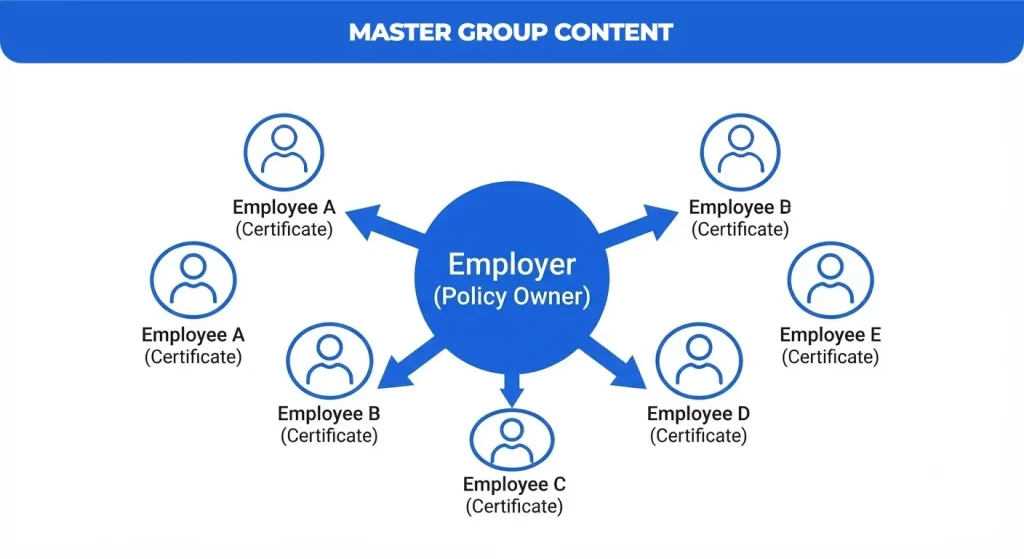
The employer (or an association, union, or other group sponsor) owns what’s called the master policy. Individual employees don’t own a policy of their own; instead, each enrolled employee receives a certificate of coverage, which summarizes their benefit amount and beneficiary designation under the larger group contract. This structure is what lets the insurer price risk across the whole group rather than underwriting each person separately.
What “Term” Really Means
“Term” means the coverage is active only for a defined period, in this case, generally tied to active employment. As long as you work for the company and the group meets its participation requirements, your coverage stays in force. Leave the job, retire, or get laid off, and in most cases, the coverage ends (though conversion or portability riders can sometimes let you carry a modified version of it forward, more on that in Section 5).
Simplified Underwriting: Why No Medical Exam
This is arguably the single biggest draw of group term life insurance for employees. Because risk is spread across a large pool of people, healthy and unhealthy alike, insurers can offer coverage on a guaranteed-issue or simplified-issue basis up to a certain amount, usually without blood tests, physicals, or detailed health questionnaires. That opens the door to people who might be declined or rated up for individual life insurance because of a pre-existing condition.
How Coverage Amounts Are Set
Employers typically structure the benefit in one of two ways:
- Flat benefit: Every eligible employee gets the same dollar amount, e.g., $50,000.
- Salary multiple: Coverage scales with pay, e.g., 1x or 2x annual salary, rounded to the nearest thousand.
Some employers combine the two: a flat base amount plus an option to purchase supplemental coverage at group rates.
Top Benefits of Group Term Life Insurance for Employers
- Recruitment and retention: In competitive labor markets, a benefits package that signals genuine care, not just a paycheck, measurably improves offer-acceptance and retention rates, especially among candidates comparing multiple offers.
- Cost-efficiency through economies of scale: Because risk is pooled across the entire group, insurers can offer group rates that are typically a fraction of what any single employee would pay for the same coverage individually.
- Tax advantages: Premiums an employer pays toward group term life coverage are generally deductible as an ordinary business expense, which improves the economics of offering the benefit at scale.
Group Term Life Insurance vs. Individual Life Insurance
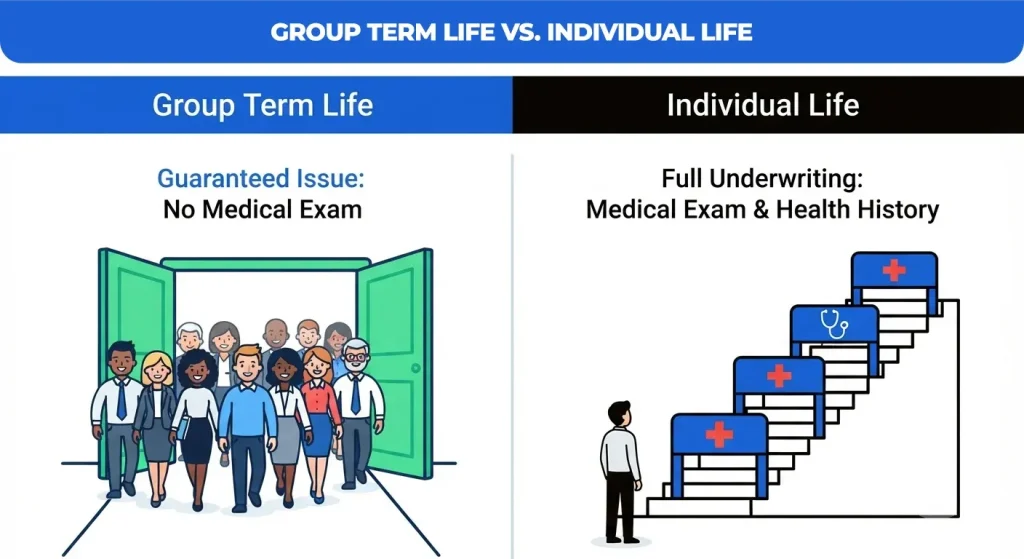
Group and individual life insurance solve different problems. The table below breaks down the core trade-offs side by side.
| Feature | Group Term Life | Individual Life |
| Cost | Low employer-negotiated group rates, often subsidized or free | Higher priced per applicant based on individual risk |
| Underwriting | Simplified or guaranteed issue; usually no medical exam | Full underwriting, medical exam, and health history are typically required |
| Portability | Generally tied to employment; may end at job loss (conversion options may apply) | Fully portable; stays in force regardless of employer |
| Customization | Limited set coverage tiers, little control over terms | High riders, terms, and death benefit amounts tailored to the buyer |
| Ownership | Employer owns the master policy; employee holds a certificate | Policyholder owns the policy outright |
Potential Limitations to Consider
Lack of Portability
The most significant limitation is that coverage is generally tied to your job. Change employers, get laid off, or retire, and your group coverage typically ends on your last day or shortly after. Some plans offer a conversion option, allowing you to convert some or all of your group coverage into an individual whole life policy without new medical underwriting, though usually at individual (and higher) rates.
Coverage Caps
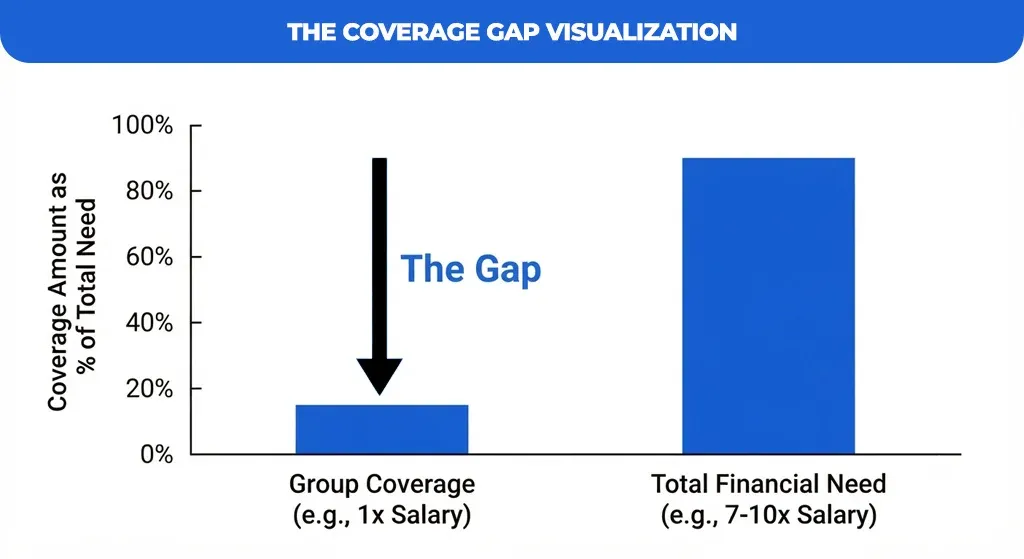
A flat $50,000 benefit or a “1x salary” formula can sound generous, but for a parent with a mortgage, young children, and other debt, it often replaces only a fraction of what the family would actually need to stay financially stable long-term. Financial planners commonly reference income-replacement targets of 7–10 times annual salary for households with dependents, a benchmark most base group policies fall well short of.
Lack of Cash Value
Group term life insurance, like all term insurance, is pure protection: if you’re covered when you pass away, the benefit pays out. There’s no savings or investment component building up in the background. This distinguishes it clearly from whole life or universal life insurance, which combine a death benefit with a cash-value account that grows over time and can potentially be borrowed against.
How Group Term Life Insurance Is Taxed
This is one of the most misunderstood parts of group term life insurance, and it answers a question a lot of employees ask when they see an unfamiliar line item on their pay stub.
Under Internal Revenue Code Section 79, the cost of the first $50,000 of employer-provided group term life coverage is excluded from an employee’s taxable income, and that portion is genuinely free. Once employer-paid coverage exceeds $50,000, the IRS requires the value of coverage above that threshold to be treated as imputed income. The employer calculates this using the IRS’s Table I rates (based on the employee’s age), adds a small dollar amount to the employee’s taxable wages each pay period, and reports it on Form W-2.
A few practical notes for anyone managing or enrolled in a plan:
- Coverage the employee pays for with after-tax dollars generally isn’t subject to this imputed income rule, regardless of the amount.
- The actual death benefit paid to a beneficiary is typically income-tax-free, regardless of the coverage amount. The taxation described above applies to the cost of coverage while the employee is alive, not to the payout itself.
- Rules can vary by plan design (e.g., key-person or discriminatory plans for executives), so employees with high coverage amounts should confirm details with HR or a tax professional.
How to Choose and Manage Your Group Policy
For Employers
Three factors should drive your plan design:
- Budget: What can you sustainably subsidize per employee, and how does that compare to competitors in your industry?
- Workforce size and profile: Larger, more stable groups typically unlock better group rates and guaranteed-issue amounts.
- Strategic goal: Are you aiming for baseline, compliant coverage, or using the benefit as a competitive differentiator in recruiting?
For Employees
- Review your beneficiary designation regularly. Update it after every major life event, such as marriage, divorce, a new child, or the death of a named beneficiary. An outdated designation is one of the most common (and most avoidable) sources of family disputes and delayed payouts.
- Assess whether you need to “ladder” your coverage. If your group benefit alone wouldn’t be enough to replace your income or cover your debts, consider adding an individual term policy sized to close that gap.
An Original Framework: The Three-Layer Coverage Stack
A useful way to think about how group term life insurance fits into a complete plan is what we call the Three-Layer Coverage Stack:
- Layer 1 Employer-paid base coverage: Your free or low-cost group benefit (often $50,000 or 1–2x salary). This is your floor, not your finish line.
- Layer 2 Voluntary supplemental group coverage: Additional coverage purchased through your employer at group rates is usually the cheapest way to add meaningful protection without a medical exam.
- Layer 3 Individual term coverage: A personally owned policy, sized to cover the gap between Layers 1–2 and your family’s real income-replacement or debt-payoff needs, and structured to stay with you regardless of your employer.
Conclusion
Group term life insurance earns its place as one of the most valuable, widely offered employee benefits because it solves a real problem cheaply and quickly by placing meaningful financial protection into the hands of those who might not otherwise have it. For employers, it remains a low-cost, high-impact way to build a culture of care and stay competitive in the recruiting landscape.
However, “foundation” is the operative word when evaluating your overall financial security. Whether you are an employer building a comprehensive benefits package or an employee reviewing your personal coverage, the smartest approach is to view group term life insurance as the critical first step in a broader financial protection plan rather than the entire plan.