


Imagine a life insurance policy that does more than sit in a drawer waiting for a claim. Variable universal life insurance is designed to protect the people who depend on you financially while simultaneously acting as an engine for tax-advantaged wealth accumulation, with your cash value invested directly in the market.
Traditional whole life insurance can feel rigid, locking you into fixed premiums and modest, guaranteed crediting rates. Meanwhile, standard market investments offer growth potential but no built-in death benefit. Variable universal life insurance (VUL) was built to bridge that gap, offering permanent coverage with the flexibility to adjust premiums and death benefits, plus cash value growth tied to sub-accounts that behave much like mutual funds.
This guide breaks down exactly what variable universal life insurance is, how the mechanics of cash value and death benefits actually work, the real benefits and risks involved, how to manage your sub-accounts, and a practical framework for deciding whether a variable universal life insurance policy belongs in your financial plan.
What Is Variable Universal Life Insurance?
Variable universal life insurance is a type of permanent life insurance that combines a flexible-premium universal life chassis with an investment-linked cash value account. Unlike term insurance, which expires after a set period, VUL is designed to last your entire lifetime as long as it remains adequately funded.
Because the cash value rises and falls with the performance of the underlying sub-accounts, a variable universal life insurance policy carries more market risk and more upside potential than a whole life or standard universal life contract.
VUL vs. Whole Life vs. Universal Life Insurance
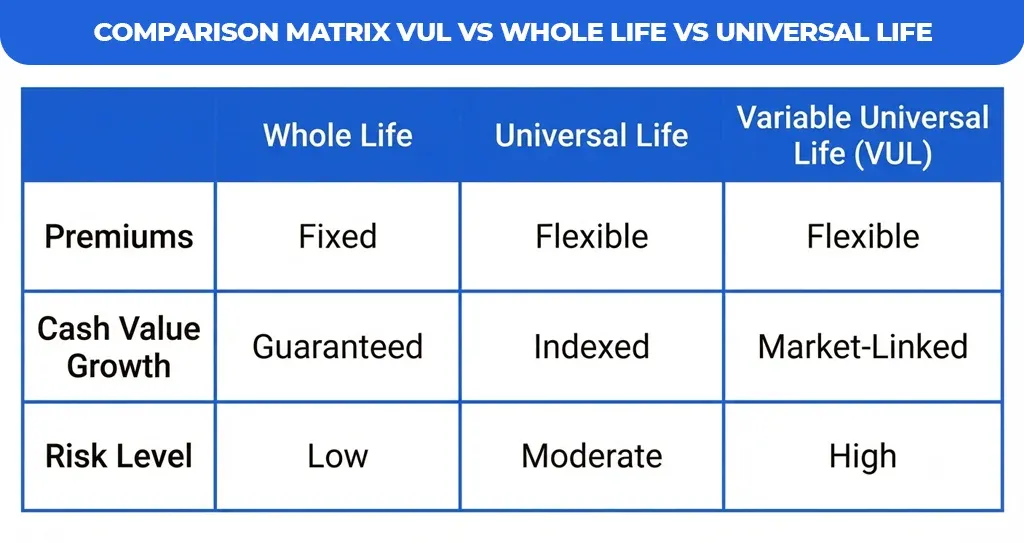
Understanding universal vs. variable life insurance structures side by side makes the tradeoffs concrete:
- Whole Life Insurance: Fixed premiums, guaranteed minimum cash value growth, and a guaranteed level death benefit. Low return ceiling, low flexibility, and low risk.
- Universal Life Insurance: Flexible premiums and death benefits, with cash value earning a fixed or indexed interest rate set by the insurer, generally with a guaranteed floor.
- Variable Universal Life Insurance: Flexible premiums and death benefits, plus direct market exposure through sub-accounts, with no guaranteed floor on investment performance.
How Does Variable Universal Life Insurance Work?
Every premium dollar you pay into a variable universal life insurance policy is split. A portion covers the cost of insurance, administrative charges, and any rider costs. The remainder is deposited into your cash value account and allocated among the sub-accounts you select.
Death Benefit Options: Level vs. Increasing
Most VUL contracts let you choose between two death benefit structures:
- Option A (Level Death Benefit): Your beneficiaries receive a fixed face amount. As cash value grows, the insurer’s net amount at risk shrinks, which can lower the cost of insurance over time.
- Option B (Increasing Death Benefit): Your beneficiaries receive the face amount plus the current cash value. This keeps the death benefit growing alongside your investments, but the cost of insurance stays higher for longer.
Cash Value Growth and Market Fluctuations
Because your cash value sits in investment sub-accounts, its performance mirrors the markets you’ve chosen, minus policy fees. A strong bull market can meaningfully accelerate accumulation; a sustained downturn can erode cash value fast enough that you may need to contribute additional out-of-pocket premium to keep the policy from lapsing.
Assuming constant premium funding, the table below shows how the cash value of a variable universal life insurance policy might increase over time at three different average annual rates of return and typical policy charges. These figures are illustrative only and not a guarantee of actual performance.
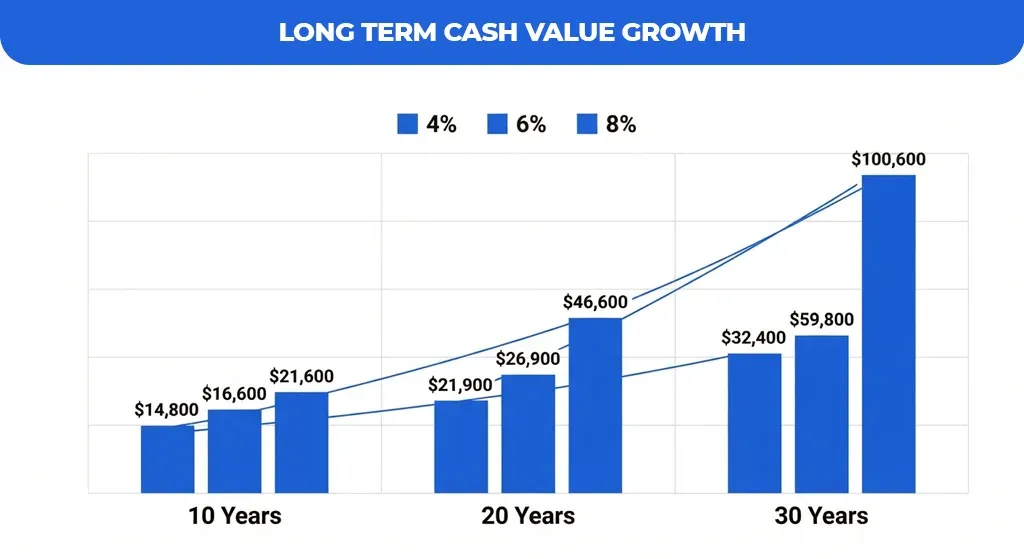
| Years Held | 4% Avg. Return | 6% Avg. Return | 8% Avg. Return |
| 10 Years | ~$14,800 | ~$17,900 | ~$21,600 |
| 20 Years | ~$21,900 | ~$32,100 | ~$46,600 |
| 30 Years | ~$32,400 | ~$57,400 | ~$100,600 |
The Core Benefits of a Variable Universal Life Insurance Policy
A well-structured VUL policy offers several advantages that set it apart from both fixed-rate permanent insurance and standalone investment accounts.
- Investment Growth Potential: Direct participation in equity and bond sub-accounts creates the opportunity for higher long-term returns than a fixed-crediting whole life or universal life policy.
- Premium Flexibility: If your cash value is sufficient to cover ongoing policy charges, many insurers allow you to reduce or temporarily skip premium payments without lapsing coverage.
- Tax Advantages: Cash value grows tax-deferred, and policyholders can typically access funds tax-free through policy loans and withdrawals up to basis, provided the policy is structured to qualify as life insurance under IRC Section 7702.
- Estate Planning Utility: The death benefit can provide liquidity to cover estate taxes and other settlement costs, and proceeds generally pass to heirs outside of probate.
Risks, Fees, and Potential Drawbacks
No discussion of variable universal life insurance is complete without an honest look at the downside. This is where most of the disadvantages of variable universal life insurance actually live.
Market Risk
Because there is no guaranteed floor on sub-account performance, a prolonged downturn can shrink your cash value substantially. If that decline is severe enough, you may be required to pay significantly higher out-of-pocket premiums simply to keep the policy from lapsing.
Underlying Fees Breakdown
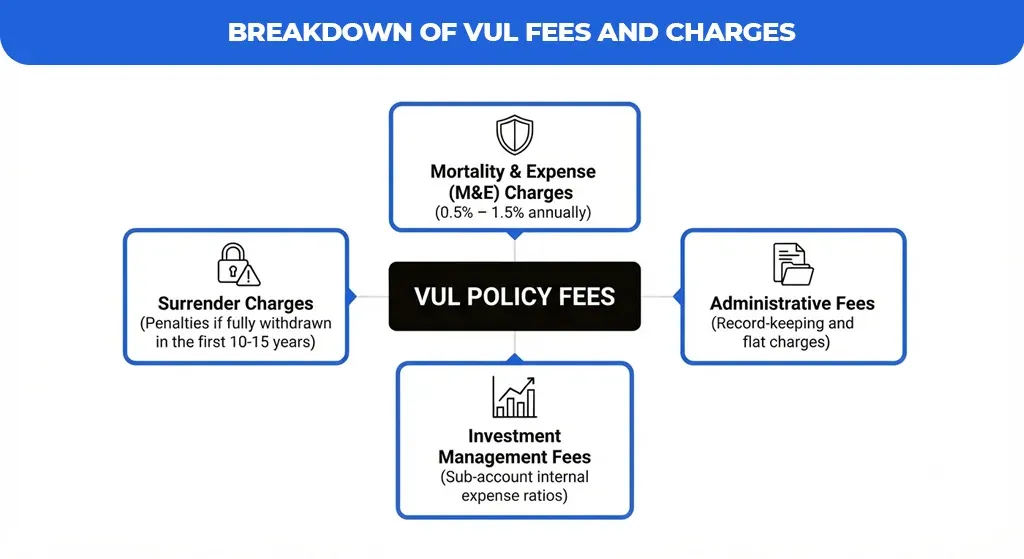
Independent research from firms tracking variable insurance products, including Morningstar and LIMRA, consistently finds that VUL products carry a meaningfully higher fee load than term insurance or simple universal life. Typical charges include:
- Mortality and Expense (M&E) Charges: Ongoing charges, often in the range of 0.5% to 1.5% annually, that compensate the insurer for mortality risk and profit margin.
- Administrative Fees: Flat or percentage-based charges for record-keeping and policy administration.
- Investment Management Fees: Expense ratios charged within each sub-account, comparable to mutual fund fees.
- Surrender Charges: Charges assessed if you fully surrender the policy within the first 10 to 15 years, which can significantly reduce the cash you actually receive.
Policy Lapse Danger
If your cash value drops too low to cover the ongoing cost of insurance, and you don’t add additional premium, the policy can lapse, which terminates coverage and can trigger taxable income on any outstanding gains or loans.
Managing Your Sub-Accounts: Investment Strategies for VUL
A flexible premium variable universal life insurance policy is only as strong as the investment decisions made inside it. Sub-account selection deserves the same attention you’d give a retirement portfolio.
- Equity Sub-Accounts: Offer the highest long-term growth potential paired with the highest volatility.
- Fixed Income Sub-Accounts: Provide more stability and income, typically with lower long-term returns.
- International and Global Sub-Accounts: Add geographic diversification but introduce currency and geopolitical risk.
- Money Market Sub-Accounts: Serve as a low-volatility holding area, often used to temporarily preserve capital.
Because a VUL policy is a long-duration commitment, your allocation should evolve with your age, risk tolerance, and time horizon, the same core principles that guide any diversified retirement portfolio. Financial advisors generally recommend periodic rebalancing, at least annually, to keep your sub-account mix aligned with your original risk tolerance rather than letting strong-performing sub-accounts silently increase your equity exposure over time.
Is Variable Universal Life Insurance Worth It for You?
Whether variable universal life insurance is worth it depends heavily on your income, existing tax-advantaged savings, and comfort with market volatility.
Ideal Candidates
- High-income earners who have already maxed out 401(k) and IRA contributions and want an additional tax-advantaged savings vehicle.
- Business owners and professionals with estate liquidity needs, such as covering estate taxes or funding a buy-sell agreement.
- Investors who are comfortable actively monitoring policy performance and adjusting premiums or allocations as needed.
Who Should Avoid It
- Conservative investors who prioritize guaranteed returns over growth potential.
- Individuals on a tight budget who primarily need low-cost, fixed protection, where term life insurance is usually the better fit.
- Anyone unwilling or unable to actively review policy statements and market performance over time.
Conclusion
Variable universal life insurance offers a genuinely distinctive combination: permanent coverage, premium flexibility, and direct market participation inside a tax-advantaged wrapper. For the right candidate, typically a high-income earner who has already maximized other retirement accounts and is comfortable with active oversight, it can be a legitimate piece of a broader wealth and estate strategy.
Before committing capital, weigh the transformative growth potential against the inherent risks of policy lapse and elevated administrative costs. For conservative planners or those seeking straightforward protection, pairing low-cost term life insurance with independent market investing remains the superior, streamlined strategy.