


Introduction
A permanent life insurance policy is a life insurance contract built to last your entire lifetime, as long as premiums are kept current, and it pairs a guaranteed death benefit with a cash value account that grows on a tax-deferred basis. Unlike term insurance, which expires after 10, 20, or 30 years, a permanent life insurance policy never runs out of coverage, making it one of the few financial tools that combines lifelong protection with a living, usable asset.
This guide breaks down what a permanent life insurance policy is, the main types of permanent life insurance policies on the market, realistic cost expectations, the pros and cons, and a practical framework for how to choose the right permanent life insurance policy for your financial goals.
What Is a Permanent Life Insurance Policy?
How Do Policies for Permanent Life Insurance Operate?
A permanent life insurance policy works by splitting each premium payment between the cost of insurance and a cash value account, so the policy accumulates savings while providing a tax-free death benefit that lasts for the insured’s whole life, provided premiums are paid on schedule.
Every permanent life insurance policy is built on two core components that work together:
- Death benefit: a tax-free payout made to your named beneficiaries whenever you pass away, regardless of your age at death.
- Cash value: a tax-advantaged savings or investment account inside the policy that grows over time and can be borrowed against or withdrawn.
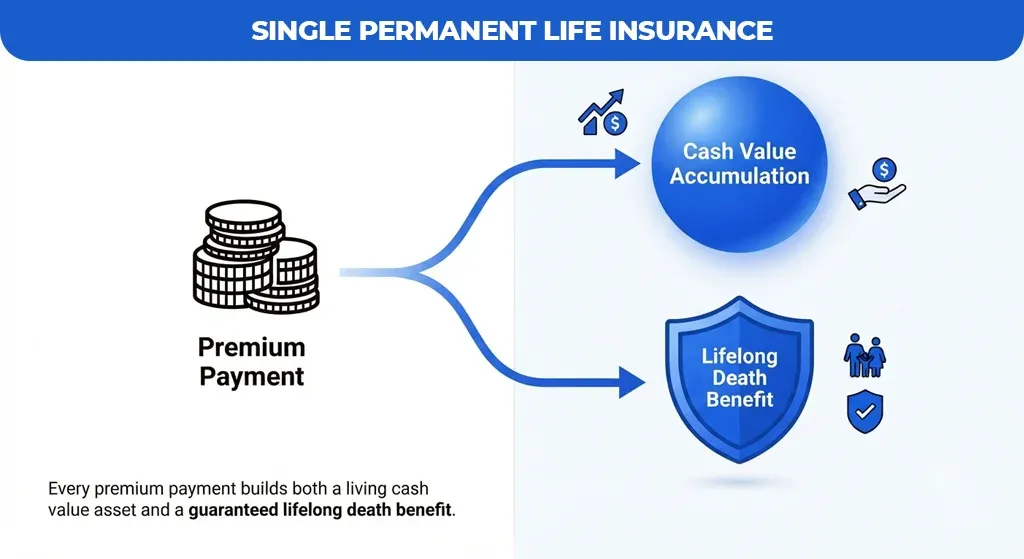
Part of every premium covers the insurer’s cost of providing coverage (based on your age, health, and death benefit amount), and the remainder is deposited into the cash value account. According to the Insurance Information Institute (III), permanent policies are structured so this cash value grows on a tax-deferred basis under current IRS guidelines, meaning you generally don’t owe taxes on the growth until you withdraw more than you’ve paid in premiums.
Types of Permanent Life Insurance Policies
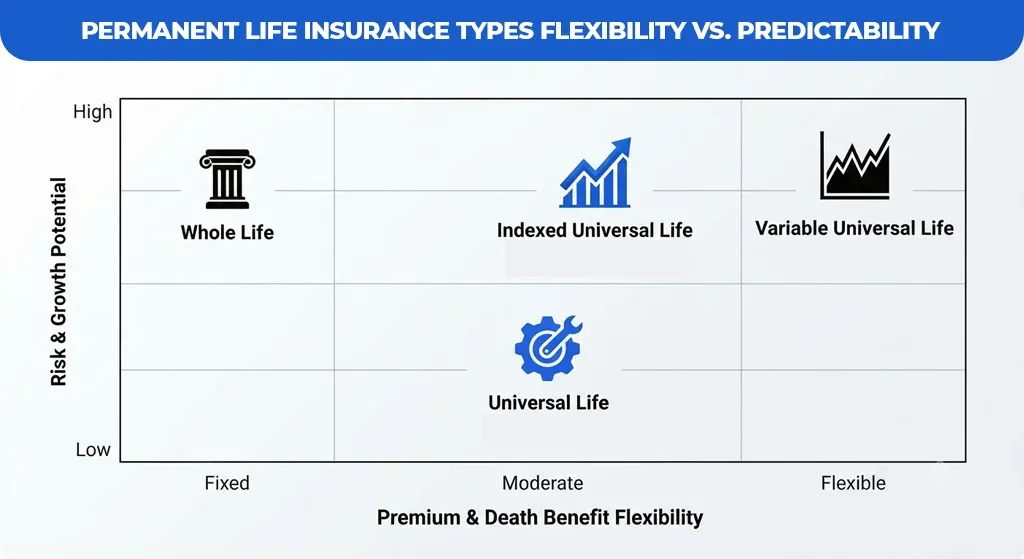
There are four main types of permanent life insurance policies: whole life, universal life, indexed universal life, and variable universal life, and each one differs in how much premium flexibility you get and how the cash value is allowed to grow.
Whole Life Insurance
Whole life insurance is the most traditional permanent life insurance policy, offering fixed premiums, a guaranteed death benefit, and a guaranteed minimum interest rate on cash value growth for the life of the contract.
Because the premium and growth rate never change, whole life is often the easiest permanent policy to budget for and predict, which is why many people searching for the best permanent life insurance policy start here.
Universal Life Insurance (UL)
Universal life insurance is a permanent life insurance policy that offers flexible premiums and an adjustable death benefit, with cash value growth tied to current interest rates set by the insurer rather than a single fixed rate.
This flexibility lets policyholders increase or decrease payments within limits as their income changes, but it also means the policy can lapse if underfunded during periods of low interest crediting.
Indexed Universal Life Insurance (IUL)
Indexed universal life insurance allows the cash value of a permanent life insurance policy to earn interest based on the performance of a stock market index, such as the S&P 500, while a guaranteed floor protects the account from market downturns.
IUL policies typically cap the maximum credited return in exchange for that downside floor, so gains in strong market years are limited but losses in down years are cushioned.
Variable Universal Life Insurance (VUL)
Variable universal life insurance gives policyholders direct control to invest their cash value into sub-accounts similar to mutual funds, offering higher growth potential alongside meaningfully higher investment risk.
Because the cash value is directly exposed to market performance with no guaranteed floor, VUL is generally best suited to policyholders who are comfortable actively managing investment risk inside their coverage. Market research firms such as LIMRA track how consumer adoption is spread across whole life, UL, IUL, and VUL, and whole life consistently remains the most widely purchased permanent life insurance policy category among individual buyers.
Permanent Life Insurance Policy Cost: What Should You Expect to Pay?
The cost of a permanent life insurance policy is significantly higher than term coverage, often 5 to 10 times more for the same death benefit, because premiums must fund both lifelong insurance protection and the cash value account simultaneously.
Several factors drive what you’ll actually pay:
- Age at purchase: premiums are locked in lower the earlier you buy.
- Health and underwriting class: medical history, tobacco use, and current conditions all affect pricing.
- Death benefit amount: a larger payout requires a larger premium.
- Policy type: whole life tends to cost more upfront than universal life for the same coverage, since its guarantees are stronger.
As a general benchmark, a healthy 40-year-old might pay several hundred dollars a month for a $500,000 whole life policy, while an equivalent term policy could cost a small fraction of that amount; the trade-off is the lifelong guarantee and cash value that term insurance doesn’t offer.
Important Advantages of Permanent Life Insurance
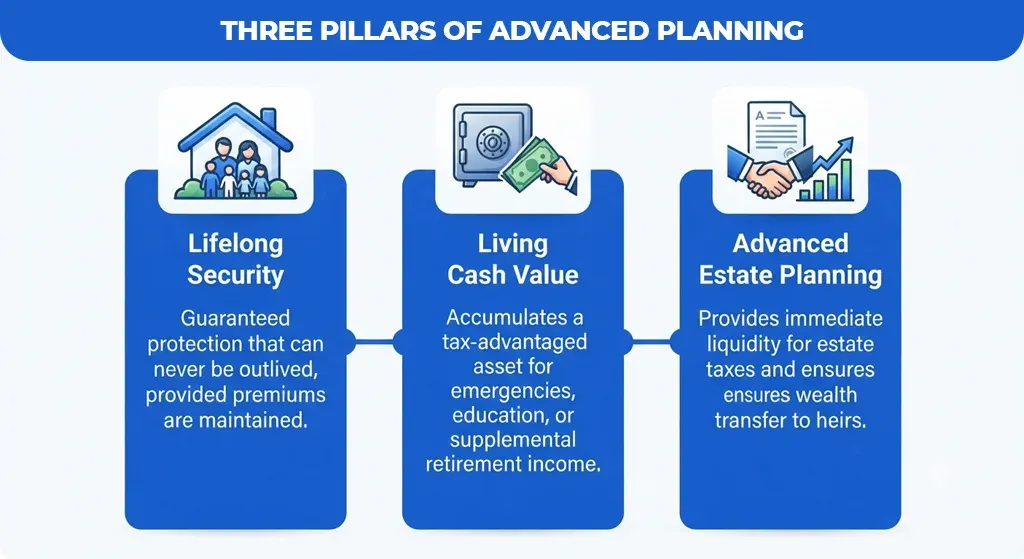
The core advantages of a permanent life insurance policy are guaranteed lifelong coverage, access to accumulated cash value, tax-deferred growth, and tools that support advanced estate planning strategies for wealth transfer.
- Lifelong security: coverage that cannot be outlived, provided premiums are maintained.
- Cash value access: the ability to borrow against or withdraw from accumulated cash value for emergencies, education funding, or retirement income.
- Estate planning power: immediate liquidity for estate taxes or a way to equalize inheritances among heirs.
- Tax advantages: tax-deferred cash growth and generally tax-free death benefits for beneficiaries.
Financial planning frameworks published by the CFP Board frequently reference cash-value life insurance as one tool within a broader, diversified wealth management strategy rather than a stand-alone investment.
Potential Drawbacks of a Permanent Life Insurance Policy
The main downsides of a permanent life insurance policy are its high cost relative to term insurance, layered fees and surrender charges, and the risk that an underfunded policy can lapse and trigger an unexpected tax bill.
- Higher cost: premiums run far above equivalent term life policies for the same death benefit.
- Complexity and fees: administrative charges, cost-of-insurance increases, and surrender charges can be difficult to fully understand upfront.
- Risk of lapse: if cash value drops too low from poor market performance or missed payments, the policy can lapse and create a taxable event.
The National Association of Insurance Commissioners (NAIC) has issued consumer awareness guidance specifically addressing policy fees and surrender periods, urging buyers to review illustrations carefully before signing.
Who Should Buy a Permanent Life Insurance Policy?
A permanent life insurance policy tends to make the most sense for people with lifelong financial obligations or estate planning needs, rather than those simply seeking maximum coverage at the lowest possible cost for a limited time period.
Strong candidates typically include:
- High-net-worth individuals looking for estate planning and tax-advantaged wealth transfer strategies.
- Parents with dependents who require lifelong support, such as a child with special needs.
- Business owners seeking key-person coverage or buy-sell agreement funding.
By contrast, young families on a tight budget who need the maximum death benefit for the lowest monthly cost during child-rearing years are usually better served by term insurance. Advisory resources such as NerdWallet and Bankrate both frame this decision around matching the policy type to your current life stage rather than choosing a product in isolation.
Conclusion
A permanent life insurance policy represents a significant lifelong financial commitment, yet it delivers guaranteed coverage that never expires alongside a cash value asset capable of supporting your retirement income, emergency reserves, or estate planning goals for decades to come. By combining lifelong security with a wealth-building component, this coverage offers distinct advantages for individuals looking beyond temporary financial safety nets.
Whether you are comparing a permanent whole life insurance policy against universal life options, or determining if a cash value permanent life insurance policy fits your comprehensive financial plan, your final choice should be grounded in your personal goals, budget, and time horizon rather than general assumptions.