



Traditional retirement accounts like 401(k)s and IRAs expose your hard-earned savings to direct market volatility and lock you into whatever tax bracket exists decades from now. Meanwhile, many people who purchase standard life insurance policies unknowingly let bloated, unnecessary insurance costs eat away at their potential cash growth. Neither scenario is ideal for someone trying to build durable, flexible wealth.
This is where the max funded IUL, or max-funded Indexed Universal Life policy, enters the conversation. By minimizing the death benefit to the lowest legal limit while funneling in the highest allowable premiums, this strategy transforms a standard insurance policy into a robust, tax-advantaged accumulation engine. So what is a max funded IUL account, exactly, and how does a max funded IUL work in practice?
This guide breaks down how a max funded IUL account works, its core benefits, the IRS guardrails that keep it compliant, its potential drawbacks, and how it compares to traditional retirement vehicles like the 401(k) so you can decide whether a max-funded IUL calculator projection is worth exploring with a licensed professional.
What Is a Max Funded IUL and How Does It Work?
At its core, a max funded IUL shifts the purpose of a life insurance policy. Instead of prioritizing a massive death benefit payout, the design goal becomes building an aggressive, tax-advantaged cash-value engine while keeping just enough death benefit in place to satisfy IRS life insurance requirements.
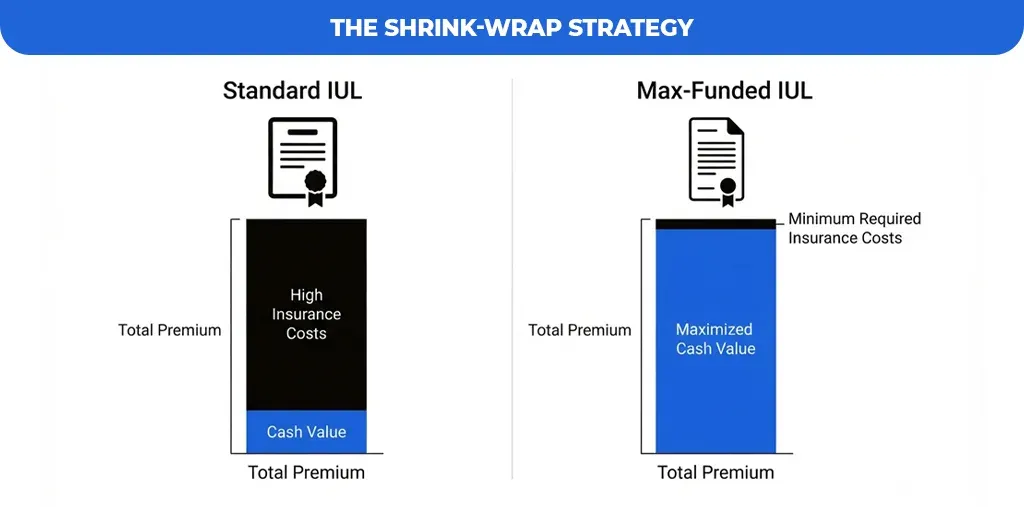
This is sometimes called the “shrink-wrap” strategy: by keeping the insurance face amount as low as the IRS allows relative to the premium being paid, policyholders reduce the internal cost of insurance. That leaves more of every premium dollar available to compound inside the policy’s cash value, rather than being consumed by mortality charges.
The growth inside a max-funded IUL account is tied to indexed crediting. Interest is linked to the performance of a market index, such as the S&P 500, but with two important guardrails: a 0% floor, which protects the accumulated principal from market drops, and a cap rate, which limits the maximum upside return credited in any given period. In other words, when the index falls, your cash value doesn’t lose ground due to that year’s performance; when the index rises, you participate in gains up to the insurer’s stated cap.
The structural rules that make all of this possible trace back to Internal Revenue Code Section 7702, which dictates how a contract must be built in order to legally qualify as life insurance and retain its tax advantages. Historically, this 0% floor design has been highlighted as a way to help protect retirement-stage withdrawals from sequence-of-returns risk the danger of being forced to withdraw funds during a market downturn early in retirement, which can permanently damage a portfolio’s longevity.
The Major Benefits of a Max Funded IUL Strategy
Why High Earners Choose a Max Funded IUL for Wealth Building
So why do high-income earners, business owners, and retirement planners increasingly ask, “What is a max funded IUL, and where to find one that fits my situation?” The appeal generally comes down to three pillars.
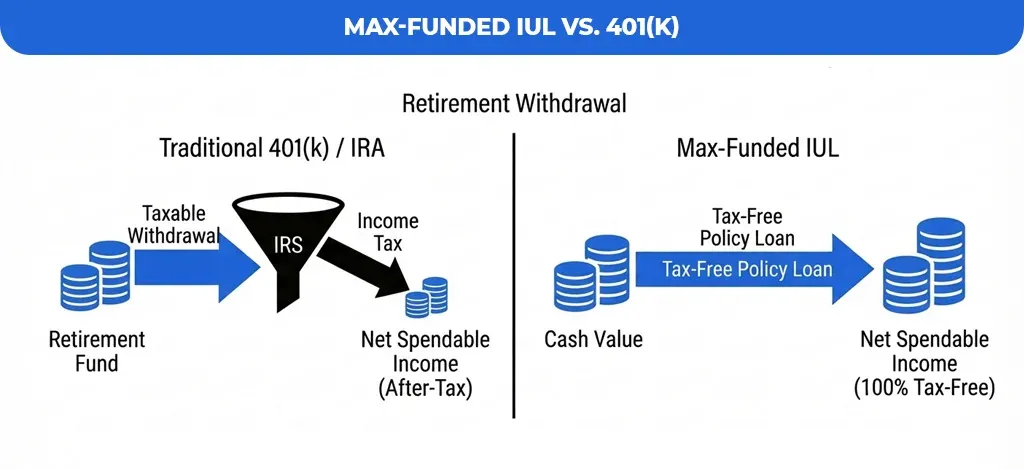
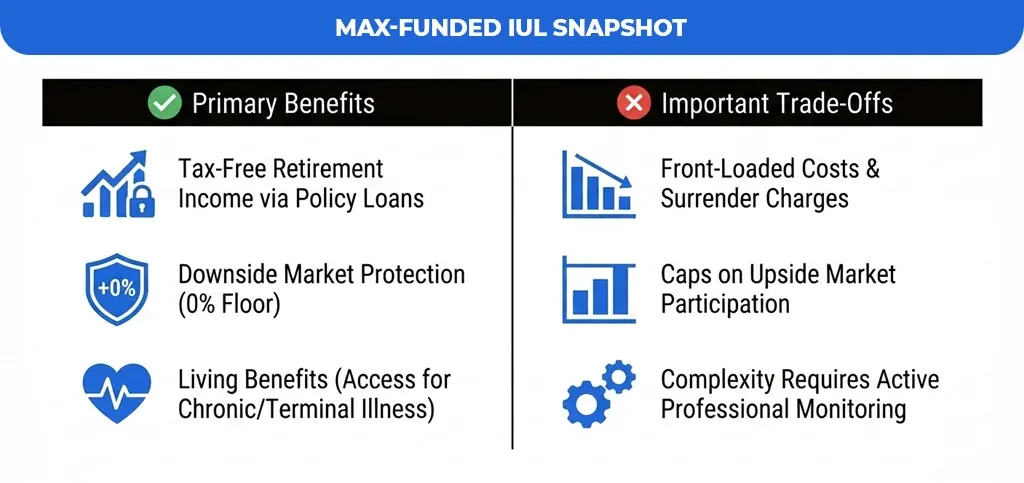
Tax-Free Retirement Income. Policyholders can access accumulated cash value through policy loans, which are generally not treated as taxable income. Because these distributions aren’t counted as ordinary income, they also avoid pushing retirees into higher Social Security taxation thresholds or increased Medicare premium brackets a meaningful advantage over pulling money from a traditional 401(k) or IRA.
Downside Market Protection. Through the annual reset feature, gains credited each year are locked in, so a bad market year simply results in a 0% return rather than an actual loss. This protects accumulated cash value from the kind of drawdowns that can devastate a portfolio invested directly in equities.
Living Benefits. Many max-funded IUL policies include riders that allow policyholders to access a portion of the death benefit early if they’re diagnosed with a chronic, critical, or terminal illness, turning the policy into a resource that can help during life, not just after it.
When people compare a max funded iul vs 401k, the differences become clear:
| Feature | Max Funded IUL | Traditional 401(k) / IRA |
| Tax Treatment of Withdrawals | Tax-free via policy loans | Fully taxable as ordinary income |
| Market Downside Risk | Protected by a 0% floor | Subject to full market losses |
| Contribution Limits | High limits based on the 7-Pay Test / IRS rules | Strictly capped annually by the IRS |
| Access Before Age 59½ | Penalty-free access via policy loans | Subject to a 10% early withdrawal penalty |
Potential Drawbacks and Risks to Consider
The Trade-Offs: Is a Max Funded IUL Flawless?
No strategy is without trade-offs, and understanding the max funded IUL pros and cons honestly is critical before committing to one.
Front-Loaded Costs. Insurance fees and surrender charges tend to be highest during the first five to ten years of the policy, which makes a max funded IUL a poor fit for short-term savings goals.
Caps and Participation Rates. Because gains are capped, you won’t capture 100% of a booming bull market. The trade-off for downside protection is a ceiling on the upside.
Complexity and Maintenance. These policies require active monitoring and professional guidance. Poor early performance or under-funding later in life can put the policy at risk of lapsing if it isn’t managed properly.
Who Should Avoid This Strategy
- Individuals who haven’t yet secured their full employer match in a 401(k), since that match is essentially free money.
- People who need complete liquidity or emergency funds within the next five to ten years.
- Investors seeking uninhibited, aggressive stock market participation without any cap on returns.
Conclusion
A max funded IUL is a sophisticated financial tool. When structured correctly, minimizing the death benefit and maximizing contributions within the limits of Section 7702, it can serve as a powerful instrument for downside protection, tax-free retirement liquidity, and long-term legacy planning. That said, its structural complexity and early-stage fee drag mean it requires a long-term commitment and expert design to work as intended.
This article is for educational purposes only and does not constitute financial, tax, or legal advice. Insurance products, IRS thresholds, and policy performance vary by carrier, health class, and individual circumstances. Consult a licensed financial or insurance professional before making decisions about a max funded IUL or any other financial strategy.
Ready to Explore a Max Funded IUL for Your Financial Plan?
Ready to find out if a max funded IUL fits your financial blueprint? Don’t navigate complex IRS guidelines and insurance policy design alone. Visit Assurance Gurus today to connect with experienced professionals who can custom-tailor a tax-advantaged strategy to protect your wealth and accelerate your journey toward financial independence.