



If you’ve ever wondered whether one life insurance policy is the ceiling or whether you’re leaving your family under-protected because you assumed you had to pick just one, you’re asking the right question. The short answer is yes: you can have multiple life insurance policies at the same time, from the same insurer or from several different carriers. This guide breaks down exactly how policy stacking works, why so many households do it, how insurers evaluate the practice, and what to weigh before you add a second (or third) policy to your coverage.
Everything below reflects standard underwriting practice across the life insurance industry, so you can walk into a conversation with an agent or advisor already knowing the right questions to ask.
Can You Have Multiple Life Insurance Policies? The Legal Basics
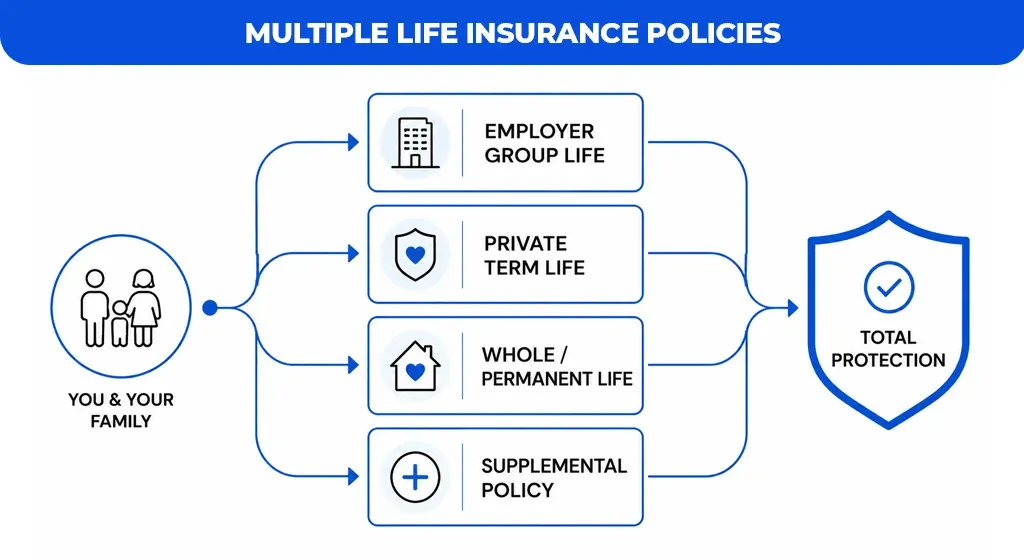
Yes, there is no federal or state law capping the number of individual life insurance policies a person can own. You could hold a term policy through your employer, a private term policy you bought at 30, and a whole life policy your parents started for you as a child, all active at once. Insurers don’t share a central registry that blocks a second application just because you already have coverage elsewhere (though, as you’ll see below, they do ask about it).
The real limiting factor isn’t legality; it’s insurable interest. Every policy you buy on your own life automatically satisfies this requirement, since you obviously have a financial stake in your own continued income and well-being. Insurable interest only becomes a question when someone else is buying a policy on your life, such as a business partner or a spouse.
Can You Have Multiple Life Insurance Policies on One Person?
Yes, and this is common in two scenarios. First, an individual can be the insured on several policies they personally own, for example, stacking a large term policy with a smaller permanent one. Second, multiple different people can each hold a separate policy on the same insured person, as long as each purchaser can demonstrate insurable interest (a spouse, business partner, or lender with a financial stake in that person’s life, for instance).
Can You Have Multiple Life Insurance Policies on Yourself?
Absolutely, this is the most common version of policy stacking. There’s no rule limiting how many policies you can buy naming yourself as the insured, provided each application is honest, and the combined coverage aligns with what an insurer would reasonably expect given your income and net worth (more on that below).
Why People Choose to Stack Multiple Life Insurance Policies
Buying more than one policy usually isn’t about hoarding coverage; it’s a deliberate strategy to match protection to specific financial obligations. Here are the three most common reasons policyholders layer coverage.
Laddering Term and Permanent Coverage
“Laddering” means pairing a large, low-cost term policy that covers your peak earning years with a smaller permanent policy that stays in force for life. The term policy handles the big, time-limited need, replacing your income while you’re raising kids or paying a mortgage, while the permanent policy covers final expenses, estate planning, or a legacy gift that never expires.
| Policy Type | Typical Purpose | Duration | Relative Cost |
| Term (large face amount) | Income replacement, mortgage payoff, child-rearing years | 10–30 years | Lower premium |
| Whole or permanent (smaller face amount) | Final expenses, estate planning, lifelong legacy | Lifetime | Higher premium per dollar of coverage |
This is also the most common answer to “can you have multiple term life insurance policies” and “can you have multiple whole life insurance policies”: yes to both, and combining the two policy types is precisely what laddering is built on. [Related guide on term vs. whole life insurance].
Supplementing Employer-Provided Coverage
Group life insurance through work is a nice perk, but it’s rarely enough on its own. Employer plans typically cap out around one to two times your annual salary, and critically, that coverage usually doesn’t follow you if you change jobs. Buying a private policy alongside your group benefit protects your family from that gap and keeps coverage in your control regardless of your employment status.
Covering Growing Financial Responsibilities
Life doesn’t stand still, and your coverage often shouldn’t either. A new mortgage, the birth of a child, or launching a business are each a legitimate reason to add a standalone policy rather than trying to unwind and replace an existing one. Layering new policies on top of old ones lets you match coverage to each obligation’s own timeline instead of overpaying for one all-purpose policy sized to your busiest years.
How Insurers Underwrite Multiple Life Insurance Policies
Just because there’s no legal cap doesn’t mean you can buy unlimited coverage. Insurers apply their own limits, largely to guard against fraud and to make sure a death benefit reflects a genuine financial loss rather than a windfall.
Total Risk and Aggregate Coverage Limits
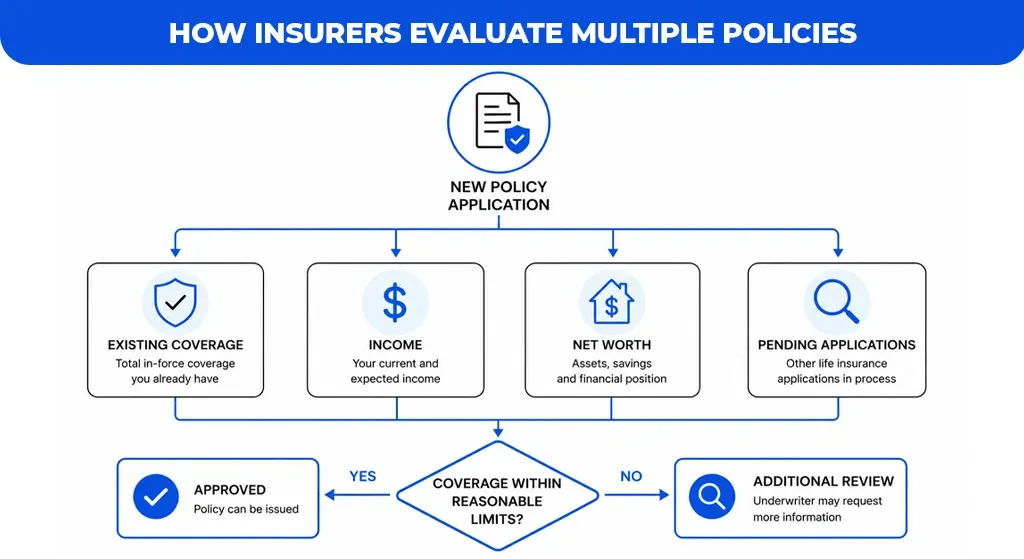
Underwriters look past any single application to your total in-force and pending coverage across every carrier. If your combined coverage starts to look disproportionate to your income or net worth, expect additional scrutiny, a request for financial documentation, or a decline on the newest application even if each individual policy would have been approved in isolation.
Income-Based Coverage Multiples
Most insurers cap total death benefit at a multiple of your annual income, and that multiple typically shrinks as you age, since there are fewer future working years to replace.
| Age Range | Typical Maximum Coverage (as multiple of income) |
| 20s–30s | Up to 25–30x annual income |
| 40s | Roughly 15–20x annual income |
| 50s | Roughly 10–15x annual income |
| 60s and older | Generally under 10x annual income |
These figures vary by carrier and by how strong the rest of your financial profile is, so treat them as a general guide rather than a hard rule. [Related guide on how much life insurance you need].
Full Disclosure Is Non-Negotiable
Every life insurance application asks whether you have existing coverage and whether you’re applying for additional coverage elsewhere. Answer honestly. Insurers routinely cross-check applications through shared industry databases such as the MIB (Medical Information Bureau), and an undisclosed policy discovered later can be treated as material misrepresentation, which can jeopardize a claim at the worst possible time for your beneficiaries.
Multiple Life Insurance Policies From Different Companies
Nothing requires your policies to come from the same insurer, and in fact spreading coverage across carriers is a deliberate strategy for some buyers. You absolutely can have multiple life insurance policies from different companies, or the reverse: several policies with different companies rather than stacking everything with one insurer.
Common reasons to diversify across carriers:
- Rate shopping over time. A carrier that offered the best price when you bought your first policy in your 20s may not be the most competitive when you shop for a second policy a decade later.
- Product specialization. Some insurers are stronger on affordable term products; others specialize in permanent or indexed policies, so buyers pick the best-fit carrier for each policy’s purpose.
- Carrier diversification. A small number of buyers spread large coverage amounts across two or three highly rated insurers rather than concentrating everything with one company, similar to how they’d diversify other financial holdings.
There’s no requirement to keep every policy with a single company, and doing so isn’t inherently better or worse; it comes down to price, product fit, and your comfort managing more than one account.
Multiple Life Insurance Policies and Beneficiaries
A frequent follow-up question is whether you can have multiple beneficiaries on a life insurance policy, and yes, a single policy can name several beneficiaries, each assigned a percentage of the payout. That’s a separate question from having multiple policies, though the two often get combined in real planning.
It’s entirely common and often smart to structure multiple life insurance policies with different beneficiaries. For example, you might name your spouse as beneficiary on your larger term policy while naming a trust for minor children, a business partner, or a charitable organization on a smaller supplemental policy. Keeping beneficiary designations separate by policy gives you precise control over where each dollar of coverage goes rather than forcing every policy into one blended beneficiary split.
Pros and Cons of Holding Multiple Life Insurance Policies
| Pros | Cons |
| Flexibility to cancel a term policy once an obligation (like a mortgage) is paid off | More premium due dates and renewal terms to track |
| Coverage tailored to specific goals: mortgage protection, tuition funding, final expenses | Potentially higher combined administrative or policy fees than one larger policy |
| Risk diversification across top-rated carriers | Multiple medical exams or underwriting processes if required |
| Ability to shop each policy for the best rate at the time you buy it | Easier to lose track of total coverage and beneficiary designations without a simple record |
Financial advisors generally recommend keeping a single, simple document, even just a spreadsheet listing every policy, carrier, face amount, and beneficiary, so nothing gets overlooked and your family knows exactly what to file a claim on when the time comes.
How to Decide How Many Policies You Actually Need
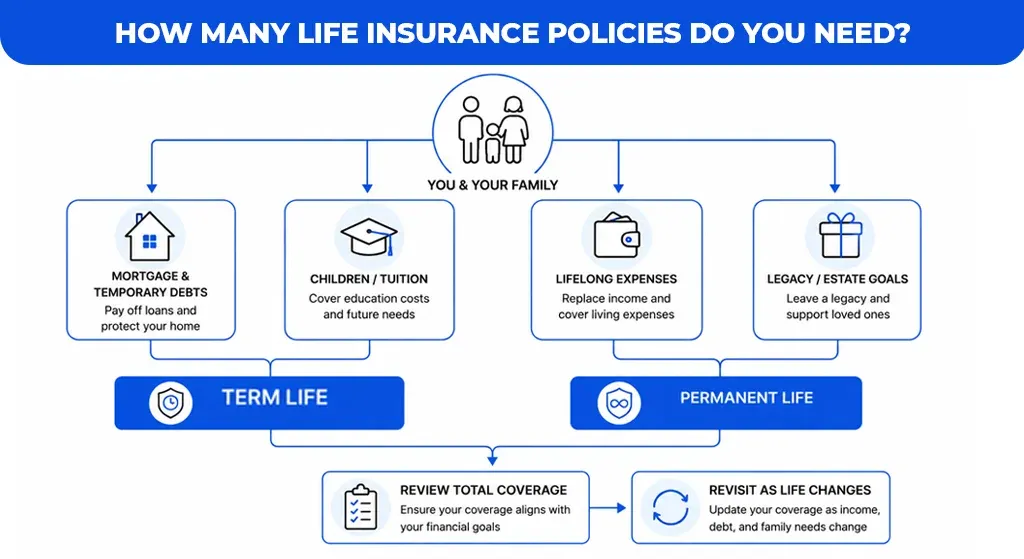
Rather than defaulting to “more coverage is always better,” work backward from your actual obligations:
- List your fixed, time-limited obligations: mortgage balance, remaining years of childcare or tuition, business loans.
- List your lifelong obligations: final expenses, estate taxes, a legacy gift.
- Match a policy type to each obligation term for anything with an end date; permanent for anything that doesn’t expire.
- Total the coverage and check it against your income multiple using the table above, so you’re not blindsided during underwriting.
- Revisit every few years as income, debt, and family circumstances change.
Conclusion
So, can you have multiple life insurance policies? Yes, legally, practically, and often strategically. Stacking a large term policy with a smaller permanent one, supplementing thin employer coverage, or adding protection as your responsibilities grow are all standard, insurer-recognized strategies rather than loopholes. The keys are staying honest on every application, keeping your total coverage proportionate to your income, and tracking your policies and beneficiaries in one place so nothing falls through the cracks.
Navigating the world of life insurance can feel overwhelming, but you don’t have to do it alone. At Assurance Gurus, we specialize in helping you compare options, find the right balance of coverage, and secure peace of mind for your family. Visit Assurance Gurus today to connect with expert advisors and get a personalized life insurance quote tailored to your unique needs.