



Receiving a life insurance payout often arrives during one of the most emotionally difficult periods of a person’s life. Amid the grief, practical financial questions surface quickly, and one of the first is simple but urgent: is life insurance taxable?
Many people assume that every insurance payout is automatically tax-free, and in most cases, that assumption is correct. But hidden tax traps can catch beneficiaries and policyholders off guard, from interest accrued on delayed payments to estate-tax exposure on larger policies.
This comprehensive guide breaks down exactly when life insurance proceeds are tax-free, how tax treatment differs across policy types, what specifically triggers taxation, and smart strategies to minimize your tax liability. This guide is brought to you by Assurance Gurus, your trusted partner in financial security.
When Are Life Insurance Proceeds Tax-Free?
For most Americans, the answer to “is a life insurance payout taxable” is reassuring: no. Lump-sum death benefits paid directly to a designated recipient are typically exempt from federal income tax under IRS Section 101(a). The beneficiary does not need to report the payout as income, and no income tax return entry is required for the death benefit itself.
This tax-free treatment is one of the core advantages of owning a policy in the first place, and it applies broadly across policy types. Whether you’re asking “is life insurance benefits taxable” for a term policy or is whole life insurance taxable for a permanent one, the death benefit itself follows the same general rule.
The tax-free lump-sum rule applies to:
- Term life insurance: pure death-benefit protection with no cash value component.
- Whole life insurance: permanent coverage with a cash value account.
- Universal life insurance: flexible permanent coverage with adjustable premiums and death benefits.
Per IRS Publication 525 (Taxable and Nontaxable Income), proceeds paid by reason of the death of the insured are not included in gross income, provided the payout is a lump sum, and the policy wasn’t transferred for valuable consideration. In short: is life insurance taxable to the beneficiary? In the vast majority of straightforward cases, no.
When Are Life Insurance Proceeds Taxable?
While the death benefit itself is typically tax-free, several common scenarios can create a tax bill. Understanding these exceptions is essential to answering “is life insurance money taxable” in your specific situation.
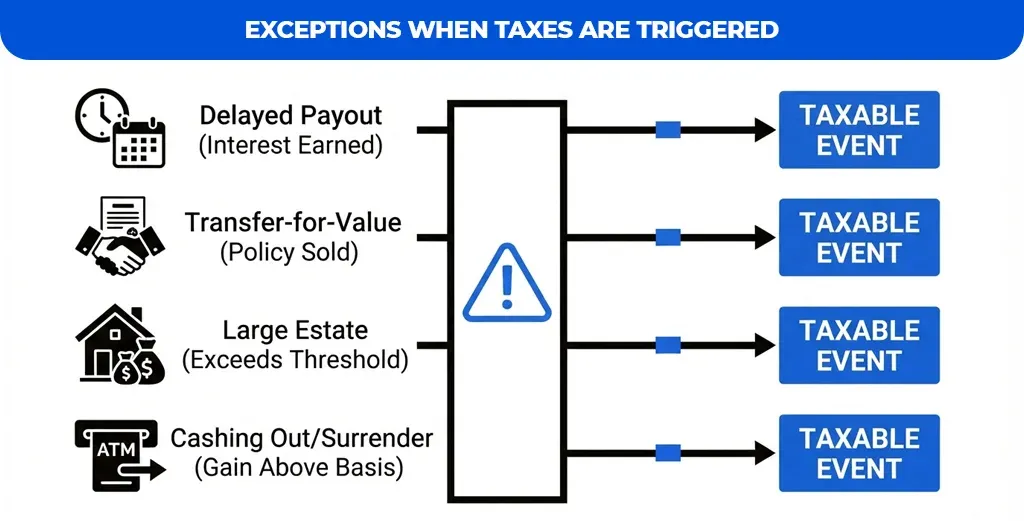
Interest Earned on Delayed Payouts
If you choose or the insurer defaults to an installment payout instead of a lump sum, the original death benefit remains tax-free, but any interest that accrues while the funds sit with the insurer is considered taxable income. This directly answers “is income from life insurance taxable”: the principal isn’t, but the interest is.
The Transfer-for-Value Rule
If a policy is sold or transferred to another party in exchange for money or other valuable consideration, the tax-free status of the death benefit can be partially lost. In these cases, only the amount equal to the purchaser’s cost basis (premiums paid plus consideration paid for the policy) remains tax-free; the rest becomes taxable income to the new owner.
Estate Taxes
If the deceased owned the policy at the time of death, the death benefit may be included in their gross estate for federal estate tax purposes, even though it’s still income-tax-free to the beneficiary. This only becomes a concern if the total estate value exceeds the federal estate tax exemption threshold, though some states apply lower thresholds. This is a key nuance when evaluating “is life insurance proceeds taxable” for larger estates.
Cashing Out or Surrendering a Policy
Permanent policies build cash value over time, and that raises a different question: “Is cash value of life insurance taxable?” If you surrender the policy or withdraw funds while the insured is still living, any amount you receive above your cost basis (total premiums paid) is taxable as ordinary income.
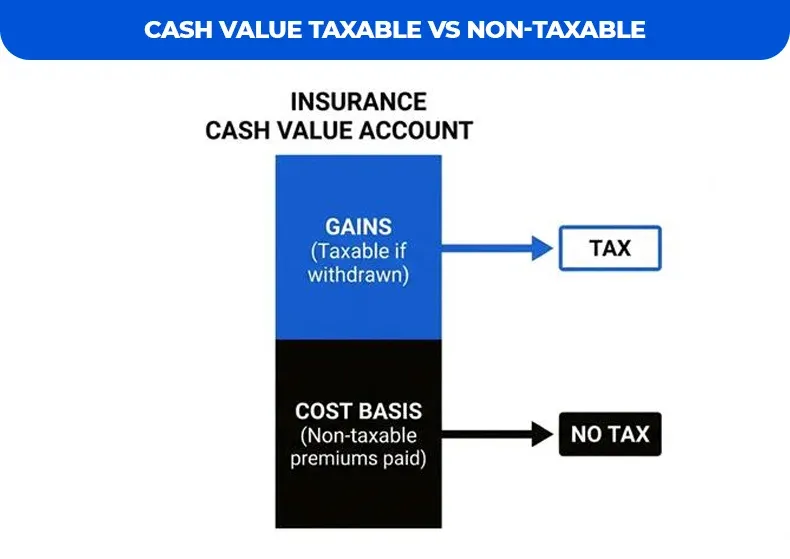
The same logic applies whether you’re asking “is the cash surrender value of life insurance taxable” or “is life insurance surrender value taxable”: gains above basis are taxed; contributions of your own premium dollars are not.
Tax Implications of Different Types of Life Insurance
Not all policies are created equal from a tax standpoint. Here’s how the three most common categories compare when it comes to permanent life insurance taxes and ongoing tax exposure.
Term Life Insurance
A pure death benefit with no cash value component. The tax treatment is the most straightforward of any policy type; beneficiaries receive the full payout income-tax-free, with none of the cash-value complications that come with permanent coverage.
Whole Life Insurance
Builds guaranteed cash value on a tax-deferred basis, meaning growth inside the policy isn’t taxed year to year. However, “is cash value life insurance taxable” becomes relevant the moment you withdraw or borrow against it improperly; gains above your cost basis, or a lapsed loan, can trigger a tax bill.
Universal and Variable Life Insurance
These policies link cash value to interest rates or market-based investment subaccounts, offering more growth potential but more complexity. To preserve their tax advantages, these policies must stay within IRS limits for a Modified Endowment Contract (MEC). Cross that threshold, and withdrawals become taxable on a last-in-first-out basis, with gains taxed before basis is recovered.
Term vs. Whole vs. Universal: Tax Treatment at a Glance
| Policy Type | Cash Value / Growth | Key Tax Consideration |
| Term Life | None, pure death benefit | Death benefit is income-tax-free to the beneficiary; no ongoing tax exposure |
| Whole Life | Guaranteed, tax-deferred cash value | Withdrawals/loans above cost basis, or a lapsed loan, can be taxable |
| Universal / Variable Life | Flexible, market- or rate-linked cash value | Must stay under MEC limits; exceeding them makes withdrawals taxable gains-first |
Tax Forms and Reporting Requirements
Navigating Tax Forms and IRS Reporting
Beneficiaries and executors may encounter a handful of IRS forms depending on how the policy was structured and how the payout was received.
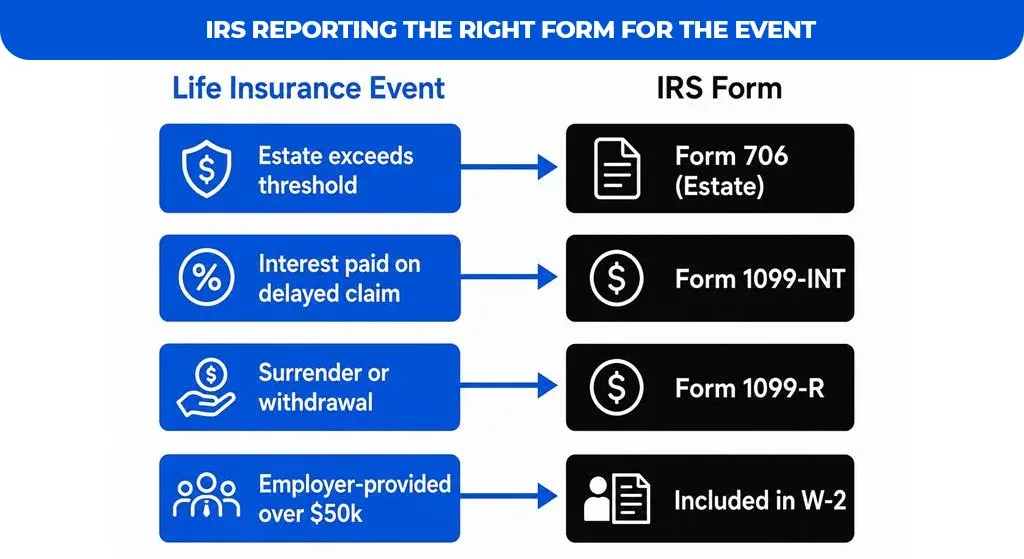
United States Estate (and Generation-Skipping Transfer) Tax Return, Form 706
Filed by the executor if the whole estate of the deceased, including any life insurance owned by the decedent, exceeds the federal estate tax exemption. Most estates fall well under this threshold and never need to file.
Form 1099-INT
Issued when an insurance company pays interest on a delayed death benefit. This form reports the taxable interest portion described in Section 2 above; the principal death benefit itself is not reported here.
Form 1099-R
Issued for cash-value withdrawals, full policy surrenders, or dividends distributed from permanent policies. So “will I receive a 1099 for life insurance proceeds”? Generally, only if you accessed the cash value or received interest, a standard lump-sum death benefit typically generates a 1099.
A note on employer-provided coverage
If your employer provides group-term life insurance, coverage amounts above $50,000 are treated differently: the IRS requires the value of that excess coverage to be added to your taxable wages. This is why “is employer-paid life insurance taxable to the employee” often comes up during open enrollment; it’s addressed further in the FAQ section below.
Considerations to Help Mitigate Tax Liabilities
Smart Strategies to Minimize Life Insurance Taxes
With the right planning, most of the tax exposure described above is avoidable. Here are three strategies worth discussing with a financial professional.
Irrevocable Life Insurance Trusts (ILITs)
An ILIT removes the policy from your taxable estate entirely. Because the trust, not you, owns the policy, the death benefit generally avoids estate tax exposure even on large policies, provided the trust is structured and funded correctly well in advance.
Proper Beneficiary Designation
Clearly naming primary and contingent beneficiaries keeps proceeds out of probate and reduces the risk of the payout being treated as part of the estate. Outdated or missing designations are one of the most common and easily preventable sources of tax and legal complications.
Strategic Policy Loans
Borrowing against a permanent policy’s cash value is generally tax-free, as long as the policy stays in force and isn’t classified as a MEC. Letting a loan grow unchecked, however, can cause the policy to lapse, turning what was a tax-free loan into a taxable event.
Conclusion
The short answer to “is life insurance taxable” is: usually not, but the exceptions matter. Delayed-payout interest, transferred policies, large estates, and cash-value withdrawals can all create tax exposure that catches families off guard. Knowing the rules and planning ahead with tools like ILITs and clear beneficiary designations helps you protect the financial legacy you’ve worked hard to build.
Navigating life insurance and tax strategy doesn’t have to be overwhelming. Visit Assurance Gurus today to explore expert resources, compare coverage options, and get personalized guidance tailored to secure your family’s financial future.