



| Quick Answer An IUL account is the cash value component of an indexed universal life insurance policy. It is not a bank account. Part of each premium pays insurance charges, and the remainder earns interest linked to a market index such as the S&P 500, subject to a cap, participation rate, and a floor (often 0%). |
People search for “IUL account” expecting to find a savings product. What they find is a life insurance contract. Indexed universal life (IUL) is a form of permanent life insurance that pays a death benefit to your beneficiaries and builds cash value inside the policy. Insurance agents often call that cash value an “IUL account,” and some marketing goes further and calls it an “IUL bank account.” That label is misleading: there is no deposit, no FDIC coverage, and no guaranteed interest rate on the indexed portion.
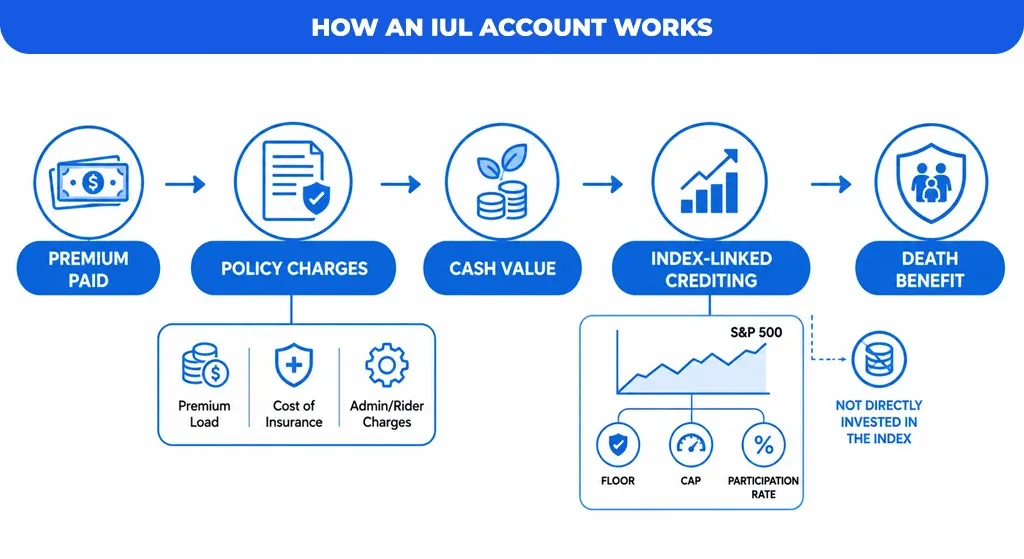
Here is what actually happens. You pay a premium. The insurer deducts a premium load, the cost of insurance, and policy administration charges. What is left goes into one or more indexed accounts, where the insurer credits interest based on the movement of an index, not on money you own in the market. Crediting is limited by a cap, a participation rate, or a spread, and protected on the downside by a floor.
Key Takeaways
- An IUL account is the cash value inside an indexed universal life insurance policy, a permanent life insurance contract, not a deposit account.
- Your money is never invested directly in the index. The insurer credits interest based on index movement, within contractual limits.
- Caps, participation rates, and spreads are non-guaranteed and can be changed by the insurer, subject to contractual minimums.
- Cash value is not FDIC insured. If an insurer fails, state guaranty associations provide limited protection, commonly $300,000 in death benefits and $100,000 in net cash surrender value (NOLHGA).
- IUL sales are large and growing: indexed universal life new annualized premium reached a record $4.5 billion in 2025, 25% of the total U.S. individual life insurance market (LIMRA).
- Tax advantages depend on staying inside the funding limits of IRC 7702 and avoiding modified endowment contract (MEC) status under IRC 7702A.
What Is an IUL Account? (IUL Account Meaning)
An IUL account is the cash value portion of an indexed universal life insurance policy. Indexed universal life is permanent life insurance with flexible premiums, an adjustable death benefit, and a cash value that earns index-linked interest rather than a fixed declared rate.
Three elements make up the contract:
- Death benefit: the amount paid to your beneficiaries. Under IRC Section 101(a), life insurance death benefits are generally received income-tax-free.
- Cash value: the accumulation account funded by premiums after charges, credited with index-linked interest and accessible through withdrawals or policy loans.
- Policy charges: cost of insurance, premium expense charges, per-policy administration fees, rider charges and, in some indexed accounts, an asset-based charge.
IUL sits in the same product family as fixed universal life and variable universal life (VUL). Fixed UL credits a declared interest rate. VUL invests cash value in market subaccounts, so the policyholder takes real market risk. IUL sits between the two: index-linked upside with a contractual floor, and no direct market participation.
The product line is a major part of the U.S. market rather than a niche. LIMRA reported that indexed universal life new annualized premium reached a record $4.5 billion in 2025, up 17% over 2024, representing 25% of total U.S. individual life insurance premium. In the second quarter of 2026, IUL premium was almost $1.1 billion, down 11% from an unusually strong prior-year quarter, while policy count rose 5%.
Is an IUL Account a Bank Account or a Savings Account?
No. An IUL is a life insurance contract issued by an insurance company and regulated by state insurance departments, not a deposit product. There is no “IUL bank account.” Three differences matter most:
- No deposit insurance. Cash value is not covered by the FDIC. Protection comes from the insurer’s claims-paying ability and, in insolvency, from your state’s life and health insurance guaranty association.
- Limited insolvency backstop. NOLHGA member guaranty associations offer resident policyholders basic limits of $300,000 in life insurance death benefits and $100,000 in net cash surrender and withdrawal values, with some states providing more.
- Early liquidity costs. Surrendering a policy in its first decade typically triggers a surrender charge, and early cash value is often well below premiums paid.
What Is an IUL Account and How Does It Work?
An IUL works in four steps: you pay a premium, the insurer deducts charges, the remainder is allocated to a fixed account or one or more indexed accounts, and at the end of each index segment the insurer credits interest based on index movement within your contract’s cap, participation rate, spread, and floor.
A worked example makes the mechanics concrete. Suppose $1,000 of monthly premium goes into a policy with a 6% premium load. Roughly $940 enters the policy, and the monthly deduction for cost of insurance, administration, and riders comes out of accumulated value. What remains sits in the indexed account. If the chosen strategy is a one-year S&P 500 point-to-point with a 9% cap and the index rises 15%, the credit is 9%. If the index falls 12%, the credit is 0% under the floor, but the monthly charges still come out, so cash value can still decline in a down year.
The Four Crediting Levers in an IUL Account
| Lever | What it does | Typical contract language |
| Floor | Sets the minimum credit, so index losses are not credited to the account. | Commonly 0%; some accounts guarantee 1% to 2%. |
| Cap | Sets the maximum credit for the segment, regardless of index gain. | Non-guaranteed and adjustable, subject to a guaranteed minimum cap. |
| Participation rate | Credits a stated percentage of index growth. | Can exceed 100% on volatility-controlled indices. |
| Spread | Subtracts a fixed percentage from index growth before crediting. | Usually paired with uncapped strategies. |
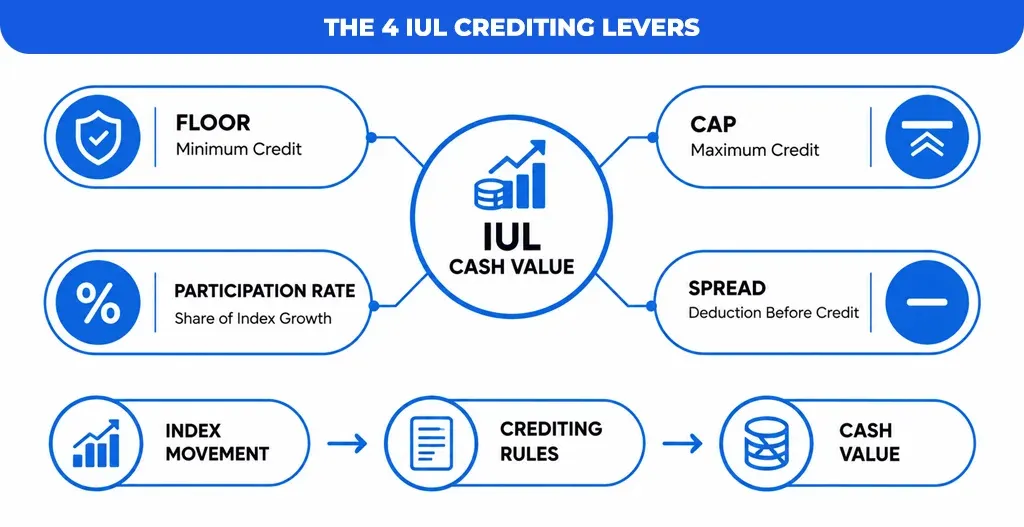
These levers are set by the insurer and published on current rate sheets. Allianz Life’s rate guide for its Life Accumulator IUL, dated 7 July 2026, shows a 5.30% fixed interest rate, an 8.00% trigger interest rate on the S&P 500, a 3.80% monthly-sum cap on the S&P 500, and a 175% participation rate on the PIMCO Tactical Balanced ER Index, with the explicit note that new business rates are not guaranteed and are subject to change at the company’s discretion.
Does an IUL Account Earn Compound Interest?
Credited interest is added to accumulated value, and the following segment’s credit is calculated on the higher balance, so compounding does apply to what remains after charges. Two qualifications matter. First, index credits exclude dividends, because you are not a shareholder. Second, monthly deductions are taken from accumulated value throughout, so the compounding base is net of charges rather than gross premium.
How Much Does an IUL Account Cost per Month?
There is no standard monthly cost. Your premium is priced from the face amount, your age, sex, health and tobacco status, the underwriting class assigned, the riders selected, and how the policy is designed. Two applicants of the same age can receive materially different quotes, so treat any single “average monthly cost” figure with caution.
What can be described precisely is the charge structure, because carriers disclose it. An IUL typically carries:
- Premium expense charge: deducted from each premium before the balance reaches cash value; it covers issuing and administering the policy.
- Cost of insurance (COI): the mortality charge on the amount at risk. It rises as you age, which is why underfunded policies come under strain in later years.
- Per-policy and per-thousand administration charges: fixed monthly deductions from accumulated value.
- Indexed account charges on some strategies: Pacific Life’s Horizon IUL guide, for example, discloses that its 1-Year High Cap Indexed Account assesses a monthly charge of 0.067% of accumulated value in that account, equal to 0.80% annually.
- Rider charges: for benefits such as chronic illness or long-term care acceleration, waiver of monthly deductions, or a no-lapse guarantee.
- Surrender charges: levied if you surrender early. Surrender charge periods commonly run 10 to 15 years and decline each policy year, as set out in the policy schedule.
The practical consequence is front-loading. Charges take their largest relative bite in the early years, which is why an IUL designed for cash accumulation is generally assessed over a 15-to-30-year horizon rather than as a medium-term savings plan.
IUL Account Tax Rules: Sections 7702, 7702A and Policy Loans
An IUL’s tax treatment depends on the contract qualifying as life insurance under IRC Section 7702 and avoiding modified endowment contract status under IRC Section 7702A. Inside those limits, cash value grows tax-deferred, the death benefit is generally income-tax-free under Section 101(a), and policy loans are not treated as taxable distributions while the policy stays in force.
The seven-pay test is the boundary. If cumulative premiums during the first seven contract years exceed what it would cost to pay the policy up in seven level annual premiums, the contract is reclassified as a MEC under Section 7702A. The consequences are specific:
- Distributions are taxed last-in, first-out, so gain comes out first as ordinary income, instead of the basis-first ordering that applies to non-MEC life insurance.
- Policy loans are treated as distributions, so borrowing from a MEC can be taxable where there is gain in the contract.
- Taxable amounts distributed before age 59½ face an additional 10% tax under Section 72(v), with narrow exceptions for disability and substantially equal periodic payments.
- MEC status is permanent. Reducing or stopping premiums afterwards does not reverse it, and a 1035 exchange of a MEC produces another MEC.
Is an IUL Account Better Than a 401(k)?
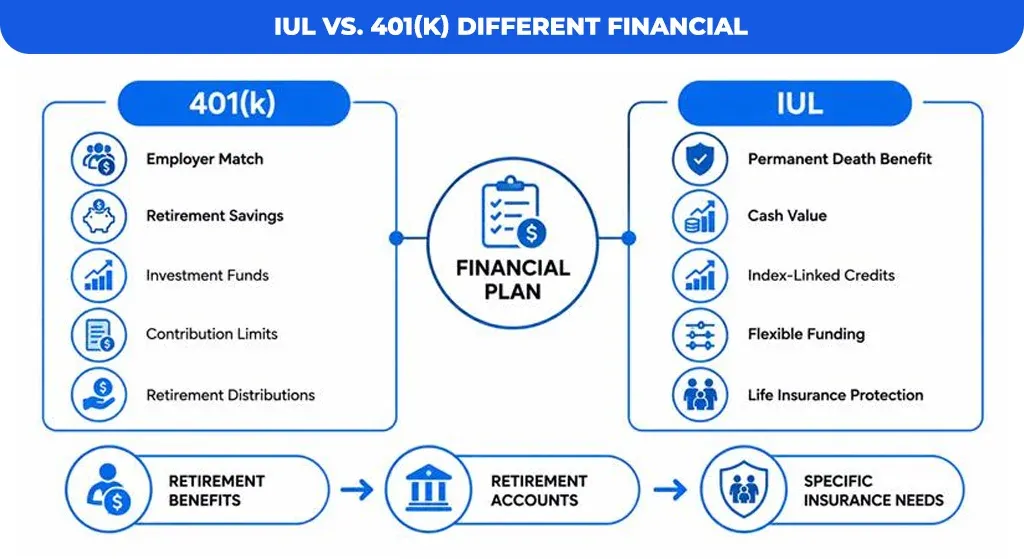
Neither is strictly better; they do different jobs. A 401(k) delivers tax-deductible or Roth contributions, possible employer matching, and low-cost investment options, but with annual contribution limits. An IUL provides a death benefit, index-linked growth with a floor, and no statutory contribution cap beyond the 7702 funding limits, at the cost of insurance charges and complexity.
| Feature | 401(k) | IUL account (cash value) |
| 2026 contribution limit | $24,500 employee deferral; $8,000 catch-up at 50+; $11,250 at ages 60–63 (IRS Notice 2025-67) | No statutory dollar cap; funding limited by IRC 7702 and the 7702A seven-pay test |
| Tax on contributions | Pre-tax (traditional) or after-tax (Roth) | After-tax premiums only |
| Growth | Market returns on chosen funds, including losses | Index-linked credits within cap/participation/spread, floor commonly 0% |
| Employer match | Possible, plan-dependent | None |
| Access before 59½ | Generally taxable plus a 10% additional tax, with exceptions | Loans and withdrawals generally available; loans not taxable while in force and not a MEC |
| Mandatory withdrawals | Required minimum distributions generally begin at age 73 (SECURE 2.0 Act) | None |
| Death benefit | Account balance to beneficiaries | Income-tax-free death benefit under IRC §101(a) |
| Ongoing costs | Fund expenses and any plan administration fees | Cost of insurance, premium load, admin charges, rider and surrender charges |
The conventional sequencing among fee-based planners is to capture an available employer match first, because that is an immediate return no insurance product replicates, then consider IRA or Roth IRA capacity, and only then evaluate an IUL for objectives the retirement accounts cannot serve: permanent death benefit, estate liquidity, or additional after-tax accumulation once qualified-plan room is used up.
Who Is an IUL Account Suitable For?
An IUL tends to fit buyers with a permanent insurance need, a long time horizon, and after-tax money left over once tax-advantaged retirement capacity is used. It tends to fit poorly where the need is temporary coverage, emergency savings, or short-term liquidity.
| Often a reasonable fit | Often a poor fit |
| A permanent death benefit is genuinely needed: estate liquidity, a special-needs dependant, business continuity | The need is temporary income replacement, where level term life insurance costs far less per dollar of cover |
| 401(k), IRA and HSA capacity is already used and further after-tax accumulation is wanted | Retirement plan capacity or an employer match is still unused |
| Premiums are affordable for decades, not months | Funding is uncertain, since a lapse can crystallise both losses and tax |
| The buyer accepts non-guaranteed caps and will review the policy annually | The buyer wants a guaranteed, deposit-insured rate where savings accounts and CDs are the honest comparison |
| Business or estate planning uses, such as key person cover or an irrevocable life insurance trust | The primary goal is index returns, where low-cost index funds avoid insurance charges entirely |
IUL Account Pros and Cons
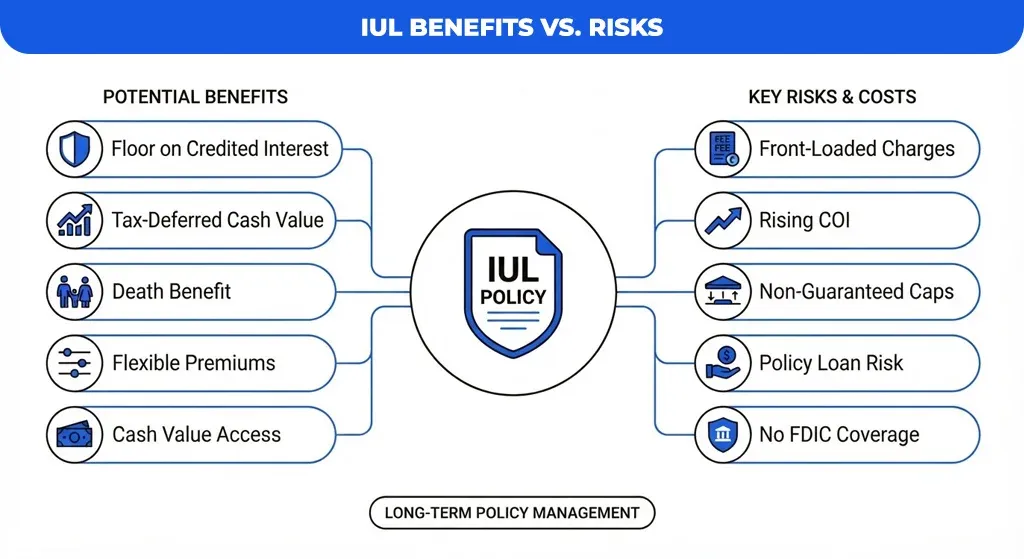
Advantages
- Downside protection on credited interest through a floor, commonly 0%, so index declines are not credited as losses.
- Tax-deferred cash value growth and an income-tax-free death benefit while the contract remains qualifying life insurance.
- Flexible premiums and an adjustable death benefit, within contractual and tax limits.
- Access to cash value through policy loans and withdrawals, without the age-based restrictions of qualified plans.
- No statutory contribution ceiling, which is why the product is used by higher earners who have exhausted qualified-plan room.
Disadvantages
- Charges are front-loaded, and the cost of insurance rises with age, so early cash value is typically less than premiums paid.
- Caps, participation rates, and spreads are non-guaranteed and can be reduced by the insurer within contractual minimums.
- Index credits exclude dividends and are calculated segment by segment, so credited returns can trail the index’s total return.
- Outstanding loans and loan interest reduce the death benefit, and a lapse with a large loan can trigger a taxable gain.
- No FDIC coverage, with only limited state guaranty association protection if the insurer becomes insolvent.
How to Open an IUL Account (and Where to Get One)
You open an IUL account by applying for an indexed universal life policy through a state-licensed life insurance agent, an independent brokerage, a fee-based financial planner working with a brokerage, or directly with a carrier that sells its own products. Underwriting usually takes two to six weeks, and the policy exists only once it is issued, delivered, and the first premium is paid.
- Define the objective first. A policy designed for maximum death benefit is built differently from one designed for cash accumulation. Say which you want before comparing quotes.
- Choose a distribution channel. Independent brokers can quote multiple carriers; a captive agent quotes one. Confirm the licence status of anyone advising you with your state insurance department.
- Compare carriers on financial strength. Review ratings from AM Best, S&P Global Ratings, Moody’s and Fitch, since the floor and the death benefit rest on the insurer’s claims-paying ability.
- Complete the application and underwriting. Expect a health questionnaire, prescription and medical records checks, possibly a paramedical exam, and financial underwriting on larger face amounts. Accelerated underwriting is available at some carriers for qualifying applicants.
- Review the illustration at both current and guaranteed assumptions. The guaranteed column shows what happens if the insurer charges the maximum permitted and credits the minimum.
- Set the funding level deliberately. Design premiums to stay below the 7702A seven-pay limit if you want non-MEC tax treatment, and understand the difference between minimum premium, target premium, and a maximum-funded design.
The Bottom Line on IUL Accounts
An IUL account is the cash value inside an indexed universal life insurance policy. Used deliberately, it combines a permanent, generally income-tax-free death benefit with index-linked accumulation protected by a floor, and no statutory contribution ceiling. Used casually, it disappoints because charges are front-loaded, caps and participation rates are not guaranteed, illustrated values are assumptions rather than promises, and the cash value carries no deposit insurance.
The deciding questions are therefore practical: do you have a lasting need for life insurance, can you fund the policy for decades, and have you already used the retirement accounts that offer employer matching and deductible or Roth treatment? If the answers line up, an IUL can earn a place in the plan. If they do not, term life insurance plus low-cost investing usually accomplishes the same goals with fewer moving parts.