



Return of premium life insurance is term life insurance that refunds the premiums you paid if you’re still alive when the term ends. The trade-off is price: published 2026 sample rates show return of premium (ROP) coverage costing roughly two to three times as much as standard term.
Quick answer: A return of premium policy pays a death benefit if you die during the term and refunds your premiums if you don’t. For a healthy 30-year-old man, published 2026 sample rates show $500,000 of 20-year term at $25 a month standard or $65 a month with ROP. The refund works out to about a 4.5% tax-free yield on the extra cost, but only if you keep the policy for the full term.
What Is the Return of Premium Life Insurance?
A return of premium life insurance policy is a term policy that promises two things: a death benefit if you die during the term, and a refund of your premiums if you outlive it. It comes either as a built-in ROP term product or as a rider added to a standard term policy. Terms are usually 10, 20, or 30 years.
Why people like it
Standard term insurance is pure protection. If you outlive the term, which most people do, you get nothing back. ROP removes that feeling of having paid for nothing. If you outlive a 20-year ROP policy, you get every premium back, so the coverage effectively cost you nothing except what that money could have earned elsewhere.
That last part is the catch. You pay much more each month for the refund, and the refund doesn’t include interest or growth. Whether that’s a good deal depends on how long you keep the policy and what you’d otherwise do with the extra money.
Is a return of premium life insurance worth it?
It can be worth it for people who will reliably keep the policy for the full term, want a guaranteed result, and wouldn’t invest the difference anyway. The implied return on the extra premium is modest, roughly 3.5% to 5% tax-free in the sample rates in this guide, and it’s lost if you cancel early. For people who are disciplined about investing, buying standard term and investing the difference has historically had the potential to come out ahead, though without the guarantee.
Note: ROP is not an investment account. You can’t borrow against it, the refund doesn’t grow, and if you stop paying before the term ends, you may get some or none of your money back, depending on the policy.
How Return of Premium Life Insurance Works
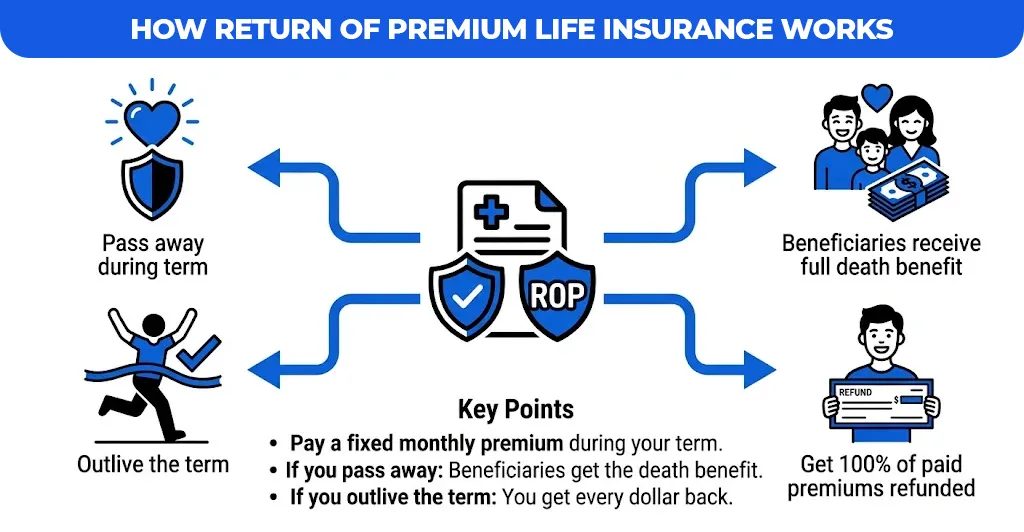
You pay a level premium for the whole term, just as with standard terms. If you die during the term, your beneficiaries receive the death benefit. If you’re alive at the end, the insurer refunds the premiums you paid, and coverage ends.
The refund math
The refund is simply your premium multiplied by the number of premiums you paid. For a 30-year-old man buying $500,000 of 20-year ROP term at Choice Mutual’s published sample rate:
Monthly ROP premium: $65
Months paid: 240 (20 years)
Refund at end of term: $65 x 240 = $15,600
Check how your policy defines the refund. Some refund only the base premium and leave out charges for other riders or policy fees, and some only refund in full if every premium was paid through the end of the term.
Why the refund is generally tax-free
A refund of premiums isn’t income, because you’re getting back money you already paid with after-tax dollars. Under the tax code’s rules for life insurance contracts, amounts you receive that aren’t paid as an annuity are generally taxable only to the extent they exceed your investment in the contract, which is essentially the premiums you’ve paid. Because an ROP refund doesn’t exceed what you paid, there’s no gain to tax. Policygenius and Choice Mutual both describe the refund as tax-free. If your situation is unusual, such as a policy owned by a business, check with a tax professional.
The death benefit itself is also generally not taxable income to your beneficiaries, the same as with any life insurance policy.
Return of premium term vs. standard term vs. whole life
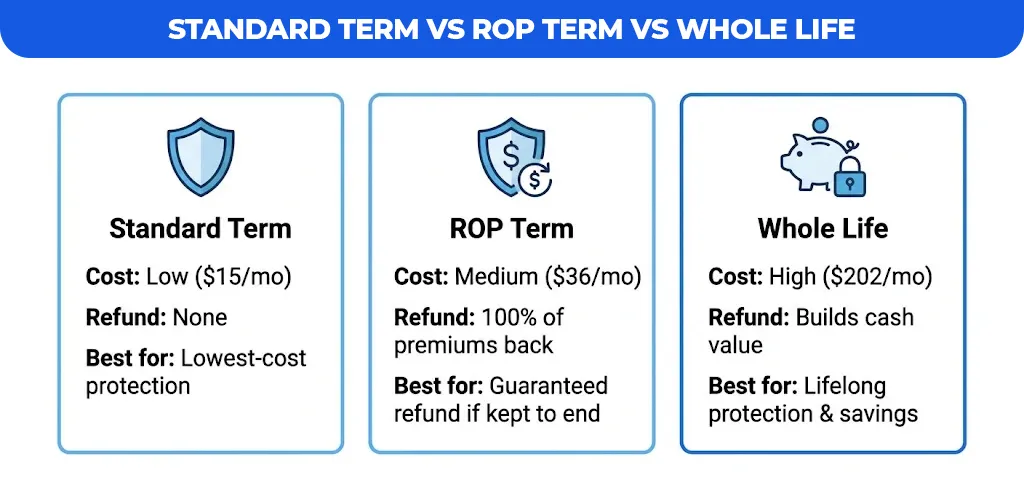
ROP sits between standard term and permanent coverage. It costs more than term but far less than whole life, and it ends when the term ends. Here’s how the three compare for $250,000 of coverage bought at 30, using Choice Mutual’s published 2026 sample rates:
| Feature | Standard 20-year term | 20-year ROP term | Whole life |
| Monthly cost, woman 30 | $12 | $25 | $176 |
| Monthly cost, man 30 | $15 | $36 | $202 |
| Coverage length | 20 years | 20 years | Lifetime |
| Money back if you outlive it | None | All premiums, if kept to the end | Not applicable; cash value builds |
| Cash value you can borrow | None | None | Yes |
| If you cancel early | Coverage stops, no refund | Partial or no refund, by policy | Receive the cash surrender value |
| Best fit | Lowest-cost protection | Guaranteed refund for disciplined keepers | Lifelong coverage and savings |
For more on the permanent side, see our guides to term vs. permanent life insurance and whether whole life insurance is worth it.
Return of Premium Life Insurance Cost, Pros, and Cons
ROP usually costs two to three times as much as standard term, and the gap widens with age. The refund gives a guaranteed, tax-free result, but the implied return on the extra premium is modest. Whether it beats investing the difference depends on your discipline, your expected returns, and whether you’ll keep the policy to the end.
How much more ROP costs
Policygenius reports that ROP is usually two to three times more expensive than standard term. Choice Mutual’s published sample rates, preferred non-tobacco and valid as of March 9, 2026, show the same pattern, with the multiple ranging from about 1.6 times for the youngest applicants to more than 3 times at older ages. A few examples for 20-year term:
| Applicant and coverage | Standard term | ROP term | ROP multiple |
| Woman 30, $500,000 | $19 | $44 | 2.3x |
| Man 30, $500,000 | $25 | $65 | 2.6x |
| Woman 40, $500,000 | $37 | $109 | 2.9x |
| Man 40, $500,000 | $45 | $143 | 3.2x |
| Man 50, $500,000 | $99 | $351 | 3.5x |
| Man 40, $100,000 | $15 | $44 | 2.9x |
The opportunity cost: ROP vs. buy term and invest the difference
The fairest way to judge ROP is to treat the extra premium as an investment. You pay the difference every month for 20 years, and you get the refund back at the end. The interest rate that turns those monthly payments into the refund is your implied return.
| $500,000, 20-year term | Woman 30 | Man 30 | Woman 40 | Man 40 |
| Standard term monthly | $19 | $25 | $37 | $45 |
| ROP term monthly | $44 | $65 | $109 | $143 |
| Extra paid each month | $25 | $40 | $72 | $98 |
| Total ROP premiums over 20 years | $10,560 | $15,600 | $26,160 | $34,320 |
| Refund if you outlive the term | $10,560 | $15,600 | $26,160 | $34,320 |
| Implied tax-free yield on the extra premium | About 5.2% | About 4.5% | About 3.9% | About 3.6% |
| Extra premium invested at a hypothetical 6% | $11,551 | $18,482 | $33,267 | $45,280 |
The last row is hypothetical: it assumes a steady 6% annual return, compounded monthly, before taxes and fees. Real investment returns vary and can be negative. Choice Mutual makes a similar point in its own example, where investing the $100 monthly difference at 6% grows to about $46,000 versus a $36,000 refund.
The results show three things:
• Younger buyers get a better deal. The implied yield is highest at 30, because the ROP surcharge is smaller relative to the refund.
• The guarantee has value. A tax-free 4.5% with no market risk is competitive with safe options like bonds or savings accounts, which are taxable.
• Investing can win, but only if you actually do it. If the extra $40 a month would otherwise be spent, ROP’s forced saving comes out ahead.
Pros and cons of return of premium life insurance
Pros:
• Guaranteed refund of premiums if you outlive the term
• Refund is generally tax-free
• Forced savings for people who don’t invest consistently
• Far cheaper than whole life for the same death benefit
Cons:
• Costs two to three times as much as standard term
• Refund has no interest or growth, and inflation reduces its buying power
• Canceling early can mean losing some or all of the extra cost
• Fewer insurers offer it, so there’s less price competition
Return of premium for seniors
ROP term is mostly sold to working-age adults, and the price climbs steeply with age. Choice Mutual’s samples stop at 60, where a man pays $850 a month for $500,000 of 20-year ROP term versus $265 for standard term. Availability narrows at older ages, so seniors usually find better value elsewhere.
When people search for “senior life return of premium,” they’re often thinking of a different feature in final expense policies. Many guaranteed issue and graded policies have a waiting period, commonly two years, and if the insured dies of natural causes during it, the insurer refunds the premiums paid, often with interest, instead of paying the full benefit. That’s a limited refund in place of coverage, not an ROP term policy. See our guides to final expense life insurance and term life insurance for seniors for senior options.
Cashing Out, Canceling Early and Selling an ROP Policy
The full refund is paid only at the end of the term. If you cancel or stop paying earlier, many ROP policies pay nothing back, and others pay a partial refund that grows with the number of years you’ve paid. Selling the policy to a third party is possible in some cases, but it’s rarely a practical option for a healthy person with a term policy.
What happens if you cancel an ROP policy early
This is the most important detail to check before buying. Choice Mutual says that on the ROP policies it describes, if you cancel at any point, or let the policy lapse after the grace period, the insurer keeps all the money. Policygenius notes that the outcome depends on the insurer: stopping payments may mean you don’t get your premiums back.
Some ROP policies and riders do include a schedule of partial refunds that starts after a set number of years and rises toward 100% at the end of the term. If a policy you’re considering has one, ask for the schedule in writing before you apply. Here’s how a graded schedule could look, using a hypothetical example for the 30-year-old man paying $65 a month:
Hypothetical partial refund schedule, 20-year ROP policy
| Years paid | Premiums paid | Refund % (example) | Refund |
| 5 | $3,900 | 0% | $0 |
| 10 | $7,800 | 25% | $1,950 |
| 15 | $11,700 | 50% | $5,850 |
| 20 | $15,600 | 100% | $15,600 |
The percentages above are illustrations, not any insurer’s actual schedule. The pattern is what matters: canceling partway through usually means losing much of the extra premium you paid for the refund.
Can you cash out a return of premium policy?
Not the way you can with whole life. ROP term policies don’t build cash value you can borrow against or withdraw. The only cash-out is the refund at the end of the term, or a partial refund if your policy has a surrender schedule. Choice Mutual also describes a paid-up option on some policies, where coverage continues without further premiums for a death benefit greater than the premiums you’ve paid. Ask whether your policy offers it.
If you need cash from a permanent policy instead, see our guide to cash surrender value of life insurance.
Selling a policy: life settlements
A life settlement is the sale of an existing life insurance policy to a third party for an immediate payment. The buyer takes over the premiums and collects the death benefit later. FINRA explains that settlement payments are generally more than the policy’s cash surrender value and less than its net death benefit.
Before considering one, know the trade-offs that FINRA and state regulators point out:
• High transaction costs: Brokers and other intermediaries can earn hefty commissions, which come out of what you receive.
• Taxes: Some or all of the proceeds may be taxable.
• Public benefits: The payment may affect eligibility for Medicaid or other government programs.
• Privacy: Buyers may see your health records and may require periodic health updates.
• A cancellation window: Kentucky’s consumer guide, for example, describes a right to rescind within 30 days of signing or 15 days after receiving payment, whichever comes first.
FINRA lists alternatives to check first, including borrowing against a policy, accelerated death benefits for people with a serious illness, reducing the coverage amount, or a 1035 exchange.
How much is a $100,000 life insurance policy worth if you sell it?
There’s no fixed percentage. What a buyer pays depends mostly on the insured’s life expectancy, the premiums the buyer will have to keep paying, and the policy’s terms. A policy on an older person with serious health problems is worth more on the secondary market than one on a younger, healthy person, because the buyer expects to collect sooner and pay fewer premiums.
For a typical ROP term policy, the secondary market is a poor fit. The insured is usually younger and healthy, the premiums are high, and the coverage ends when the term does, so a buyer may not expect to collect at all. Get several offers through a licensed provider, and compare them with your policy’s surrender options, before selling any policy.
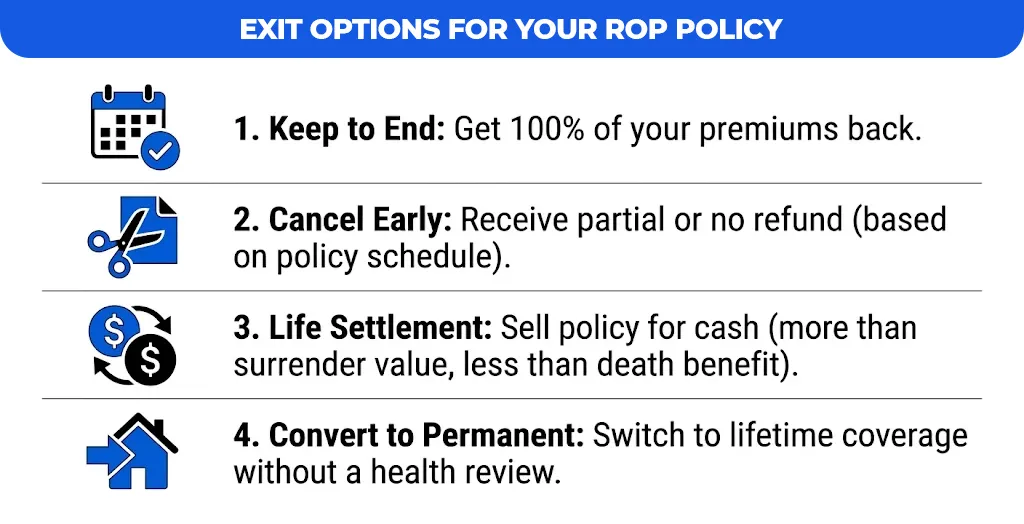
| Exit option | What you receive | Health review needed? | Best for |
| Keep to the end of the term | 100% of premiums paid | No | Anyone who can keep paying |
| Cancel early | Nothing, or a partial refund if the policy has a schedule | No | Last resort if premiums are unaffordable |
| Paid-up option, if offered | Reduced coverage with no further premiums | No | Wanting some coverage without paying more |
| Life settlement | More than surrender value, less than the net death benefit | Yes, the buyer reviews health records | Older or seriously ill policyholders |
| Convert to permanent, if allowed | Lifetime coverage at a new, higher premium | No, under most conversion privileges | Health has declined and coverage is still needed |
How to Find the Right ROP Coverage With Assurance Gurus
The best ROP policy is one you’ll keep to the end of the term, with a clear refund schedule and a price you can afford for every year of it. Compare ROP quotes against standard term from the same insurers so you can see exactly what the refund is costing you.
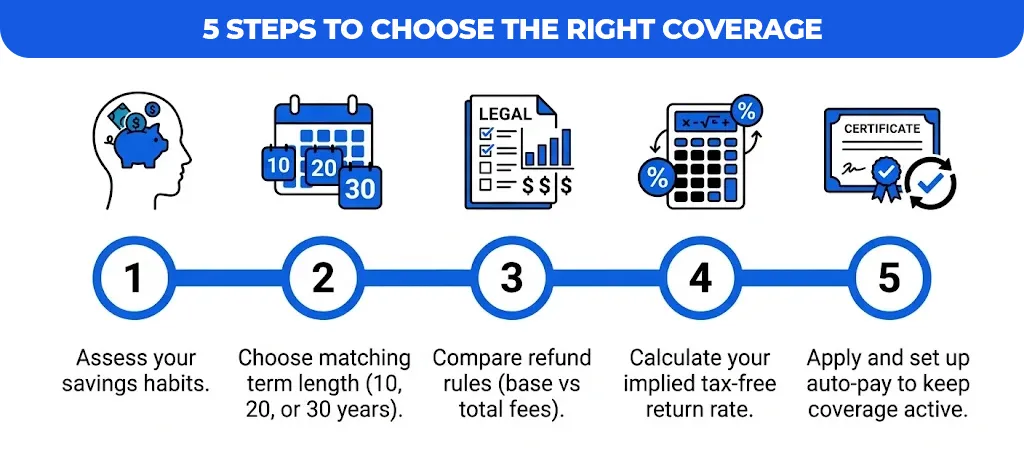
Step 1: Be honest about your savings habits
If you already invest regularly and would invest the difference, standard term plus investing may serve you better. If the extra money would otherwise be spent, ROP turns it into guaranteed savings. Also ask yourself whether you’re confident you can pay the higher premium for the full term, since canceling early is where ROP buyers lose money.
Step 2: Choose the right term length
Match the term to your needs. A 20-year ROP policy suits parents covering children until they’re independent, while a 30-year term fits a new 30-year mortgage. Longer terms mean a larger refund, but also more years of higher premiums to keep up with. If you only need coverage for 10 years, compare standard 10-year term life insurance first.
Step 3: Compare refund terms, not just prices
When you request quotes, ask each insurer:
• Is the refund 100% of all premiums, or only the base premium?
• Is there a partial refund schedule if I cancel early, and what does it pay each year?
• Is there a paid-up or conversion option?
• Can the ROP rider be added later, or only at application?
Choice Mutual notes that an ROP rider generally must be chosen when you apply or added within a short window after the policy is issued, so decide before you buy.
Step 4: Run the numbers for your age
Calculate the implied return on the extra premium for your own quotes. Use a compound interest calculator to find the annual rate at which the extra monthly cost would grow to the refund, compare it with what you’d realistically earn elsewhere, and remember that the refund is generally tax-free while most investment returns aren’t. The Assurance Gurus life insurance calculator can help you settle the coverage amount first.
Step 5: Apply and keep the policy in force
Once you’ve chosen, set up automatic payments so a missed premium never threatens the refund. Review your coverage after major life changes. If you later decide you’d rather have permanent coverage, check whether your policy’s conversion option is still available.
Assurance Gurus can help you compare standard and ROP term life insurance quotes side by side.
Conclusion
Return of premium life insurance gives you term coverage plus a guaranteed, generally tax-free refund if you outlive the policy. That guarantee costs two to three times as much as standard term, and the implied return on the extra premium is modest and depends on keeping the policy to the end. It’s strongest for younger buyers who value certainty and wouldn’t invest the difference; for disciplined investors, standard term usually leaves more money working for them.
| Your situation | Option to consider |
| Young, healthy, and you won’t invest the difference | 20- or 30-year ROP term |
| You invest consistently and want the lowest premium | Standard term, investing the difference |
| You might not keep the policy for the full term | Standard term |
| You want lifelong coverage and cash value | Whole life or guaranteed universal life |
| You’re a senior wanting coverage for final expenses | Final expense whole life |
| You already own ROP and can’t afford it | Ask about paid-up or partial refund options before canceling |
Compare Return of Premium Quotes at Assurance Gurus
To see what a refund would really cost you, calculate return of premium quotes at Assurance Gurus. Share your age, health, and coverage goal, and a licensed agent can compare standard and ROP options across carriers and walk you through each policy’s refund rules.
• Request a quote: Get a quote from Assurance Gurus
• Estimate your coverage: Life insurance calculator
• Call: 888-363-1938