



Whole life insurance divides opinion like few financial products. Agents call it a guaranteed, tax-advantaged foundation. Critics, Dave Ramsey loudest among them, call it one of the worst places to put your money.
Both sides have a point, and the right answer depends on what you need the policy to do. For most families who need to replace income, term life is cheaper and simpler. For a few specific goals, whole life’s lifetime guarantees are hard to replicate any other way.
Quick answer: Whole life insurance is worth it when you have a permanent need: final expenses, estate liquidity, a lifelong dependent, or a guaranteed inheritance. It’s usually not worth it as your main protection or as an investment, because term plus disciplined investing has historically built more wealth. Permanent coverage typically costs six to 10 times more than term.
Is Whole Life Insurance Worth It in 2026?
Whole life insurance is worth it in 2026 for people with a lifelong need for a death benefit, those who have already maxed out other tax-advantaged savings, and seniors who want guaranteed funeral coverage. It’s usually not worth it for budget-conscious breadwinners who need the most coverage for the least money; level term does that job far better.
| Whole life is often worth it if you… | Whole life is usually not worth it if you… |
| Need coverage that lasts your entire life (funeral costs, a special-needs dependent) | Mainly need to replace income while kids are young |
| Have an estate large enough to owe estate tax, or need cash to settle an estate | Haven’t yet maxed out your 401(k), IRA, or HSA |
| Want a guaranteed inheritance for children or a charity | Can’t comfortably afford the premium for decades |
| Value guarantees over higher potential returns | Want the highest long-term growth on your savings |
| Are a senior buying a small final expense policy | Might cancel within the first 10 years |
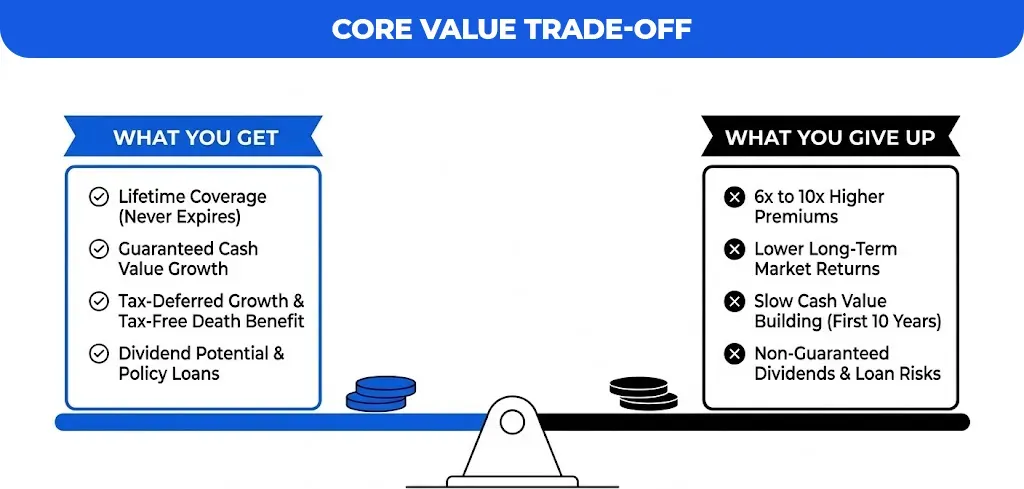
The core value trade-off
Whole life gives you four guarantees: coverage for life, a fixed premium, a guaranteed death benefit, and guaranteed cash value growth. You pay for those guarantees with much higher premiums and lower long-term returns than you’d likely get by investing.
| What you get | What you give up |
| Lifetime coverage that can’t expire | Premiums typically 6–10x higher than term (NerdWallet) |
| Guaranteed cash value growth | Lower long-term growth than stock market investing |
| Tax-deferred growth and tax-free death benefit | Little cash value in the first several years |
| Possible dividends from mutual insurers | Dividends aren’t guaranteed |
| Policy loans without credit checks | Loans reduce the death benefit if unpaid |
For background on how the policy works, see whole life insurance cost and cash value life insurance.
Is Whole Life Insurance Worth It Mathematically?
Mathematically, whole life usually loses to “buy term and invest the difference” over long periods, as long as the investor actually invests the difference and stays invested. Whole life cash value grows at modest guaranteed rates, while the S&P 500 has averaged about 10% a year (geometric) since 1928. Whole life’s advantages are certainty, tax treatment, and a death benefit that never expires, not higher returns.
The internal rate of return (IRR) reality
Whole life cash value grows two ways:
1. Guaranteed growth. The contract guarantees a minimum cash value schedule. NerdWallet notes that whole life typically guarantees a 1% to 4% annual return on cash value.
2. Dividends. Policies from mutual (policyholder-owned) insurers may pay dividends, which can buy more coverage or add to cash value. Dividends are not guaranteed.
The IRR on cash value, meaning your return after all costs, is lower than the credited rate in the early years because of commissions, administrative costs, and the cost of the death benefit itself.
Front-loaded costs and the breakeven curve
In the first years of a whole life policy, much of each premium goes to the insurer’s costs rather than your cash value:
• Commissions. NerdWallet reports that permanent policies typically pay higher first-year commissions than term, and that 5% to 10% of all premiums over a policy’s life can go to commissions.
• Policy and administrative fees.
• Cost of insurance for the death benefit.
• Surrender charges if you cancel early.
The result is a breakeven point, the year when your cash value finally exceeds the total premiums you’ve paid. It can take many years. Your policy’s guaranteed cash value table shows the exact year; ask for it before you buy.
Note: Canceling a whole life policy in the first few years is one of the costliest mistakes buyers make. If you’re not sure you can keep paying for decades, whole life is probably not the right product.
The comparison: $1,000/month in whole life vs. term plus investing
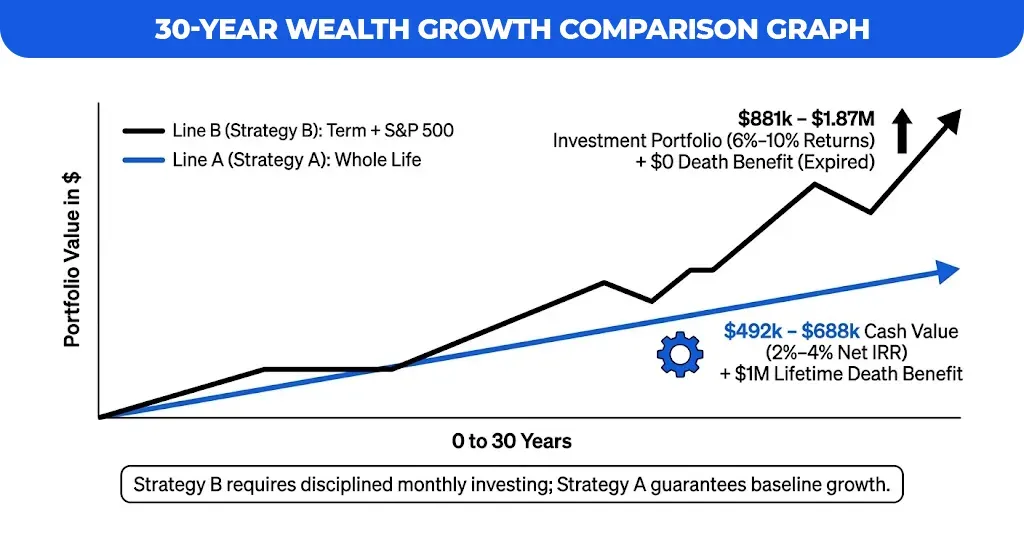
Consider a healthy 40-year-old woman with $1,000 a month to spend on insurance and savings for 30 years. Choice Mutual’s published rates show about $985 a month for $1,000,000 of whole life at 40, and about $71 a month for $1,000,000 of 30-year term.
Hypothetical projection, 30 years ($360,000 total paid):
Strategy A: $1,000/month into whole life
Cash value at year 30 if the net IRR is 2%: about $492,000
Cash value at year 30 if the net IRR is 3%: about $580,000
Cash value at year 30 if the net IRR is 4%: about $688,000
Death benefit: about $1,000,000+, guaranteed for life
Strategy B: $100/month term + $900/month into an S&P 500 index fund
Portfolio at year 30 if returns average 6%: about $881,000
Portfolio at year 30 if returns average 8%: about $1,276,000
Portfolio at year 30 if returns average 10%: about $1,871,000
Death benefit: $1,000,000 for 30 years, then none
These are hypothetical illustrations, not projections for any specific policy. The calculation assumes monthly contributions growing at a constant annual rate.
Mathematical benchmark matrix
| Strategy | 30-year premiums/contributions | Guaranteed death benefit | Estimated wealth at year 30 | Tax treatment | Risk level |
| Whole life ($1,000/mo) | $360,000 | About $1M, for life | About 490,000–690,000 cash value (2%–4% IRR) | Tax-deferred growth; tax-free death benefit; loans not taxed if the policy stays in force and isn’t a MEC | Low: guaranteed values |
| Term (100/mo)+indexfund(900/mo) | $360,000 | $1M for 30 years only | About 880,000–1.87M (6%–10% returns) | Taxes on gains in a taxable account; tax advantages if inside a 401(k), IRA, or Roth | Higher: market swings, sequence risk |
| Term ($100/mo) only, no investing | $36,000 | $1M for 30 years only | $0 | Death benefit tax-free | Low cost, no savings |
The catch for Strategy B is behavior. It only wins if you invest the difference every month for 30 years and don’t sell in a downturn. The catch for Strategy A is cost and commitment: you must keep paying for decades to get the value.
Note: Historical returns don’t guarantee future results. According to NYU Stern’s Aswath Damodaran, the S&P 500’s geometric average annual return including dividends was about 10.0% from 1928 to 2025, with large losses in some years.
Is Whole Life Insurance Worth It? Pros and Cons 2026
Whole life’s biggest pros are lifetime coverage, fixed premiums, guaranteed cash value, and favorable tax treatment. Its biggest cons are high premiums, slow early cash value, surrender losses if you cancel, and a death benefit that’s far smaller per dollar than term. Whether the pros outweigh the cons depends on whether your need is truly permanent.
The pros of whole life insurance
• Guaranteed lifetime coverage. As long as premiums are paid, the policy can’t expire.
• Fixed, level premiums. Your premium is set at purchase and never rises.
• Guaranteed cash value. The policy’s cash value grows on a guaranteed schedule.
• Dividend potential. Participating policies from mutual insurers may pay dividends, though they aren’t guaranteed.
• Tax-deferred growth. A policy that meets the definition of life insurance under Internal Revenue Code §7702 builds cash value without annual income tax.
• Tax-free death benefit. Under IRC §101(a), death benefits paid because of the insured’s death are generally excluded from the beneficiary’s gross income.
• Policy loans. You can borrow against cash value without a credit check. Loans generally aren’t taxed while the policy stays in force and isn’t a modified endowment contract. Some insurers offer non-direct recognition loans, where dividends are calculated as if no loan existed.
What is the downside of whole life insurance?
• High premiums. Permanent coverage costs six to 10 times more than term, according to NerdWallet.
• Slow early liquidity. Little cash value builds in the first years.
• Surrender charges. Canceling early can return less than you paid.
• Lower long-term returns than diversified stock investing, historically.
• Loan risk. Unpaid loans and interest reduce the death benefit. If the policy lapses with a loan outstanding, the gain can become taxable.
• MEC risk. If you pay in too much, too fast, the policy fails the 7-pay test under IRC §7702A and becomes a modified endowment contract (MEC). Loans and withdrawals from a MEC lose their favorable tax treatment.
• Complexity. Dividend illustrations and guaranteed vs. non-guaranteed columns are hard to compare across companies.
Whole life insurance pros and cons 2026 summary
| Pros | Cons | Fiduciary takeaway |
| Lifetime coverage | Costs 6–10x more than term | Buy only for a permanent need |
| Fixed premiums | Premium is a long-term commitment | Choose an amount you can pay for life |
| Guaranteed cash value | Slow early growth; surrender charges | Plan to hold for decades |
| Possible dividends | Dividends aren’t guaranteed | Judge it on the guaranteed column |
| Tax-deferred growth (IRC §7702) | Taxable if surrendered for a gain or lapsed with a loan | Avoid overfunding into a MEC |
| Tax-free death benefit (IRC §101(a)) | Proceeds can count in your taxable estate if you own the policy | Consider an irrevocable life insurance trust for large estates |
| Loans without credit checks | Unpaid loans reduce the death benefit | Treat loans as debt, not free money |
See our guides to the permanent life insurance policy and universal life insurance for alternatives.
When Is Whole Life Insurance Worth It? Scenario Analysis
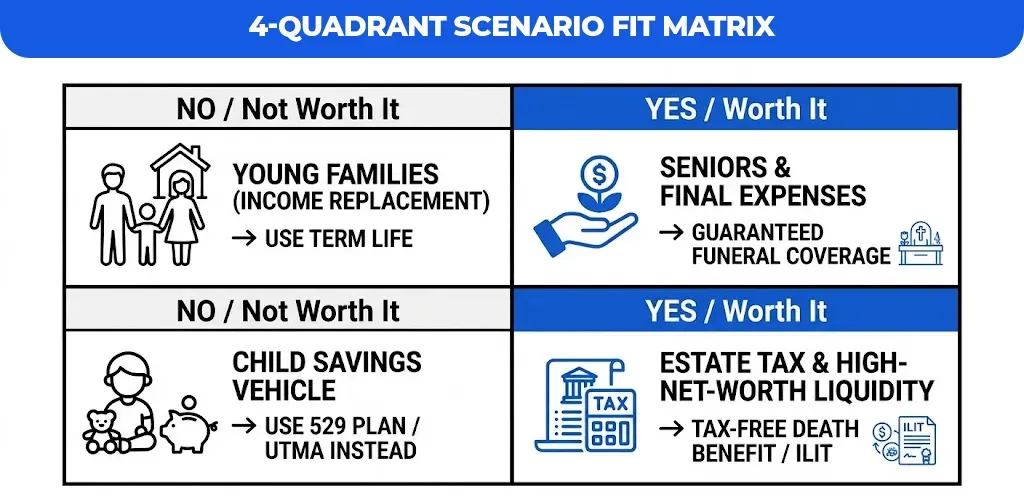
Whole life is most likely to be worth it in four situations: buying small coverage for a child to guarantee future insurability, buying final expense coverage as a senior, funding estate liquidity or a guaranteed inheritance, and adding a conservative, tax-deferred asset for high earners who have maxed out other options.
Is whole life insurance worth it for a kid?
Whole life for a child is worth it mainly for guaranteed insurability, protecting the ability to get coverage later even if the child develops a health condition. It’s rarely worth it as a savings vehicle.
| Factor | Child whole life policy | 529 plan or UTMA/UGMA account |
| Main purpose | Guaranteed future coverage; small death benefit | Saving for college or the child’s future |
| Growth | Modest, guaranteed | Market-based; potentially higher |
| Tax treatment | Tax-deferred cash value; tax-free death benefit | 529 earnings are tax-free for qualified education costs; UTMA earnings are taxable |
| Flexibility | Cash value can be borrowed later | 529 is limited to education (with some exceptions); UTMA belongs to the child at adulthood |
| Best for | Families with a history of serious illness, or who want guaranteed coverage | Families focused on growing savings |
A common middle path: insure the parents properly first, add a low-cost child term rider if desired, and save for the child in a 529. See our guide on whether life insurance for kids is worth it.
Is whole life insurance worth it for seniors?
For seniors, small whole life policies are often worth it because the need, a funeral, never expires, while term policies do. A $10,000 non-tobacco final expense policy costs about $53 (women) to $70 (men) a month at 70, based on Choice Mutual’s published rates. The National Funeral Directors Association put the 2023 median cost of a funeral with viewing and burial at $8,300, before cemetery costs.
Whole life is less likely to be worth it for a senior who already has enough savings set aside for final expenses. See whole life insurance for seniors and burial insurance for seniors.
Is whole life insurance worth it for estate planning and beneficiaries?
For estate planning, whole life can be worth it because it delivers cash exactly when an estate needs it. Key points:
• Tax-free to beneficiaries. Under IRC §101(a), the death benefit is generally not income to the beneficiary.
• Outside probate. Proceeds go directly to named beneficiaries, not through the will.
• Estate tax liquidity. The federal estate tax exemption is 15millionperperson(30 million per married couple) in 2026, with a top rate of 40% above it, according to Kiplinger. Families above that level may use life insurance to pay the tax without selling assets.
• Estate inclusion rule. Under IRC §2042, proceeds are included in your gross estate if you hold “incidents of ownership” at death. That’s why large estates often hold policies in an irrevocable life insurance trust (ILIT).
• Special needs planning. A policy payable to a special needs trust can provide for a disabled dependent without disqualifying them from means-tested benefits. Work with an estate attorney on the trust.
Note: Fewer families face federal estate tax at a $15 million exemption, but some states have their own estate or inheritance taxes with lower thresholds. Check your state’s rules.
High-net-worth wealth preservation
For high earners who have already maxed out 401(k), IRA, and HSA contributions, whole life can serve as a conservative, tax-deferred asset whose guaranteed cash value doesn’t move with the stock market. Some use it as a “volatility buffer,” borrowing against cash value in a down market instead of selling investments. It’s a niche strategy that works best with a large, stable income and a long time horizon.
Financial Criticisms and Cost Benchmarks
The sharpest criticism of whole life comes from Dave Ramsey, who argues that term insurance plus investing beats it for nearly everyone. That critique is mathematically sound for most families who need income protection. It’s weaker for people with a permanent need or those who wouldn’t invest the difference consistently.
Why does Dave Ramsey say not to buy whole life insurance?
Dave Ramsey says not to buy whole life insurance because he believes its costs are too high and its returns too low. On his site, he calls whole life “a terrible option (for many reasons)” and says its “low returns and high costs make it a bad choice in the long run.” He compares about $29.09 a month for $1 million of term with $234.34 a month for the same amount of whole life at age 25.
His alternative is “buy term and invest the difference”: buy 15–20 year term coverage worth 10 to 12 times your income, invest the rest, and aim to be “self-insured by the time your term ends.” He adds, “we never recommend keeping a cash value policy.”
Where Ramsey’s critique is sound:
• For income replacement, term buys far more coverage per dollar.
• Over 30 years, diversified stock investing has historically outgrown whole life cash value.
• Many people buy whole life without understanding the costs, and lose money by canceling early.
Where permanent guarantees still add value:
• Needs that never expire, like funeral costs or a lifelong dependent.
• Estates that will owe tax or need quick cash.
• People who won’t invest consistently. “Invest the difference” only works if you actually do it.
• Seniors who can no longer buy affordable term.
Why are people so against whole life insurance?
People are against whole life insurance mainly because of how it’s often sold:
• Mis-selling. Agents may recommend whole life to young families who need large, cheap term coverage.
• Commission bias. NerdWallet notes that agents have an incentive to promote permanent policies because commissions are a percentage of much larger premiums.
• Unrealistic illustrations. Sales illustrations often show dividends at today’s rates continuing for decades. Only the guaranteed column is promised.
• High premiums. Coverage can cost six to 10 times more than term.
• Slow early liquidity. Buyers who cancel in the first years often get back far less than they paid.
Note: Always ask for an illustration that shows both the guaranteed and non-guaranteed values side by side. Make your decision based on the guaranteed column.
How much does a $100,000 whole life insurance policy cost per month?
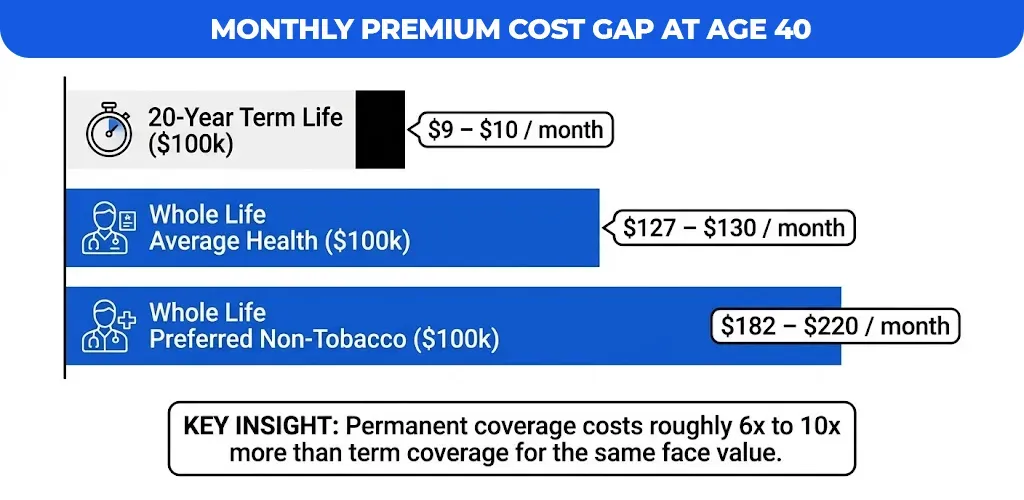
A $100,000 whole life policy costs roughly $86 to $103 a month for adults in their 20s and 30s, and about $127 to $220 at 40, based on two published sources. Prices climb steeply after 50. Sources differ significantly depending on the carrier, product, and health class used, so treat these as ranges, not quotes.
2026 sample monthly premiums: $100,000 whole life
| Age | MoneyGeek, average health (F / M) | Choice Mutual, non-tobacco (F / M) | For comparison: $100k 20-yr term, Choice Mutual preferred (F / M) |
| 20 | Not published (25: $86 / $93) | Not published | $8 / $8 |
| 30 | $98 / $103 | Not published | $8 / $9 |
| 40 | $127 / $130 | $182 / $220 | $9 / $10 |
| 50 | $146 / $186 | $214 / $276 | $17 / $21 |
| 60 | $288 / $308 | $304 / $412 | $37 / $51 |
| 70 | Not published | $506 / $720 | 10-yr term: $56 / $82 |
Note: Choice Mutual’s whole life rate chart lists ages 40 to 89; MoneyGeek’s table lists ages 25 to 60. The wide gap between the two at the same age shows why comparing several insurers matters. See whole life insurance quotes and term life insurance quotes.
Conclusion
Whole life insurance is worth it when its guarantees solve a problem that term and investing can’t: a need that lasts your whole life, an estate that needs cash, a dependent who will always rely on you, or a senior’s funeral fund. For most working families who need to replace income, term plus consistent investing is cheaper and has historically built more wealth. Decide based on the job the money needs to do, not the sales pitch.
| Your situation | Is whole life worth it? |
| Young family needing to replace income | Usually no. Buy term and invest the difference |
| High earner with retirement accounts maxed out | Possibly, as a conservative tax-deferred asset |
| Estate likely to exceed the exemption, or needing quick cash | Often yes, usually held in an ILIT |
| Parent of a child with special needs | Often yes, paired with a special needs trust |
| Senior wanting funeral coverage | Often yes, as a small final expense policy |
| Parent considering a policy for a child | Only for guaranteed insurability; save in a 529 instead |
| Unsure you can pay for decades | No. Early cancellation is costly |
Find the Right Policy Strategy with Assurance Gurus
The question isn’t whether whole life is good or bad. It’s whether it fits your plan. Assurance Gurus helps you compare term and whole life side by side, see the guaranteed numbers, and decide with clear information.
• Compare rates: request whole life insurance quotes and term life insurance quotes.
• Get a custom quote: start on our quote page.
• Talk to a licensed agent: call 888-363-1938 to walk through whether whole life fits your goals.
Evaluate whole life insurance at Assurance Gurus before you commit to a policy you’ll pay for the rest of your life.