



Whole life insurance for seniors is a type of permanent life insurance designed to stay in force for your entire life, as long as premiums are paid. Unlike term life insurance, which expires after a set number of years, whole life insurance does not run out, and the premium locked in at enrollment does not increase with age or a later change in health.
For seniors, this structure makes whole life insurance a common way to guarantee that final expenses, such as funeral costs, medical bills, or small debts, do not fall on family members. Coverage for older adults generally falls into two categories: traditional whole life insurance with larger face amounts and full underwriting, and final expense or burial insurance, which offers smaller death benefits and simplified or guaranteed underwriting. This guide explains how whole life insurance works, what it costs at different ages, the difference between simplified issue and guaranteed issue policies, and the trade-offs to weigh before buying a policy.
Key Takeaways
- Whole life insurance is permanent coverage with fixed premiums, a guaranteed death benefit, and a cash value component that grows over time.
- Seniors most often buy final expense (burial) insurance, with face amounts typically between $5,000 and $25,000.
- No-exam options exist: simplified issue policies use health questions but no exam, while guaranteed issue policies ask no health questions at all but cost more and include a waiting period.
- Premiums rise sharply with age. According to MoneyGeek’s 2026 rate analysis, monthly whole life premiums roughly double each decade after age 60.
- Life insurance death benefits are generally paid to beneficiaries free of federal income tax, according to the IRS and multiple insurer disclosures.
What Is Whole Life Insurance, and How Does It Work?
Whole life insurance is a type of permanent life insurance, meaning it covers the policyholder for life rather than for a fixed term. Permanent policies combine a guaranteed death benefit with a cash value component that accumulates over time, a structure the Insurance Information Institute describes as one of the principal types of life insurance available to consumers.
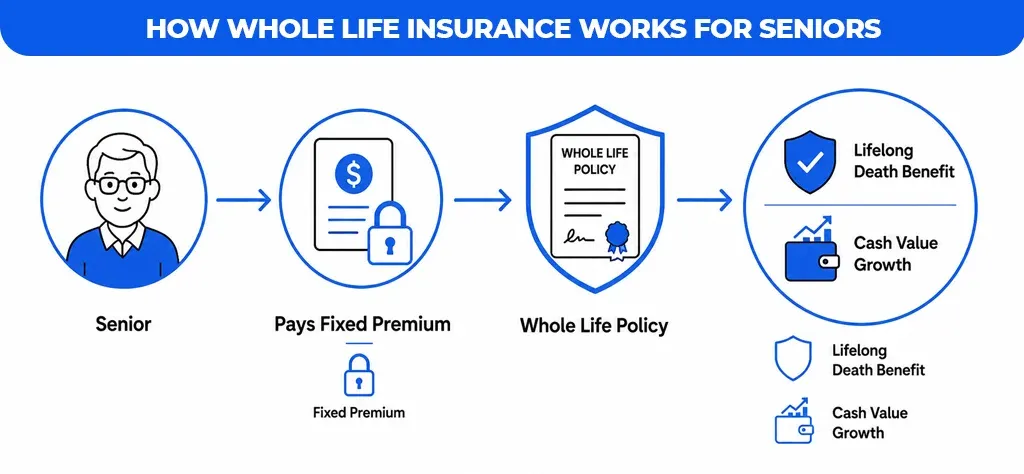
Three features distinguish whole life insurance from term coverage:
- Fixed premiums: the premium is set when the policy is issued and does not increase for the life of the contract, a protection outlined in the NAIC Life Insurance Buyer’s Guide.
- Guaranteed death benefit: the payout to beneficiaries is contractually guaranteed and does not decrease as the policyholder ages, provided premiums are paid on time.
- Cash value accumulation: a portion of every premium payment is allocated to a cash value account that grows on a tax-deferred basis, typically at a fixed interest rate set by the insurer.
The cash value component functions as a living benefit that the policyholder can access while still alive, generally through a policy loan or a partial withdrawal. Policy loans accrue interest and reduce the death benefit if not repaid, and an unpaid loan can cause the policy to lapse, so this feature is best used deliberately rather than as a routine source of cash.
Benefits of Whole Life Insurance for Seniors
Whole life insurance offers several structural advantages that appeal specifically to older adults planning for final expenses and legacy goals:
- Locked-in premiums: rates are guaranteed not to increase because of age or a later change in health, once the policy is issued.
- Final expense protection: coverage is sized to absorb funeral, medical, and estate settlement costs so family members are not left covering them.
- Tax-advantaged transfer: life insurance death benefits are generally paid to named beneficiaries free of federal income tax, according to the IRS, and pass outside of probate when a beneficiary is named directly rather than the estate.
- Living cash value access: accumulated cash value can be borrowed against for emergencies or supplemental needs while the policyholder is still living.
Estate taxes on life insurance proceeds only become a factor if the total value of an estate exceeds the federal estate tax exemption, which was reported at $15 million for 2026; most senior policyholders fall well under that threshold.
No-Exam Policies: Convenience for Older Adults
Yes. Two underwriting paths let seniors skip the medical exam, and it helps to understand the difference before comparing quotes:
- Simplified issue: no medical exam, but the application includes a short set of yes-or-no health questions and may include a prescription drug database check.
- Guaranteed issue: no medical exam and no health questions at all. Applicants within the insurer’s age range, typically 50 to 85, cannot be declined for health reasons.
The trade-off for skipping underwriting is cost and timing. Guaranteed issue policies carry higher premiums per dollar of coverage than simplified issue policies for the same applicant. Industry rate data compiled by InsuranceGeek in 2026 found that a 70-year-old male paid $69.78 per month for $10,000 of simplified issue final expense coverage, compared with $99.18 per month for guaranteed issue coverage at the same amount, a difference of roughly 42 percent.
Guaranteed issue policies also include a graded, or limited, benefit period, commonly two years. If the insured dies of natural causes during that window, the policy typically returns the premiums paid plus interest rather than the full face amount; accidental death is generally covered in full from day one. Simplified issue policies do not usually include this waiting period, but approval depends on passing the health questionnaire.
Types of Whole Life Coverage Available for Seniors
Whole life insurance policies for seniors generally fall into a few distinct categories, each suited to a different budget and health profile:
- Traditional whole life insurance: comprehensive coverage with larger face amounts and the strongest cash value growth, typically requiring health questions and, for larger amounts, a medical exam.
- Final expense or burial insurance: a smaller whole life policy, typically ranging from $5,000 to $25,000, designed specifically to cover funeral costs, medical bills, and other end-of-life expenses. This category usually uses simplified issue underwriting.
- Guaranteed issue whole life insurance: no health questions and no medical exam, aimed at seniors who have been declined elsewhere or manage a chronic condition, subject to the graded benefit period described above.
Understanding graded versus modified benefit structures matters because it directly affects what a family receives if the insured passes away early in the policy. A graded death benefit policy pays a percentage of the face amount, or a refund of premiums plus interest, if death from natural causes occurs within the waiting period, then pays the full benefit afterward. Reviewing this provision, along with the state-approved policy form, is one of the most important steps before buying a no-exam policy.
Cost Factors: How Much Does Senior Whole Life Insurance Cost?
Whole life insurance premiums for seniors are driven primarily by age at issue, gender, tobacco use, coverage amount, and health classification. Because premiums are locked in at the age of purchase, age is the single largest driver of lifetime cost.
Whole Life Insurance for Seniors Over 60, 70, and 80: Rate Trends by Age
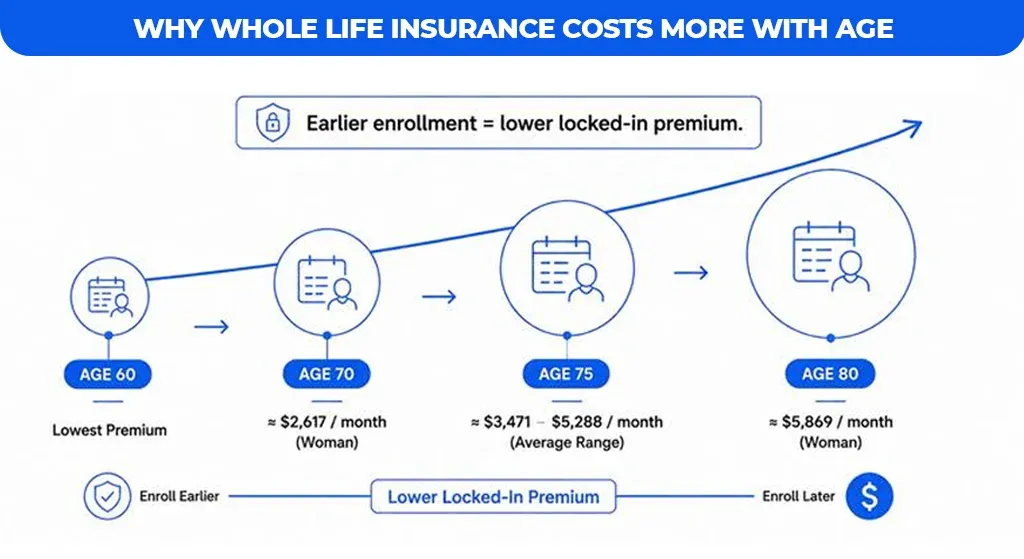
The table below reflects MoneyGeek’s 2026 analysis of whole life insurance rates for a $500,000 policy among nonsmokers in average health. Rates for seniors over 80 and beyond are shown separately, since fewer carriers offer coverage at those ages.
Age | Monthly Premium (approx.) | Notes |
40 (woman) | $540 | Baseline for comparison |
40 (man) | $574 | Men average slightly higher than women |
70 (woman) | ~$2,617 | Nearly 5x the age-40 premium |
75 (USAA average) | $3,471 | Lowest-cost carrier in MoneyGeek’s review at this age |
75 (Gerber Life average) | $5,288 | Highest-cost carrier in the same review |
80 (woman) | $5,869 | Top of MoneyGeek’s published age range |
Two patterns stand out. First, monthly costs roughly double each decade after age 60, according to MoneyGeek’s analysis, which is why locking in a policy earlier, such as at age 60 rather than waiting until 70 or 75, meaningfully reduces lifetime premium cost. Second, pricing differences between insurers widen with age; MoneyGeek found a $1,817 monthly gap between the lowest- and highest-priced carrier it surveyed at age 75, which makes comparing multiple quotes especially important for older applicants.
For smaller, no-exam final expense policies, Asurgo’s 2026 multi-carrier comparison found that a 70-year-old typically pays between $53 and $86 per month for $10,000 of simplified issue coverage, depending on the carrier, with Mutual of Omaha at the lower end and Transamerica at the higher end of that range.
The Pros and Cons of Whole Life Insurance for Seniors
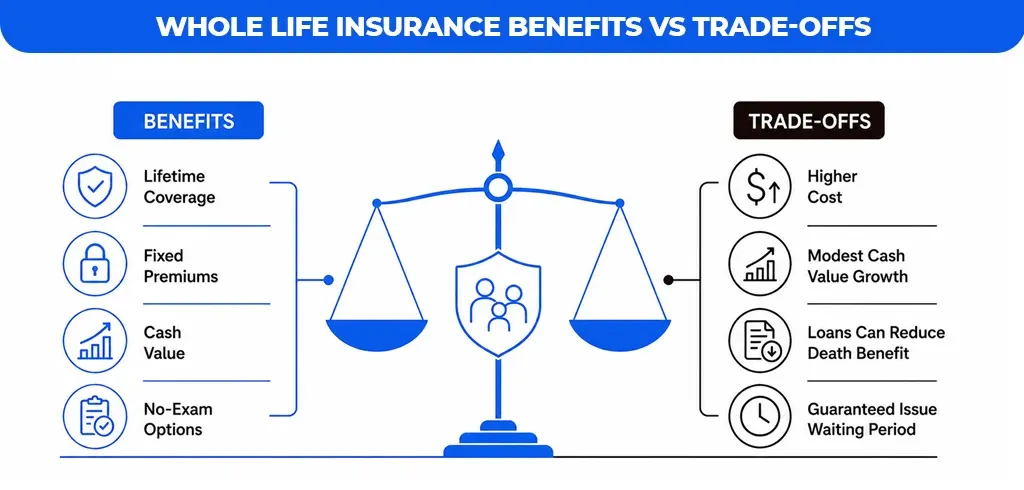
Whole life insurance is not the least expensive way to buy a given amount of coverage, but it offers guarantees that term insurance does not. The primary trade-offs are summed up in the comparison that follows.
Pros | Cons |
Lifetime coverage that never expires as long as premiums are paid | Costs significantly more per dollar of coverage than term life insurance at the same age |
Premiums are locked in at issue and guaranteed not to increase | Cash value growth is typically modest compared with direct investment returns |
Cash value grows tax-deferred and can be borrowed against while living | Policy loans and withdrawals reduce the death benefit and can create tax consequences if the policy lapses |
Final expense tiers are often available without a medical exam | Guaranteed issue policies include a waiting period, typically two years, before the full death benefit applies |
The cost gap with term insurance can be significant at older ages. MoneyGeek’s 2026 data shows a 70-year-old woman paying about $397 per month for a $500,000, 10-year term policy, compared with roughly $2,617 per month for a $500,000 whole life policy at the same age; term insurance is cheaper because it does not build cash value and does not guarantee coverage for life.
It is also worth noting that permanent policies are not always kept for life. According to data from the Insurance Information Institute cited by Britannica, policy surrenders, meaning policyholders withdrawing the cash value and ending the contract, reached $416.2 billion in 2023, a 17.9 percent increase over 2022. That trend suggests that for some policyholders, the ongoing cost of maintaining a permanent policy outweighs the benefit over time, which is a reasonable factor to weigh against the guarantees whole life insurance provides.
Conclusion
Whole life insurance offers older adults a reliable way to secure lifetime coverage, protect loved ones from unexpected end-of-life expenses, and lock in premiums that will never increase regardless of age or future health changes. While the initial costs can be higher than term insurance and rise sharply if purchased later in life, the structural guarantees such as a tax-free death benefit, cash value accumulation, and simplified or guaranteed issue options that skip medical exams provide unmatched financial stability and peace of mind during retirement.
Navigating the various policy types, underwriting requirements, and carrier rate differences does not have to be an overwhelming process. Visit Assurance Gurus today to compare personalized quotes from top-tier providers, find the exact coverage tier that fits your retirement budget, and secure your family’s financial future with complete confidence.