



Key Takeaways
- Term life insurance covers a set period and generally costs less per month than permanent life insurance for the same death benefit.
- Rates increase with age, and the range of term lengths available shrinks the older you apply.
- Most insurers cap new term applications between ages 75 and 80; a few extend to 80 for shorter terms only.
- Final expense and guaranteed issue policies stay available up to 85 in most states but cost more per dollar of coverage and offer smaller death benefits.
- Comparing quotes across several A-rated carriers, ideally through an independent broker, helps you avoid overpaying for the same coverage.
What Is Term Life Insurance and How Does It Work for Seniors?
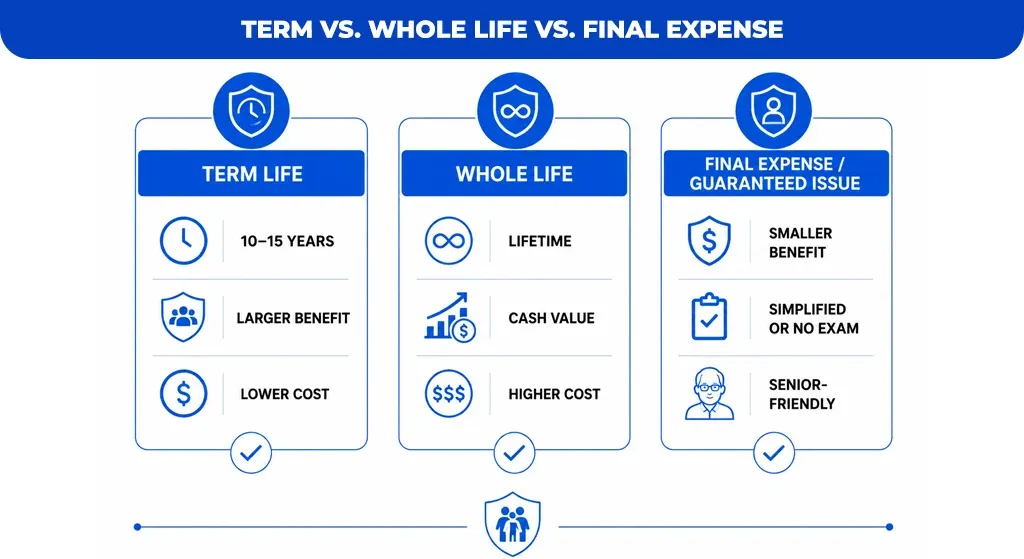
Term life insurance pays a death benefit to your beneficiaries if you pass away during the policy term, such as 10, 15, or 20 years. If you outlive the term, coverage simply ends unless you renew or convert it, and no cash value is paid out. This is the core difference from whole life insurance, a type of permanent coverage that lasts your entire life and builds cash value, but at a significantly higher premium for the same death benefit.
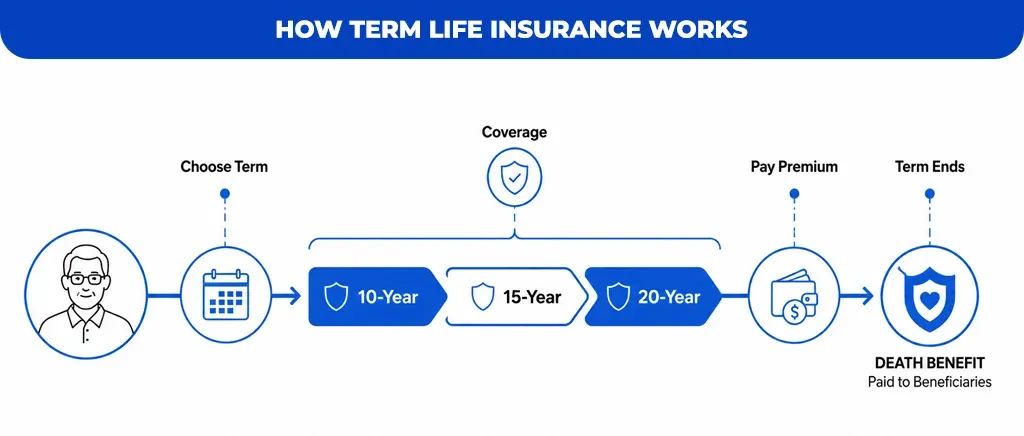
For seniors, term length options shrink with age. Twenty-year terms are typically limited to applicants under 65, while 10- to 15-year terms remain available into the early 70s at most carriers, according to MoneyGeek Best Term Life Insurance for Seniors in 2026. A traditional term policy is a reasonable fit when you have a defined, time-limited need for coverage, such as a mortgage balance, a business loan guarantee, or income replacement until a spouse reaches retirement age.
Coverage amounts can also be substantial even for older applicants. Some carriers offer no-exam term coverage up to several million dollars, and John Hancock’s Select-a-Term product allows coverage as high as $65 million with applications accepted through age 80, according to MoneyGeek, Best Term Life Insurance for Seniors in 2026. Whole life and universal life policies, by contrast, are commonly available through age 85, with a limited number of insurers extending to 90, according to CNBC Select, Best Life Insurance Companies for Seniors, August 2026.
Pros and Cons of Term Life Insurance for Seniors
Pros
- Lower premiums than permanent life insurance for the same death benefit, since coverage lasts a defined period instead of a lifetime.
- Fixed monthly payments that do not increase during the level term, making budgeting predictable.
- A straightforward way to cover a specific financial obligation, such as a mortgage, debt, or a set number of years of income replacement.
Cons
- Coverage ends once the term expires, and there is no payout or refund if you outlive the policy, unless you added a return-of-premium rider.
- Renewing or reapplying at an older age comes at a substantially higher premium, since pricing is reassessed based on your age and health at that time.
- Applicants over 70 who want the lowest available rates will often still need to complete a medical exam, and the range of insurers willing to issue new term policies narrows considerably after age 75.
Cost is often the deciding factor. For adults over 65, a 20-year, $250,000 term policy averages around $293 a month, compared with roughly $1,117 a month for the same amount of whole life coverage, according to Policygenius, Cost of Life Insurance for Older Adults. That gap is the main reason term insurance remains attractive for seniors who need a large death benefit but only for a limited number of years.
Key Factors That Influence Senior Term Life Insurance Rates
Four factors do most of the work in setting your premium: age and gender, current health and medical history, tobacco use, and the coverage amount and term length you choose. Because mortality risk rises with age, the same policy can cost several times more at 75 than at 60.
Example rates for a 10-year term policy (nonsmoking applicants):
Age / Coverage | Female (approx.) | Male (approx.) | Source |
65, $250,000 (John Hancock) | $85/month | $126/month | MoneyGeek, 2026 |
70, $500,000 (market average) | $397/month | $600/month | MoneyGeek, 2026 |
The gender gap in pricing also widens with age. At age 70, women pay an average of $397 a month for a 10-year, $500,000 term policy while men pay about $600, a 51% difference driven by longer average female life expectancy. According to MoneyGeek, How Much Is a $500,000 Life Insurance Policy, 2026.
Maximum issue ages also vary meaningfully by carrier, which is one reason comparing multiple insurers matters. Mutual of Omaha issues term policies up to age 80 and separately offers guaranteed acceptance whole life up to 85, according to CNBC Select, August 2026. Nationwide’s no-exam term product caps out at age 55, though its universal life policies extend eligibility to 70 or 80 depending on the plan, according to U.S. News, Best Life Insurance Companies for Seniors. Checking a carrier’s financial strength rating from AM Best, and confirming it is licensed in your state through your state insurance department or the National Association of Insurance Commissioners (NAIC), is a reasonable step before committing to a policy.
Alternatives to Consider: Is Term Life Right for You?
If you are past the age where insurers issue new term policies, or you have health conditions that make traditional underwriting difficult, a few alternatives are worth understanding.
Final Expense (Burial) Insurance
Final expense policies are small whole life policies, typically $2,000 to $25,000, designed to cover funeral and burial costs rather than replace income. The National Funeral Directors Association reports that the median cost of a funeral with burial in the United States now exceeds $8,000, which is why even a modest policy can matter to a family, according to NFDA, cited via mylifeinsurancecalc.com 2026). These policies typically use simplified underwriting, meaning a short health questionnaire but no medical exam, and are commonly available between ages 50 and 85.
Guaranteed Issue Life Insurance
Guaranteed issue policies accept every applicant within the eligible age range, usually 50 to 85, with no health questions and no medical exam. Nearly all guaranteed issue policies include a two-year graded death benefit period: if the insured dies of natural causes within the first two years, beneficiaries receive a refund of premiums paid rather than the full face amount. After that period, the full death benefit applies to any cause of death. Physicians Mutual, for example, prices a guaranteed issue policy at roughly $72 a month for women and $92 for men, covering ages 45 to 85 up to a $30,000 maximum benefit.
Colonial Penn’s well-advertised “$9.95 plan” is a guaranteed acceptance whole life policy sold in units. Each unit costs $9.95 a month, but the death benefit each unit buys shrinks as you age, from roughly $1,258 at 65 down to smaller amounts at older ages, and up to 25 units can be purchased according to U.S. News, Colonial Penn Life Insurance Review, 2026. A 70-year-old man buying the maximum 15 units available at that age would pay about $149 a month for roughly $10,300 in coverage.
Return of Premium (ROP) Term Riders
Some insurers offer an ROP rider that refunds the premiums you paid if you outlive the term. This trades a meaningfully higher monthly premium for the guarantee that you get money back rather than nothing if you never file a claim, and it is worth asking a broker whether the added cost fits your budget compared with simply investing the difference.
Tips for Finding the Best Policy and Getting a Quote
Shopping for senior life insurance is easier when you approach it as a short, structured process rather than accepting the first quote you receive.
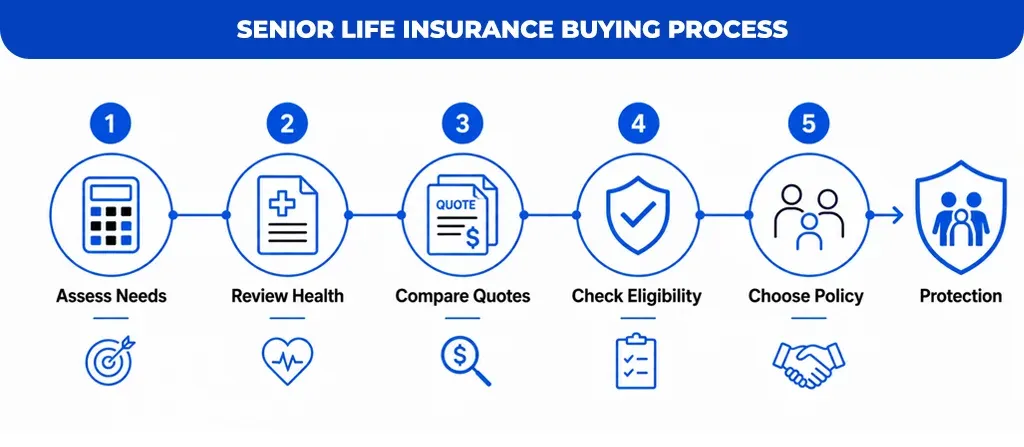
- Assess your financial needs. Add up final expenses, outstanding debts, and any income your dependents would need replaced, then decide how many years of protection actually makes sense.
- Gather your health and medication history in advance so you can answer underwriting questions accurately and avoid delays.
- Compare quotes from several A-rated carriers rather than a single company, since pricing for the same applicant can vary by a meaningful margin between insurers.
- Ask about maximum issue age, available term lengths, and whether a medical exam is required at your age before applying.
- Work with an independent broker who represents multiple carriers so you are not limited to one company’s underwriting rules and pricing.
Get Your Personalized Quote
Navigating life insurance in your senior years does not have to be a guessing game. Whether you are looking to protect a remaining mortgage, cover final expenses, or ensure a spouse is financially secure for a specific number of years, term life insurance delivers robust protection at a fraction of the cost of permanent coverage. By understanding how policy terms shrink with age and how insurers weigh your health, gender, and age, you can target the exact coverage length and amount that fits your timeline without paying for features you do not need.
Ready to take the next step and find a policy tailored to your unique budget and lifestyle? Visit Assurance Gurus today to compare personalized term life insurance options from top-rated carriers and get a free quote in minutes. Our independent guidance helps you cut through the confusion, compare real market rates, and secure the right protection for you and your loved ones.