

Key Takeaways
- Voluntary life insurance is employee-paid, offered through a workplace, and separate from any free basic life insurance an employer provides.
- Only about 59 percent of private industry workers had access to any employer-sponsored life insurance plan in March 2026, and access ranged sharply by company size, according to the U.S. Bureau of Labor Statistics.
- Voluntary plans often use guaranteed issue or simplified issue underwriting, which can matter a great deal for people with pre-existing health conditions.
- Coverage is frequently not portable at the same rate, or at all, once you leave the employer, a key difference from an individually owned policy.
- The DIME method (Debt, Income, Mortgage, Education) is a practical way to estimate how much total coverage your family actually needs.
What Is Voluntary Life Insurance?
Voluntary life insurance is a form of group life insurance made available through an employer’s benefits package, where the employee elects the coverage and pays 100 percent of the premium, typically through automatic payroll deductions. It is also called supplemental life insurance or employee-paid life insurance.
How Voluntary Life Insurance Works
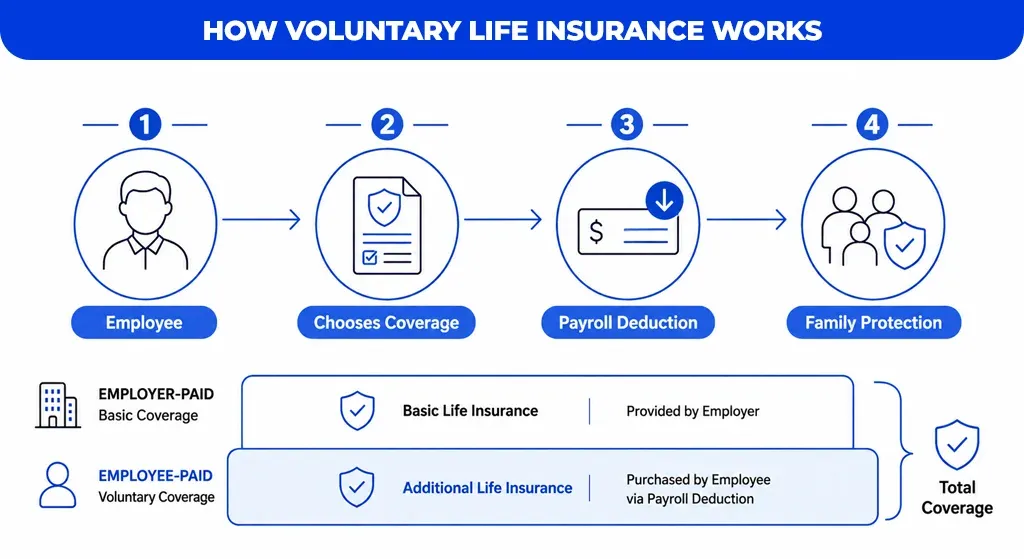
During open enrollment, employees are usually offered the option to purchase additional coverage in set increments, such as $10,000 or one to five times their annual salary, up to a plan maximum. The insurance itself is still a group policy underwritten and administered by a carrier the employer selects, and the coverage generally ends when employment ends unless the plan includes a conversion or portability provision.
Employer-Paid Basic Life vs. Voluntary Coverage
It helps to separate two things that often get lumped together on a benefits portal.
- Basic (employer-paid) life insurance: A modest amount of coverage, often a flat sum such as $25,000 or a multiple of one to two times salary, fully funded by the employer at no cost to the employee.
- Voluntary (employee-paid) life insurance: Additional coverage the employee elects and pays for, layered on top of the basic plan, usually available up to a much higher multiple of salary or a flat dollar cap set by the insurer.
According to the Bureau of Labor Statistics’ National Compensation Survey, 59 percent of private industry workers had access to an employer-sponsored life insurance plan of any kind as of March 2026, and access climbed with company size: only 42 percent of workers at establishments with fewer than 100 employees had access, compared with 87 percent at establishments with 500 or more employees. Among workers who had access to a plan, the take-up rate, the share who actually enrolled, was 98 percent (U.S. Bureau of Labor Statistics, Employee Benefits in the United States, March 2026).
Portability: What Happens If You Leave the Company
Portability is one of the most overlooked details in a voluntary life insurance policy. Some group plans allow you to convert or port the coverage to an individual policy if you leave the employer, but the converted policy is often priced using your current age and health class rather than the group rate you were paying, which can make it considerably more expensive. Other plans terminate coverage entirely on your last day of employment. Reviewing your certificate of coverage for conversion and portability language is a necessary step before you rely on a voluntary policy as a long-term safety net.
Types of Voluntary Life Insurance
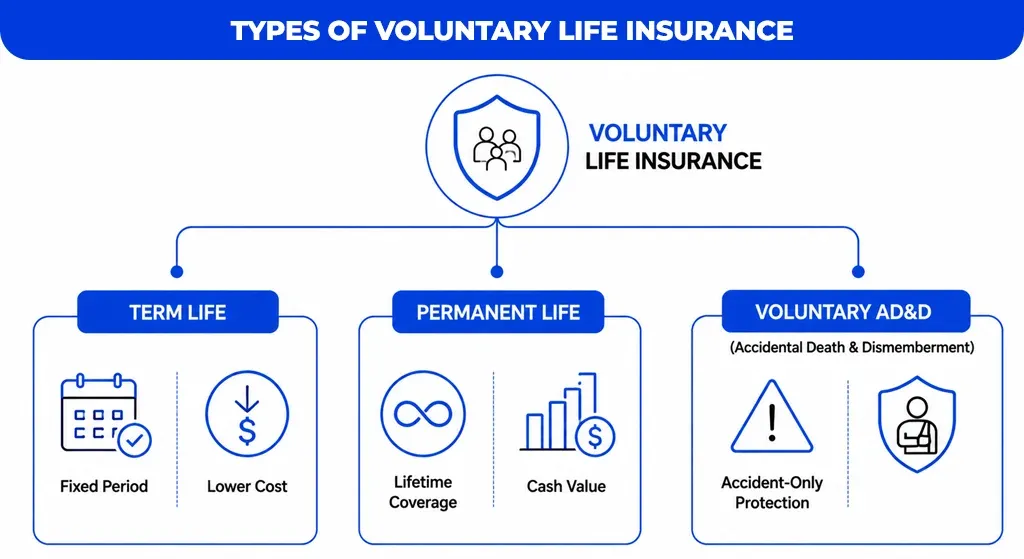
Most voluntary life insurance offered through work falls into one of two categories: term life or permanent life. A related but separate benefit, voluntary AD&D, is often bundled alongside them.
Voluntary Term Life Insurance
Voluntary term life insurance provides coverage for a fixed period, commonly structured in workplace plans as annually renewable term rather than a locked 10-, 20-, or 30-year term you would see on the individual market. It is generally the most affordable type of voluntary coverage per dollar of death benefit, which makes it well suited to income replacement during the years when mortgage payments, childcare costs, and other obligations are highest.
Voluntary Permanent Life Insurance (Whole and Universal)
Voluntary permanent life insurance offered as whole life or universal life provides lifetime coverage as long as premiums are paid, and it builds a cash value component that grows over time and can sometimes be borrowed against. Premiums are higher than term coverage for the same death benefit, since the insurer is guaranteeing a payout eventually rather than only if death occurs within a set window.
Voluntary AD&D: A Related but Different Benefit
Voluntary accidental death and dismemberment (AD&D) insurance is frequently sold alongside voluntary life and ad&d as a combined election, but it is not the same product. In contrast to life insurance, voluntary AD&D only provides benefits in the event that an accident causes death or a covered dismemberment (such as losing a limb or vision). Out regardless of cause of death, subject to standard exclusions. Employees weigh voluntary accident insurance against voluntary life insurance.
Matching the Policy Type to Your Life Stage
A useful rule of thumb: term coverage tends to fit people who need the largest amount of protection at the lowest cost during a defined window, such as while raising children or paying down a mortgage, while permanent coverage tends to fit people prioritizing lifelong coverage or a cash-value savings component, often as a smaller supplemental piece rather than their primary protection.
What Benefits Does Voluntary Life Insurance Offer?
Voluntary employee benefits like supplemental life insurance offer four practical advantages that make them worth evaluating during open enrollment, even for employees who already carry some coverage.
Financial Protection for Loved Ones
The core purpose of any life insurance death benefit is income replacement. A voluntary policy can help a surviving spouse or partner cover a mortgage, childcare, tuition, and everyday living expenses during a period when household income has suddenly dropped.
Simplified and Guaranteed Issue Underwriting
- Guaranteed issue: Up to a set coverage amount during the initial enrollment window, employees can typically enroll without a medical exam or health questions, which matters most for people with pre-existing conditions who might otherwise be declined or rated up on the individual market.
- Simplified issue: Coverage above the guaranteed issue threshold usually requires a short health questionnaire rather than a full paramedical exam, which is still faster and less invasive than fully underwritten individual life insurance.
Group-Rate Cost Efficiency
Because the employer negotiates rates across its entire employee population, group pricing can be more favorable than an individually underwritten policy for employees who are older or have health conditions that would otherwise increase their premium. Younger, healthier employees do not always see the same advantage, which is covered in the pros and cons section below.
Payroll Deduction Convenience
Premiums are deducted automatically from each paycheck, which removes the administrative burden of remembering a separate monthly bill and reduces the risk of a policy lapsing due to a missed payment.
Pros and Cons of Voluntary Life Insurance
Like any financial product, voluntary life and AD&D coverage involves real trade-offs. Weighing them honestly is more useful than treating the benefit as an automatic yes or no.
Advantages
- Access to coverage despite pre-existing health conditions, through guaranteed issue enrollment windows.
- Group pricing that can beat individually underwritten policies for older employees or those with health risk factors.
- Fast, paperless enrollment through an existing workplace benefits portal, with no separate application to a private insurer.
Disadvantages
- Can cost more than a fully underwritten individual term policy for employees who are young and in excellent health, since group rates are often pooled by age band rather than individually priced.
- Limited portability: premiums can rise sharply, or coverage can end outright, if you leave the employer.
- Coverage caps, typically expressed as a multiple of salary or a flat dollar maximum, can fall short for people who need several million dollars of protection.
Should I Get Voluntary Life Insurance? A Decision Framework
The right amount of coverage is a math problem before it is a preference. The DIME method offers a structured starting point.
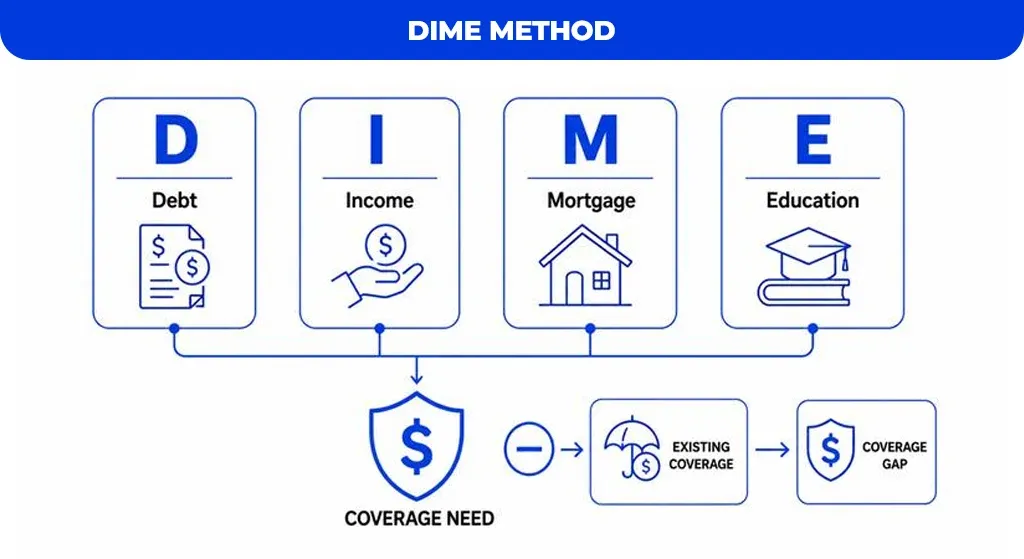
The DIME Method
- Debt: Add up non-mortgage debt, such as credit cards, auto loans, and personal loans, that would otherwise fall to your family.
- Income: Multiply your annual income by the number of years your family would need it replaced, commonly 5 to 10 years bls.gov/news.release, until children are financially independent.
- Mortgage: Add your remaining mortgage balance so a surviving partner is not forced to sell the home.
- Education: Add estimated future education costs for any dependents.
Summing these four figures, then subtracting any existing coverage (basic employer life insurance plus any individual policy already in force), gives a working estimate of the coverage gap that voluntary Life insurance, individual life insurance, or both would have to close.
Voluntary Term Life vs. Individual Life Insurance
Voluntary term life vs individual life insurance is not an either-or decision for most households; it is a question of sequencing. A voluntary policy is fast to obtain and often the only realistic option for guaranteed issue amounts if you have a health condition. An individually underwritten term policy purchased on the open market, medically underwritten and rated by a company evaluated by AM Best or another ratings agency, is portable for its full term regardless of your employer and can be locked in at a rate that does not depend on group renewal pricing.
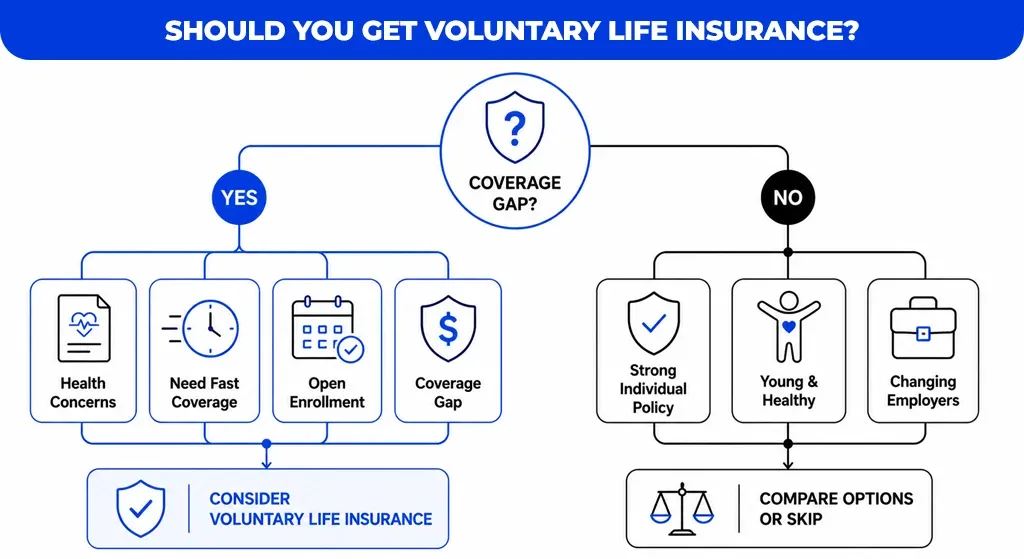
When to Buy
- You have a health condition that would trigger a high premium, or a decline, on the individual market.
- You want a fast, no-hassle way to add supplemental coverage during open enrollment without a medical exam.
- You need to close a coverage gap quickly while you shop for a longer-term individual policy.
When to Skip
- You already hold an individual term life policy, medically underwritten, that meets your DIME-based coverage need at a locked-in rate.
- You are young, in excellent health, and would qualify for lower premiums through a fully underwritten individual policy.
- You expect to change employers soon, and the plan offers no meaningful conversion or portability option.
Conclusion & Next Steps
Voluntary life insurance bridges the gap between the modest coverage most employers provide for free and what a family may actually need to stay financially secure after losing a primary income earner. It will not replace a dedicated, portable individual policy for every household, but its guaranteed issue underwriting, group pricing, and payroll-deduction convenience make it worth a serious look during open enrollment, especially for anyone who has struggled to get affordable coverage on the open market.
Before your next enrollment deadline, run the DIME calculation, pull your current certificate of coverage to check portability, and compare your voluntary plan’s rates against individual quotes. Assurance Gurus offers free comparison tools that let you check voluntary group rates side by side with individual term and whole life quotes from multiple carriers.