



The term vs permanent life insurance decision comes down to two questions: how long your family needs the money, and how much you can afford to pay for that protection each month. The term covers a set number of years for a low price. Permanent covers your whole life and builds cash value, but for the same death benefit it can cost 5 to 20 times more.
Quick answer: Term life insurance is cheaper, temporary coverage that pays only if you die during the term, which makes it the right fit for most families protecting income and a mortgage. Permanent life insurance (whole, universal, indexed, or variable) lasts for life and builds cash value, and it fits estate planning, lifelong dependents, or business needs where coverage must never expire.
Term vs Permanent Life Insurance
Term life insurance is pure protection for a fixed period, usually 10 to 30 years; permanent life insurance is lifelong coverage with a savings component called cash value. Term costs far less because coverage ends at a set date and many policies end without a claim; permanent costs more because the insurer expects to pay eventually and because part of each premium funds the cash value.
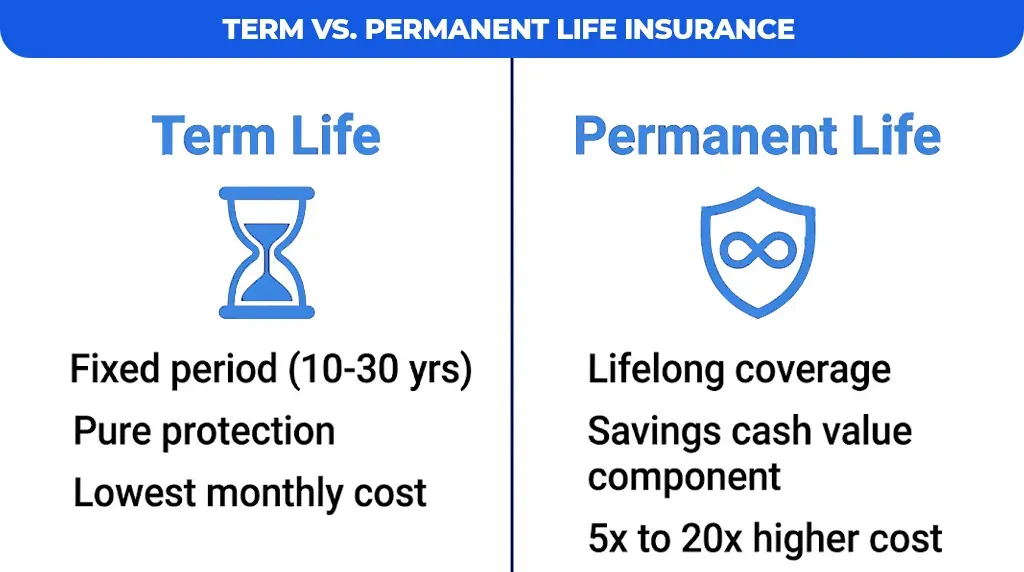
The primary price metric: how much more permanent costs
For the same $500,000 death benefit, whole life costs roughly 7 to 22 times more than 20-year term, and universal life about 5 to 14 times more, depending on age. The gap is widest for young buyers: a healthy 30-year-old man might pay about $18 a month for 20-year term and about $393 a month for whole life, based on published 2026 sample rates. By 60, the multiple narrows because term itself gets expensive.
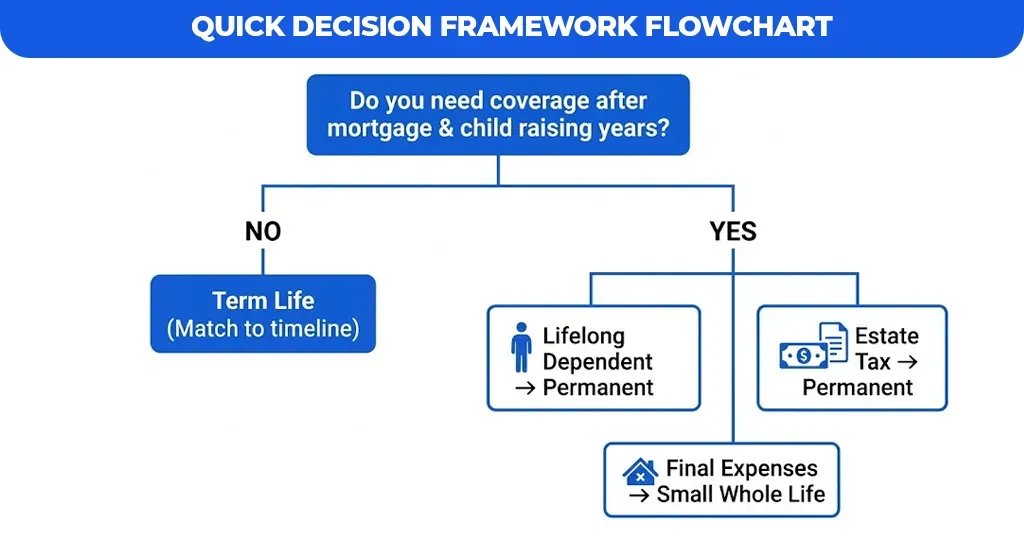
Quick choice framework: who needs term vs. permanent?
Do you need coverage after your youngest child is independent
and your mortgage is paid off?
NO -> Term life (match the term to the last year you need it)
YES -> Why?
– Lifelong dependent (special-needs child) -> Permanent
– Estate tax or estate equalization -> Permanent
– Business buy-sell or key-person, long horizon -> Permanent or long term
– Guaranteed final expenses -> Small whole life
– “Forced savings” only -> Usually better: term + retirement accounts
Most households fall into the first group. Permanent insurance is a specialized tool that works best when it’s clear why coverage has to last for life and the premium fits comfortably for decades.
Term vs. Permanent
Term insurance buys a death benefit for a fixed number of years and nothing else; permanent insurance combines a lifelong death benefit with a cash value account that grows tax-deferred. The four main permanent types differ in how premiums, cash value growth, and guarantees work.
Term life insurance mechanics
Term life insurance pays the death benefit only if you die during the term, typically 10, 15, 20, 25, or 30 years. Most policies are level term, meaning the premium and death benefit stay the same for the whole term. When the term ends, coverage stops, or you can renew at a much higher annual rate based on your age then. There’s no cash value, so if you outlive the term, there’s nothing paid out. Many term policies include a conversion privilege that lets you switch to permanent coverage without a new medical exam (covered below).
Permanent life insurance sub-types
Permanent life insurance is designed to last your entire life, as long as the policy stays funded. The four main types:
• Whole life: fixed premiums, a guaranteed death benefit, and cash value that grows at a guaranteed rate. Participating policies from mutual insurers may also pay dividends, which aren’t guaranteed. The simplest and most expensive permanent option.
• Universal life (UL): flexible premiums and an adjustable death benefit. Cash value earns a credited interest rate set by the insurer. Guaranteed universal life (GUL) policies minimize cash value to offer a lower, guaranteed lifetime premium.
• Indexed universal life (IUL): cash value growth is tied to a market index, with a floor (often 0%) and a cap or participation rate limiting upside. Returns depend on caps that the insurer can change.
• Variable universal life (VUL): cash value is invested in subaccounts similar to mutual funds. Highest growth potential and highest risk; poor markets can reduce cash value and require higher premiums to keep the policy in force. VUL is a securities product sold with a prospectus.
Understanding cash value, surrender charges, and IRC 7702 MEC limits
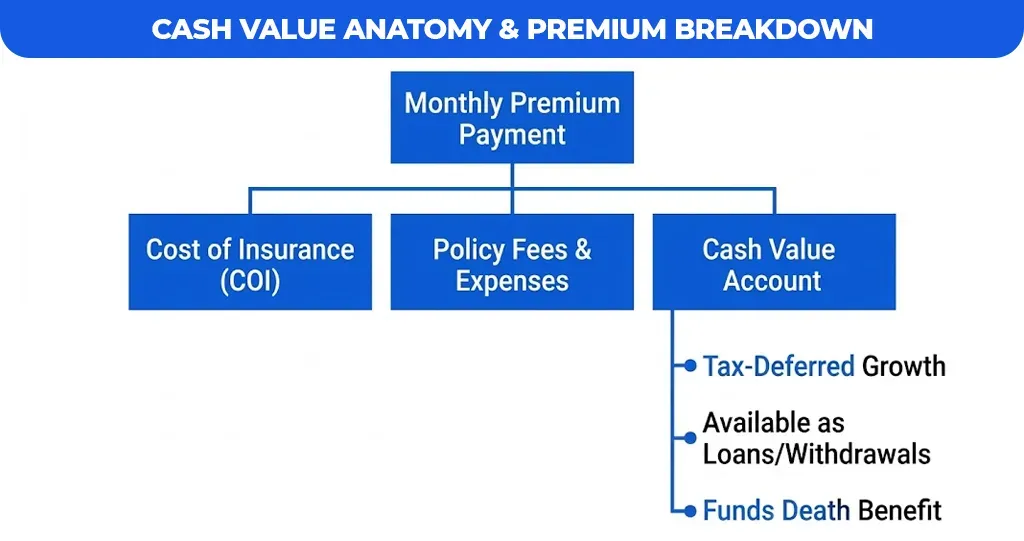
Cash value is the savings portion of a permanent policy: part of each premium, minus the cost of insurance and fees, goes into it, and it grows tax-deferred. You can borrow against it, withdraw from it, or surrender the policy for it. See our cash value life insurance guide.
Premium payment
|
+–> Cost of insurance (COI) – rises with age in UL policies
+–> Policy fees and expenses
+–> Cash value account
|
+–> Grows tax-deferred (guaranteed, credited, indexed, or market)
+–> Available as loans, withdrawals, or surrender value
+–> If you die: beneficiaries generally receive the death benefit
(in most designs, not death benefit plus cash value)
Three mechanics that matter most:
• Surrender charges: if you cancel in the early years, the insurer keeps a surrender charge, so your cash surrender value can be far below the cash value shown. Check the surrender schedule in your contract before buying.
• Cost of insurance (COI): in universal life, the monthly COI deduction rises as you age. If premiums and credited interest don’t keep up, cash value drains and the policy can lapse late in life.
• IRC 7702 and MEC limits: to keep life insurance tax treatment, a policy must meet the IRC Section 7702 definition. If you pay in more during the first seven years than the “7-pay test” allows (IRC 7702A), the policy becomes a modified endowment contract (MEC). A MEC’s death benefit is still generally income-tax-free, but loans and withdrawals are taxed gains-first and can face a 10% additional tax before age 59½.
Term vs. permanent master comparison matrix
| Feature | Term life insurance | Whole life insurance | Universal life (UL/IUL) | Operational winner |
| Coverage length | 10 to 30 years | Lifetime | Lifetime if adequately funded | Permanent, for lifelong needs |
| Premium | Lowest; level for the term | Highest; fixed for life | Flexible; can rise if underfunded | Term, on cost |
| Cash value | None | Guaranteed growth, plus possible dividends | Credited or index-linked; not guaranteed beyond minimums | Whole life, on certainty |
| Death benefit guarantee | Guaranteed during term | Guaranteed for life | Guaranteed only with GUL design or full funding | Whole life or GUL |
| Complexity | Simple | Moderate | High (caps, COI, illustrations) | Term |
| Access to money while living | None | Loans, withdrawals, surrender | Loans, withdrawals, surrender | Permanent |
| Best for | Income replacement, mortgage, young children | Estate planning, lifelong dependents, guaranteed legacy | Flexible premiums, estate planning, supplemental savings | Depends on the goal |
Term vs. Permanent Prices by Age
At age 30, a healthy man can buy $500,000 of 20-year term for about $18 a month, while the same amount of whole life costs about $393 a month. At 50, the figures are about $69 and $895. Permanent coverage costs more at every age, but the multiple shrinks as term itself becomes expensive.
2026 monthly premium benchmarks for $500,000 of coverage
| Age and sex | 20-year level term | Whole life | Universal life | Whole life vs. term |
| 30 female | $16 | $342 | $216 | 21x |
| 30 male | $18 | $393 | $246 | 22x |
| 40 female | $24 | $496 | $310 | 21x |
| 40 male | $28 | $583 | $362 | 21x |
| 50 female | $54 | $768 | $406 | 14x |
| 50 male | $69 | $895 | $551 | 13x |
| 60 female | $140 | $1,310 | $765 | 9x |
| 60 male | $199 | $1,500 | $930 | 8x |
Sources: term and whole life from Choice Mutual published sample rates (preferred non-tobacco, valid March 9, 2026); universal life from MoneyGeek’s 2026 averages across 20 insurers (nonsmoker, average health). The UL column uses a different health class and source, so treat it as a rough midpoint, not a like-for-like quote. Your price depends on health, tobacco use, state, and carrier.
For other term lengths at $500,000 (preferred non-tobacco, female/male): 10-year term runs about 11/13 at 30 and 32/40 at 50, and 30-year term about 24/29 at 30 and 93/123 at 50. See our guide to how much life insurance costs per month.
Note: A different independent source, Insure.com, lists average annual premiums for a $500,000 20-year term policy at $262 (age 30) to $2,656 (age 60) for men in its best health class, or about $22 to $221 a month. Shopping across carriers matters, because the same applicant can get very different prices.
Why is permanent life insurance so much more expensive?
Three reasons: the insurer expects to pay the claim, the premium is level for life, and part of it funds cash value.
1. Guaranteed payout: a term policy may expire without a claim; a permanent policy kept in force will pay out eventually. The insurer has to price for a near-certain claim.
2. Pre-funding later years: the cost of insuring you at 85 is enormous. A level lifetime premium means you overpay in early years, and that excess builds the reserve and cash value.
3. Cash value and expenses: part of the premium goes to savings, and permanent policies carry higher administrative, distribution, and policy expenses that are reflected in early surrender charges.
Direct term vs. group term coverage: why employer plans fall short
Group term life through work is a valuable free or cheap benefit, but it usually isn’t enough by itself and it doesn’t travel with you. In the March 2026 BLS National Compensation Survey, 59% of private-industry workers had access to employer life insurance (40% at firms with fewer than 50 workers, 86% at firms with 500 or more). See our group term life insurance guide.
| Factor | Direct (individual) term | Group term through an employer |
| Coverage amount | You choose, based on need | Often a set amount or multiple of salary |
| Portability | Yours regardless of job | Usually ends or must be converted when you leave |
| Price | Locked in for the term at today’s health | Cheap or free, but rates can change; supplemental amounts priced by age bands |
| Underwriting | Medical questions or exam | Often guaranteed up to a limit |
| Tax | Premiums paid with after-tax money | Employer-paid coverage above $50,000 creates taxable imputed income (IRC Section 79) |
A common approach: keep the group coverage as a bonus and buy an individual term policy sized to your actual need.
Dave Ramsey, Common Buyer Pitfalls and Estate Planning
Popular financial advice leans heavily toward term, while estate and business planners use permanent insurance for specific jobs. Both views are right in their own context; the mistake is applying one to the other.
The Dave Ramsey view: “buy term and invest the difference”
Ramsey Solutions recommends only term life insurance, about 10 to 12 times your income for 15 to 20 years, and investing the money you’d otherwise spend on a permanent policy. Its site calls whole life and indexed universal life “just different names for mixing life insurance and investing (a bad idea).”
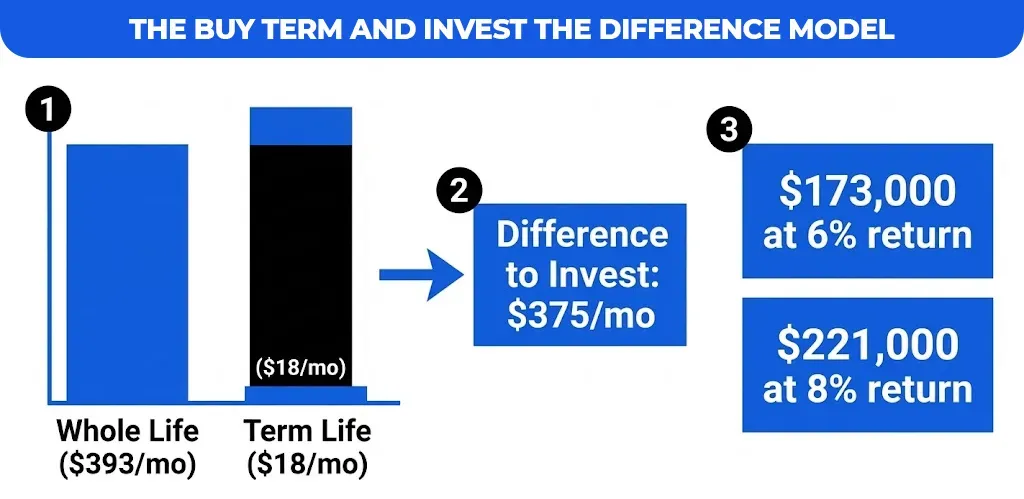
The math behind it, using the $500,000 rates above for a 30-year-old man:
Whole life premium ……………… $393/month
20-year term premium ……………. $18/month
Difference available to invest …… $375/month
Illustrative growth of $375/month for 20 years
at 6% average annual return ……. about $173,000
at 8% average annual return ……. about $221,000
(Hypothetical; investment returns aren’t guaranteed and are taxable
unless held in tax-advantaged accounts.)
Where the strategy works: for disciplined savers who actually invest the difference, have access to 401(k)s and IRAs, and won’t need coverage after the term ends.
Where it can fall short: if the difference gets spent instead of invested, if you develop a health condition and still need coverage after 20 years, or if you have a permanent need such as a special-needs dependent or a large estate.
Common buyer pitfalls with permanent policies
The most frequent complaints about permanent life insurance come from policies that were sold to the wrong buyer or funded too thinly. Patterns to watch for:
• Underfunded universal life: a UL policy bought at a low “target” premium can look fine for years, then require sharply higher payments in your 70s or 80s as COI rises and cash value runs out.
• Early surrender losses: canceling a whole life or UL policy in the first several years often returns far less than the premiums paid, because of surrender charges and front-loaded costs.
• Optimistic IUL illustrations: sales illustrations project index credits at assumed rates; if caps fall or returns lag, the cash value may grow much less than shown.
• Policy loans that compound: unpaid loans accrue interest. If the loan balance grows large enough, the policy can lapse and trigger income tax on the gain.
• Relying only on group term: employees who change jobs or retire can lose coverage when they need it most.
Note: Before buying a permanent policy, ask for an illustration at guaranteed (not just current or assumed) rates, and confirm the premium you’d need to keep coverage to age 100 or beyond.
Permanent insurance in estate and business planning
Estate and business planners use permanent insurance because it guarantees cash at death, whenever death occurs. Common uses:
• Estate taxes: for 2026, the federal estate tax basic exclusion is $15 million per person, so only large estates face the tax. For them, permanent insurance can provide liquidity to pay it without selling a business or real estate.
• Irrevocable life insurance trust (ILIT): a trust owns the policy so the death benefit stays out of the taxable estate. Transfers of an existing policy within three years of death are pulled back into the estate (IRC Section 2035), so trusts often buy the policy directly.
• Business buy-sell agreements: life insurance funds the purchase of a deceased owner’s share. After the Supreme Court’s 2024 decision in Connelly v. United States, the structure (entity-owned vs. cross-purchase) can affect estate tax value, so review it with an attorney.
• Estate equalization and special-needs planning: permanent coverage can leave an inheritance to children who don’t take over a family business, or fund a special-needs trust for a lifelong dependent.
Consumer and strategic perspectives matrix
| Perspective | Core stance | Primary audience | Key takeaway |
| Ramsey Solutions | Term only; invest the difference | Families paying off debt and building savings | Works if you actually invest the savings and need only temporary coverage |
| Personal finance consensus | Term for most people; permanent only for specific needs | Middle-income households | Max out retirement accounts before buying cash value insurance |
| Estate planners | Permanent insurance as estate liquidity and transfer tool | High-net-worth families | Most useful when estates exceed the $15 million exclusion or are illiquid |
| Business planners | Permanent or long-term coverage for buy-sell and key-person needs | Business owners and partners | Ownership structure matters for tax treatment |
| Insurance-skeptical buyers | Avoid cash value products | DIY investors | Understand surrender charges and funding risk before committing |
Pros, Cons and Converting Term to Permanent Coverage
The term’s big advantage is price and its big drawback is that it ends; permanent’s big advantage is that it never ends and its big drawback is cost and complexity. Conversion riders let you start with term and move to permanent later, without new medical underwriting.
Term life insurance pros and cons
| Pros | Cons |
| Lowest cost per dollar of coverage | Expires; nothing paid if you outlive the term |
| Simple to understand and compare | Renewal after the term is very expensive |
| Easy to match to a mortgage or child-raising years | No cash value or living benefit (unless riders are added) |
| Frees money to invest elsewhere | Needing new coverage later depends on your health at that time |
| Many policies are convertible to permanent |
Permanent life insurance pros and cons
| Pros | Cons |
| Coverage for life if kept in force | Premiums often 5 to 20 times higher than term |
| Cash value grows tax-deferred | Surrender charges in early years |
| Can borrow against or withdraw cash value | Fees, COI charges, and illustrations can be hard to evaluate |
| Whole life guarantees premiums and death benefit | Cash value returns are often modest compared with long-term investing |
| Useful for estate taxes, buy-sell, and lifelong dependents | UL and IUL can lapse if underfunded |
Is it worth converting term life insurance to permanent?
It’s worth converting when your health has declined and you still need lifelong coverage, because conversion skips medical underwriting; it’s usually not worth it just because the term is ending and you’re healthy. A convertible term policy lets you exchange all or part of the coverage for a permanent policy from the same insurer at your health class from the original policy, priced at your current age.
Conversion makes sense when:
• You’ve developed a condition (heart disease, cancer, diabetes) that would make new coverage expensive or unavailable.
• You have a lifelong dependent, such as a child with special needs.
• Your estate has grown to where permanent liquidity matters.
• You want to keep a smaller amount for final expenses for life.
Things to check in your policy: the conversion deadline (often a set number of years or a maximum age), which permanent products you can convert into, and whether you can convert part of the coverage. Converting only the amount you need permanently keeps the premium manageable.
At what age should you stop paying term life insurance?
You can stop when no one depends on your income anymore, which for many people happens between 60 and 65, or whenever you’re “self-insured.” You’re self-insured when your savings, retirement accounts, and other assets would cover your family’s needs without a death benefit. Signs you’ve reached that point:
• Your mortgage is paid off or nearly so.
• Your children are financially independent.
• Your spouse would have enough retirement income (savings, pensions, Social Security survivor benefits) without your earnings.
• You have no large debts that would pass to family.
If you still need some coverage after your term ends (final expenses, a spouse who relies on your pension), consider converting a portion or buying a small permanent policy instead of renewing the full term at high annual rates.
Can you cash out permanent life insurance?
Yes, in three ways: a policy loan, a partial withdrawal, or surrendering the policy for its cash surrender value. Each has different tax and coverage effects (for a non-MEC policy):
| Method | How it works | Tax treatment (non-MEC) | Effect on coverage |
| Policy loan | Borrow against cash value; interest accrues | Generally not taxable while the policy stays in force | Unpaid loans and interest reduce the death benefit; a lapse with a loan can trigger tax |
| Partial withdrawal | Take money out of cash value (UL types) | Tax-free up to your basis (premiums paid); gains above basis taxable | Reduces cash value and usually the death benefit |
| Full surrender | Cancel the policy; receive cash surrender value | Gain over premiums paid is taxable as ordinary income | Coverage ends |
For MEC policies, loans and withdrawals are taxed gains-first and can face a 10% additional tax before 59½. Read more about cash surrender value.
Note: Some older policyholders sell a policy they no longer need through a life settlement, which can pay more than the surrender value. Settlements have their own tax and fee issues; compare offers and get tax advice.
Navigating Your Options with Assurance Gurus
Decide how much coverage you need and for how long before you decide what type to buy. The need usually points to the answer: a temporary need calls for term, a permanent one for permanent coverage, and many families end up with a mix.
Step 1: Calculate your total coverage need
A common rule of thumb is 10 to 12 times your income, but a needs-based estimate is more accurate. Add up what your family would need, then subtract what’s already in place:
Income replacement (annual income x years needed)
+ Mortgage and other debts
+ Future costs (college, childcare)
+ Final expenses
– Existing savings and investments
– Existing life insurance (including group coverage)
= Coverage need
Our life insurance calculator runs this estimate for you.
Step 2: Match term lengths to your financial horizons
Pick the term that ends when your biggest obligation ends.
| Your situation | Suggested term |
| Youngest child is 10; wants coverage to college graduation | 15 years |
| New 30-year mortgage; young children | 30 years |
| Kids in high school; mortgage 18 years left | 20 years |
| Business loan with 10 years remaining | 10 years |
Step 3: Layer term and permanent policies for hybrid strategies
Layering means buying a large term policy for your peak-need years and a smaller permanent policy for lifelong needs. Example: a 35-year-old buys $750,000 of 20-year term to protect the family while the kids are young and $100,000 of whole life to cover final expenses and leave a legacy. Another version is “laddering” two or three term policies of different lengths so coverage steps down as debts shrink.
Step-by-step blueprint to compare carriers with Assurance Gurus
Assurance Gurus is an independent agency that compares term and permanent life insurance from multiple carriers. A typical review:
1. Share your goals: income, debts, dependents, and how long you need coverage.
2. Get your coverage estimate from the calculator or a specialist.
3. Compare quotes for term, whole, and universal life side by side, including conversion privileges and riders.
4. Review guarantees: for permanent policies, look at guaranteed values, not just illustrated ones.
5. Apply and review yearly: confirm beneficiaries and adjust as your family and finances change.
Read more about term or whole life insurance and how life insurance works.
Conclusion:
For most families, term life insurance gives the most protection for the money during the years when others depend on their income; permanent insurance is the better fit when a need truly lasts for life. Before choosing, add up your obligations, decide how long they last, and make sure the premium fits your budget for as long as you’ll be paying it.
| Your situation | Best fit |
| Young family, mortgage, tight budget | 20- or 30-year term |
| Healthy, disciplined investor | Term, and invest the savings in retirement accounts |
| Special-needs child or other lifelong dependent | Permanent (whole life or GUL), often with a trust |
| Estate likely above the federal exclusion | Permanent, often owned by an ILIT |
| Business co-owners | Term or permanent to fund a buy-sell, depending on the horizon |
| Term ending but health has declined | Convert part of the term to permanent |
| Want guaranteed final expense coverage | Small whole life policy |
| Only covered through work | Add an individual term policy you control |
Compare Life Insurance Policies at Assurance Gurus
The right policy is the one that covers your real need at a price you can keep paying. Assurance Gurus specialists can help you estimate coverage, compare term and permanent options from multiple carriers, and find a policy that fits your budget.
• Get custom life insurance quotes on Assurance Gurus
• Estimate your need with the life insurance calculator
• Call 888-363-1938 to talk with a licensed specialist