



Life insurance is simple in principle: you pay premiums, and if you die while covered, your beneficiaries receive money. The details that matter are which deaths the policy pays for, which it doesn’t, and what your family can actually do with the payout.
Quick answer: Life insurance covers death from almost any cause, including illness, accidents, and natural causes, once the policy is in force. The death benefit is generally income-tax-free and can be used for anything. Common exclusions are application misrepresentation, suicide in the first two years, and death while committing a crime.
What Does Life Insurance Cover?
Life insurance covers the death of the insured person by paying a lump sum, called the death benefit, to the beneficiaries named on the policy. It pays for death from natural causes, illness, and accidents, and the beneficiary can spend the money however they need. Under IRC § 101(a), life insurance death benefits are generally excluded from federal income tax.
So what does life insurance cover you for, in plain terms? It covers the financial gap your death would leave: lost income, debts, the mortgage, final expenses, and future goals like your children’s education.
The primary purpose
Life insurance protects the people who depend on you financially. It can:
• Replace your income so your family can keep up with bills.
• Pay off the mortgage and other debts.
• Cover funeral and final medical costs.
• Fund college or leave an inheritance.
what life insurance does not cover
| Usually not covered | Why |
| Death after lying on the application (if discovered) | Material misrepresentation |
| Suicide within the first two years (most states) | Suicide clause |
| Death while committing a felony | Illegal-act exclusion (policy-specific) |
| Death from an undisclosed high-risk activity | Misrepresentation or a specific exclusion |
| Death after the policy lapsed or the term ended | No coverage in force |
| War or acts of war (some policies) | Specific exclusion |
Note: Exclusions vary by policy. Read the exclusions section of your contract, or ask the insurer for a copy before you buy.
Core Categories of Coverage: What the Death Benefit Pays For
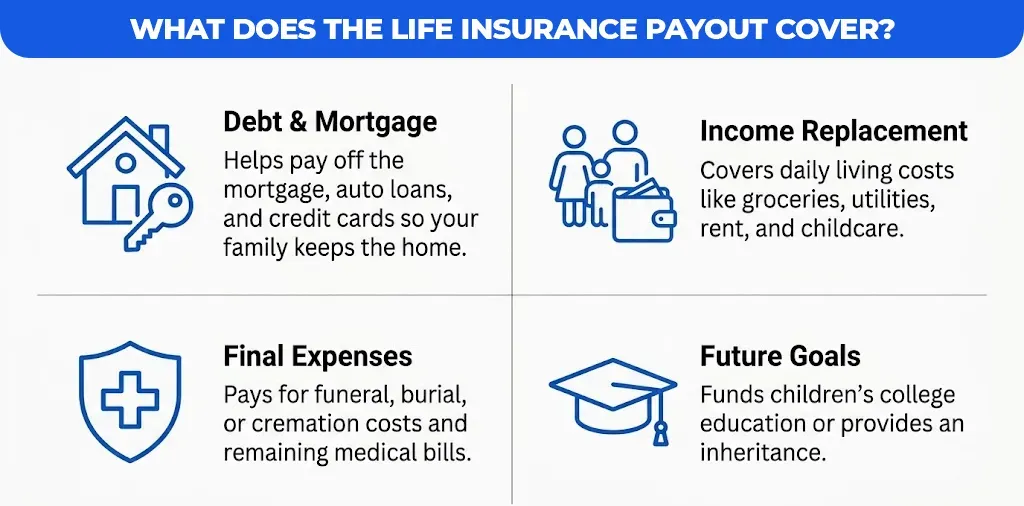
The death benefit is paid in cash to your beneficiary, who can use it for any purpose. Most families use it for four kinds of needs: debts and the mortgage, ongoing living expenses, final expenses, and future goals.
Category 1: Mortgage payoff and debt settlement
What does life insurance cover on a mortgage? A regular life insurance policy doesn’t pay the lender directly, but your beneficiary can use the payout to pay off the mortgage and keep the home. That’s different from mortgage protection insurance, which typically pays the lender and decreases as the loan balance falls.
The payout can also cover car loans, credit cards, personal loans, and home equity lines. See our guide to decreasing term life insurance for coverage that shrinks with a mortgage.
Category 2: Income replacement and living expenses
For most working parents, replacing income is the biggest reason to buy life insurance. The payout can cover groceries, utilities, rent or mortgage payments, childcare, and health insurance for years after a death.
Category 3: Final expenses, funeral costs, and medical bills
What does life insurance cover when you die? Often the very first bills: the funeral, burial or cremation, and final medical costs. The NFDA’s 2023 median for a funeral with viewing and burial was $8,300, before cemetery costs.
Small whole life policies built for this purpose are called final expense life insurance.
Category 4: Education funding and estate liquidity
A larger death benefit can fund a child’s college savings or leave an inheritance. For larger estates, the payout can provide cash to pay taxes or settle the estate without selling property. The 2026 federal estate tax basic exclusion is $15 million per person, so most families won’t owe federal estate tax.
Living benefits: accelerated death benefit riders
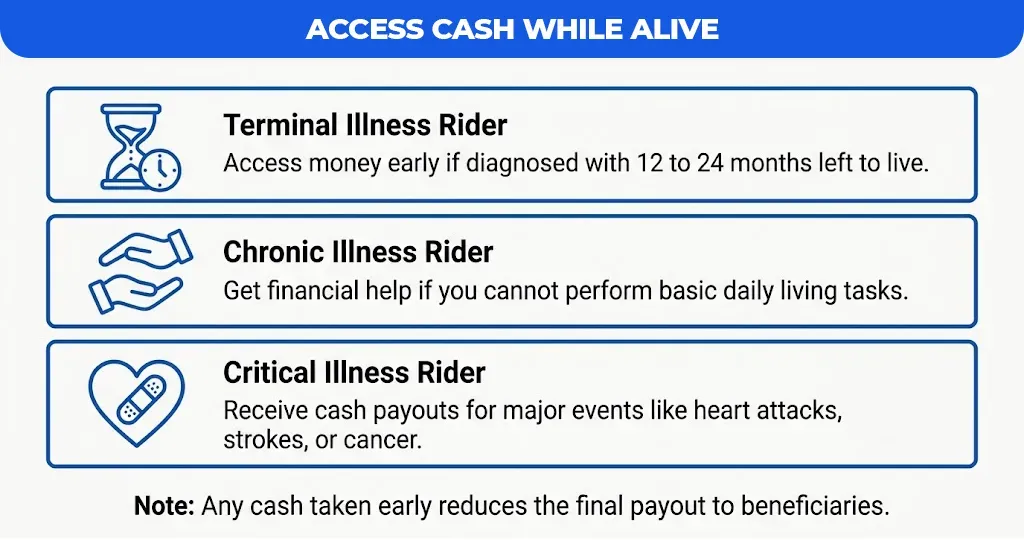
Many policies let you access part of the death benefit while you’re alive if you’re diagnosed with a terminal, chronic, or critical illness. This is called an accelerated death benefit (ADB) rider.
• Terminal illness rider: usually requires a life expectancy of 12 to 24 months, depending on the policy.
• Chronic illness rider: for people unable to perform basic daily activities.
• Critical illness rider: for specific diagnoses like heart attack, stroke, or cancer.
Whatever you take early is subtracted from the death benefit your beneficiaries receive. Learn more about life insurance with living benefits.
Master life insurance coverage breakdown
| Financial need | How the policy is used | Typical amount to plan for | Family benefit |
| Mortgage and debt | Lump sum paid to beneficiary | Remaining mortgage + other debts | Keeps the home, removes debt |
| Income replacement | Lump sum invested or drawn down | Annual income x years of support | Keeps daily life stable |
| Final expenses | Lump sum | Funeral and final bills (NFDA median $8,300 for viewing and burial) | Avoids out-of-pocket costs |
| Education | Lump sum or trust | Expected tuition per child | Funds college goals |
| Estate liquidity | Lump sum to estate or trust | Taxes and settlement costs | Avoids forced asset sales |
| Serious illness | Accelerated death benefit | Part of the death benefit | Cash while living |
Cause of Death Analysis: What Is Covered vs. What Is Excluded
Life insurance covers almost every cause of death once the policy has been in force for two years and the application was accurate. Most denials come from application misrepresentation, the suicide clause, or specific policy exclusions.
What is covered
- Natural causes: heart disease, cancer, stroke, and old age.
- Illnesses: including infectious diseases and conditions diagnosed after the policy was issued.
- Accidents: car crashes, falls, drowning, and other accidental deaths.
- Pre-existing conditions: covered if they were disclosed on the application and priced into the policy.
- Suicide: covered after the suicide clause period ends, usually two years from the issue date.
What things does life insurance not cover?
- Material misrepresentation: lying about smoking, health history, medications, or substance use can lead to a denied claim if discovered during the contestability period.
- Suicide during the exclusion period: most policies exclude suicide within the first two years. New Jersey, for example, limits the exclusion to no more than two years, with the payment limited to premiums paid. Some states or policies use a shorter period, so check your contract.
- Illegal acts: many policies exclude death while committing a felony.
- Undisclosed hazardous activities: skydiving, private piloting, scuba diving, or dangerous occupations that weren’t disclosed, or that the policy specifically excludes.
- War or acts of war: some policies exclude deaths related to war.
- Lapsed or expired policies: if premiums stopped or the term ended, there’s no coverage.
Note: If you or someone you know is struggling, call or text 988 to reach the 988 Suicide & Crisis Lifeline. Help is available 24/7.
The two-year contestability period
For the first two years after a policy is issued, the insurer can review the application if the insured dies and deny the claim for material misstatements. After two years, the policy generally becomes incontestable except for nonpayment of premium and, in some cases, fraud.
Why honesty matters:
• An insurer that discovers undisclosed smoking or a serious diagnosis may deny the claim or adjust the payout.
• Increasing coverage or replacing a policy can restart the contestability clock for the new coverage.
Covered vs. excluded death causes matrix
| Cause or circumstance | Coverage status | Key policy clause | How to avoid denial |
| Heart attack, cancer, stroke | Covered | General coverage | Disclose health history honestly |
| Car accident | Covered | General coverage | None needed (unless a crime was involved) |
| Pre-existing condition, disclosed | Covered | Underwriting | Report every condition on the application |
| Pre-existing condition, hidden | May be denied in year 1–2 | Contestability clause | Never omit conditions |
| Suicide, within two years | Usually excluded (premiums may be refunded) | Suicide clause | N/A |
| Suicide, after two years | Covered | Suicide clause ends | N/A |
| Death during a felony | Often excluded | Illegal-act exclusion | N/A |
| Undisclosed skydiving or aviation | May be denied | Misrepresentation / hazard exclusion | Disclose hobbies; buy a rider if needed |
| Death after lapse | Not covered | Grace period and lapse rules | Pay premiums; use autopay |
For tax questions on payouts, see do you pay taxes on life insurance.
State Rules, Carrier Spotlights, & Financial Realities
Life insurance is regulated by each state, so some consumer protections differ depending on where you live. The core coverage, death from almost any cause, is similar everywhere.
What does life insurance cover in New York?
Coverage in New York works like other states, but New York adds a strong consumer protection on how policies are sold. Regulation 187 (11 NYCRR 224) requires insurers and agents to meet a suitability and best interest standard when recommending life insurance or annuities. It took effect for life insurance transactions on February 1, 2020.
What does life insurance cover in New Jersey?
New Jersey policies follow standard coverage rules, with several protections built into state law:
| Provision | New Jersey rule |
| Free look | 10 days (20 days if age 65+), with a full refund |
| Incontestability | 2 years from issue, with exceptions for nonpayment and fraud |
| Suicide exclusion | No more than 2 years; payment limited to premiums paid |
| Grace period | 31 days |
| Reinstatement | Within 3 years, with proof of insurability and back premiums |
Source: New Jersey life policy requirements summary (Open Exam Prep). Confirm with the NJ Department of Banking and Insurance.
Carrier spotlights: MassMutual and Aetna
MassMutual: a mutual life insurer that sells term, whole, and universal life. Its whole life policies are participating, meaning eligible policyholders may receive dividends. MassMutual announced a 6.60% dividend interest rate for 2026. Dividends aren’t guaranteed. What MassMutual life insurance covers is set by each policy contract, like any carrier.
Aetna: Aetna sold its U.S. group life and disability business to The Hartford in a deal announced in 2017. If you have group life insurance that once came through Aetna, check your current certificate of coverage for the carrier now administering it.
Note: For any carrier, the policy contract is what defines coverage. Ask for the full contract, including exclusions and riders, before you buy.
How much does a $100,000 life insurance policy cost a month?
For a healthy non-smoker, a $100,000 term policy costs about $8 a month at age 20 to 30, rising to $24 to $51 a month by age 60, depending on the term length.
| Age | 10-year female | 10-year male | 20-year female | 20-year male |
| 20 | $8 | $8 | $8 | $8 |
| 30 | $8 | $8 | $8 | $9 |
| 40 | $8 | $9 | $9 | $10 |
| 50 | $13 | $14 | $17 | $21 |
| 60 | $24 | $30 | $37 | $51 |
Source: Choice Mutual published sample rates, preferred non-tobacco, valid March 9, 2026. Coverage amount inferred from table order on the source page. Your rate depends on health, tobacco use, and carrier.
See more at how much is life insurance per month.
What is the downside of life insurance?
The main downsides are ongoing cost, the risk of losing coverage if premiums lapse, and, for permanent policies, high premiums and complex fees.
• Term life: you may pay for decades and never receive a payout if you outlive the term.
• Whole and universal life: premiums are many times higher than term for the same death benefit.
• Fees and surrender charges: cash value policies can have high early-year costs and surrender charges if you cancel.
• Lapse risk: missing payments past the grace period can end coverage.
• Underwriting: health issues can raise rates or limit options.
Understand the costs of cancelling in our guide to cash surrender value.
What happens after 20 years of paying life insurance?
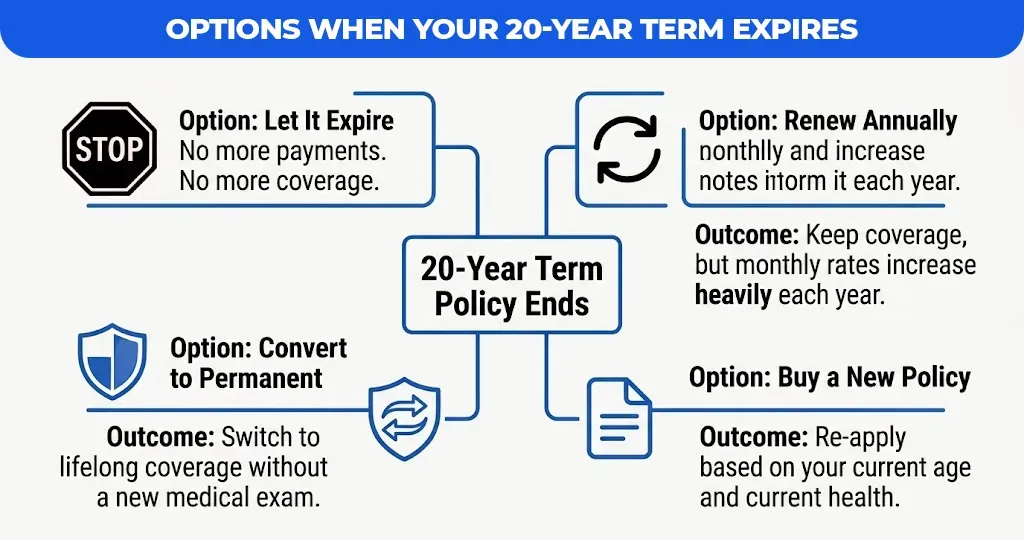
When a 20-year term ends, coverage stops unless you convert or renew it, and term policies don’t pay back premiums. Your options:
20-year term ends
|– Let it expire -> No more premiums, no more coverage
|– Renew annually -> Coverage continues at much higher, rising rates
|– Convert -> Switch to permanent coverage without a new medical exam
| (if the policy has a conversion option and you’re within the deadline)
`– Buy a new policy -> New underwriting at your current age and health
With your whole life, after 20 years you’ve built cash value you can borrow against or surrender. Return of premium term policies refund premiums at the end of the term, at a higher price. See our convertible term life insurance guide.
How to Get the Right Coverage
Getting the right life insurance comes down to three choices: how much coverage, what type, and how you’ll qualify. Answer them in order.
Step 1: Calculate your coverage need with the DIME method
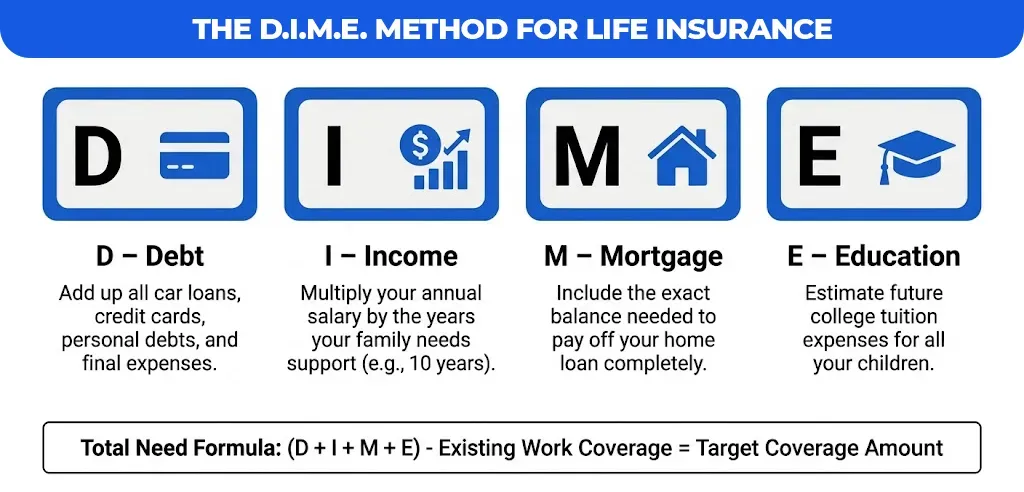
DIME stands for Debt, Income, Mortgage, and Education.
Example (hypothetical): parent, age 35
Debt: $20,000 (car loan, cards, final expenses)
Income: $65,000 x 10 years = $650,000
Mortgage: $240,000
Education: $60,000 x 2 children = $120,000
Total need: $1,030,000
Less existing work coverage: -$65,000
Coverage to buy: ~$965,000 → round to $1,000,000
Try the Assurance Gurus life insurance calculator or read how much life insurance do I need.
Step 2: Choose term or permanent coverage
| If you need… | Consider |
| Coverage while kids are young or the mortgage is unpaid | Term life (10–30 years) |
| Coverage that never expires | Whole or guaranteed universal life |
| Funeral and final expenses only | Final expense whole life |
| Cash value and lifelong coverage | Whole life |
Compare options in our term or whole life insurance guide.
Step 3: Navigate underwriting or choose no-exam options
Fully underwritten policies usually offer the lowest rates for healthy people. If you want speed or have health issues, life insurance without a medical exam or guaranteed issue life insurance may fit, usually at higher prices or lower coverage limits.
Step 4: Compare carriers with Assurance Gurus
1. Run DIME -> Know your target coverage amount
2. Pick term length -> Match it to the mortgage or youngest child
3. Disclose honestly -> Health, tobacco, hobbies, medications
4. Compare carriers -> Assurance Gurus compares options with you
5. Review the contract -> Exclusions, riders, conversion option
6. Name beneficiaries -> Primary and contingent
Conclusion:
Life insurance covers death from almost any cause and pays a generally tax-free lump sum your family can use for anything, from the mortgage to college to the funeral. The main risks to a payout are misrepresentation, the suicide clause in the first two years, specific exclusions, and letting the policy lapse.
| Your situation | Best next step |
| Young family with a mortgage | 20–30 year term sized with DIME |
| Health condition | Disclose it fully; compare simplified or guaranteed issue |
| Risky hobby or job | Disclose it; ask about riders or exclusions |
| Term ending soon | Check conversion deadlines before it expires |
| Want lifelong coverage | Whole or guaranteed universal life |
| Group coverage only | Add an individual policy you can keep |
| Living in NY or NJ | Use your free-look period to review the contract |
The younger and healthier you are when you apply, the lower your level premium will be.
Protect Your Family’s Legacy with Assurance Gurus
Ready to make sure your family is covered? Evaluate life insurance coverage at Assurance Gurus with a specialist who compares policies across carriers.
Assurance Gurus can help you:
• Calculate how much coverage your family needs.
• Compare term, whole, and final expense policies.
• Review exclusions, riders, and conversion options before you buy.
• Find coverage options if you have health conditions.
Call 888-363-1938 or request free life insurance quotes. There’s no obligation to buy.