


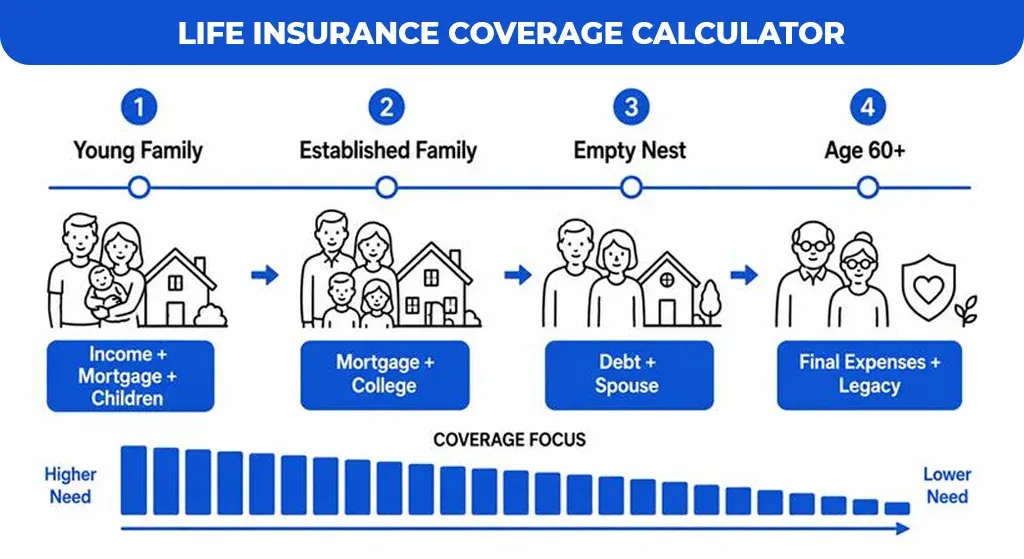
How Much Life Insurance Do I Need

How Much Life Insurance Do I Need? Exact Coverage Calculator

The short answer to how much life insurance do I need is that most people need coverage equal to roughly 10 to 12 times their annual income, adjusted for outstanding debt, a mortgage balance, and future costs such as college tuition. This is the starting point recommended by Ramsey Solutions and echoed across the personal finance industry, and it works as a baseline for most working adults with dependents.

The right number for your household, however, depends on your debts, your income, the ages of your children, and how much your existing savings and employer coverage already provide. Nearly 40% of American adults say they, or their family, need more life insurance than they currently have, and that gap represents roughly 100 million adults nationwide, according to the LIMRA and Life Happens Insurance Barometer Study for 2026.

This guide walks through the income multiplier rule of thumb, the DIME formula, and the Human Life Value method, so you can calculate a precise, personalized coverage amount instead of guessing.

Quick Answer: How Much Life Insurance Do I Need?

For most people with dependents, a reasonable starting point is:

  • 10 to 12 times your annual income in term life insurance, per Ramsey Solutions’ widely used guideline.
  • Add your outstanding debt and mortgage balance (non-mortgage debt plus the remaining home loan) to that figure.
  • Add roughly $100,000 to $150,000 per child if you want the policy to help fund future education costs, per Guardian’s coverage guidelines.
  • Subtract existing savings, investments, and any group life insurance your employer already provides.

Example: A 35-year-old earning $70,000 a year with $20,000 in debt, a $250,000 mortgage, and two children might reasonably target $900,000–$1,050,000 in term coverage. Your own number will differ, so use the calculators in this guide to run your figures.

Life Insurance Coverage Calculator

What Is Life Insurance, and Which Terms Do You Need to Know?

An insurance company and you, the policyholder, enter into a contract for life insurance. You pay regular premiums, and in exchange, the insurer pays a tax-free lump-sum death benefit to your named beneficiaries if you die while the policy is active. Before you can calculate how much coverage you need, it helps to understand the two main product categories.

Term Life Insurance

Term life insurance covers you for a fixed period, typically 10, 20, or 30 years, and has no cash value component. Because it is temporary and simpler to underwrite, it is the most affordable way to buy a large death benefit, which is why it is the type most commonly recommended for income replacement during your working and child-rearing years.

Whole Life and Other Permanent Life Insurance

Whole life insurance and other permanent policies (such as universal life) last for your entire lifetime and build a cash value component you can borrow against. How much whole life insurance do I need is a different question from term needs, because permanent coverage is usually purchased for estate planning, final expenses, or supplementing a smaller amount of term coverage rather than replacing a full income. Whole life premiums run substantially higher than term for the same face amount.

Underwriting, Insurers, and Ratings

When you apply, the insurer evaluates your age, health, lifestyle, and occupation through a process called underwriting to determine your premium and risk class. Before purchasing a policy, it is worth checking an insurer’s financial-strength rating, commonly published by AM Best, and confirming the company is licensed in your state through your state insurance department or the National Association of Insurance Commissioners (NAIC) consumer resources.

How Much Life Insurance Do I Need? Rule-of-Thumb Methods

Rule-of-thumb methods are the fastest way to get a working estimate. They will not account for every detail of your finances, but they give you a defensible starting number in minutes.

📊 COVERAGE ESTIMATOR

Don’t guess how much life insurance your family actually needs. Stop relying on rough estimates and calculate an exact, personalized coverage amount in under 2 minutes based on your income, debts, and children’s future.

The Income Multiplier Rule of Thumb

The most common heuristic is a multiplier of 10 to 15 times your annual income. This is the approach behind the ” how much do I need rule of thumb searches people run before getting quotes, and it is also the foundation of the guidance most frequently cited in consumer finance coverage from outlets such as Forbes Advisor and Investopedia.

The Dave Ramsey Method: 10–12x Income

Ramsey Solutions, the financial platform founded by Dave Ramsey, recommends level term life insurance equal to 10 to 12 times your annual income, with a term length of 15 to 20 years (up to 30 years for younger families with small children). The idea is that beneficiaries can invest the payout and draw on it to replace lost income over time. Ramsey Solutions also recommends that stay-at-home parents carry a policy sized to replace the cost of the childcare, housekeeping, and other unpaid labor they provide, not just wage-earners.

The ‘Income Plus Per-Child’ Adjustment

A common refinement used by insurers such as Guardian is to take your annual salary, add a zero to estimate a base 10x-income figure, then add $100,000 to $150,000 per child on top of that base to account for future education and dependent-care costs. This addresses how much life insurance do I need for my child and how much life insurance do I need for my family as a single combined calculation rather than two separate ones.

Limitations of Rule-of-Thumb Methods

  • They do not account for existing savings, a working spouse’s income, or employer-provided group coverage.
  • They can overstate or understate needs for households with unusual debt loads, such as private student loans or a large mortgage balance.
  • They treat every family the same, when in reality a young family with a 30-year mortgage has very different needs than an empty-nester household.

For a more precise number, use one of the two calculation methods below.

The DIME Formula: A Detailed Life Insurance Calculator Method

DIME is a step-by-step framework that answers how do I calculate how much life insurance I need by adding up four specific categories of financial obligation: Debt, Income, Mortgage, and Education.

  • Debt: Total non-mortgage liabilities, including car loans, credit cards, and personal or student loans.
  • Income: Your annual salary multiplied by the number of years your dependents would need financial support (commonly the number of years until your youngest child turns 18 or finishes college).
  • Mortgage: The remaining balance needed to pay off your home loan in full.
  • Education: Estimated future tuition and living expenses for each child’s education.
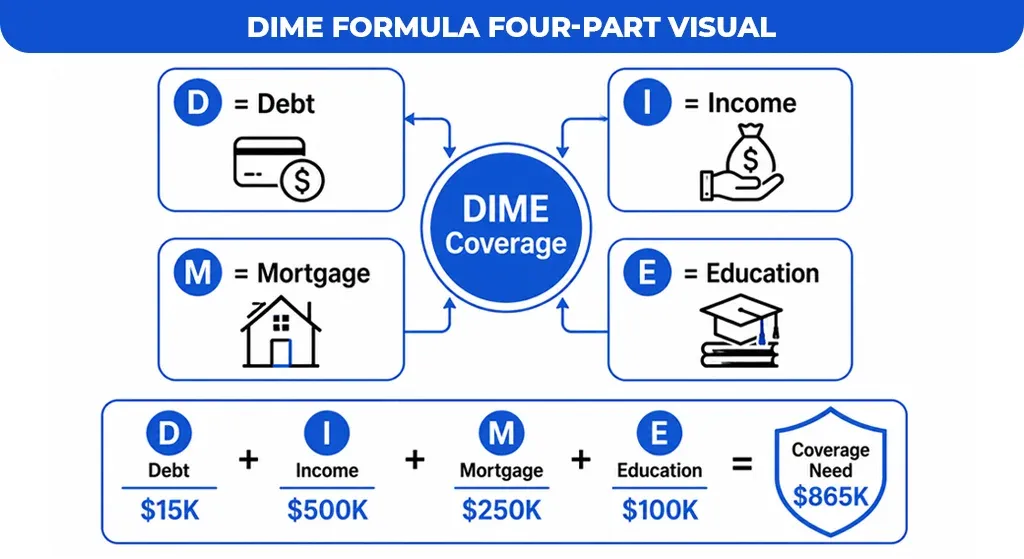
DIME Formula Four-Part Visual

DIME Formula Example

Category

Assumption

Amount

Debt

Car loan, credit cards, personal loan

$15,000

Income

$50,000/year x 10 years of support

$500,000

Mortgage

Remaining home loan balance

$250,000

Education

College fund for two children

$100,000

Total DIME Coverage Need

Sum of all four categories

$865,000

The Human Life Value Method

The Human Life Value method takes a different approach: instead of totaling your obligations, it estimates the economic value you contribute to your household over your remaining working years. This concept is grounded in actuarial and economic valuation principles used across the insurance industry and referenced in consumer education materials published by state insurance regulators through the NAIC.

To estimate your Human Life Value, consider:

  • Your current annual salary and reasonably expected wage growth.
  • The number of years remaining until your expected retirement age.
  • Your personal living expenses, which are subtracted from earnings because they end when you do.
  • A discount rate applied to convert future earnings into today’s dollars.

DIME focuses on paying off specific, immediate obligations, such as a mortgage or college fund. Human Life Value focuses on replacing your full future earning potential. Comparing the two figures side by side and choosing the higher, lower, or midpoint number based on your risk tolerance is a reasonable way to determine how much life insurance I need if the DIME total feels too conservative for your situation.

How Much Term Life Insurance Do I Need vs. Whole or Supplemental Coverage?

For most working adults with dependents, how much term life insurance do I need is the more relevant question, because term insurance is built specifically to replace income during your working years at the lowest cost per dollar of coverage.

Cost Context: What Coverage Actually Costs

Affordability is often overestimated. The 2026 Insurance Barometer Study found that about three-quarters of adults overestimate the true cost of life insurance, and healthy adults age 35 and under guessed premiums at seven to twelve times the actual price, according to LIMRA and Life Happens.

Representative 2026 average monthly premiums for a healthy, non-smoking applicant illustrate the actual cost, according to Guardian’s published term life insurance rate data:

Age

$500,000 / 20-year term (Male)

$500,000 / 20-year term (Female)

30

$28.00/mo

$23.50/mo

40

$34.50/mo

$35.27/mo

50

$76.50/mo

$78.30/mo

60

$298.50/mo

$216.00/mo

The Cost of Whole Life Insurance Do I Need It?

Because whole life insurance costs several times more per dollar of coverage than term, it is typically sized to a specific, smaller goal rather than a full income-replacement figure. Common uses include covering final expenses, leaving a legacy gift, or supplementing a term policy that is set to expire. If you are using whole life for final-expense purposes, size it to your estimated funeral, medical, and end-of-life costs rather than a multiple of income.

How Much Supplemental or Voluntary Life Insurance Do I Need Through Work?

Many employers offer supplemental or voluntary life insurance you can add on top of a small base policy the company provides for free. A majority of working adults, 55%, say they have life insurance coverage through their employer, according to the 2026 Insurance Barometer Study from LIMRA and Life Happens. Employer coverage is convenient, but it is usually capped at one to two times your salary and is generally not portable if you leave the job. When calculating how much supplemental or voluntary life insurance you need, subtract your employer’s base and supplemental coverage from your total DIME or income-multiplier figure.

How Much Life Insurance Coverage Do I Need at Different Life Stages?
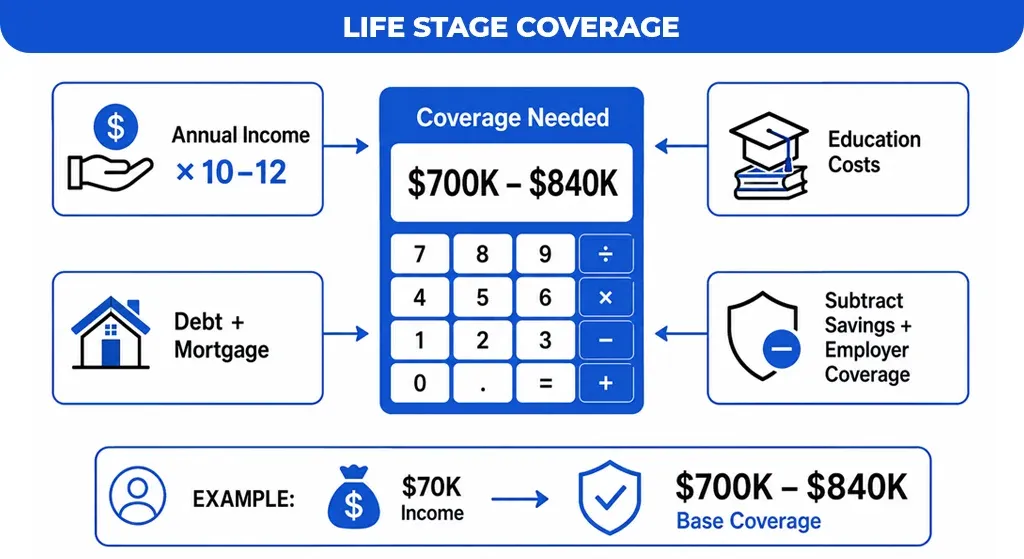
Life Stage Coverage

The formulas above apply everywhere in the country, whether you are calculating how much life insurance you need in Sioux Falls, South Dakota, or in any other city; the underlying math does not change by location. What does vary by state and insurer is the specific rate you’re quoted, so it is worth comparing quotes from multiple companies licensed in your state.


Life Stage

Typical Priority

Coverage Consideration

New parents / young family

Income replacement, mortgage, childcare

Higher end of the 10–12x income range, plus per-child education costs

Established family, teenage children

Remaining mortgage, near-term college costs

DIME formula, weighted toward mortgage and education

Empty nesters / near retirement

Debt payoff, spousal income gap

Often a reduced amount as debts shrink and savings grow

Age 60 and older

Final expenses, remaining debt, legacy goals

Smaller term or whole life policy sized to specific remaining obligations

Key Takeaway

  • A common starting point is 10 to 12 times your annual income in term life insurance, per Ramsey Solutions.
  • The DIME formula (Debt, Income, Mortgage, Education) gives a more precise, itemized figure than a flat multiplier.
  • The Human Life Value method estimates your future earning potential as an alternative or cross-check.
  • Subtract existing savings and employer group coverage from your total before shopping for a policy.
  • Term life insurance is significantly cheaper than whole life for the same coverage amount, which is why it is generally recommended for income replacement.

Conclusion

Determining the right amount of life insurance is not about guessing or defaulting to a round number. Start with a rule-of-thumb multiplier for a quick estimate, then refine it using the DIME formula or the Human Life Value method, and finally subtract your existing savings, investments, and employer-provided coverage. Revisit the number whenever your income, debt, or family situation changes significantly, such as after a new mortgage, a new child, or a career change.

Ready to compare policies based on your actual coverage needs? Explore expert guides, compare term and whole life quotes, and get personalized guidance at Assurance Gurus to find coverage that fits your family’s budget and financial goals.

💡 EXPERT ADVICE

Still unsure which policy type or coverage limit matches your family’s financial goals? Get personalized guidance and expert recommendations from trusted insurance advisors at Assurance Gurus to protect your family’s future.

Frequently Asked Questions

It depends on your income, debt, and dependents. Under the 10–12x income guideline from Ramsey Solutions, $500,000 aligns with an annual income of roughly $42,000 to $50,000. For a higher earner, a household with a large mortgage, or a family with several children's education to fund, $500,000 may fall short of the DIME formula total. Run your own numbers using the DIME formula above rather than relying on a single fixed amount.

There is no single amount that fits every household, which is precisely the gap the 2026 Insurance Barometer Study highlights: 40% of adults say their loved ones would be barely or not at all financially secure if the primary wage earner died unexpectedly, according to LIMRA and Life Happens. A good amount is one calculated from your own debt, income, mortgage, and dependent-care costs using the DIME formula or the Human Life.

For many households, $1,000,000 is substantial coverage, particularly under the 10–12x income guideline, which corresponds to an annual income of roughly $83,000 to $100,000. Whether it is enough depends on your total debt, remaining mortgage balance, number of children, and any existing savings or employer coverage. High earners, households with significant debt, or families in high-cost-of-living areas may need more; households with lower debt and existing savings may need less.

A $100,000 term life insurance policy is one of the least expensive coverage amounts available. For a healthy, non-smoking 30-year-old woman, a 10-year term averages about $8 per month, and a 30-year term averages about $11 per month, according to Forbes Advisor. For a healthy 40-year-old buying a 20-year term, MoneyGeek's analysis of insurer quotes.