



Whole life insurance cash value is the savings portion of a whole life policy. Part of each premium goes into it, it grows tax-deferred at a guaranteed rate, and participating policies may add dividends on top. You can borrow against it, withdraw from it, or surrender the policy for it.
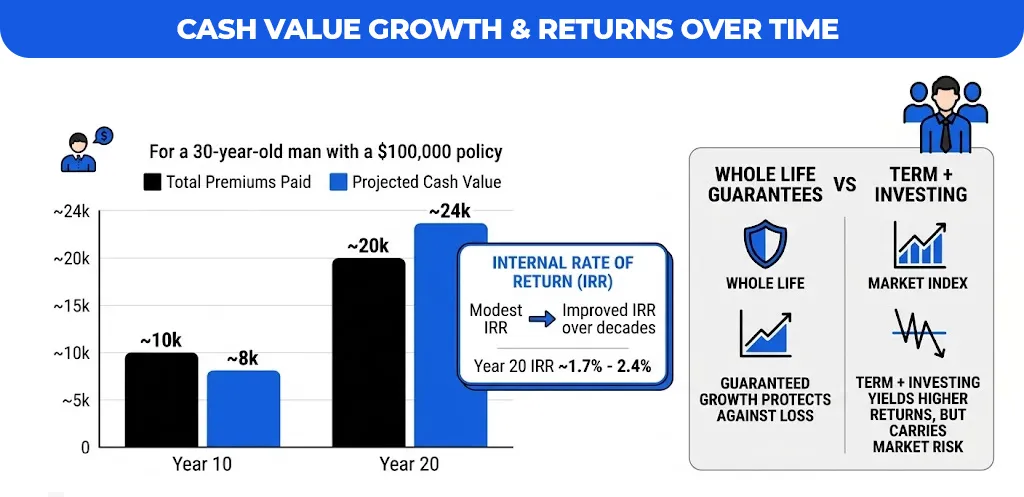
Quick answer: Whole life cash value grows slowly at first, often close to zero in year one, then builds steadily. In one 2026 sample chart, a $100,000 participating whole life policy for a 30-year-old man costing $1,013 a year had about $8,259 of cash value after 10 years and $24,272 after 20. You can access it through policy loans, withdrawals, or surrender, and the death benefit is usually paid instead of, not in addition to, the cash value.
What Is Whole Life Insurance Cash Value?
Cash value is the part of a whole life policy that builds up over time, separate from the death benefit. It’s what the insurer would pay you if you surrendered the policy, and it’s what you can borrow against while you’re alive.
Every whole life policy has cash value. That’s one of the main differences between whole life and term insurance, which has none. Cash value has three key features:
• Guaranteed growth: the policy contract guarantees a minimum cash value schedule. Choice Mutual describes guaranteed values as “the insurer’s absolute minimum cash value figures.”
• Potential dividends: participating policies from mutual insurers may pay dividends, which aren’t guaranteed but can be used to buy more coverage and grow cash value faster.
• Tax-deferred growth: cash value grows without yearly income tax, and policy loans from a policy that isn’t a modified endowment contract are generally not taxable.
Guaranteed values vs. projected values
Policy illustrations usually show two columns:
| Column | What it means | Can it change? |
| Guaranteed cash value | The minimum the contract promises if you pay premiums as scheduled | No, it’s contractual |
| Non-guaranteed (projected) cash value | Guaranteed value plus projected dividends, based on the insurer’s current dividend scale | Yes, dividends can go up or down |
Choice Mutual notes non-guaranteed figures are predictions based on the insurer’s past investment performance. When you compare policies, look at both columns.
Is whole life cash value worth it?
It depends on your goals. Cash value growth is steady and protected from market losses, but it starts slowly and its long-term return on premiums has typically been modest. Whole life tends to fit people who want permanent coverage, prefer guarantees, have already maxed out tax-advantaged retirement accounts, or need lifelong coverage for estate planning. For people mainly looking to build wealth, buying term and investing the difference often grows more money, with more risk. We compare both later in this guide. See also is whole life insurance worth it.
How Whole Life Cash Value Grows Over Time
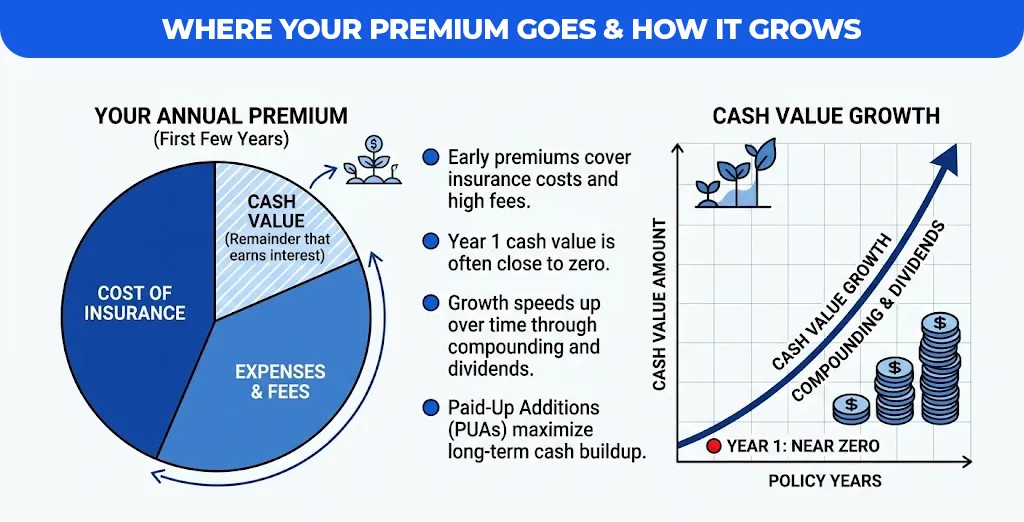
Cash value grows slowly in the early years because a large share of early premiums goes to the cost of insurance, sales expenses, and policy fees. Growth speeds up over time as more of each premium goes to cash value and dividends compound.
Where your premium goes
Each whole life premium is split among:
• Cost of insurance: what the insurer needs to cover the death benefit risk.
• Expenses and fees: administration, underwriting, and agent commissions, which are heaviest in the first years.
• Cash value: the remainder, which earns the policy’s guaranteed rate. Choice Mutual says this credited interest is “typically 3-4%.”
That’s why the first-year cash value is often close to zero, and why surrendering a policy in the first several years usually means getting back less than you paid.
Dividends and paid-up additions
Participating whole life policies, usually from mutual insurers, may pay annual dividends. Dividends aren’t guaranteed, but you can typically use them to:
• Buy paid-up additions (small amounts of extra, fully paid coverage that also build cash value)
• Reduce premiums
• Take them as cash
• Leave them on deposit to earn interest
Using dividends to buy paid-up additions is the most common choice for maximizing cash value growth, because each addition earns its own dividends over time.
High cash value policy design
Some buyers add a paid-up additions (PUA) rider, which lets them pay extra premium beyond the base policy that goes largely toward paid-up additions. Shifting more of the premium into a PUA rider generally builds cash value faster in the early years than a standard design. The trade-off is less death benefit per dollar at first.
There’s a limit. If you put in too much premium too quickly, the policy can fail the IRS “7-pay test” and become a modified endowment contract (MEC), which changes how loans and withdrawals are taxed. A well-designed high cash value policy stays just under that limit.
2026 whole life cash value chart (30-year-old man)
These sample figures are from Choice Mutual’s published charts for participating whole life, preferred non-tobacco, valid March 9, 2026. The cash value shown is total expected cash value, which includes non-guaranteed dividends.
| Policy year | 100,000policy(1,013/yr): premiums paid | Cash value | 250,000policy(2,420/yr): premiums paid | Cash value | 500,000policy(4,711/yr): premiums paid | Cash value |
| 1 | $1,013 | $0 | $2,420 | $0 | $4,711 | $0 |
| 5 | $5,065 | $2,564 | $12,100 | $6,410 | $23,555 | $12,821 |
| 10 | $10,130 | $8,259 | $24,200 | $20,648 | $47,110 | $41,297 |
| 20 | $20,260 | $24,272 | $48,400 | $60,681 | $94,220 | $121,362 |
| 30 | $30,390 | $48,894 | $72,600 | $122,235 | $141,330 | $244,470 |
Cash value by starting age ($250,000 policy, men)
| Starting age | Annual premium | Year 10 cash value | Year 20 cash value | Year 30 cash value |
| 30 | $2,420 | $20,648 | $60,681 | $122,235 |
| 40 | $3,570 | $31,508 | $89,316 | $174,816 |
| 50 | $5,460 | $48,369 | $131,851 | $245,837 |
| 60 | $9,127 | $76,086 | $194,253 | $335,234 |
In these examples, cash value passes total premiums paid somewhere between years 10 and 20. Your own policy may cross that point earlier or later depending on the insurer, design, and dividends.
Note: These are sample projections, not quotes, and the insurer isn’t named in the source. Dividends aren’t guaranteed. Always ask for an illustration that shows both guaranteed and non-guaranteed values.
How to Access Whole Life Cash Value
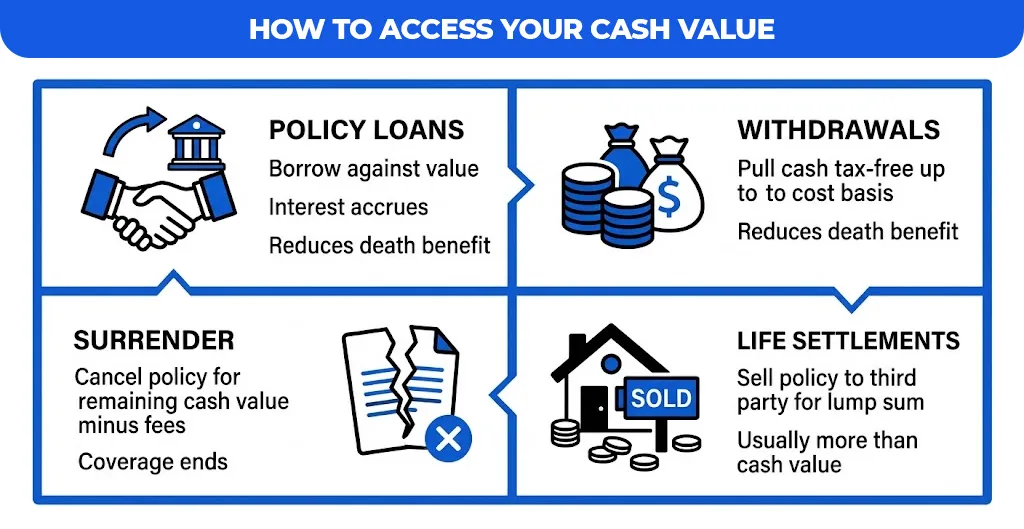
There are four main ways to get money from a whole life policy: borrow against it, withdraw part of it, surrender the whole policy, or sell the policy to a third party. Each one affects your taxes and death benefit differently.
Policy loans
A policy loan lets you borrow from the insurer using your cash value as collateral. There’s no credit check, and you can usually repay on your own schedule, but interest accrues.
• Taxes: for a policy that isn’t a MEC, a loan is generally not taxable income, according to Tax Facts.
• Death benefit: any unpaid loan and interest is subtracted from the death benefit.
• Lapse risk: if the loan balance grows larger than the cash value, the policy can lapse. Tax Facts notes that a loan outstanding at surrender or lapse becomes taxable to the extent the cash value exceeds what you paid in.
Direct vs. non-direct recognition
With participating policies, the insurer’s dividend method affects how loans interact with dividends:
• Direct recognition: the insurer adjusts the dividend on the borrowed portion of your cash value, which may be lower (or sometimes higher) than on the unborrowed portion.
• Non-direct recognition: your dividend rate stays the same whether or not you have a loan.
Neither is automatically better; it depends on the loan interest rate and the dividend rate. Ask the insurer which method it uses before you buy if you plan to borrow often.
Withdrawals (partial surrenders)
A withdrawal takes money out of the policy permanently. For policies that aren’t MECs, withdrawals are generally treated as a return of your premiums (your cost basis) first, so they’re not taxed until you’ve withdrawn more than you paid in. Withdrawals reduce cash value and the death benefit, and in some whole life policies they’re made by surrendering paid-up additions.
Surrendering the policy
If you cancel the policy, you receive the cash surrender value: cash value minus any surrender charges and outstanding loans. Coverage ends. Any amount above your cost basis is taxable as ordinary income. See our guide to cash surrender value of life insurance.
Modified endowment contracts
If a policy fails the 7-pay test in Internal Revenue Code § 7702A, because too much premium was paid in during the first seven contract years, it becomes a modified endowment contract. Loans and withdrawals from a MEC are taxed as distributions, with gains coming out first, and Tax Facts notes a 10% penalty generally applies to the taxable amount, typically before age 59½. The death benefit is still generally income-tax-free.
Life settlements: selling your policy
A life settlement is a sale of your policy to an investor, who takes over the premiums and receives the death benefit later. You get a lump sum that’s usually more than the cash surrender value but less than the death benefit.
According to the Life Insurance Settlement Association’s 2025 member data, reported by ThinkAdvisor, the average life settlement paid $212,066, while the average cash value of those policies was $24,360, roughly nine times more. Settlements tend to make sense for older policyholders, often in their 70s or 80s, or people whose health has declined. Proceeds may be partly taxable, so talk with a tax advisor.
How much is a $100,000 life insurance policy worth if you sell it?
There’s no fixed percentage. Buyers price a policy based on your age, life expectancy, health, the premiums still to be paid, and the policy type. A $100,000 policy on a healthy 65-year-old may get little or no offer, while the same policy on an 85-year-old with serious health issues could sell for a meaningful share of its face value. Small face amounts may attract fewer buyers. Getting quotes from more than one licensed buyer or broker is the only way to know.
Ways to access cash value compared
| Method | Tax treatment (non-MEC) | Effect on death benefit | Cost | Best for |
| Policy loan | Generally not taxable | Reduced by unpaid loan and interest | Loan interest | Short-term cash needs you’ll repay |
| Withdrawal | Tax-free up to cost basis | Permanently reduced | None, but cash value is gone | Smaller, permanent needs |
| Surrender | Gain above basis is taxable | Coverage ends | Surrender charges in early years | You no longer need coverage |
| Life settlement | Can be partly taxable | Passes to the buyer | Broker fees may apply | Older or ill policyholders who no longer need coverage |
| Dividends taken as cash | Generally not taxable until they exceed basis | Unchanged | Slower cash value growth | Supplementing income |
Calculating Whole Life Cash Value and Return
The most accurate way to calculate a policy’s cash value is to read its illustration, the year-by-year projection the insurer provides. To judge whether the growth is good, compare the cash value with the premiums you’ve paid by calculating an internal rate of return (IRR).
How to read an illustration
An illustration shows, for each policy year, the premium, the guaranteed cash value, the non-guaranteed (projected) cash value, and the death benefit. For an existing policy, ask the insurer for an in-force illustration that reflects your actual history. A whole life insurance cash value calculator online can give rough estimates, but only the insurer’s illustration reflects your exact policy.
Cash value return by policy size
The IRR below compares premiums paid with projected cash value only, using Choice Mutual’s 2026 sample charts. It ignores the value of the death benefit, which is the main thing you’re buying.
| Policy | Annual premium | Year 10 cash value | Year 20 cash value | Cash value IRR at year 20 | Cash value IRR at year 30 |
| $10,000 final expense, woman age 50 | $292 | $1,118 | $2,977 | About -7.0% | About -3.5% |
| $100,000, man age 30 | $1,013 | $8,259 | $24,272 | About 1.7% | About 2.9% |
| $100,000, man age 40 | $1,473 | $12,603 | $35,727 | About 1.8% | About 2.8% |
| $500,000, man age 30 | $4,711 | $41,297 | $121,362 | About 2.4% | About 3.3% |
IRRs are our calculations, assuming premiums are paid at the start of each year. The $10,000 example is from a separate Choice Mutual illustration of Mutual of Omaha’s Living Promise final expense policy. Projected values include non-guaranteed dividends.
What is the cash value of a $10,000 whole life policy?
Small final expense policies build very little cash value, because they’re designed for the death benefit, not savings. In the illustration above, a 50-year-old woman paying $24.31 a month had about $378 of cash value after 5 years, $1,118 after 10, $2,977 after 20, and $5,264 after 30, while paying $8,752 in total premiums over 30 years. If she dies, her beneficiary receives the $10,000 death benefit, not the cash value on top of it. See final expense life insurance.
Whole life vs. buying term and investing the difference
The classic alternative is to buy cheaper term insurance and invest the premium difference. Here’s a hypothetical comparison for a healthy 30-year-old man who wants $500,000 of coverage, using Choice Mutual’s 2026 sample rates:
Whole life: $4,711 per year
20-year term: about 216peryear(18 per month)
Difference invested each year: $4,495
After 20 years:
Whole life projected cash value: $121,362 (coverage continues for life)
Invested difference at 4% a year: $139,207 (term coverage has ended)
Invested difference at 6% a year: $175,272
Invested difference at 8% a year: $222,156
The investment returns are hypothetical, not guaranteed, and before taxes and fees. Market investments can lose value, while whole life’s guaranteed cash values don’t fall with the market.
The comparison isn’t purely about returns:
• Coverage length: the term policy ends at 50. If you still need coverage then, a new policy will cost much more, or you may not qualify. Whole life coverage continues.
• Discipline: the comparison only works if you actually invest the difference every year.
• Taxes: money in a taxable brokerage account is taxed on gains, while cash value grows tax-deferred. Using tax-advantaged accounts such as a 401(k) or IRA changes the math in favor of investing.
• Guarantees: whole life’s guaranteed values protect against market downturns.
For people focused mainly on building wealth, term plus disciplined investing often grows more over long periods. Whole life can make sense when you need permanent coverage, want guaranteed growth, or have already used other tax-advantaged options. See term vs. permanent life insurance.
How to Choose a Whole Life Policy for Cash Value
The best whole life insurance for cash value depends on why you want it. Start with your goal, compare participating policies from financially strong mutual insurers, and look closely at how the policy is designed, not just the premium.
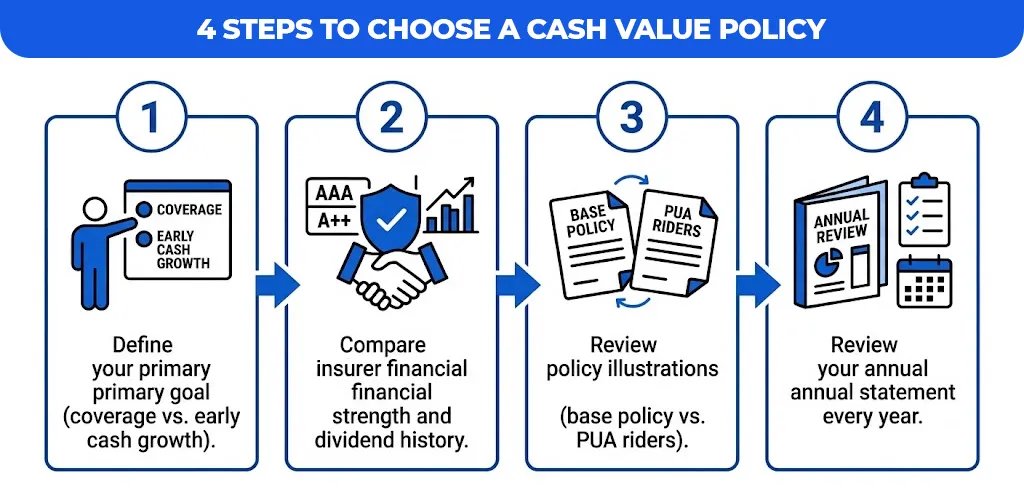
Step 1: Define your goal
• Lifelong coverage with modest savings: a standard whole life policy may be enough.
• Faster early cash value for future borrowing: consider a design with a paid-up additions rider.
• Estate planning or leaving a set legacy: focus on the guaranteed death benefit.
• Covering funeral costs only: a small final expense policy is simpler and cheaper.
Step 2: Compare insurers and dividend history
For participating policies, look at each insurer’s financial strength ratings from independent agencies, its history of paying dividends, and whether it uses direct or non-direct recognition for loans. Past dividends don’t guarantee future ones, but a long, steady record is a good sign.
Step 3: Compare policy design and illustrations
Ask each insurer for an illustration with the same premium, and compare:
• Guaranteed and projected cash value at years 5, 10, 20, and 30
• How much premium goes to the base policy versus a PUA rider
• Whether the design stays under the MEC limit
• Surrender charges and loan interest rates
• How flexible the PUA rider is if you need to pay less some years
The right balance between base premium and PUA rider depends on your goals, budget, and the insurer’s rules, so have an advisor model a few options.
Step 4: Review the policy every year
Check your annual statement for cash value, dividends, and any loan balance. If you borrow, keep the loan well below the cash value so the policy doesn’t lapse.
Comparing whole life policies with Assurance Gurus
Assurance Gurus helps people compare whole life and other permanent life insurance from multiple insurers. You can review whole life insurance quotes, see how whole life insurance costs compare, and talk with an agent about how a policy’s cash value, death benefit, and premiums fit your plans. Our life insurance calculator can help you estimate how much coverage you need.
Conclusion
Whole life insurance cash value grows slowly at first, then steadily, with guaranteed minimums and possible dividends. It gives you a tax-advantaged source of money you can borrow against, withdraw, or take by surrendering the policy, but its long-term return on premiums has typically been modest. Weigh the guarantees and lifelong coverage against alternatives like term insurance plus investing, and always compare illustrations before you buy.
| Your situation | What to consider |
| Want lifelong coverage and guaranteed growth | Participating whole life from a financially strong insurer |
| Want faster early cash value | A design with a paid-up additions rider that stays under the MEC limit |
| Focused mainly on building wealth | Compare term plus investing, especially in tax-advantaged accounts |
| Need cash from an existing policy | Compare a policy loan, withdrawal, and surrender, and their tax effects |
| Over 70 or in declining health, policy no longer needed | Get life settlement quotes before surrendering |
| Only need funeral costs covered | A small final expense policy; don’t expect much cash value |
| Already own a policy | Request an in-force illustration and review it yearly |
Compare Whole Life Policies With Assurance Gurus
If you’re weighing whole life insurance for its cash value, compare a few policies side by side before you decide. Assurance Gurus can help you compare whole life options from multiple insurers and understand how cash value, premiums, and coverage work together.
• Get a quote: request life insurance quotes
• Estimate your coverage: use the life insurance calculator
• Talk to an agent: call 888-363-1938