



A $10,000 burial policy for a 60-year-old man costs about $43 a month, while $100,000 of 20-year term life for a 40-year-old man costs about $19. The two products solve different problems, and the price per dollar of coverage shows it. Burial insurance is a type of life insurance, but it’s small, permanent, and easy to qualify for. Traditional life insurance is large, often temporary, and fully underwritten. This guide compares them side by side, with 2026 rates, the real math behind Colonial Penn’s $9.95 units, and a clear answer to whether you need both.
Quick answer: Burial insurance is a small whole life policy (2,000–50,000) designed to pay funeral and final bills, with no exam and coverage for life. Traditional life insurance is usually $100,000 or more and replaces income or pays off debt. If you’re young and healthy, term life is far cheaper per dollar. If you’re older, have health issues, or your term is ending, burial insurance fills the gap.
Burial insurance vs. life insurance: the core differences
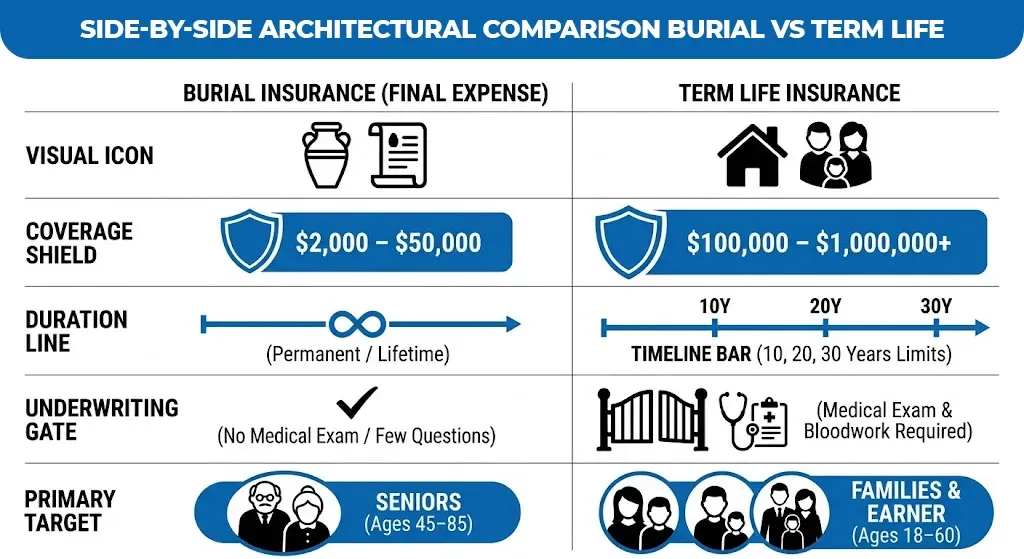
Burial insurance is life insurance: specifically, a small whole life policy built to cover end-of-life costs. The difference between burial and life insurance is size, purpose, and underwriting. Burial policies are small and easy to get; traditional policies are large, aimed at income replacement, and require more health screening. Is burial insurance the same as life insurance? In structure, mostly yes; in purpose and price, no.
• Face amount: burial insurance usually ranges from $2,000 to $50,000; traditional term and whole life usually starts at $100,000 and can exceed $1 million.
• Purpose: burial coverage pays the funeral, cremation, cemetery, and final bills. Traditional life insurance replaces income, pays off a mortgage, funds college, or covers estate taxes.
• Underwriting: burial policies use a short health questionnaire or none at all. Traditional policies often require a medical exam, bloodwork, and records review.
Burial Insurance vs. term life vs. whole life
| Feature | Burial (final expense) insurance | Term life | Traditional whole life |
| Typical face amount | 2,000–50,000 | 100,000–1 million+ | 25,000–1 million+ |
| Typical issue ages | About 45–85 | About 18–75 | About 0–85 |
| Underwriting | Simplified issue (questions) or guaranteed issue (none) | Full underwriting or accelerated; exam common | Full underwriting; exam common |
| Duration | Lifetime | 10, 15, 20, or 30 years | Lifetime |
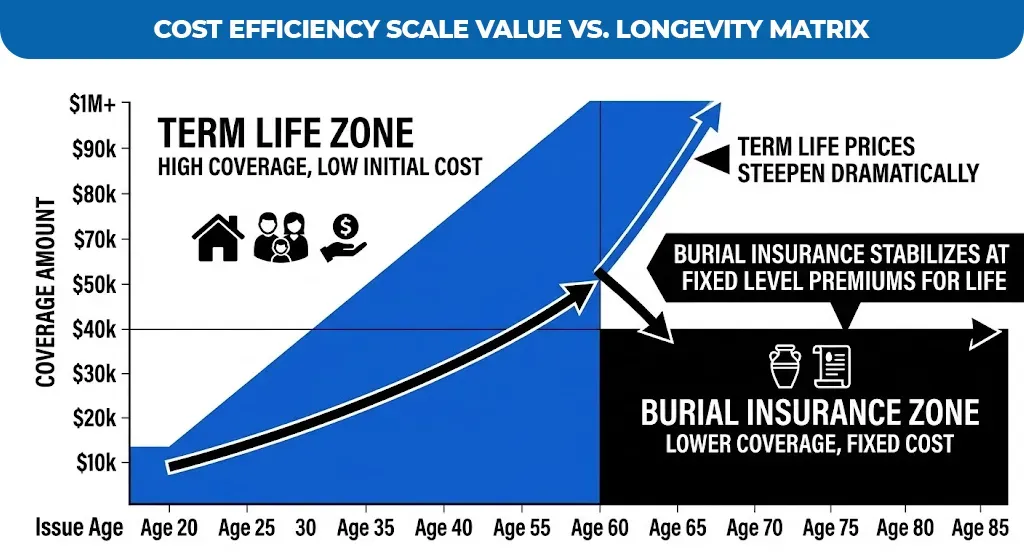
| Premiums | Fixed for life | Fixed for the term, then much higher | Fixed for life |
| Cash value | Small | None | Builds steadily; loans available |
| Cost per $1,000 of coverage | Highest | Lowest | High |
| Payout speed | Often within days of a claim | Typically weeks | Typically weeks |
| Best for | Seniors, health issues, final expenses only | Income replacement while you have dependents or debt | Lifelong need plus cash accumulation |
Compare more options on Assurance Gurus’s term or whole life insurance page.
Note: “Death insurance” isn’t a separate product. People searching for death insurance vs. life insurance usually mean either life insurance (which pays for any covered death) or accidental death insurance (which pays only for accidents). That difference is covered below.
How burial insurance works
Burial insurance is whole life insurance on a small scale. You pay a fixed premium for life, the coverage never expires as long as you pay, and the policy builds a small cash value. When you die, your beneficiary gets a tax-free cash payment to use for the funeral or anything else.
The whole life foundation
• Level premiums: the price is set at issue and never increases.
• Permanent coverage: the insurer can’t cancel for age or changes in health, only for non-payment.
• Cash value: grows slowly; you can borrow against it or surrender the policy for it, though early values are small.
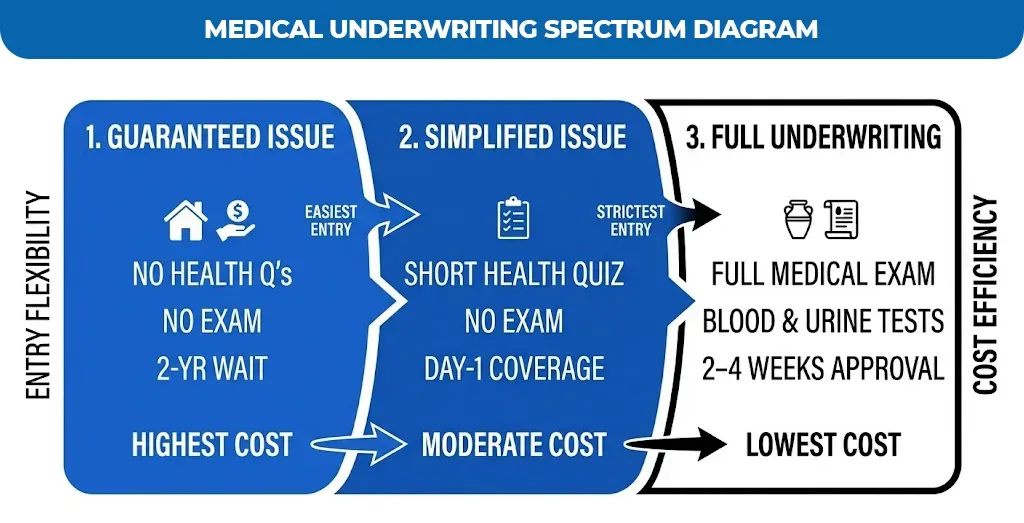
Simplified issue vs. guaranteed issue
| Feature | Simplified issue (level benefit) | Guaranteed issue |
| Health questions | Yes, a short questionnaire plus prescription and MIB checks | None |
| Medical exam | No | No |
| Coverage from day one | Full benefit (graded plans pay partial benefits in years 1–2) | Accidental death only; natural death in the first 2 years returns premiums plus interest |
| Price | Lower | Higher, often about 20–25% more at age 70 |
| Best for | Most seniors, including many with managed conditions | Serious recent health issues or past declines |
Read more in Assurance Gurus’s guides to burial insurance with no waiting period and guaranteed issue life insurance.
How the death benefit covers funeral bills
The insurer pays the cash benefit to your named beneficiary after receiving a claim form and death certificate. The beneficiary then pays the funeral home directly, or assigns part of the benefit to the funeral home, which many funeral homes accept as payment. Because the money isn’t tied to one provider, the family can choose any funeral home and use leftover funds for medical bills or travel. The NFDA’s median costs are $8,300 for a funeral with viewing and burial and $6,280 with cremation, before cemetery charges. See funeral cost breakdown.
How traditional life insurance works
Traditional life insurance comes in two forms: term, which covers a set number of years for a low price, and permanent (whole or universal), which covers you for life and builds cash value. Both pay for death from natural causes and accidents, unlike accidental death insurance, which pays only for accidents.
Term life insurance
Term life is the cheapest way to buy a large death benefit. A healthy 40-year-old man can get $100,000 of 20-year coverage for about $19 a month. It’s designed to replace income while children are young and the mortgage is outstanding. The trade-off: if you outlive the term, coverage ends with no payout or cash value, and buying new coverage at 70 costs far more. Some policies can be converted to permanent coverage without new health questions. See convertible term life insurance.
Whole and universal life insurance
Permanent life insurance provides lifelong coverage and a cash value that grows tax-deferred. You can borrow against it, and it gives heirs immediate cash for estate taxes or business succession. Premiums are much higher than term for the same death benefit. Universal life adds flexible premiums; see universal life insurance and whole life insurance cost.
Accidental death insurance vs. life insurance
The main difference between life insurance and accidental insurance is what causes of death are covered. Life and burial insurance pay for death from almost any cause, including illness. Accidental death and dismemberment (AD&D) pays only if death results from a covered accident, plus partial benefits for losing a limb or eyesight.
| Feature | Burial or life insurance | AD&D insurance |
| Death from illness (heart disease, cancer, stroke) | Covered | Not covered |
| Death from an accident | Covered | Covered |
| Health questions | Yes (except guaranteed issue) | Usually none |
| Cost | Higher | Very low |
| Typical exclusions | Suicide in the first 2 years; misrepresentation | Illness, overdose, many high-risk activities |
Most deaths are caused by illness, not accidents, especially in older age groups, so AD&D is a supplement, not a substitute. More detail: life insurance vs. accidental death insurance.
Burial insurance vs. life insurance: pros and cons
Burial insurance wins on access: almost any senior up to about 85 can get it, quickly and without an exam. Traditional life insurance wins on value: term coverage costs a fraction as much per $1,000. The right choice depends on your age, health, and what the money needs to do.
Burial insurance pros and cons
| Pros | Cons |
| Available to about age 85, often with no exam | Highest cost per $1,000 of coverage |
| Premiums never rise; coverage never expires | Low face amounts, usually $50,000 or less |
| Fast payouts to cover funeral bills | Guaranteed issue plans have a 2-year waiting period |
| Options for most health conditions | Total premiums can exceed the benefit if you live a long time |
| Small cash value | Cash value grows slowly |
Traditional life insurance pros and cons
| Pros | Cons |
| Large death benefits at low cost (term) | Medical exam and full underwriting are common |
| Replaces income, pays off debt, funds education | Term coverage expires, often before you die |
| Permanent policies build significant cash value | Permanent coverage is expensive |
| Strong pricing for healthy, younger applicants | Harder to qualify for with serious health issues or at older ages |
Do you need burial insurance if you already have life insurance?
Not if your existing policy will still be in force when you die and is large enough to cover your final expenses plus everything else it’s meant to pay. Ask three questions:
1. Will it last? A 20-year term policy bought at 45 ends at 65. If you’re likely to outlive it, plan for permanent coverage.
2. Is it portable? Group life through an employer often ends or shrinks at retirement.
3. Is it enough? If the policy is earmarked for a spouse’s income or a mortgage, the funeral may still be unfunded.
If any answer is no, a small burial policy, or converting part of your term policy to permanent coverage, closes the gap. See can you have multiple life insurance policies.
Cost comparison: 2026 monthly rate benchmarks
Per dollar of coverage, term life is far cheaper than burial insurance. A 50-year-old man pays about $38 a month for $100,000 of 20-year term, and about $31 a month for just $10,000 of burial insurance. But burial coverage lasts for life, and term may not be available or affordable at 70 or 80.
What drives the price
• Age has the biggest effect on both products.
• Sex: women pay less.
• Tobacco: smokers pay noticeably more.
• Face value: cost per $1,000 falls a little as coverage rises.
• Health tier: preferred, standard, graded, or guaranteed issue.
Burial insurance monthly rates ($10,000 and $20,000)
| Age | Women, $10,000 | Women, $20,000* | Men, $10,000 | Men, $20,000* |
| 50 | $24 | $45 | $31 | $58 |
| 60 | $33 | $62 | $43 | $83 |
| 70 | $53 | $102 | $70 | $136 |
| 80 | $98 | $193 | $135 | $266 |
Non-tobacco, level coverage; Choice Mutual sample rates valid March 9, 2026. *$20,000 rates are our estimates, interpolated from published $10,000 and $25,000 rates. See burial insurance cost.
$100,000 20-year term life monthly rates
| Age | Women | Men |
| 30 | $12 | $13 |
| 40 | $16 | $19 |
| 50 | $30 | $38 |
| 60 | $74 | $100 |
Nonsmoker, average health; MoneyGeek averages updated October 2, 2026. See how much is life insurance per month.
Colonial Penn’s $9.95 unit model, explained
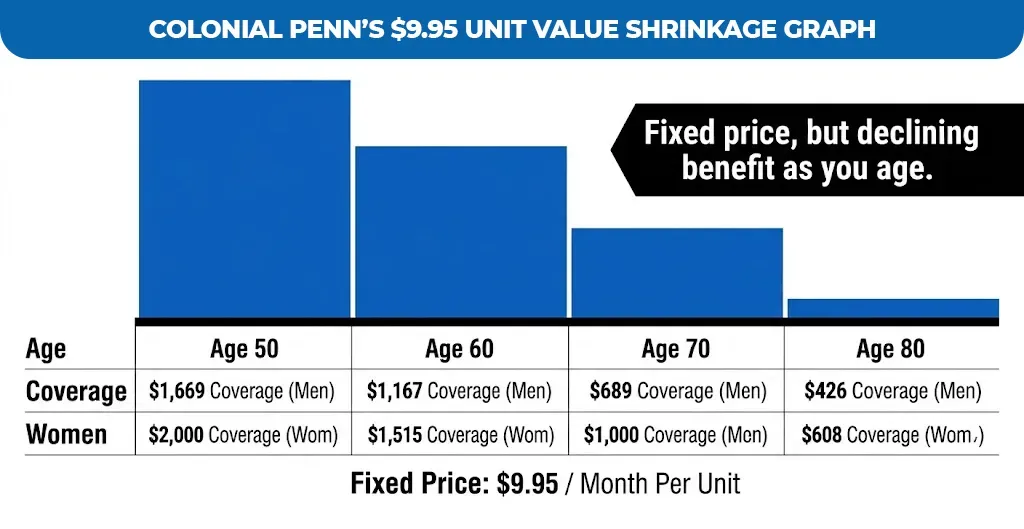
Colonial Penn’s guaranteed acceptance plan costs $9.95 per “unit” per month, but the coverage each unit buys shrinks as you age. Everyone pays the same price per unit, and the death benefit per unit changes. You can buy up to 25 units (12 in New York), and the policy has a two-year waiting period.
| Age | Coverage per unit, men | Coverage per unit, women |
| 50 | $1,669 | $2,000 |
| 60 | $1,167 | $1,515 |
| 70 | $689 | $1,000 |
| 80 | $426 | $608 |
| 85 | $418 | $468 |
What $25,000 costs:
• Woman, 70: 25 units = $25,000 for $248.75 a month.
• Man, 70: the 25-unit maximum buys only $17,225, also for $248.75 a month, so $25,000 isn’t possible.
• Man, 60: 22 units = about $25,674 for $218.90 a month.
For comparison, a $25,000 level burial policy with health questions costs about $127 a month for a 70-year-old woman and $169 for a 70-year-old man, with full coverage from day one. Even another carrier’s guaranteed issue plan (Mutual of Omaha) costs about $158 and $215 for the same coverage.
Note: Colonial Penn’s rates and unit values come from Choice Mutual’s published rate chart (retrieved March 9, 2026). Unit values vary by age band; request an exact quote before buying.
What do financial experts say?
Dave Ramsey’s answer is direct: skip burial insurance, buy term life while you have dependents, and build savings to cover your own funeral. That advice works well for people who start early and stay healthy. Final expense insurance makes more sense for people whose term coverage has ended, who can’t qualify for term, or who don’t have savings to fall back on.
Dave Ramsey’s stance on burial insurance
Ramsey Solutions’ guide to final expense insurance answers “should you buy it?” with “The short answer: No,” adding that “final expense insurance isn’t usually the best option.” Its alternative: a level term policy worth 10–12 times your income, which it says will also cover burial expenses, plus money in a savings account. Ramsey generally favors 15- to 20-year level term and investing the difference, so that by the time the term ends, savings can cover final costs.
When final expense insurance is the right choice
The Ramsey plan assumes you’ll have enough savings when your term ends. Final expense insurance is often the better choice when:
• Your term life has expired or will expire after 65, and new term coverage is expensive or unavailable.
• You have health conditions that make term underwriting difficult or impossible.
• You live on a fixed income and can’t set aside $8,000 to $10,000 or more in savings.
• You want a guaranteed, separate fund for the funeral, so a spouse doesn’t have to use retirement money.
• You’re planning for Medicaid and want funeral money set aside in a way your state allows.
A simple decision path: if you’re under 60, healthy, and have dependents, start with term life. If you’re 60–85, your term is ending, or your health is a concern, compare burial insurance quotes. If you have both a large estate and a lifelong need, consider permanent life insurance. Learn more in final expense life insurance and term life insurance for seniors.
Conclusion:
Burial insurance and traditional life insurance aren’t rivals; they serve different stages of life. Term life protects a family’s income cheaply during the working years. Burial insurance makes sure the funeral and final bills are paid once that protection ends or when health makes other coverage hard to get.
| Your situation | Best fit |
| Age 25–55, healthy, with dependents or a mortgage | Term life, 10–12 times income |
| Term ending after 65, no other coverage | Burial insurance, or convert part of the term policy |
| Age 60–85, managed health conditions | Simplified issue burial insurance (level benefit) |
| Serious recent illness or declined elsewhere | Guaranteed issue burial insurance (2-year waiting period) |
| Considering Colonial Penn at 70+ | Compare level-benefit quotes first; often much cheaper for the same coverage |
| Want only accident protection | AD&D as a supplement, not a replacement |
| Large estate or lifelong need | Whole or universal life |
Get transparent quotes at Assurance Gurus
Choosing between burial insurance and life insurance is easier with real numbers. Assurance Gurus is an independent agency that works with carriers including Corebridge Financial, Occidental Life, CICA Life, GTL, and others. Assurance Gurus policy specialists can review the coverage you already have, show where the gaps are, and compare burial and term quotes side by side.
Evaluate coverage options on Assurance Gurus with the life insurance calculator, get a free quote, or call 888-363-1938.